

Facet Joint Injection Statistics (2026): Success Rates, Duration, and Evidence Data
Facet joint injections deliver reliable short-term relief for many patients, with success rates around 60% to 64% in the first few weeks, but the evidence for lasting benefit is more mixed. That honest picture is exactly what makes them useful when placed correctly in a treatment plan. Here is what the 2026 data says about how well facet joint injections work, how long relief lasts, and how they compare to other facet-targeted options.
Key Takeaways
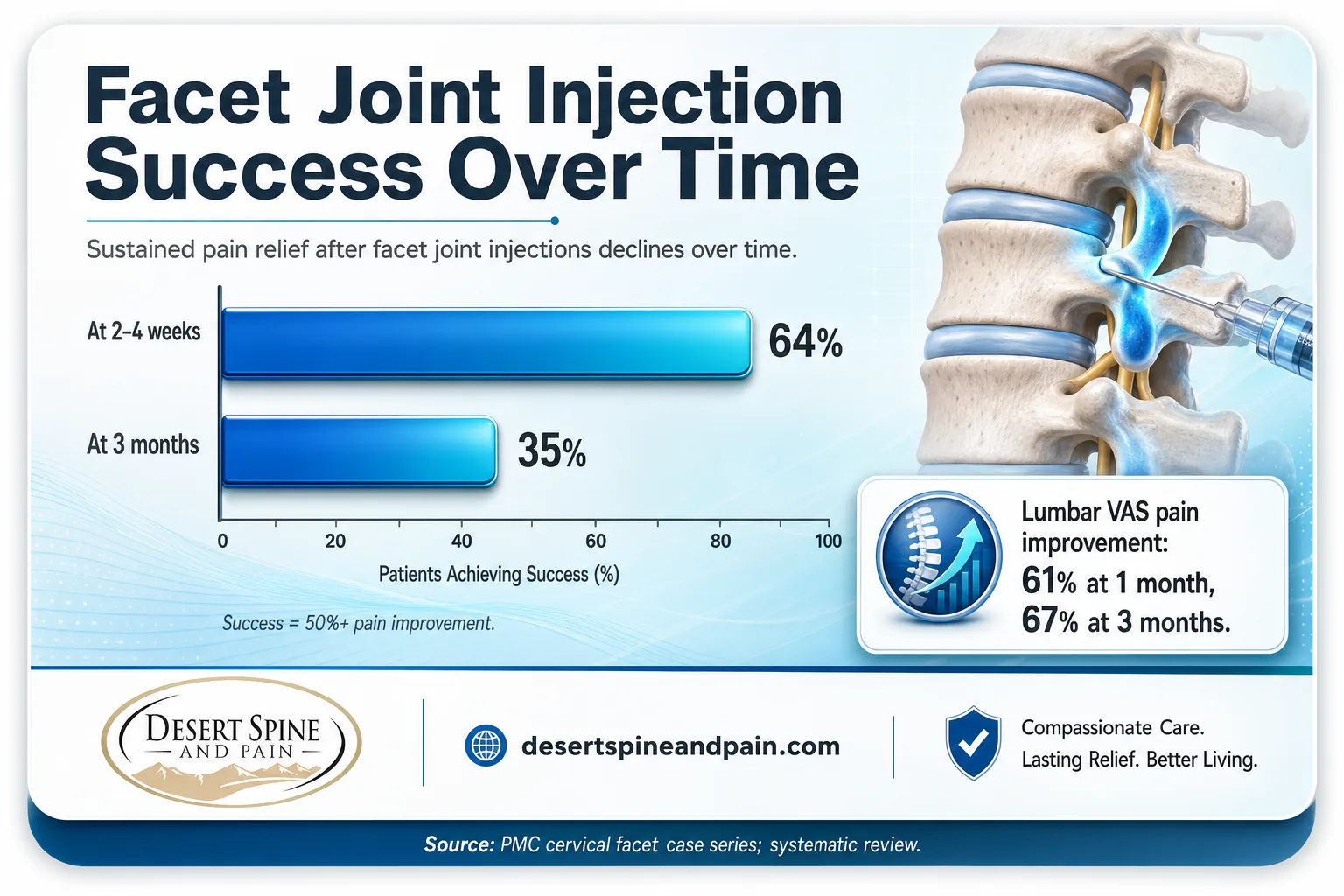
- Short-term success runs about 60% to 64% at 2 to 4 weeks (defined as 50%+ pain improvement).
- Relief often diminishes over time: one prospective study showed success dropping from 64% at 2-4 weeks to 35% at 3 months.
- Pain scores improve meaningfully short-term: ~61% VAS improvement at 1 month and ~67% at 3 months in a systematic review.
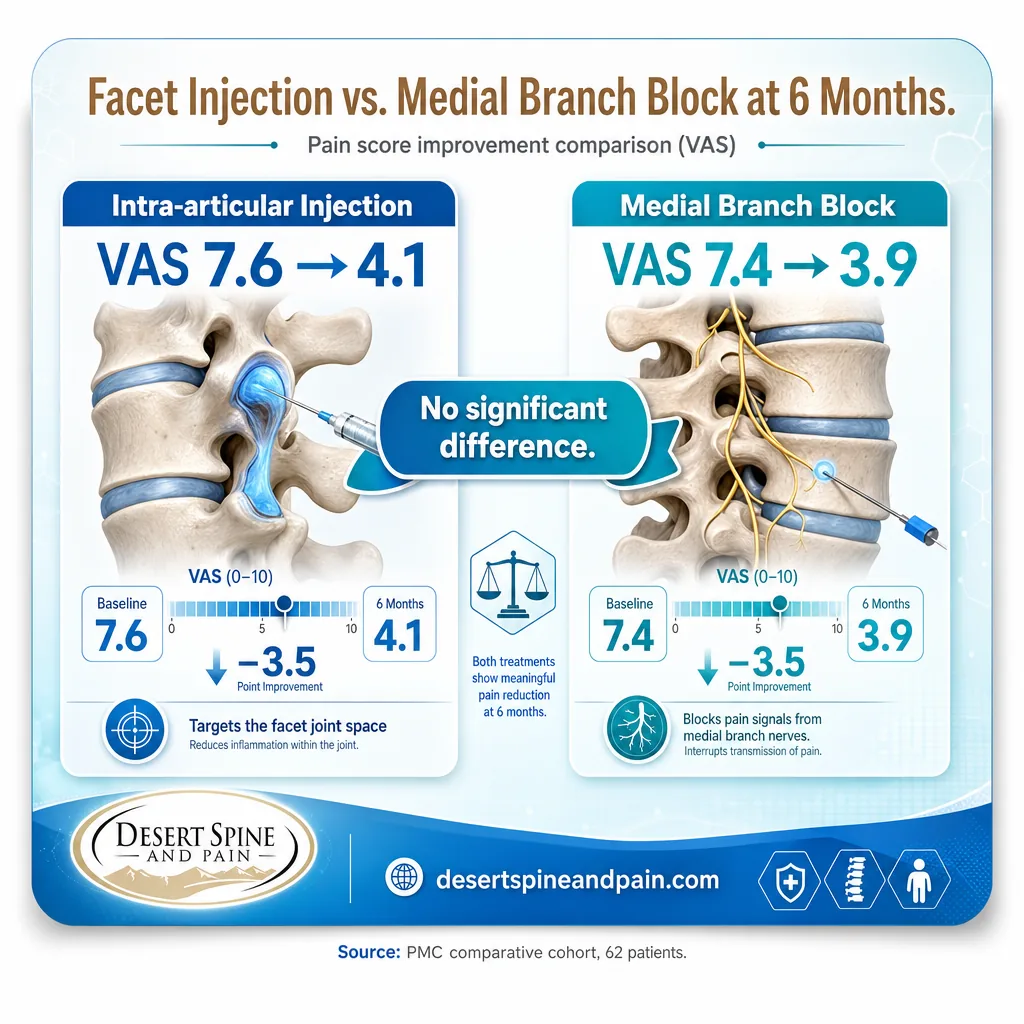
- Comparable to medial branch blocks: a retrospective study found no significant difference between the two at 6 months.
- Long-term evidence is limited: rigorous trials often find intra-articular steroid no more durable than saline.
- Strong safety profile: adverse events are minimal, mostly minor and temporary.
- Best used within a plan: when short-term relief is clear but brief, radiofrequency ablation is often the next step.
What's in This Guide
01 Short-Term Success Rates
A facet joint injection places corticosteroid and local anesthetic directly into an arthritic spinal joint. The data shows it is genuinely effective in the short term, which is where its value is clearest.
In a prospective multi-center case series of cervical facet injections in patients with confirmed peri-facet joint edema on MRI, 64% met the success threshold of at least 50% pain improvement at 2 to 4 weeks, and 86% reported feeling better or much better on a global perception-of-change scale. For lumbar injections, a systematic review found mean pain scores improved by about 61% at one month and 67% at three months. The short-term signal is consistent and clinically meaningful.
Facet joints are a common source of spinal pain, they account for roughly 31% of chronic low back pain when confirmed by diagnostic testing, so a large population is potentially served by these injections. (For the full diagnostic picture, see our nerve block statistics guide.)
Source: PMC, cervical facet injection case series (2025) | Interventional Pain Medicine, lumbar facet injection systematic review
See how facet joint injections work
02 How Long Relief Lasts
The most important nuance in the facet-injection data is duration. Relief is real, but it tends to fade, and understanding that upfront leads to better treatment decisions.
The same cervical facet series that reported 64% success at 2 to 4 weeks found success nearly cut in half by three months, down to 35%. This pattern, strong early relief that diminishes over the intermediate term, appears across multiple studies. It does not mean the injection failed; it means the relief window is often measured in weeks rather than many months. For some patients that window is enough to support rehabilitation and recovery; for others, it points toward a more durable next step.
Myth: "A facet joint injection should fix my pain for good."
Facet joint injections are designed primarily for short-term relief, and the data reflects that. Expecting a permanent cure sets up disappointment, but a realistic expectation, meaningful relief for a period of weeks, makes the injection a useful tool. When short-term relief is clear but brief, that positive response actually helps identify who may benefit from a longer-lasting procedure. Outcomes vary by individual, and this is general information rather than medical advice.
Source: ScienceDirect, cervical facet injection outcomes
Compare longer-lasting radiofrequency ablation
03 Injections vs. Medial Branch Blocks
Patients often ask how intra-articular injections compare to medial branch blocks, the other main way to target facet pain. The data shows they perform similarly.
A retrospective cohort of 62 patients with lumbar facet joint syndrome compared intra-articular corticosteroid injections (Group A) to medial branch blocks (Group B). Both produced significant pain reduction and functional improvement at six months, VAS scores fell from 7.6 to 4.1 with injections and from 7.4 to 3.9 with blocks, with no significant difference between the two approaches at any time point. Adverse events were minimal and comparable.
Desert Spine and Pain Analysis: Same Target, Different Strategy
Combining the comparative data, roughly equivalent six-month outcomes for intra-articular injections and medial branch blocks, with U.S. practice patterns, where medial branch blocks are typically used to select radiofrequency ablation candidates, shows the choice is often strategic rather than about raw efficacy. If the goal is durable relief, a block that confirms the target and opens the door to ablation may serve the patient better than an injection alone, even when their short-term numbers look alike.
Formula: Comparable 6-month outcomes (VAS ~4.0 both groups) + block-to-ablation pathway = strategy, not just efficacy, drives the choice.
Calculation and interpretation original to Desert Spine and Pain. Source figures: PMC comparative cohort (IACI vs MBB) and U.S. practice-pattern literature.
Source: PMC, IACI vs MBB comparative study
Learn about medial branch nerve blocks
04 What the Long-Term Evidence Shows
A trustworthy statistics article has to report the harder findings too. For facet joint injections, the rigorous long-term evidence is genuinely mixed, and that matters.
The Facet Treatment Study (FACTS), a randomized controlled trial of 229 participants, compared intra-articular facet injections, medial branch blocks, and saline, using positive diagnostic response to guide next steps. Rigorous trials that select patients with dual comparative blocks have sometimes found that intra-articular steroid injection is no more effective than saline for durable relief, and systematic reviews grade much of the injection literature as having a high risk of bias. This is not a reason to dismiss injections; it is a reason to use them deliberately, for short-term relief and as part of a plan, rather than as a promised long-term fix.
The takeaway from the evidence is nuanced but practical: facet joint injections earn their place as a short-term tool and a decision aid, not as a standalone cure. Matching the procedure to a realistic goal is what makes it valuable.
Source: PMC, Facet Treatment Study (FACTS) RCT | PMC, cooled RFA vs facet injection (12-month)
Meet Dr. Greenwald, spine surgeon and neurosurgeon
05 Safety and Where Injections Fit
Facet joint injections are among the safer interventional procedures, which supports their role as an early, low-risk step for confirmed facet pain.
Reported adverse events are minimal and mostly minor, temporary increased pain or vasovagal (fainting) reactions, with serious complications rare when injections are performed under fluoroscopic or ultrasound guidance. That favorable safety profile is part of why facet injections often appear early in the interventional ladder for confirmed facet-mediated pain.
Where Facet Joint Injections Sit in the Ladder
- Conservative first: non-opioid medication, bracing, physical therapy by referral.
- Facet-targeted injections and blocks: short-term relief and diagnostic clarity for confirmed facet pain.
- Radiofrequency ablation or surgery: ablation for durable relief when short-term response is positive; surgery reserved for structural problems that require it.
Because Dr. Greenwald is both a spine surgeon and a neurosurgeon, Desert Spine and Pain can place a facet injection in the context of the whole plan, using a short-term response to inform whether a longer-lasting option, up to and including surgery when warranted, is the better path, without a referral handoff.
This is general information, not individual medical advice. Whether a facet joint injection is appropriate depends on a full evaluation.
Source: Interventional Pain Medicine, systematic review (safety data) | PMC, comparative safety data
Explore the full range of interventional pain care
06 All the Numbers in One Table
| Statistic | Figure | Source | Year |
|---|---|---|---|
| Cervical facet injection success, 2-4 wk | 64% | PMC case series | 2026 |
| "Better/much better" at 2-4 wk | 86% | PMC case series | 2026 |
| Cervical facet injection success, 3 mo | 35% | PMC case series | 2026 |
| Worst-case success, 2-4 wk | 55% | PMC case series | 2026 |
| Lumbar VAS improvement, 1 mo | ~61% | Systematic review | 2026 |
| Lumbar VAS improvement, 3 mo | ~67% | Systematic review | 2026 |
| NDI improvement (cervical), 2-4 wk | 19.3 → 8.9 | PMC case series | 2026 |
| Injection vs MBB difference, 6 mo | None significant | PMC comparative cohort | 2026 |
| VAS with injection, 6 mo | 7.6 → 4.1 | PMC comparative cohort | 2026 |
| VAS with MBB, 6 mo | 7.4 → 3.9 | PMC comparative cohort | 2026 |
| Comparative cohort size | 62 patients | PMC comparative cohort | 2026 |
| FACTS trial participants | 229 | PMC (FACTS RCT) | 2026 |
| Facet pain share of chronic LBP | ~31% | Pain Physician | 2026 |
| Progression to RFN (steroid group) | 67% | Systematic review | 2026 |
| Progression to RFN (saline group) | 68% | Systematic review | 2026 |
| Serious adverse events | Rare | Systematic review | 2026 |
| Long-term steroid vs saline | Comparable | PMC / FACTS | 2026 |
07 Frequently Asked Questions
What is the success rate of a facet joint injection?
How long does a facet joint injection last?
Are facet joint injections better than medial branch blocks?
Do facet joint injections work long-term?
Are facet joint injections safe?
Methodology & Sources
All figures trace to Tier 1 peer-reviewed sources. Short-term success rates come from a 2025 prospective multi-center case series of cervical facet injections (PMC/ScienceDirect) and a systematic review of fluoroscopically guided lumbar facet steroid injections published in Interventional Pain Medicine. Comparative outcomes versus medial branch blocks come from a PMC-indexed retrospective cohort of 62 patients. Long-term evidence context comes from the Facet Treatment Study (FACTS) randomized controlled trial (229 participants) and a 12-month RCT comparing cooled radiofrequency ablation to facet injection. Facet pain prevalence figures come from Pain Physician.
Success is generally defined as at least 50% pain improvement. Facet joint injection outcomes are strongest short-term and less certain long-term; this article deliberately presents both to give an accurate picture. Ranges and time points are specified because results shift substantially between the 2-4 week and 3-month marks.
Media & press: Journalists and researchers may cite these statistics with attribution to Desert Spine and Pain and a link to this page. The Desert Spine and Pain Analysis box contains original calculation and interpretation.
Talk to a Phoenix Spine and Pain Specialist
Desert Spine and Pain is led by Dr. David L. Greenwald, MD, FACS, a board-certified surgeon who is both a spine surgeon and a neurosurgeon. The practice serves out-of-network patients across Greater Phoenix and partners with personal injury attorneys, offering 24/7 concierge response for their clients. Care follows a least-invasive-first philosophy, from conservative treatment through interventional pain management to complex spine surgery.
Call (602) 566-9500 to book a consultation.