

Spinal Cord Injury Employment Statistics (2026): Return-to-Work Rates and What Drives Them
After a spinal cord injury, only about 35% of people return to any form of paid work, and just 12% return to their exact pre-injury job. Employment is one of the clearest measures of an injury's long-term impact, and one of the most important in a legal claim. This 2026 reference lays out the employment data after spinal cord injury, the factors that shape it, and why it matters for patients and the attorneys who represent them.
- About 35% of people work after a spinal cord injury, far below the general population.
- Only 12% return to their exact pre-injury job, even though many eventually work in some capacity.
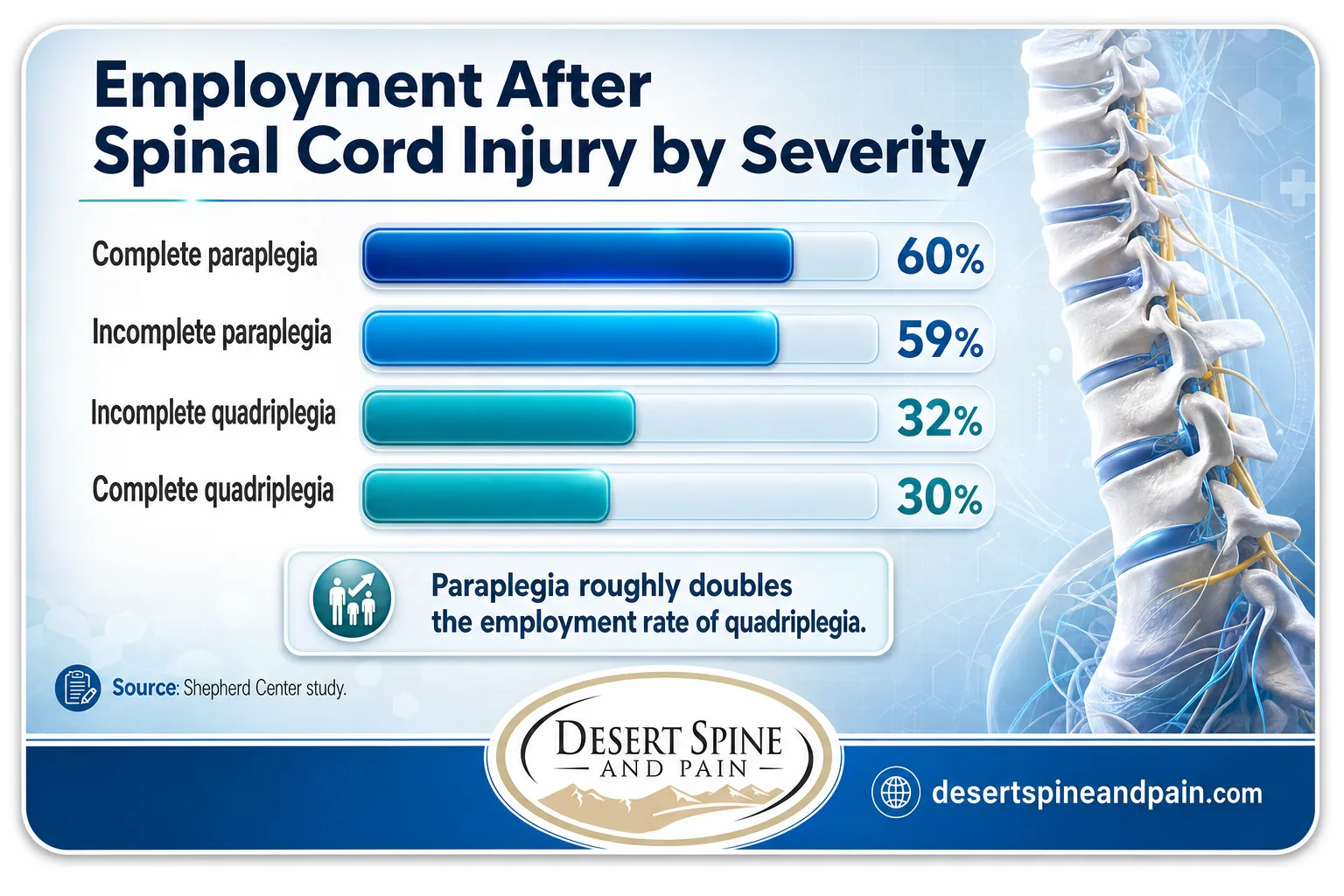
- Severity drives employment: roughly 60% for paraplegia versus 30% for quadriplegia in one study.
- Return to work takes years: an average of 4.9 years to the first post-injury job.
- Education and age matter: younger, more educated people return to work at much higher rates.
- 57.4% were employed at the time of injury, and most injuries strike during prime working years.
- Lost earning capacity is central to legal claims, making these figures directly relevant to personal injury cases.
What's in This Guide
Overall Employment Rates
The single most cited figure in this area is the overall post-injury employment rate, and it tells a stark story. A comprehensive review of 60 studies found that, on average, about a third of people with spinal cord injury are employed after injury.
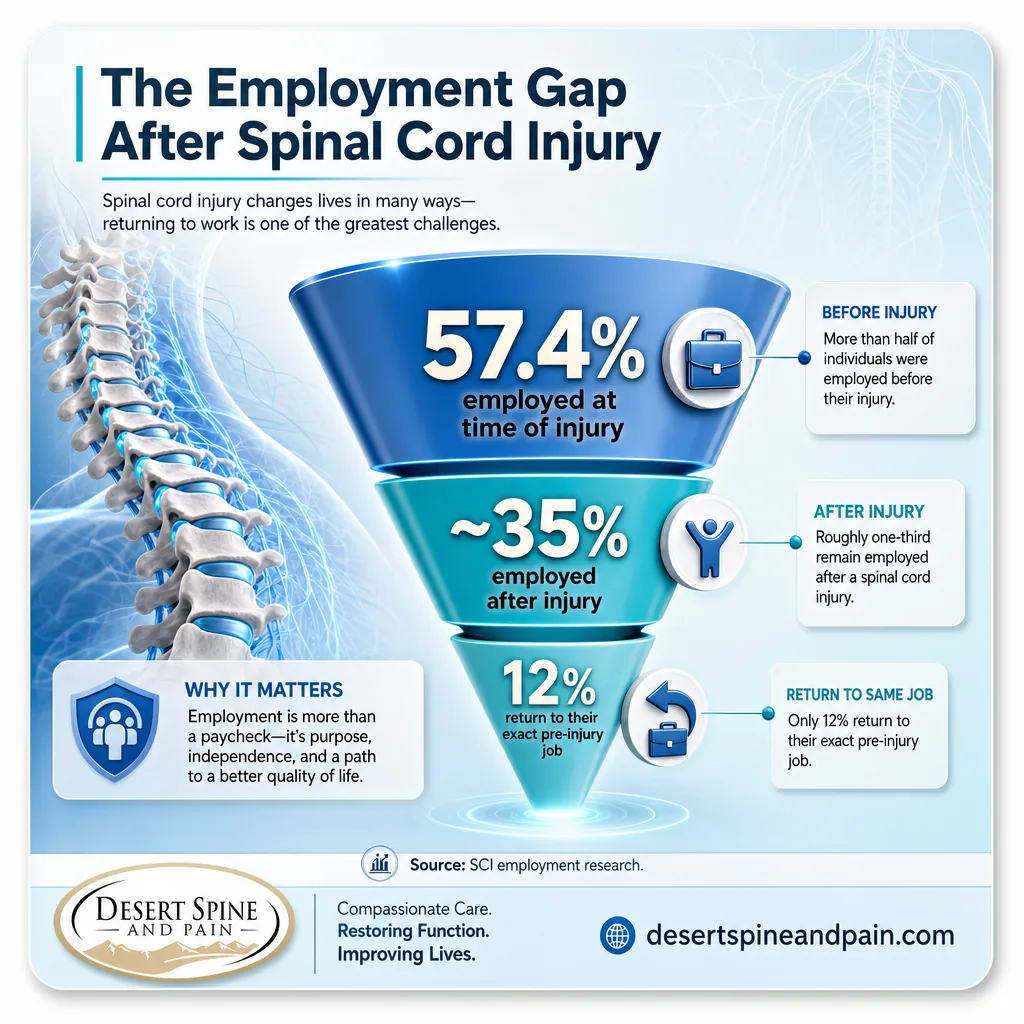
The wide range reflects how much depends on how employment is defined and when it is measured. But the central finding is consistent: employment drops sharply and permanently for most people after a spinal cord injury. This matters especially because most injuries strike during prime working years. For the demographic backdrop, see our full spinal cord injury statistics.
Source: Journal of Spinal Cord Medicine
Explore the spine conditions we treatReturning to the Same Job
There is a crucial distinction between working again in any capacity and returning to the job a person held before their injury. The gap between those two is large.
Many people who return to work do so in a different role, often one requiring retraining, less physical demand, or accommodation. This is why vocational rehabilitation and education play such a large role in post-injury employment, and why the raw employment rate understates how much a person's working life changes.
Myth: if someone with a spinal cord injury works again, they have fully recovered their earning power. The data says otherwise. Only about 12% return to their exact pre-injury job, and many who work again do so in lower-demand, often lower-paying roles after retraining. Being employed after injury is not the same as being restored to pre-injury earning capacity, a distinction that matters greatly for both quality of life and legal claims.
Source: Employment after Spinal Cord Injury, PubMed
Explore conservative, non-invasive careEmployment by Injury Severity
Injury severity is one of the strongest predictors of whether someone works again. The difference between paraplegia and quadriplegia, and between complete and incomplete injuries, is substantial.
| Group | Employment measure |
|---|---|
| Paraplegia, 10 years post-injury | 32.4% employed |
| Tetraplegia, 10 years post-injury | 24.2% employed |
| Complete paraplegia, since injury | 60% employed |
| Complete quadriplegia, since injury | 30% employed |
The pattern is consistent across studies: preserved function translates into employment. This connects directly to the recovery data, since the severity grade that shapes physical recovery also shapes the ability to return to work.
Source: Archives of Physical Medicine and Rehabilitation
See recovery outcomes dataTime to Return to Work
Returning to work after a spinal cord injury is rarely quick. For those who do go back, the road is often measured in years, not months.
The long and highly variable timeline has a clear implication: return to work should be treated as a realistic goal even years after injury, and the economic impact of an injury unfolds over a long horizon, not just in the immediate aftermath.
Desert Spine and Pain Analysis: The economic impact compounds over a working lifetime. Combining the ~35% average employment rate with the 4.9-year average delay to a first post-injury job shows that lost earnings are not a one-time event but a multi-year, often permanent reduction. A person injured in their prime earning years may face decades of diminished capacity, which is why lifetime, not just immediate, economic impact is the right frame for both financial planning and legal claims. Interpretation original to Desert Spine and Pain, based on published employment-rate and time-to-return findings.
Source: Spinal Cord, time to first job
Explore interventional pain managementWhat Predicts Employment
Beyond severity, researchers have identified a consistent set of factors that raise or lower the odds of working again after a spinal cord injury.
Factors linked to higher employment after SCI:
- Younger age at injury: younger people return to work at higher rates.
- Higher education: nearly 95% of those with 16+ years of education had worked at some point since injury in one study.
- Less severe injury: paraplegia and incomplete injuries fare better than complete quadriplegia.
- Lighter pre-injury work: those in physically demanding jobs return far less often.
- Being employed at the time of injury and returning to a pre-injury employer.
These predictors underscore that employment after injury is shaped by more than the injury alone. Occupation, education, and the timing and quality of care all play a role, which is one reason expert medical management and coordination matter beyond the operating room.
Source: Return to work after SCI, PubMed
See our spine surgery optionsWhy This Matters Legally
Employment statistics after spinal cord injury are not just academic. In personal injury cases, lost earning capacity, the reduction in a person's ability to earn over their lifetime, is frequently one of the largest components of a claim.
For personal injury attorneys: The employment data here, low overall employment, rare same-job return, long time-to-return, and severity-driven differences, is exactly the evidence base used to establish how a spinal cord injury affects a client's working life and lifetime earnings. Desert Spine and Pain partners with attorneys and their clients through the full arc of spine care, with fast response, coordination of documentation, and evaluation by a board-certified spine surgeon and neurosurgeon whose assessment carries weight. When a client's future work capacity is central to a case, expert medical involvement early makes a measurable difference.
The through-line for both patients and attorneys is that a spinal cord injury reshapes a working life for years or permanently, and quantifying that accurately depends on sound medical and vocational evidence.
Source: Work systematic review and meta-analysis
Partner with us on a spine caseFull Statistics Table
| Statistic | Figure | Source | Year |
|---|---|---|---|
| Average employment rate after SCI | ~35% | J Spinal Cord Med review | 2009 |
| Return to exact pre-injury job | 12% | SCI employment research | various |
| Employed at time of injury | 57.4% | NSCISC-linked review | 2009 |
| Return-to-work range | 21–67% | RTW systematic review | 2007 |
| Complete paraplegia employed since injury | 60% | Shepherd Center | 1998 |
| Incomplete paraplegia employed since injury | 59% | Shepherd Center | 1998 |
| Incomplete quadriplegia employed since injury | 32% | Shepherd Center | 1998 |
| Complete quadriplegia employed since injury | 30% | Shepherd Center | 1998 |
| Quadriplegia returning to pre-injury job | 5% | Shepherd Center | 1998 |
| Paraplegia employed, 10 years post | 32.4% | NSCISC-linked review | 2009 |
| Tetraplegia employed, 10 years post | 24.2% | NSCISC-linked review | 2009 |
| Average time to first post-injury job | 4.9 years | Spinal Cord | 2011 |
| Half returned to work by | 4 years | Spinal Cord | 2011 |
| Time-to-return range | 3 months–20 years | Spinal Cord | 2011 |
| Worked since injury, 16+ years education | ~95% | SCI employment study | 1992 |
| Return for heavy physical pre-injury work | 21–25% | RTW predictors study | 2000 |
Frequently Asked Questions
What percentage of people work after a spinal cord injury?
How many people return to their same job after a spinal cord injury?
Does injury severity affect employment after SCI?
How long does it take to return to work after a spinal cord injury?
Why does employment after SCI matter in a legal case?
Methodology & Sources
The average 35% employment rate and the 57.4% employed-at-injury and 10-year employment figures come from a comprehensive review of employment after spinal cord injury published in the Journal of Spinal Cord Medicine, which drew on NSCISC and other data. The 21 to 67% return-to-work range comes from a systematic review in Spinal Cord. Severity-specific employment figures come from a Shepherd Center study published in the Archives of Physical Medicine and Rehabilitation. Time-to-return figures come from a study published in Spinal Cord. Predictor data, including education and pre-injury work type, come from peer-reviewed studies indexed in PubMed and a systematic review and meta-analysis published in Work. Because studies define and measure employment differently, figures are best read as ranges and patterns rather than exact universal rates. This article is informational and is neither individual medical nor legal advice; anyone dealing with a spinal cord injury should seek qualified medical and, where relevant, legal counsel.
Media and press: Journalists and researchers are welcome to cite these statistics with attribution to the original primary sources named above, and to Desert Spine and Pain for any analysis labeled as original.