
Spinal Cord Injury Recovery Statistics (2026): Neurological, Walking, and Functional Outcomes
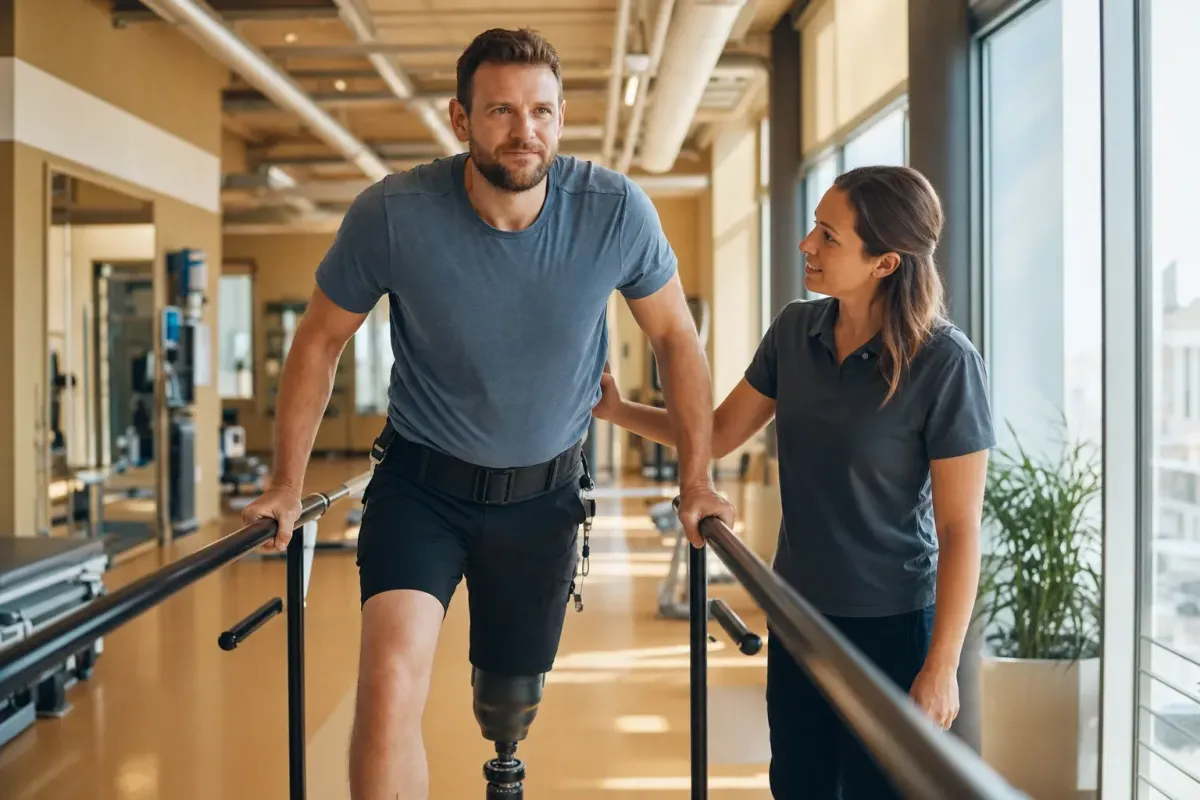
Recovery after a spinal cord injury is not all-or-nothing. About a third of people regain some walking ability, and that figure swings from roughly 15% for the most complete injuries to 100% for the mildest. This 2026 reference lays out what the research shows about neurological recovery, walking, and functional independence after spinal cord injury, and how severity, age, and the timing of treatment shape the odds.
- About 33% of people regain some walking ability overall, but the range by severity is enormous.
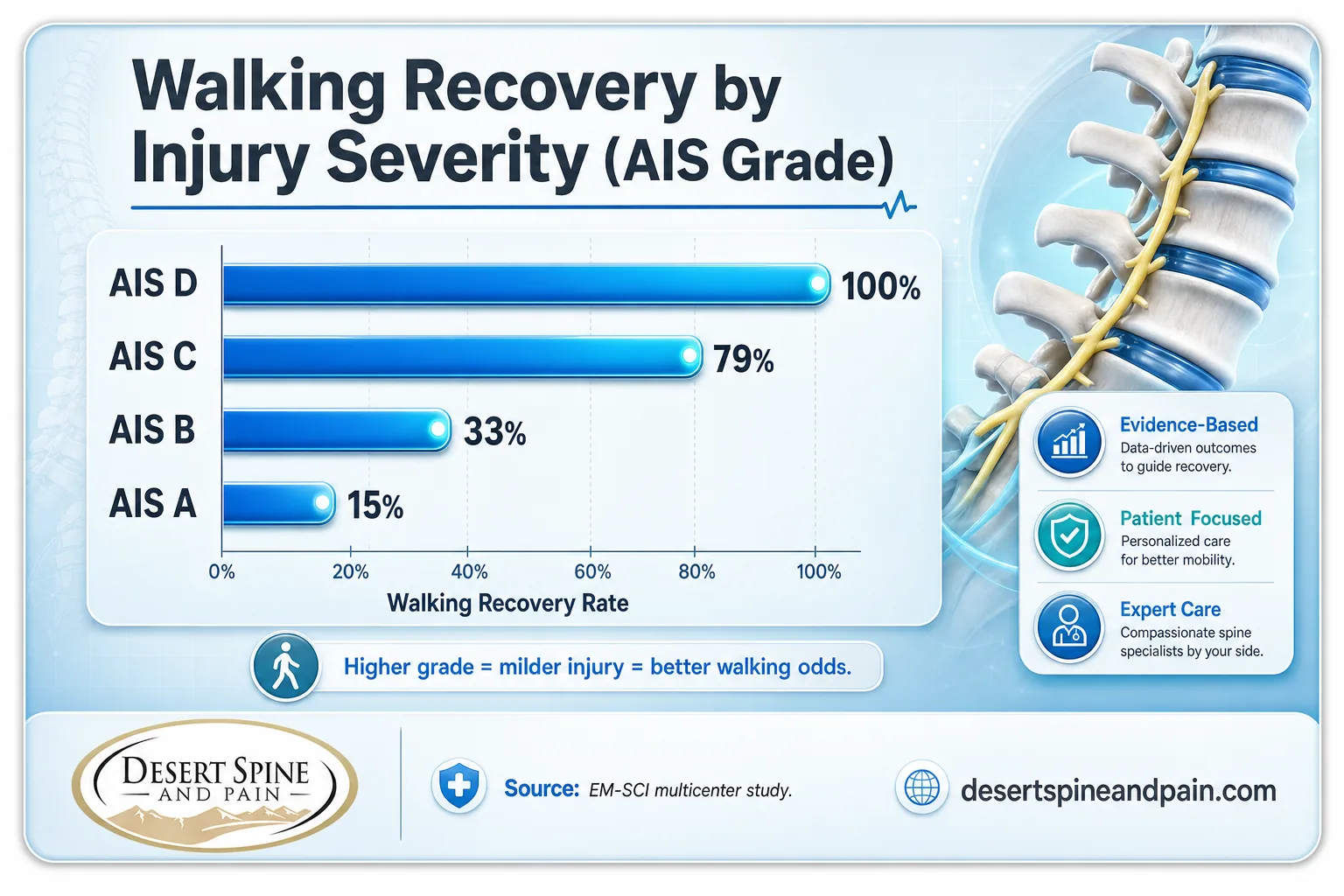
- Walking recovery by grade: roughly 15% for AIS A, 33% for AIS B, 79% for AIS C, and 100% for AIS D.
- AIS grade conversion is common in incomplete injuries: 26% converted from grade A, 73% from B, and 75% from C in one study.
- Timing appears to matter: assessment within four hours of injury was linked to 79% conversion versus 47% later.
- Most recovery happens in 6 to 12 months, though improvement can continue for years.
- Age affects the odds: for AIS C, 91% of those under 50 reached community walking versus 42% of those 50 and older.
- Fewer than 1% fully recover neurologically by discharge, but that is not the same as no meaningful recovery.
What's in This Guide
Overall Recovery Odds
The single most important thing to understand about spinal cord injury recovery is that averages mislead. A blanket recovery rate hides a range that runs from almost none to near-complete, depending entirely on how severe and complete the injury is.
These two figures seem to conflict but do not. Very few people recover completely, yet a substantial share recover meaningfully, regaining function, sensation, or the ability to walk with or without aids. Recovery is best understood as a spectrum, and where a given injury falls on it is set mostly by its severity grade. For the broader outcome and demographic picture, see our complete spinal cord injury statistics.
Source: Frontiers in Human Neuroscience
Explore the spine conditions we treatAIS Grade Conversion
Neurological recovery is often measured by AIS conversion: improving from a more severe ASIA Impairment Scale grade to a less severe one. Conversion from a complete (AIS A) injury to an incomplete grade is a meaningful milestone, and how often it happens depends sharply on the starting grade.
The low AIS D conversion figure is not bad news: those patients start with the mildest injuries and have the least room to improve on the scale, since many are already close to normal. The headline is that incomplete injuries, especially AIS B and C, improve most of the time. It is also worth knowing that AIS conversion and walking ability are related but not identical, which is why researchers track both.
Source: Spinal Cord (Nature)
See our spine surgery optionsWalking Recovery by Severity
For most patients and families, the question that matters most is whether walking will return. The data gives a clear, severity-dependent answer.
Functional Walking Recovery by Acute AIS Grade (% who regained ambulation)
Two nuances matter here. First, injury level shapes walking odds independently of grade: complete injuries at T12 and below, and incomplete cervical injuries, carry better walking prognoses than high thoracic complete injuries. Second, preserved pinprick sensation early on is associated with better walking recovery in AIS B patients, because it signals less extensive damage to key spinal cord tracts.
Myth: if you cannot walk right after a spinal cord injury, you never will. The data flatly contradicts this. Most AIS C patients and all AIS D patients in one study regained walking, and even a minority of complete-injury patients recover some ambulation. Early severity is a strong predictor, but it is not a verdict. Realistic prognosis requires individual evaluation by a spine specialist, not a rule of thumb.
Source: Academy of Neurologic Physical Therapy
Learn about spinal decompression surgeryWhy Treatment Timing Matters
One of the most consequential findings in recovery research is that how quickly a patient is evaluated and treated appears to influence neurological outcomes. Earlier is better.
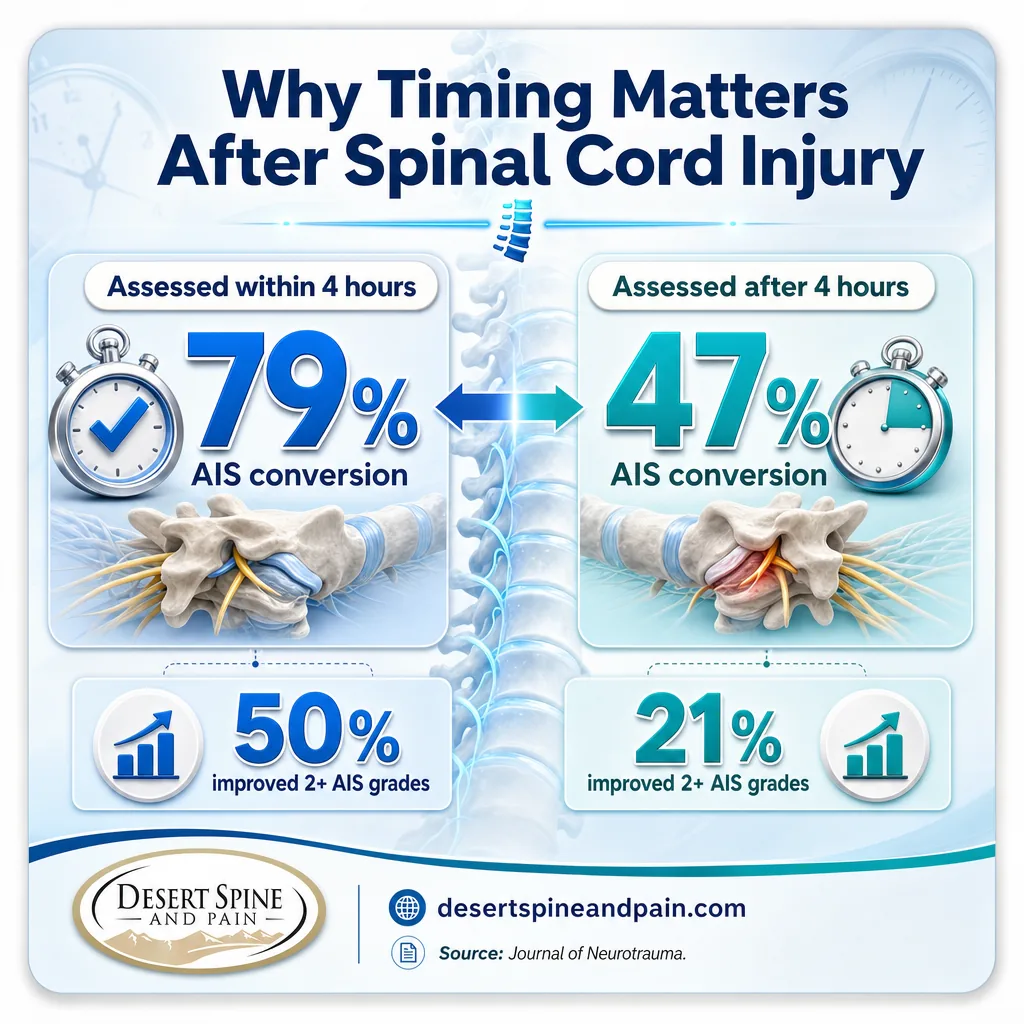
In the adjusted analysis, patients assessed within four hours of injury were about five times more likely to experience AIS conversion than those assessed later. While assessment timing is not identical to surgical timing, the broader literature points the same direction: prompt expert evaluation and, where appropriate, timely surgical decompression to relieve pressure on the cord are associated with better outcomes.
Desert Spine and Pain Analysis: The timing signal is a case for early specialist involvement. Combining the four-hour assessment data (79% vs 47% conversion) with the general severity-recovery gradient suggests the window in which intervention can influence outcome is early. That is exactly why rapid access to a board-certified spine surgeon and neurosurgeon matters, both for patients and for the personal injury attorneys coordinating their care. Calculation and interpretation original to Desert Spine and Pain, derived from published assessment-timing and AIS-conversion data.
Source: Journal of Neurotrauma
Reach us for urgent spine consultationAge and Other Predictors
Severity is the biggest driver of recovery, but it is not the only one. Age in particular has a strong, measurable effect on walking recovery.
| Predictor | Effect on recovery |
|---|---|
| Injury severity (AIS grade) | Strongest predictor; higher grade means better odds |
| Age | Under 50 recovers better, especially for incomplete injuries |
| Injury level | Lower and incomplete injuries carry better walking prognoses |
| Preserved pinprick sensation | Associated with better walking recovery in AIS B |
| Assessment and treatment timing | Earlier linked to higher conversion rates |
For AIS D patients, notably, age was not a barrier to walking: essentially all regained ambulation within months regardless of age. The age effect concentrates in the middle-severity injuries, where there is the most to gain or lose.
Source: Journal of Neurotrauma
Explore interventional pain managementFunctional Independence and Long-Term Recovery
Walking is only one dimension of recovery. Functional independence, bladder and bowel control, and pain all shape quality of life, and recovery in these areas can continue well beyond the first year.
The same long-term study found meaningful reductions in bladder and bowel dysfunction over time, though neuropathic pain often persisted. That persistence of pain is a reminder that long-term spinal cord injury care is not finished when walking returns; ongoing management of pain and secondary complications remains central to quality of life, which is where interventional pain management continues to play a role.
Source: Scientific Reports (Nature)
Explore motion-preservation surgeryFull Statistics Table
| Statistic | Figure | Source | Year |
|---|---|---|---|
| Overall walking recovery | ~33% | Frontiers review | 2014 |
| Full neurological recovery by discharge | <1% | NSCISC | 2026 |
| Walking recovery, AIS A | 15% | EM-SCI study | 2008 |
| Walking recovery, AIS B | 33% | EM-SCI study | 2008 |
| Walking recovery, AIS C | 79% | EM-SCI study | 2008 |
| Walking recovery, AIS D | 100% | EM-SCI study | 2008 |
| AIS conversion from A | 26% | EM-SCI study | 2008 |
| AIS conversion from B | 73% | EM-SCI study | 2008 |
| AIS conversion from C | 75% | EM-SCI study | 2008 |
| AIS conversion from D | 16% | EM-SCI study | 2008 |
| Conversion within 4 hours of injury | 79% | J Neurotrauma | 2021 |
| Conversion after 4 hours | 47% | J Neurotrauma | 2021 |
| 2+ grade improvement within 4 hours | 50% | J Neurotrauma | 2021 |
| AIS C community ambulation, under 50 | 91% | J Neurotrauma | 2021 |
| AIS C community ambulation, 50+ | 42% | J Neurotrauma | 2021 |
| Long-term AIS improvement (cervical) | 41% | Scientific Reports | 2024 |
| Long-term ambulation recovery (cervical) | 51% | Scientific Reports | 2024 |
Frequently Asked Questions
What percentage of people recover from a spinal cord injury?
Can you walk again after a spinal cord injury?
What is AIS grade conversion?
Does the timing of treatment affect spinal cord injury recovery?
How long does spinal cord injury recovery take?
Methodology & Sources
Walking recovery and AIS conversion rates by grade come from a European multicenter study of human spinal cord injury (EM-SCI) of 273 patients, published in Spinal Cord (Nature). Overall ambulation recovery figures come from a systematic review published in Frontiers in Human Neuroscience. Treatment and assessment timing data, and the age-related ambulation figures, come from a review published in the Journal of Neurotrauma. Long-term recovery figures come from a population-based cervical spinal cord injury cohort published in Scientific Reports (Nature). The figure for complete neurological recovery by discharge comes from the National Spinal Cord Injury Statistical Center. Injury-level and pinprick-sensation predictors are drawn from the Academy of Neurologic Physical Therapy and the cited reviews. Recovery statistics describe study populations and do not predict any individual outcome. This article is informational and is not individual medical advice; anyone dealing with a spinal cord injury should seek evaluation from a qualified specialist.
Media and press: Journalists and researchers are welcome to cite these statistics with attribution to the original primary sources named above, and to Desert Spine and Pain for any analysis labeled as original.