

Kyphoplasty vs. Corpectomy: How the Procedures Differ
Kyphoplasty and corpectomy both treat a damaged vertebra, but they sit at opposite ends of the surgical spectrum and do almost opposite things. Kyphoplasty keeps the bone and stabilizes it from the outside with cement, through two small needle punctures. A corpectomy removes the vertebral body completely and rebuilds the spine to take pressure off the spinal cord. That single difference, stabilize versus remove and reconstruct, drives everything else: how invasive each is, what each can fix, the risks, and the recovery. This guide explains how each procedure works, how they compare head to head, and how a spine surgeon decides which one a patient actually needs.
- Kyphoplasty is a minimally invasive, percutaneous procedure: a balloon creates a cavity in a fractured vertebra and bone cement is injected to stabilize it and relieve pain. The vertebra stays in place.
- Corpectomy is a major open operation: the entire vertebral body plus the discs beside it are removed to decompress the spinal cord, and the gap is rebuilt with a cage or strut graft and hardware.
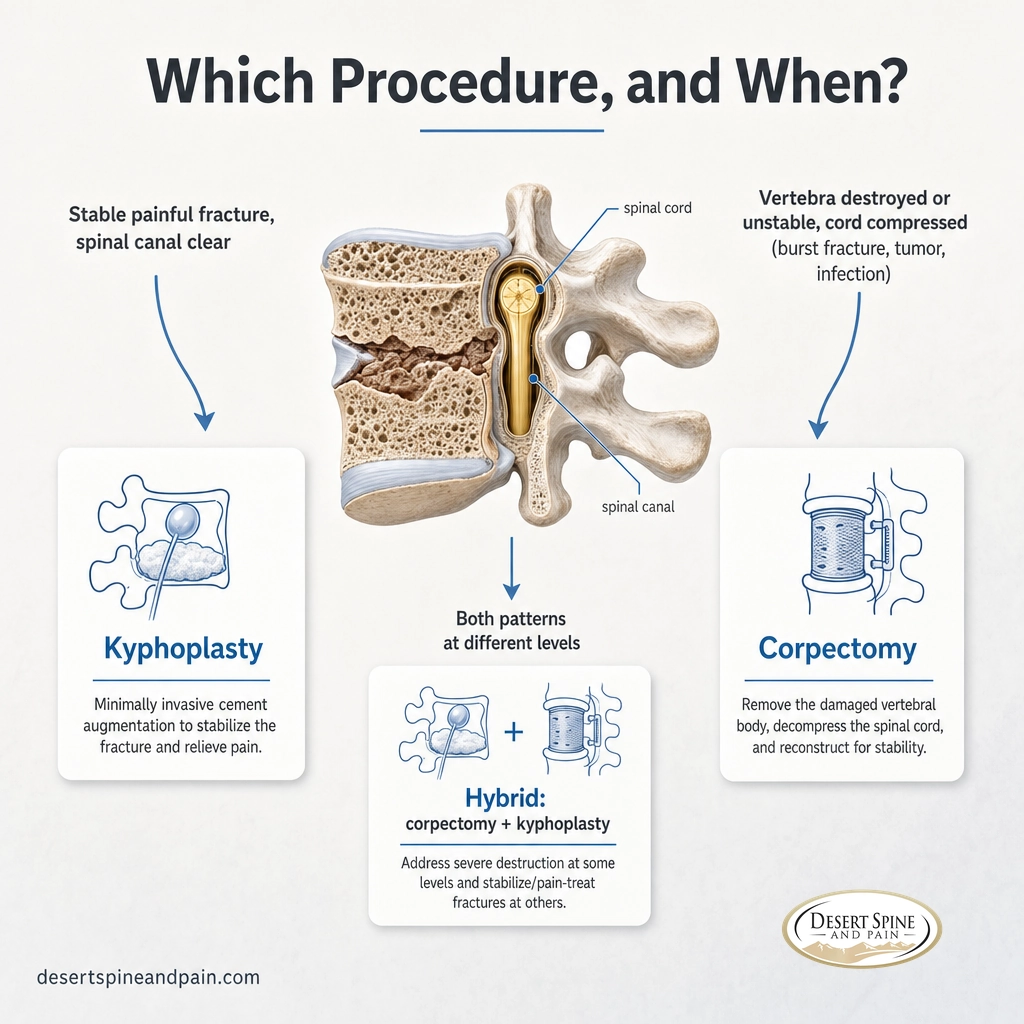
- The deciding factor is the spinal cord: a stable painful fracture with a clear canal points to kyphoplasty, while a destroyed or unstable vertebra pressing on the cord (a burst fracture, tumor, or infection) usually requires a corpectomy.
- Kyphoplasty means a quick, often same-day procedure and fast pain relief. A corpectomy reaches problems kyphoplasty cannot, at the cost of a far larger reconstruction and recovery.
- They are not competitors. The right operation is the least invasive one that fully solves the problem, which is why an imaging-based evaluation matters more than the name of the procedure.

What's in This Guide
- Kyphoplasty vs. Corpectomy at a Glance
- Understanding Kyphoplasty
- Understanding Corpectomy
- The Core Difference: Stabilize vs. Remove and Rebuild
- Head-to-Head: How They Compare
- Kyphoplasty vs. Corpectomy: Full Comparison
- Who Should Consider Kyphoplasty
- Who Should Consider a Corpectomy
- The Verdict: Which Is Right?
- Common Questions
- Sources
Kyphoplasty vs. Corpectomy at a Glance
Kyphoplasty (Balloon Kyphoplasty)
- Keeps the fractured vertebra and stabilizes it with injected bone cement
- Done through two small punctures in the back, guided by live imaging
- A balloon makes a cavity and can partly restore lost vertebral height
- Best for a stable, painful compression fracture with a clear spinal canal
- Usually outpatient, with fast fracture-pain relief and no fusion
Corpectomy
- Removes an entire vertebral body plus the discs above and below it
- Open surgery that decompresses the spinal cord and nerves
- Rebuilds the gap with a cage or strut graft, plus plates, screws, or rods
- Best for a destroyed or unstable vertebra, canal compromise, tumor, or infection
- Larger operation with a hospital stay, bracing, and a longer recovery
Understanding Kyphoplasty (Balloon Kyphoplasty)
Kyphoplasty treats a vertebral compression fracture, the kind of collapse that most often happens when weakened, osteoporotic bone gives way, or when a tumor has weakened a vertebra. These fractures are common: an estimated 700,000 occur each year in the United States, and they can cause sudden, sharp back pain, loss of height, and a stooped posture. When the pain is severe and has not settled with conservative care such as rest, bracing, and medication, kyphoplasty can stabilize the broken bone and calm the pain.
The procedure is percutaneous, meaning it works through the skin rather than through an open incision. Guided by real-time X-ray, the surgeon passes a narrow instrument through a small puncture in the back and into the fractured vertebral body. A balloon (a bone tamp) is then inflated inside the bone to create a cavity and gently lift the collapsed vertebra back toward its original height. The balloon is removed and the cavity is filled with medical-grade bone cement, which hardens within minutes to splint the fracture from the inside. Because it stabilizes rather than replaces the vertebra, kyphoplasty involves no fusion and no hardware. You can read more on the kyphoplasty procedure page, and the closely related cement-only option is covered in kyphoplasty versus vertebroplasty.
Genuine strengths: It is minimally invasive and often done as an outpatient, with many patients feeling meaningful fracture-pain relief within a day or two. It can partly restore vertebral height and improve a kyphotic deformity. Honest limits: kyphoplasty treats the fracture, not the spinal cord. It does not remove bone fragments or relieve pressure on the nerves, so it is not an option when a fracture is unstable or when something is squeezing the spinal canal.
Source: StatPearls: Vertebral Compression Fractures (NCBI) | Mayo Clinic: Osteoporosis
Understanding Corpectomy
A corpectomy is the answer when the vertebral body itself is the problem and has to come out. The word corpectomy literally means removing the body (corpus) of a vertebra. Working through an open approach, from the front, side, or back depending on the level and pathology, the surgeon removes the entire vertebral body along with the discs on either side of it. That clears a wide, continuous channel and takes direct pressure off the spinal cord and nerve roots, something no cement procedure can do.
Removing a vertebra leaves a large gap, so reconstruction is the second half of the operation. The surgeon bridges the space with a strut, either a block of bone graft or, more often today, an expandable titanium cage sized to fit, then anchors it with plates, screws, or rods and fuses the adjacent levels into a solid unit. Because the construct spans a long distance and the spine has been rebuilt, many patients wear a brace while it heals. The details are covered on the corpectomy procedure page, and related decompression comparisons are covered in corpectomy versus laminectomy.
Genuine strengths: It is the most reliable way to decompress the spinal cord when a burst fracture, tumor, or infection has pushed bone into the canal or destroyed the vertebra, and it rebuilds the spine's load-bearing column at the same time. Honest limits: it is a major operation, with more blood loss, a hospital stay, and a longer, more involved recovery than any percutaneous procedure, which is why surgeons reserve it for problems that genuinely require removing and reconstructing the bone.
Source: AO Foundation: Thoracolumbar burst fracture, anterior stabilization | Mayo Clinic: Spinal fractures
The Core Difference: Stabilize vs. Remove and Rebuild
Strip away the terminology and the whole comparison comes down to one question: can the vertebra be saved and splinted in place, or does it have to be removed and replaced? Kyphoplasty keeps the bone and stabilizes it with cement. A corpectomy takes the bone out and rebuilds the column. Everything else, the invasiveness, the hardware, the hospital stay, the recovery, flows from that.
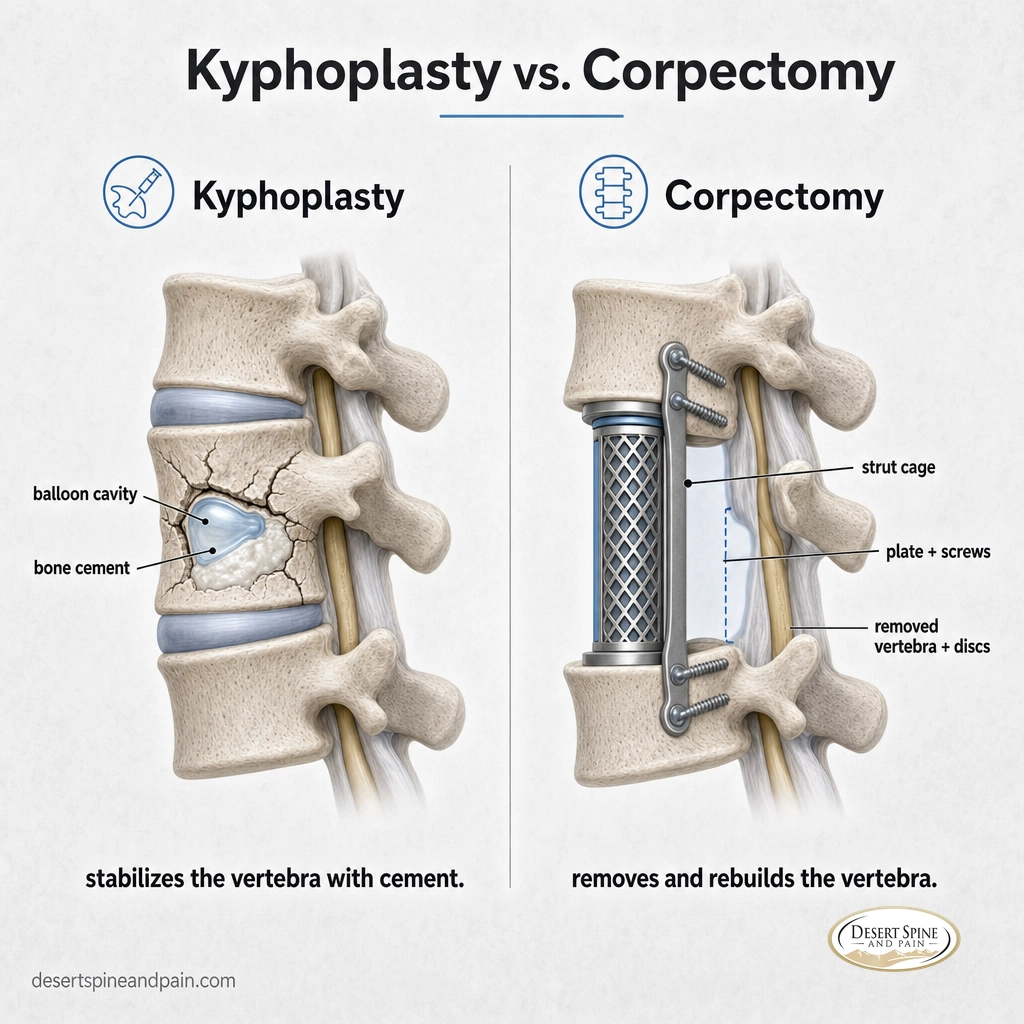
Picture a collapsed vertebra. If the bone is cracked and painful but still holding its shape, and nothing is pressing on the spinal cord, kyphoplasty can splint it from the inside with cement and the problem is solved with a needle. But if that vertebra has shattered and pushed fragments back into the spinal canal, or a tumor has eaten through it, cement cannot reach or remove the compressing bone. The vertebra has to come out and be rebuilt. This is why the choice is a matter of anatomy and stability, not of picking the smaller surgery.
Myth: "Kyphoplasty and corpectomy are two versions of the same fracture surgery, so start with the smaller one." Neither half of that is true. They do opposite things, and the smaller procedure is not always a valid starting point. Kyphoplasty stabilizes a fracture but leaves any spinal-cord compression untouched. Choosing it when fragments are pressing on the cord would leave the real danger in place. Choosing a corpectomy for a simple, stable fracture would remove a vertebra that never needed to go. The right operation is the least invasive one that fully addresses both the fracture and the spinal cord.
Kyphoplasty vs. Corpectomy: Full Comparison
| Criterion | Kyphoplasty | Corpectomy | Typical edge |
|---|---|---|---|
| What happens to the vertebra | Kept and stabilized with bone cement | Removed entirely and rebuilt | Depends on the pathology |
| Main goal | Stabilize the fracture, relieve pain | Decompress the spinal cord, reconstruct the spine | Different jobs |
| Approach | Percutaneous, two small punctures | Open surgery, front, side, or back | Kyphoplasty (far less invasive) |
| Decompresses the cord | No | Yes | Corpectomy |
| Hardware and fusion | None | Cage or strut graft, plates/screws, fusion | Problem-specific |
| Anesthesia and stay | Often local/sedation, usually same-day | General anesthesia, hospital stay | Kyphoplasty |
| Recovery | Days, fast pain relief | Weeks to months, with bracing | Kyphoplasty |
| Best suited for | Stable, painful compression fracture, clear canal | Burst fracture, tumor, infection, cord compression | Problem-specific |
Who Should Consider Kyphoplasty
Kyphoplasty is typically the right fit for a patient whose vertebra is fractured but still stable, and whose spinal cord is not under pressure. You are more likely to be a kyphoplasty candidate if:
- You have a painful vertebral compression fracture, often from osteoporosis or a weakened (pathologic) vertebra, confirmed on imaging.
- The fracture is stable and there is no bone or tumor pressing on the spinal cord or nerves.
- Severe fracture pain has not improved with conservative care such as rest, bracing, and medication over a reasonable period.
- You want the least invasive option that stabilizes the fracture and relieves pain quickly, ideally as an outpatient.
- Restoring some lost vertebral height and improving a stooped, kyphotic posture are goals your surgeon thinks are achievable.
When the fracture is stable but you are weighing cement options, the choice between a balloon and cement-only approach is covered in vertebroplasty, a related procedure worth discussing with your surgeon.
Source: StatPearls: Vertebral Compression Fractures | Mayo Clinic: Osteoporosis
Who Should Consider a Corpectomy
A corpectomy is the right call when stabilizing the vertebra is not enough and the bone itself has to be removed. You are more likely to need a corpectomy if:
- A burst fracture has shattered the vertebra and pushed fragments back into the spinal canal, where they are compressing the cord.
- A tumor or infection has destroyed or significantly weakened the vertebral body, so it needs to be removed and rebuilt.
- There is spinal cord or nerve compression, or a new or worsening neurological deficit such as leg weakness, numbness, or problems with bowel or bladder control.
- The vertebra is unstable and cement alone could not safely support the spine's load-bearing column.
- Your surgeon determines a combined or hybrid plan is best, such as a corpectomy at the destroyed level and a kyphoplasty at a separate, stable fracture nearby.
In other words, a corpectomy is chosen because the anatomy demands it, not because it is a more thorough operation by default. For a sense of how corpectomy compares with other decompression and fusion surgeries, see corpectomy versus ACDF and corpectomy versus discectomy.
Source: AO Foundation: Thoracolumbar burst fracture, anterior stabilization | Mayo Clinic: Spinal fractures
The Verdict: Which Is Right?
There is no single winner here, because kyphoplasty and corpectomy are not really competing for the same patient. For a stable, painful compression fracture with a clear spinal canal, kyphoplasty is almost always the better choice: it stabilizes the fracture, relieves pain fast, and does it through two small punctures with a quick recovery. It is the least-invasive answer, and when it fits, it fits well.
But when a vertebra has been destroyed by a burst fracture, tumor, or infection, or when bone is pressing on the spinal cord, a corpectomy is not just a bigger option, it is the only operation that actually solves the problem. Cement cannot decompress a cord or replace a shattered vertebra. The real decision is made at the imaging, by looking at whether the fracture is stable and whether the spinal cord is compromised, not by starting with the smaller procedure and hoping it is enough.
Desert Spine and Pain is a Phoenix, Arizona practice led by Dr. David L. Greenwald, MD, FACS, a board-certified surgeon who is both a spine surgeon and a neurosurgeon, a dual expertise that matters most when a decision sits at the line between a minimally invasive fix and major reconstruction. Every plan starts with the least invasive effective option and a careful look at whether surgery is needed at all. Patients travel from across the Greater Phoenix area and beyond for this level of surgical care.
Learn about spinal decompression surgery
Explore all spine surgery options
Book a consultation or second opinion
Common Questions About Kyphoplasty and Corpectomy
What is the difference between kyphoplasty and corpectomy?
Is kyphoplasty or corpectomy more serious?
Can kyphoplasty be done instead of a corpectomy?
Can you have both a kyphoplasty and a corpectomy?
Which has a faster recovery, kyphoplasty or corpectomy?
Sources
Sources and Methodology
This guide summarizes established clinical references and peer-reviewed research on balloon kyphoplasty and vertebral corpectomy. Incidence, leakage, and procedure figures are drawn from clinical reference texts and comparative studies and are presented as general reference, not individual predictions. It is educational information, not medical advice. Decisions about diagnosis and treatment should be made with a qualified spine specialist after an in-person evaluation and review of your imaging.
- McCarthy J, Davis A. Vertebral Compression Fractures. StatPearls, NCBI Bookshelf (annual vertebral-compression-fracture incidence and management)
- Taylor RS, Fritzell P, Taylor RJ. Balloon kyphoplasty and vertebroplasty for vertebral compression fractures: a comparative systematic review of efficacy and safety. Spine (Phila Pa 1976). 2006 (cement leakage rates)
- AO Foundation Surgery Reference: Thoracolumbar burst fracture, anterior decompression and stabilization (corpectomy for burst fractures)
- Mayo Clinic: Osteoporosis (compression fractures)
- Mayo Clinic: Spinal fractures