
Corpectomy vs. ACDF: Comparing Two Cervical Spine Procedures
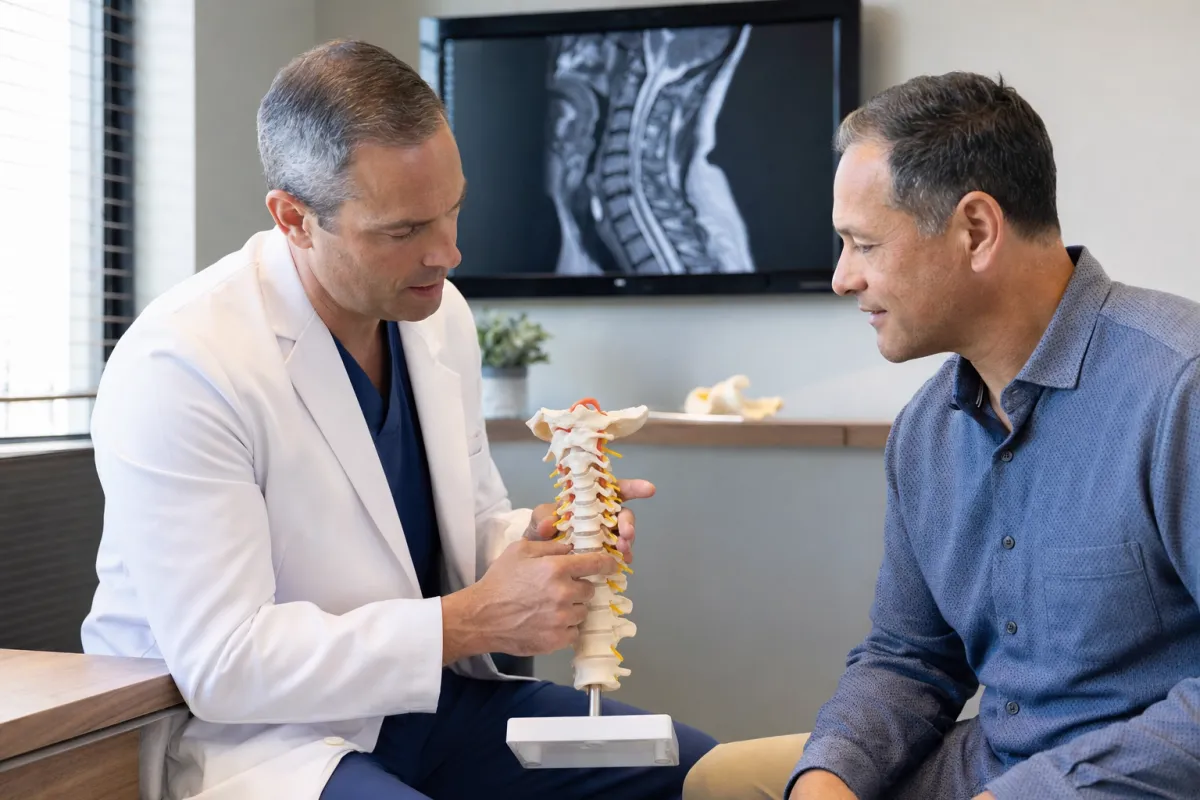
Corpectomy and ACDF are both anterior cervical fusion surgeries, done through the front of the neck to take pressure off the spinal cord and nerves. The difference is how much they remove: an ACDF removes the disc between two vertebrae, while a corpectomy removes an entire vertebral body and rebuilds the gap. That one distinction drives almost everything else, including which problems each can fix, how long recovery takes, and the risks involved. This guide walks through how each procedure works, how they compare head to head, and how a spine surgeon chooses the right one.
- An ACDF (anterior cervical discectomy and fusion) removes one or more discs and fuses the neighboring vertebrae. A corpectomy (anterior cervical corpectomy and fusion, or ACCF) removes a whole vertebral body plus the discs around it.
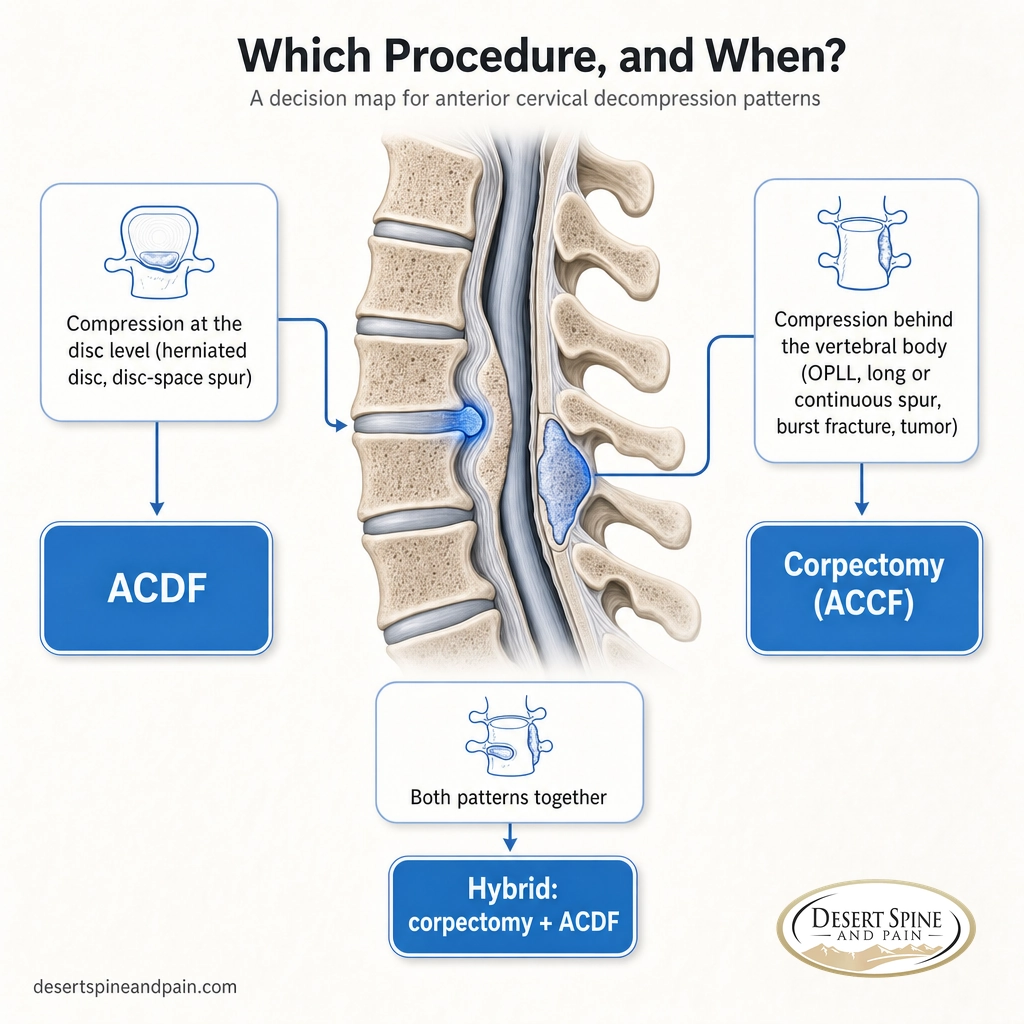
- The deciding factor is where the pressure sits: compression at the disc level usually calls for an ACDF, while compression behind the vertebral body (large bone spurs, ossified ligament, a fracture, or a tumor) may require a corpectomy.
- ACDF generally means shorter surgery, less blood loss, and a quicker recovery. Corpectomy reaches pathology an ACDF cannot, at the cost of a larger reconstruction.
- Both procedures achieve high fusion rates and strong relief of myelopathy and radiculopathy when matched to the right patient.
- The least invasive option that fully decompresses the spinal cord is the goal, which is why a careful, imaging-based evaluation matters more than the name of the operation.

What's in This Guide
- ACDF vs. Corpectomy at a Glance
- Understanding ACDF
- Understanding Corpectomy (ACCF)
- The Core Difference: Disc Level vs. Vertebral Body
- Head-to-Head: How They Compare
- ACDF vs. Corpectomy: Full Comparison
- Who Should Consider ACDF
- Who Should Consider a Corpectomy
- The Verdict: Which Is Better?
- Common Questions
- Sources
ACDF vs. Corpectomy at a Glance
ACDF (Anterior Cervical Discectomy and Fusion)
- Removes the disc (or discs) between vertebrae, leaving the vertebral bodies in place
- Fills each disc space with a small cage or graft, usually held by a front plate
- Best for compression at the disc level, such as a herniated disc or spur
- Shorter operation, less blood loss, often a short or same-day stay
- The most common anterior cervical procedure
Corpectomy (Anterior Cervical Corpectomy and Fusion, ACCF)
- Removes an entire vertebral body plus the discs above and below it
- Bridges the larger gap with a strut graft or an expandable cage, plus a plate
- Best for compression behind the vertebral body, long segments, OPLL, fracture, or tumor
- Larger reconstruction, more blood loss, often a longer recovery
- Reaches pathology an ACDF alone cannot
Understanding ACDF (Anterior Cervical Discectomy and Fusion)
ACDF is one of the most frequently performed spine operations, and for good reason: it treats the most common structural causes of neck-related arm pain and spinal cord pressure. Working through a small incision at the front of the neck, the surgeon gently moves aside the soft tissues (rather than cutting through muscle), reaches the spine, and removes the damaged disc. With the disc gone, any bone spurs or disc fragments pressing on a nerve root or the spinal cord can be cleared away.
Once the pressure is relieved, the empty disc space is filled with a spacer, either a small cage or a bone graft, that restores the normal height between the vertebrae. A thin metal plate and screws on the front of the spine hold everything steady while the two vertebrae grow together into a single solid unit, which is the fusion. ACDF can be done at one level or across several adjacent levels when more than one disc is involved. For many patients it is a candidate for minimally invasive techniques, and you can read more about the procedure on the ACDF surgery page.
Genuine strengths: It preserves the vertebral bodies, keeps the operation and recovery relatively contained, and has a long, well-studied track record for relieving radiculopathy and myelopathy. Honest limits: because it works at the disc space, an ACDF cannot directly reach compression that sits squarely behind a vertebral body, and fusing several levels in a row can place more stress on the discs above and below over time.
Source: 2025 systematic review and meta-analysis of ACDF vs. ACCF in cervical myelopathy (PubMed) | Mayo Clinic: Cervical spondylosis
Understanding Corpectomy (Anterior Cervical Corpectomy and Fusion)
A corpectomy, sometimes written ACCF for anterior cervical corpectomy and fusion, is the answer when removing discs alone will not fully free the spinal cord. The word corpectomy literally means removing the body (corpus) of a vertebra. The surgeon approaches from the front of the neck just as in an ACDF, but instead of stopping at the disc, removes an entire vertebral body along with the discs on either side of it. That opens a wide, continuous channel in front of the spinal cord.
Removing a vertebra leaves a much larger gap, so reconstruction is the second half of the operation. The surgeon fills the space with a strut, either a block of bone graft or, more often today, an expandable titanium cage that is lengthened to fit, then secures it top and bottom with a plate and screws. Because the construct spans a longer distance, some patients also benefit from a brace during healing, and in certain cases a surgeon adds posterior (back-of-neck) support. The details are covered on the corpectomy procedure page.
Genuine strengths: It is the most reliable way to decompress pressure that sits behind the vertebral body, to clear long or continuous ossified ligament, and to rebuild the spine after a fracture or tumor has destroyed a vertebra. Honest limits: it is a bigger operation, with more blood loss and a longer reconstruction, and a long single strut has slightly higher demands on fixation than a series of smaller cages, which is one reason surgeons sometimes prefer to stage the decompression across disc levels when the anatomy allows.
Source: Comparative study of multilevel ACDF and corpectomy for cervical myelopathy (PMC) | 2025 ACDF vs. ACCF meta-analysis (PubMed)
The Core Difference: Disc Level vs. Vertebral Body
Strip away the terminology and the whole comparison comes down to one question: where is the spinal cord being squeezed, and can the surgeon reach it by clearing out discs, or does a vertebra itself have to come out? An ACDF removes the cushions between the bones. A corpectomy removes a bone. Everything else, the blood loss, the hardware, the recovery, flows from that.
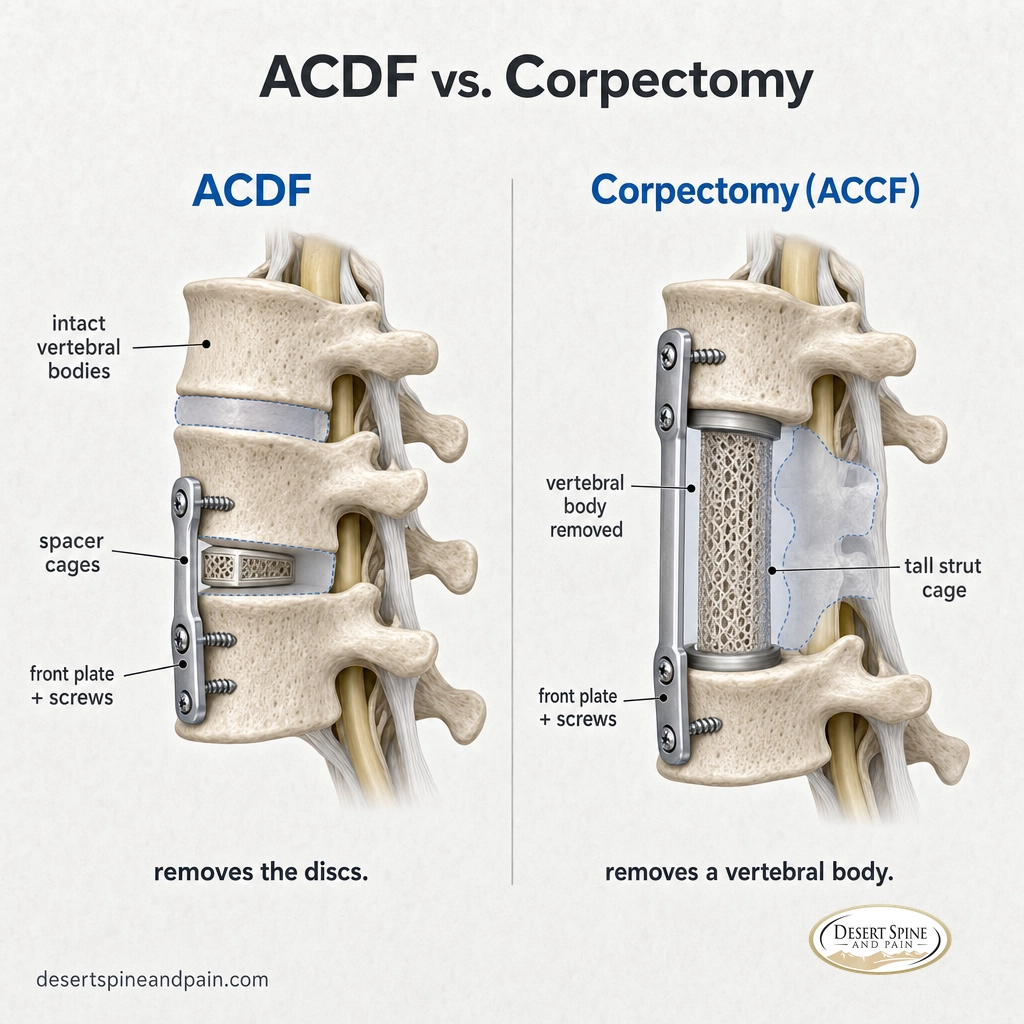
Picture three stacked vertebrae with discs between them. If the problem is a herniated disc or a spur growing off the edge of a disc space, an ACDF removes those discs and the trouble with them. But if a large spur, an ossified ligament, or a collapsed vertebra is pressing on the cord from directly behind the middle bone, no amount of disc removal reaches it. Taking out that vertebral body creates the room the cord needs. This is why the choice is a matter of anatomy, not of picking the smaller surgery.
Myth: "A corpectomy is just a bigger, better ACDF, so pick whichever is less invasive." Neither half of that is true. A corpectomy is not an upgrade, and the right operation is not always the smaller one. The two reach different places. Choosing an ACDF when compression sits behind the vertebral body would leave the cord squeezed, and choosing a corpectomy when discs are the whole problem removes bone that never needed to go. The least invasive operation that fully decompresses the cord is the right one.
Edge: ACDF for a generally quicker, simpler recovery, with the caveat that a longer multilevel ACDF narrows that gap.
Source: Mayo Clinic: Cervical spondylosis treatment and recovery
ACDF vs. Corpectomy: Full Comparison
| Criterion | ACDF | Corpectomy (ACCF) | Typical edge |
|---|---|---|---|
| What is removed | One or more discs; vertebral bodies left intact | A full vertebral body plus the discs beside it | Depends on pathology |
| Where it decompresses | At the disc spaces | Behind the vertebral body, over a long segment | Corpectomy for retrovertebral compression |
| Reconstruction | Small cage or graft per level, plus a plate | One long strut graft or expandable cage, plus a plate | ACDF (more fixation points) |
| Operative time & blood loss | Shorter, less blood loss | Longer, more blood loss | ACDF |
| Fusion rate | High (around 88% in one multilevel series) | High (around 93% in the same series) | Even |
| Cervical alignment | Finer control across multiple levels | Fewer points to tune the curve | ACDF |
| Hospital stay & bracing | Often short stay, soft collar | Often longer stay, firmer brace | ACDF |
| Best suited for | Disc herniations, spurs, disc-level stenosis | OPLL, burst fracture, tumor, retrovertebral or long compression | Problem-specific |

Who Should Consider ACDF
An ACDF is typically the right fit for a patient whose cervical problem lives at the disc spaces. That describes the majority of cervical surgeries. You are more likely to be an ACDF candidate if:
- Your symptoms come from a herniated disc or disc-level bone spur pinching a nerve root or the spinal cord, confirmed on MRI.
- The compression is at one, two, or a few adjacent disc levels, not behind the body of a vertebra.
- You want the shortest, least invasive operation that still fully relieves the pressure, in keeping with a least-invasive-first philosophy.
- You have radiculopathy (arm pain, numbness, or weakness) or early myelopathy that has not improved with non-surgical care.
- Preserving the vertebral bodies and fine-tuning the neck's curve are priorities for your anatomy.
For some single-level cases, a motion-sparing cervical disc replacement may even be an alternative to fusion, which is a separate conversation worth having with your surgeon.
Source: Oh et al., Journal of Spine Surgery (2020) | 2025 ACDF vs. ACCF meta-analysis (PubMed)
Who Should Consider a Corpectomy
A corpectomy is the right call when removing discs alone cannot free the spinal cord. You are more likely to need a corpectomy if:
- Compression sits directly behind a vertebral body rather than at the disc spaces, where an ACDF cannot reach it.
- You have ossification of the posterior longitudinal ligament (OPLL) or a large retrovertebral spur running continuously behind the bone.
- A burst fracture, tumor, or infection has damaged or destroyed a vertebral body that needs to be removed and rebuilt.
- The compression is long and continuous, so a single wide channel decompresses more reliably than clearing individual disc spaces.
- Your surgeon has determined that a combined or hybrid construct (a corpectomy at one level plus an ACDF at an adjacent disc) gives the safest, most complete decompression.
In other words, a corpectomy is chosen because the anatomy demands it, not because it is a larger or more thorough operation by default. You can compare related options in corpectomy versus discectomy and corpectomy versus laminectomy.
Source: Comparative study of multilevel ACDF vs. ACCF (PMC) | Mayo Clinic: Cervical spondylosis
The Verdict: Which Is Better?
There is no single winner, and any article that crowns one is oversimplifying. For the common situation where disease sits at the disc spaces, an ACDF is usually the better choice: it decompresses the problem, fuses reliably, and does it with less blood loss, a shorter recovery, and finer control of the neck's curve. When these two are weighed against each other for multilevel myelopathy, the evidence generally favors ACDF for perioperative outcomes when the anatomy allows it.
But when compression sits behind a vertebral body, or a vertebra has been destroyed by a fracture or tumor, a corpectomy is not just better, it is the only operation that reaches the problem. The real decision is made at the MRI, by matching the operation to where the pressure actually sits. That is a judgment best made by a surgeon who performs both, who starts with the least invasive effective option, and who will tell you honestly when a bigger operation is genuinely the safer path.
Desert Spine and Pain is a Phoenix, Arizona practice led by Dr. David L. Greenwald, MD, FACS, a board-certified surgeon who is both a spine surgeon and a neurosurgeon, a dual expertise that matters most for complex cervical decisions like this one. Patients travel from across the Greater Phoenix area and beyond for this level of surgical care, and every plan starts with a careful look at whether surgery is needed at all.
Explore cervical spine surgery options
Learn about cervical fusion surgery
Book a consultation or second opinion
Common Questions About Corpectomy and ACDF
What is the difference between a corpectomy and an ACDF?
Is a corpectomy more serious than an ACDF?
Which has a faster recovery, ACDF or corpectomy?
Can you have both an ACDF and a corpectomy at the same time?
How does a surgeon decide between corpectomy and ACDF?
Sources
Sources and Methodology
This guide summarizes established clinical references and peer-reviewed comparative research on anterior cervical discectomy and fusion (ACDF) and cervical corpectomy (ACCF). Complication and fusion figures are drawn from meta-analyses and comparative cohort studies and are presented as general reference, not individual predictions. It is educational information, not medical advice. Decisions about diagnosis and treatment should be made with a qualified spine specialist after an in-person evaluation and review of your imaging.
- Oh LJ, et al. (2020): Dysphagia rates in single- and multiple-level anterior cervical discectomy and fusion surgery: a meta-analysis. Journal of Spine Surgery 6(3):581-590
- 2025 systematic review and meta-analysis: ACDF vs. ACCF for two-level cervical spondylotic myelopathy (PubMed)
- Comparative study of multilevel ACDF vs. corpectomy (ACCF) for cervical myelopathy, five-year follow-up (PMC)
- Mayo Clinic: Cervical spondylosis