
Corpectomy vs. Laminectomy: Comparing Spinal Decompression
If your spine surgeon has mentioned decompression, you may be weighing two very different operations with similar goals. Corpectomy and laminectomy both aim to take pressure off a crowded spinal cord or nerve, yet they come at the problem from opposite directions and remove different bone. The stakes are real: for people over 65 who have spine surgery, lumbar spinal stenosis is the single most common diagnosis, and matching the operation to where the compression actually sits is what separates lasting relief from a second surgery. This guide breaks down what each procedure removes, how recovery compares, and how a dual board-certified brain and spine surgeon decides which one fits your spine.
Key Takeaways
- Different bone, different direction. A corpectomy removes an entire vertebral body plus the neighboring discs, usually from the front. A laminectomy removes the lamina, the bony roof at the back of the vertebra, from behind.
- Corpectomy rebuilds, laminectomy often does not. Because a corpectomy takes out a load-bearing column, it always needs a bone graft, cage, and hardware. A laminectomy frequently relieves pressure on its own, with fusion added only when needed.
- Where the pressure comes from decides the approach. Compression in front of the cord points toward a corpectomy; compression behind it points toward a laminectomy.
- Recovery differs. A minimally invasive laminectomy can mean a return to most activity in four to six weeks, while a corpectomy with fusion often takes several months.
- Neither is "better." The right choice is the one that matches your anatomy, which is why the surgeon's evaluation matters more than the name of the operation.

What's in This Guide
- Corpectomy vs. Laminectomy at a Glance
- Understanding Corpectomy
- Understanding Laminectomy
- What Each Surgery Removes
- Front vs. Back: The Surgical Approach
- Reconstruction and Fusion
- Conditions Each Procedure Treats
- Invasiveness and Recovery
- Risks and Complications
- Side-by-Side Comparison Table
- Who Should Consider a Corpectomy
- Who Should Consider a Laminectomy
- The Verdict: Matching Surgery to Spine
- Frequently Asked Questions
Corpectomy vs. Laminectomy at a Glance
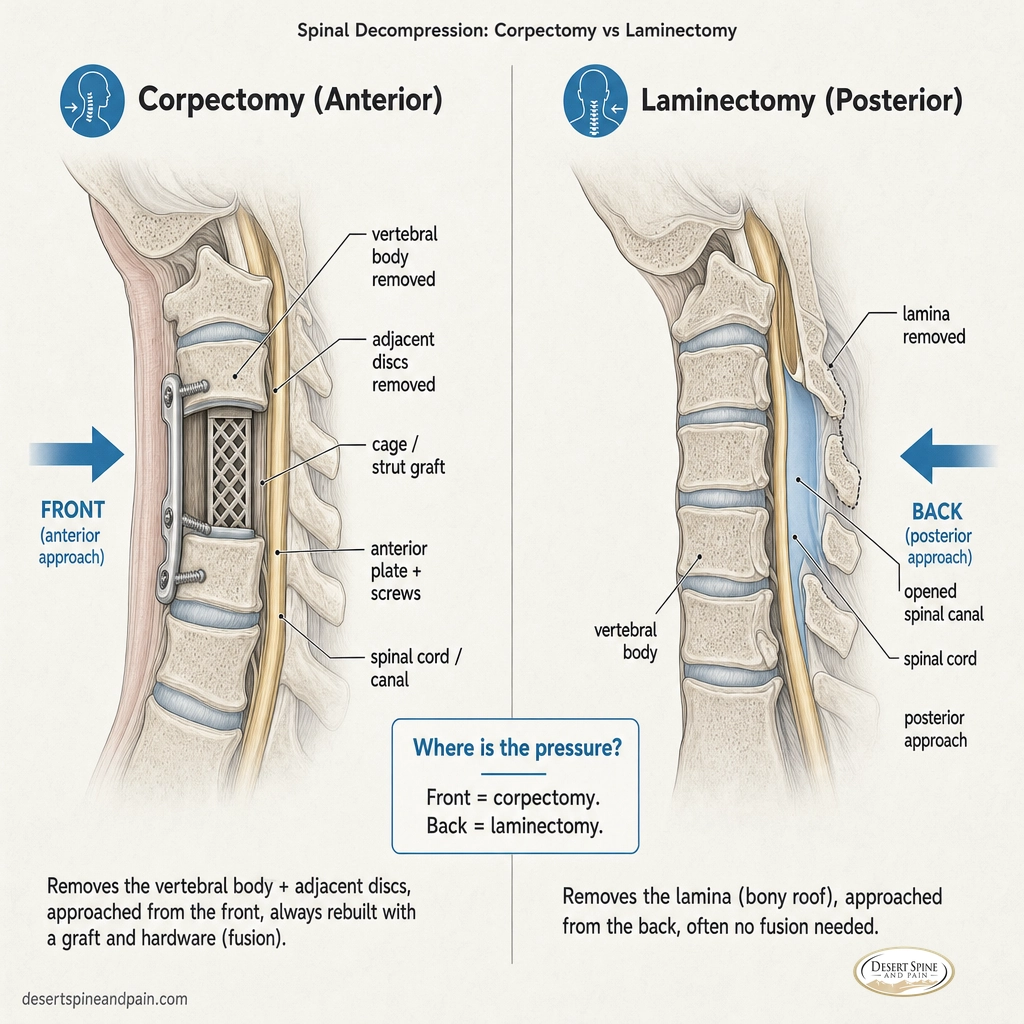
Both operations are forms of spinal decompression, the general term for surgery that creates more room for a compressed spinal cord or nerve root. The difference is strategic. A corpectomy clears pressure from the front of the spinal canal by removing the vertebral body itself. A laminectomy clears pressure from the back by removing the bony arch that forms the roof of the canal. If your compression comes from a collapsed or diseased vertebra, clearing the back of the canal will not reach it, and vice versa.
The short version
Corpectomy (usually anterior / front)
- Removes a full vertebral body plus the discs above and below
- Reaches pressure coming from in front of the cord
- Always rebuilt with a graft, cage, and hardware (fusion)
- More complex; recovery measured in months
- Used for collapsed vertebrae, tumors, and front-of-canal disease
Laminectomy (posterior / back)
- Removes the lamina, the bony roof at the back of the vertebra
- Reaches pressure coming from behind the cord or nerves
- Often stands alone; fusion added only when needed
- Less invasive; recovery often measured in weeks
- Used for spinal stenosis, bone spurs, and thickened ligament
Understanding both operations starts with understanding why decompression is so common in the first place. Degenerative spinal changes affect up to 95% of people by age 50, and while most never need surgery, the subset whose narrowing actually squeezes the cord or nerve are the ones these procedures are designed for. If you want a plain-language overview of the narrowing itself, our page on the spinal conditions we treat explains how stenosis develops.
Source: Cleveland Clinic — Spinal Stenosis
Understanding Corpectomy
A corpectomy removes the body of a vertebra, the thick, drum-shaped block at the front of each spinal segment, along with the discs directly above and below it. In the neck, this is most often done through a small incision at the front, so the surgeon can reach the spine from the side where the pressure sits without disturbing the spinal cord from behind. Bone spurs and disc fragments pushing into the canal come out with the vertebral body.
Because the vertebral body is a weight-bearing pillar, removing it leaves a gap that has to be rebuilt. The surgeon fills the space with a strut graft, taken from the patient or a bone bank, or a cage made of titanium, ceramic, or synthetic bone, and secures it with a titanium plate and screws. Over the following months, bone grows across that bridge and the segment fuses into one solid unit. This is what makes a corpectomy as much a reconstruction as a decompression.
Genuine strengths
- Reaches compression that sits directly in front of the spinal cord, where a back-of-the-spine operation simply cannot reach
- Removes diseased or collapsed bone completely, which matters for tumors, fractures, and infection
- Restores height and alignment to a segment that has lost structural support
Honest trade-offs
- More complex, with a longer operation and a longer recovery
- Always requires a graft and fusion, so the treated segment loses its motion
- Front-of-neck approaches carry their own specific risks, such as temporary swallowing or voice changes
Corpectomy is one of several spinal decompression surgeries Dr. Greenwald performs, and it is often paired with a cervical spinal fusion to lock in stability.
Source: Columbia Neurosurgery — Anterior Cervical Corpectomy
Understanding Laminectomy
A laminectomy removes the lamina, the bony arch at the back of the vertebra that forms the roof over the spinal canal. Taking off that roof instantly creates more room inside the canal, relieving pressure on the cord or the nerve roots branching from it. The surgeon works from an incision in the back or the neck, with the patient face down under general anesthesia, and can use either a traditional open approach or a minimally invasive one with smaller incisions and specialized tools.
Unlike the vertebral body, the lamina is not a primary weight-bearing structure, so removing it does not automatically destabilize the spine. That is why a laminectomy frequently works on its own, without any graft or hardware. A surgeon adds a fusion only when taking out enough bone would leave the segment unstable, or when the laminectomy is done together with a discectomy, foraminotomy, or fusion as part of a larger plan.
Genuine strengths
- Directly relieves pressure from behind the cord, the most common pattern in spinal stenosis
- Often avoids fusion, preserving the segment's natural motion
- Available as a minimally invasive procedure with a shorter recovery
Honest trade-offs
- Cannot address compression that sits in front of the cord
- If the underlying wear continues, symptoms can return over time
- When combined with fusion, recovery lengthens considerably
A laminectomy procedure is frequently performed with minimally invasive spine surgery techniques when a patient is a candidate.
Source: Cleveland Clinic — Laminectomy
What Each Surgery Removes
This is the clearest line between the two procedures. A corpectomy removes the vertebral body, the solid block at the front, along with the adjacent discs. A laminectomy removes the lamina, the thin bony plate at the back. One takes out the floor of the problem, the other takes off the roof.
That single difference drives everything else. Remove a load-bearing vertebral body and you must rebuild the column, which means a graft and fusion every time. Remove the non-load-bearing lamina and the structure usually holds, so fusion becomes optional. The amount of bone involved also explains why a corpectomy is the more involved operation.
A common misconception
Patients often assume the "bigger" surgery is always the more thorough fix. It is not. A laminectomy that perfectly matches back-of-the-canal compression will outperform a corpectomy aimed at the wrong target, and the reverse is equally true. The goal is not to remove the most bone, it is to remove the right bone. Choosing the larger operation when a smaller, targeted one would do adds risk and recovery time without adding benefit.
Front vs. Back: The Surgical Approach
Corpectomy in the neck is typically an anterior procedure, reached from the front. Laminectomy is a posterior procedure, reached from the back. The approach is not a surgeon's stylistic preference; it is dictated by where the compression lives.
Picture the spinal cord running through a canal. If the thing crowding it, a collapsed vertebra, a tumor, a large central disc, or a bone spur behind the vertebral body, sits in front of the cord, the surgeon has to come from the front to reach it safely. A laminectomy from behind would never touch that pressure. If instead the crowding comes from a thickened ligament, overgrown facet joints, or the lamina itself pressing from behind, a posterior laminectomy goes straight to the source. Spinal alignment matters too: the overall curve of the neck or back can make one approach safer and more effective than the other.
Reconstruction and Fusion
Here the two operations diverge sharply. A corpectomy always includes reconstruction. After the vertebral body comes out, the gap is bridged with a graft or cage and fixed with a plate and screws, and the segment fuses permanently. There is no version of a corpectomy that skips this step, because the spine cannot bear load through an empty space.
A laminectomy is different. Removing the lamina usually leaves the spine stable enough to function without hardware, so many laminectomies involve no graft and no fusion at all. Fusion is added selectively, when the decompression removes enough bone or joint to risk instability, or when it is combined with another procedure. This is one reason a straightforward laminectomy can have a markedly shorter recovery than a corpectomy.
Source: Healthline — Corpectomy vs. Laminectomy

Conditions Each Procedure Treats
The two procedures overlap on some diagnoses and part ways on others, again based on the direction of the pressure.
Corpectomy is chosen for problems centered on the vertebral body itself: vertebrae damaged by trauma or fracture, tumors such as chordoma, chondrosarcoma, or giant cell tumor, deformity, and degenerative disease, like multilevel bone spurs or ossification, that compresses the cord from the front. When a simpler discectomy would not remove enough to decompress the cord, a corpectomy steps up.
Laminectomy is the workhorse for spinal stenosis, the narrowing that most often squeezes the cord or nerves from behind and around. It is also used for herniated discs, bone spurs, arthritis, bone fractures, and spinal tumors or abscesses that sit where a posterior approach can reach them. Surgery is generally considered only after conservative treatment has failed to control symptoms.
Overlap worth understanding
Some patients have compression from both front and back, or across several levels. In those cases a surgeon may combine approaches or stage the operations. This is exactly the kind of judgment call that depends on reading the imaging and the whole spine, not on a single rule of thumb. Dr. Greenwald's background as both a dual board-certified brain and spine surgeon is built for these multi-factor decisions.
Invasiveness and Recovery
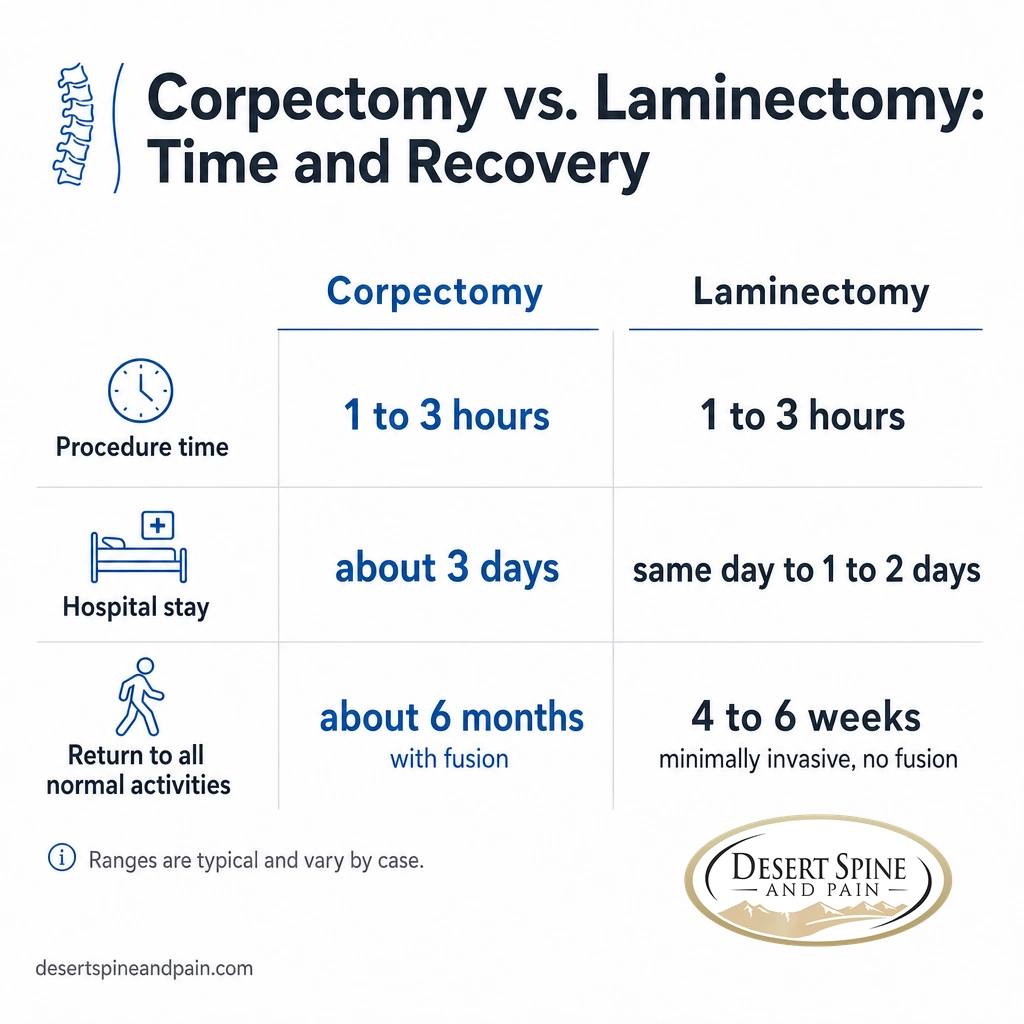
Both operations generally take one to three hours in the operating room. After that, the paths diverge. A laminectomy patient may go home the same day or stay one to two days; a corpectomy patient typically stays longer, often around three days, because of the reconstruction.
Recovery timelines follow the same pattern. A minimally invasive laminectomy without fusion often allows a return to most activities within four to six weeks, with many people driving in one to two weeks and back to non-strenuous work within about a month. A corpectomy, which always includes a fusion, heals more slowly: early recovery spans roughly six to eight weeks, and a full return to all normal activities commonly takes around six months, often with a cervical collar worn for several weeks. A laminectomy done together with a fusion lands in that same longer range, up to about six months to heal completely.
Typical time to return to all normal activities (weeks)
Ranges are typical and vary by level, number of segments, and individual healing. Your surgeon will give you a timeline for your specific case.
Source: Cleveland Clinic — Laminectomy | Columbia Neurosurgery
Risks and Complications
Every spine operation carries risk, and the two share a core set: continued or incomplete pain relief, bleeding, infection, injury to the spinal cord or a nerve root, and blood clots. A laminectomy specifically can involve recurring back pain if the underlying degeneration continues, and when it includes a fusion, patients may face a higher chance of future problems at neighboring segments.
A corpectomy adds risks tied to its reconstruction and its approach: the graft can shift before it fuses, and anterior neck procedures carry a small risk of injury to nearby structures such as the windpipe, along with temporary swallowing or voice changes. None of this means the surgery is unsafe; it means the right operation, done for the right reason by an experienced surgeon, is how risk is kept low. A thorough second opinion is a reasonable step before any irreversible procedure.
Source: Healthline — Corpectomy vs. Laminectomy | Cleveland Clinic — Laminectomy
Side-by-Side Comparison Table
| Factor | Corpectomy | Laminectomy | Edge |
|---|---|---|---|
| What is removed | Entire vertebral body + adjacent discs | Lamina (bony roof), sometimes with ligament | Depends on target |
| Typical approach | Anterior (from the front, in the neck) | Posterior (from the back) | Depends on target |
| Compression it reaches | In front of the spinal cord | Behind the cord or nerves | Depends on target |
| Reconstruction | Always: graft/cage + plate and screws (fusion) | Often none; fusion only when needed | Laminectomy (less hardware) |
| Procedure time | 1-3 hours | 1-3 hours | Even |
| Hospital stay | About 3 days | Same day to 1-2 days | Laminectomy |
| Return to full activity | About 6 months (with fusion) | 4-6 weeks (minimally invasive, no fusion) | Laminectomy |
| Motion of the segment | Fused (motion lost at that level) | Usually preserved | Laminectomy |
| Best for | Collapsed/diseased vertebrae, tumors, front-of-canal pressure | Spinal stenosis, bone spurs, back-of-canal pressure | Depends on target |
"Edge" reflects which option is simpler or quicker on that factor; it is not a verdict. The operation that fits your compression is the right one even when the table favors the other on convenience.
Who Should Consider a Corpectomy
A corpectomy tends to be the right operation when the problem is in the vertebral body or directly in front of the spinal cord. You are more likely to be a candidate if:
- A vertebra has collapsed from a fracture, tumor, or infection and needs to be removed and rebuilt
- Imaging shows the cord is compressed from the front by a diseased vertebra, large central disc, or bone spur behind the vertebral body
- A less extensive procedure such as a discectomy cannot fully decompress the cord
- Several levels of front-of-canal disease need to be cleared and the column restored to proper height and alignment
In these situations, no amount of back-of-the-spine surgery will reach the pressure, and the reconstruction that comes with a corpectomy is a feature, not a drawback, because the spine genuinely needs rebuilding.
Who Should Consider a Laminectomy
A laminectomy is usually the better fit when the pressure comes from behind and the spine is otherwise stable. You are more likely to be a candidate if:
- You have spinal stenosis with narrowing that squeezes the cord or nerves from behind and around
- The compression comes from a thickened ligament, overgrown facet joints, or the lamina itself
- Conservative care such as therapy, medication, and injections has not relieved your symptoms
- You are a candidate for a minimally invasive approach and want the shortest reasonable recovery that still solves the problem
For many people with classic stenosis, a targeted laminectomy relieves the pressure without the added recovery of a fusion, which is why it is one of the most common spine operations performed.
The Verdict: Matching Surgery to Spine
Corpectomy versus laminectomy is not a contest with a single winner. They are different tools for different problems. The corpectomy is the answer when pressure and damage sit in the vertebral body or in front of the cord and the column needs rebuilding. The laminectomy is the answer when pressure comes from behind and the spine can be decompressed without major reconstruction. Choosing the larger operation for a back-of-the-canal problem, or a posterior operation for a front-of-the-canal problem, is how patients end up needing revision surgery.
That is why the most important decision you make is not which procedure to pick from an article, it is who evaluates your imaging and your spine as a whole. At Desert Spine and Pain in Phoenix, Dr. David L. Greenwald is board-certified as both a spine surgeon and a neurosurgeon, and he practices a least-invasive-effective-treatment-first philosophy, so the recommendation you receive is matched to your anatomy, not to a default. Patients travel from across the country for exactly this kind of evaluation, and many come specifically for a clear-headed second opinion before committing to surgery.
Book a consultation with Desert Spine and Pain
If you want to read more about the full range of options before your visit, start with our overview of spinal decompression surgery and the corpectomy procedure in detail.
Frequently Asked Questions
What is the main difference between a corpectomy and a laminectomy?
Is a corpectomy more serious than a laminectomy?
Does a laminectomy require spinal fusion?
How long does recovery take after each procedure?
How do surgeons decide between a corpectomy and a laminectomy?
Sources
- Cleveland Clinic — Laminectomy (procedure, recovery, success and satisfaction rates, risks)
- Cleveland Clinic — Spinal Stenosis (prevalence, most common diagnosis for spine surgery over 65)
- Columbia Neurosurgery — Anterior Cervical Corpectomy (procedure, reconstruction, recovery)
- Healthline — Corpectomy vs. Laminectomy (approach, hospital stay, recovery, shared and specific risks)
This article is for general education and is not individual medical advice. Treatment decisions should be made with a qualified spine surgeon after review of your imaging and history.