

Corpectomy vs. Discectomy: When Each Spine Surgery Is Used
The short answer: A discectomy removes a damaged disc, the soft cushion between two vertebrae. A corpectomy removes an entire vertebra (the block of bone itself) along with the discs on either side of it. The disc is the target of a discectomy; the bone is the target of a corpectomy. Which one you need depends on where the pressure on your spinal cord or nerves is coming from and how many levels it spans.
If a spine surgeon has mentioned a corpectomy and a discectomy as options, the names can blur together, yet the two operations are very different in scale. One removes a disc; the other removes a vertebra. Choosing between them is not a matter of preference. It is decided by what is actually pressing on your spinal cord or nerves, and getting that decision right matters, because one comparison of these approaches found the larger operation involved more than double the blood loss of the smaller one. This guide explains what each surgery removes, how invasive each is, what recovery and success look like, and the specific situations where each one is the correct choice.
- A discectomy removes a damaged disc; a corpectomy removes a whole vertebral body plus the discs above and below it. The corpectomy is the bigger operation.
- A corpectomy is chosen when the compression comes from the bone itself, from a fracture or tumor, or spans multiple levels behind the vertebral body, places a discectomy cannot reach.
- A corpectomy nearly always needs a structural graft or cage and fusion to rebuild the spine; a lumbar microdiscectomy often needs no fusion at all.
- Both are decompression surgeries with strong, well-documented symptom relief, and when they treat comparable problems their outcomes are broadly similar.
- The imaging and the source of the pressure decide which operation is right, not a one-size rule, which is why a careful specialist review and often a second opinion matter before surgery.

What's in This Guide
Understanding Discectomy
A discectomy removes the part of a spinal disc that is pressing on a nerve or on the spinal cord. The disc is the soft, shock-absorbing cushion that sits between each pair of vertebrae, with a tough outer ring and a gel-like center. When that center pushes out through a crack in the ring, a herniated disc, it can crowd a nearby nerve and cause pain, numbness, or weakness that travels into an arm or a leg. A discectomy takes out the offending disc material, and sometimes bone spurs, to give the nerve room again.
Where the disc sits changes how the operation is done. In the low back, the usual version is a minimally invasive microdiscectomy, performed through a small incision with a microscope. The surgeon removes only the herniated fragment and leaves the rest of the disc and the normal spacing in place, so fusion is usually not needed. In the neck, a discectomy is almost always done from the front as an anterior cervical discectomy and fusion (ACDF), where the whole disc is removed and the gap is filled with a spacer so the two vertebrae grow together.
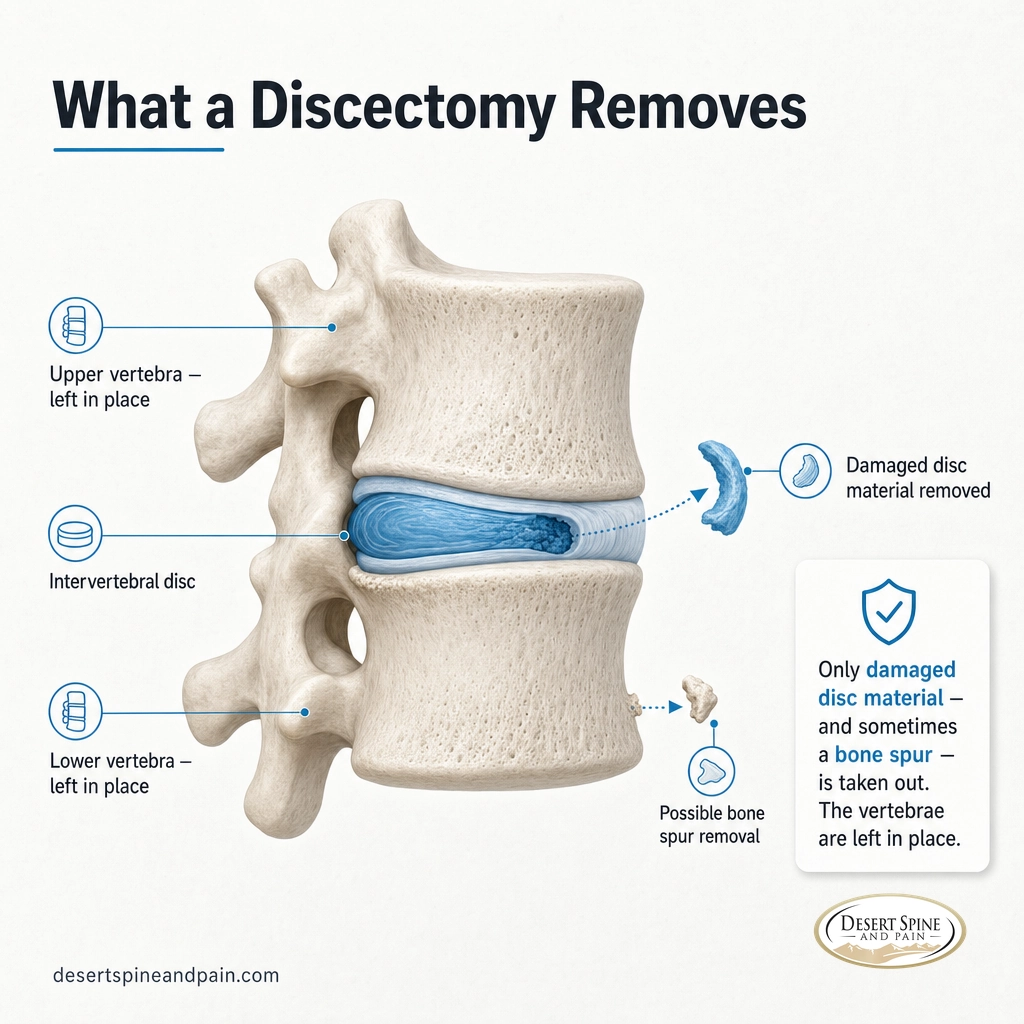
The strength of a discectomy is that it is targeted. It solves disc-based compression with the least disruption to the surrounding spine, and in the lumbar form it often preserves motion entirely. Its honest limits are just as clear: a discectomy can only relieve pressure that comes from a disc. If the problem is a collapsed or fractured vertebra, a tumor in the bone, or compression that sits directly behind the body of a vertebra, a discectomy cannot reach it. It also does not address compression that spans several levels of thick bone spurs behind the vertebrae.
Source: American Academy of Orthopaedic Surgeons: Microdiscectomy | Columbia Neurosurgery: anterior cervical procedures
Understanding Corpectomy
A corpectomy removes the vertebral body, the solid, drum-shaped block of bone at the front of a vertebra, along with the discs directly above and below it. The word itself means removal of the body. By taking out that block of bone and its neighboring discs in one step, a corpectomy clears pressure that sits behind the vertebra, which is exactly the zone a disc-only operation cannot get to. As Columbia Neurosurgery describes it, the discs, bone spurs, and vertebrae are removed to decompress the spinal cord and nerves.
Because removing a vertebral body leaves a sizable gap in the spinal column, a corpectomy is not finished when the bone comes out. The surgeon rebuilds the front of the spine, placing a strut graft (a piece of bone) or a titanium, ceramic, or synthetic cage into the space, then securing it with a plate and screws so the vertebrae above and below can fuse into one solid unit. This reconstruction and fusion is a defining feature of the operation, not an optional add-on.
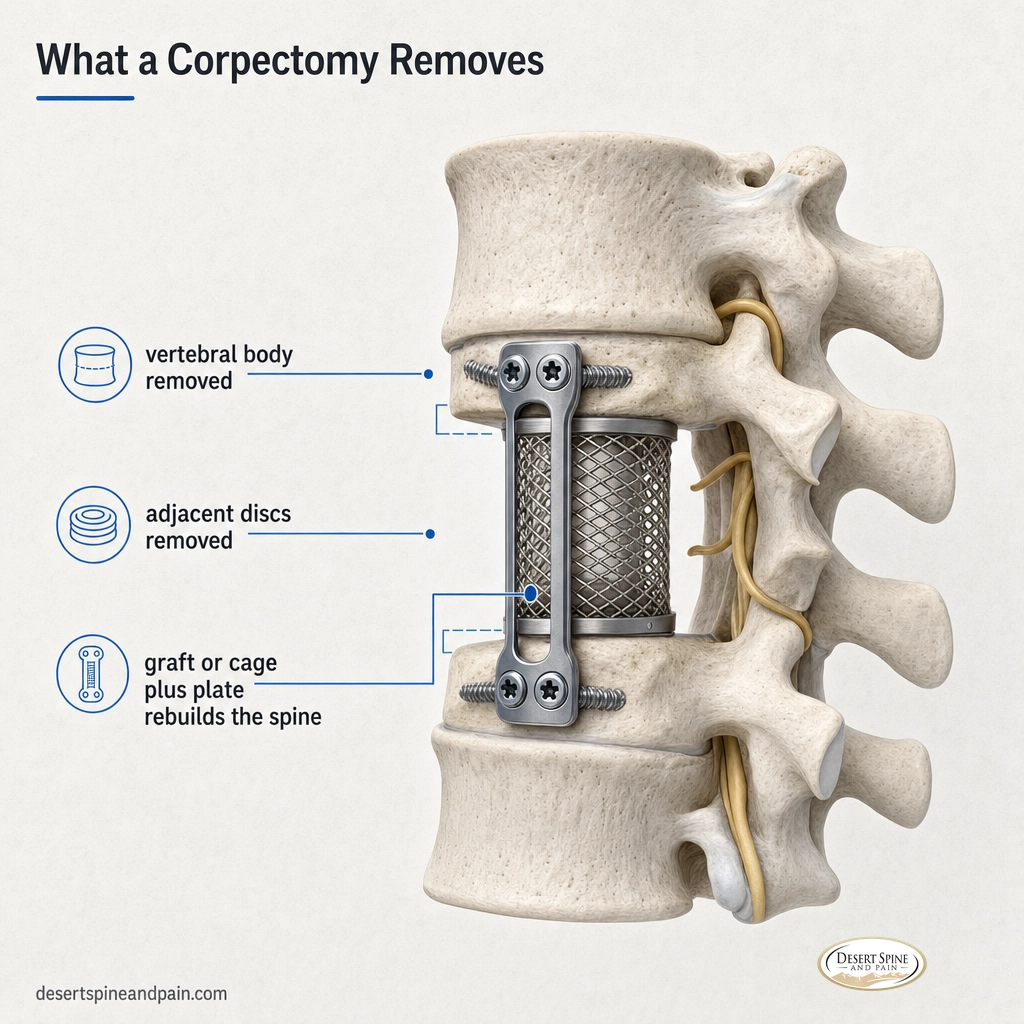
The strength of a corpectomy is reach. It decompresses the spinal cord across a vertebra and multiple disc levels at once and rebuilds a spine weakened by fracture, tumor, infection, or deformity. Its trade-off is scale: it is a more extensive procedure than a discectomy, with more blood loss, a longer operation, and a recovery built around a healing fusion. Surgeons weigh that scale carefully, which is why the decision is driven by the imaging rather than by habit.
Source: Columbia University Department of Neurological Surgery: Anterior Cervical Corpectomy
How Much Is Removed
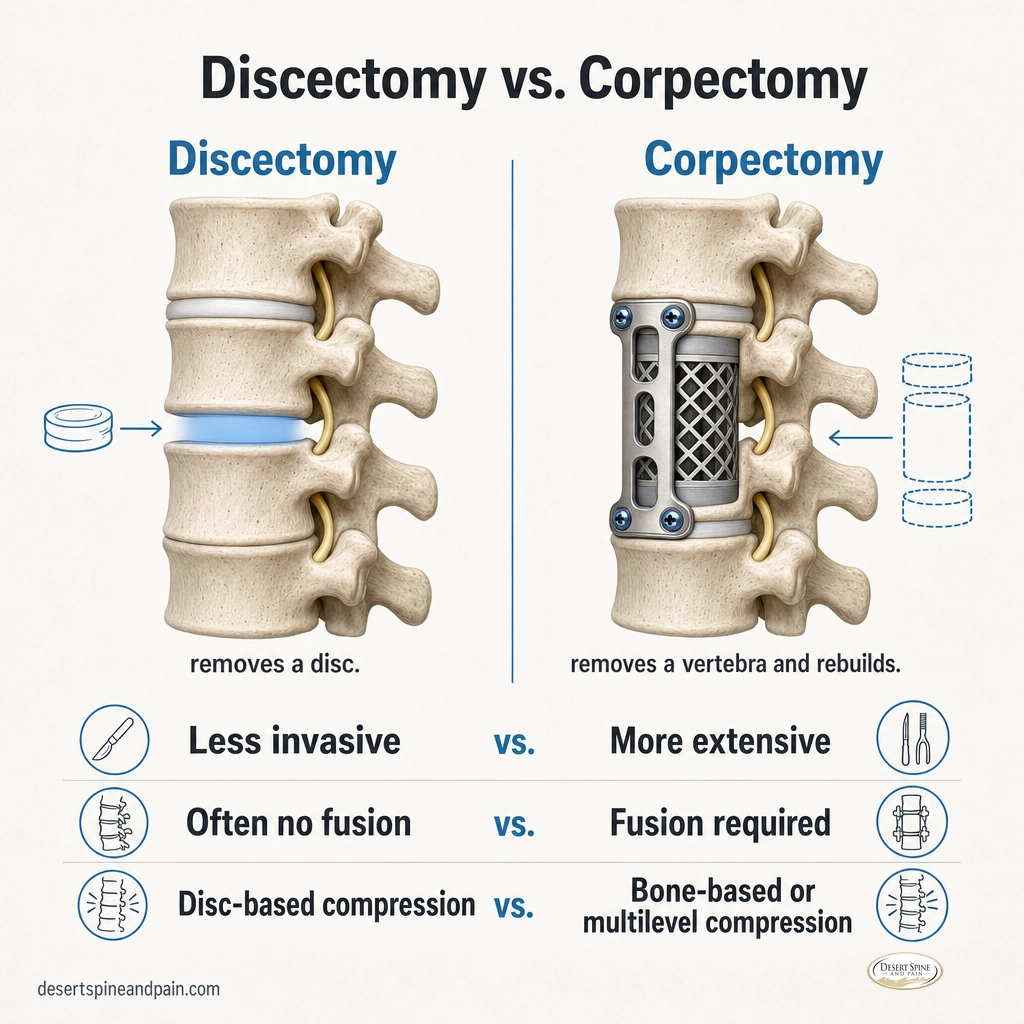
The single clearest way to tell these operations apart is to look at what leaves the body. A discectomy removes soft tissue, the disc, and sometimes small bone spurs. A corpectomy removes a structural piece of the skeleton, a whole vertebra, plus the two discs attached to it. That difference in what is removed drives almost everything else: how long the surgery takes, how much is reconstructed, and how the spine heals afterward.
Put another way, a discectomy is a subtraction from the cushioning between bones, while a corpectomy is a subtraction from the bones themselves. A corpectomy almost always includes at least one discectomy as part of the exposure, since the discs on either side come out to free the vertebral body. That is why it helps to think of a corpectomy as a discectomy that also removes the bone in between, rather than as a separate, unrelated operation.
That gap is also why fusion is nearly always required after a corpectomy, to bridge the space the removed vertebra leaves behind, while a lumbar microdiscectomy often needs no fusion at all.
Winner, scope of surgery: This is not a contest so much as a definition. If the goal is to remove the least tissue necessary, the discectomy wins by design. If the goal is to clear compression that a disc removal physically cannot reach, only the corpectomy does the job. Each wins at exactly the task it was built for.
Source: Columbia Neurosurgery: Anterior Cervical Corpectomy | AAOS OrthoInfo: Microdiscectomy
Invasiveness, Blood Loss, and Recovery
Removing bone is a bigger undertaking than removing a disc, and the clinical data reflect that. In a comparison of patients who had a two-level cervical corpectomy against patients who had a three-level ACDF (discectomy and fusion), the corpectomy group lost more than twice as much blood during surgery. Both operations treated a similar span of the neck, so the difference came from taking out the vertebral bodies rather than working only within the disc spaces.
Average surgical blood loss: corpectomy vs. discectomy approach
Mean intraoperative blood loss for a two-level cervical corpectomy versus a three-level anterior cervical discectomy and fusion. Source: Lau et al., Congress of Neurological Surgeons (2014).Recovery follows the same pattern. A lumbar microdiscectomy is frequently an outpatient procedure, with many patients home the same day and easing back into light activity within a couple of weeks. A cervical corpectomy usually means an overnight hospital stay, a cervical collar worn for several weeks, and an early recovery of roughly six to eight weeks, with the bone fusion continuing to solidify for months after that. Neither timeline is a promise, since the number of levels, the reason for surgery, and your general health all shift it, but the direction is consistent: the corpectomy asks more of the body on the way out.
Bigger does not mean better, and smaller does not mean safer. It is tempting to assume the less invasive discectomy is always the wiser choice, or that the more thorough corpectomy must be more effective. Neither is true. A discectomy done where a corpectomy was needed leaves the real compression untreated, and a corpectomy done where a discectomy would have worked removes healthy bone for no reason. The right operation is the smallest one that actually reaches the problem, no smaller and no larger.
Source: Lau, Chou, Mummaneni, Congress of Neurological Surgeons 2014 Annual Meeting | Columbia Neurosurgery recovery guidance
When Each One Is the Right Choice
The decision almost always comes down to one question: where is the pressure coming from? A discectomy is the right choice when the compression is clearly disc-based and sits within one or two disc spaces. A corpectomy becomes the right choice when the compression comes from, or sits behind, the vertebral body itself, or when it spans a length of spine that disc removal cannot fully open.
Situations that point to a discectomy
- A herniated disc pinching a single nerve root, causing sciatica or arm pain, when non-surgical care has not worked.
- Disc-based compression at one or two levels in the neck, treatable with an ACDF.
- A contained problem where the vertebral bodies are healthy and well aligned.
Situations that point to a corpectomy
- A burst or compression fracture that has damaged the vertebral body and is pressing bone fragments toward the spinal cord.
- A tumor or infection involving the vertebral body that must be removed along with the bone.
- Multilevel cervical stenosis or bone spurs sitting behind the vertebral body, where the spinal cord is squeezed over a span the discs alone do not explain.
- Compression caused by the bone and ligament behind the vertebra rather than by the disc in front of it.
Often the two are not even either-or. A surgeon may be able to treat a multilevel problem with a series of discectomies in one patient and need a corpectomy in another with the same symptoms, because their imaging shows the pressure in a different place. This is also why a careful reading of the MRI and CT, by a surgeon who does both operations, is worth more than any general rule. At Desert Spine and Pain, that evaluation always aims for the least invasive operation that genuinely solves the problem.
Winner, matching the operation to the cause: For disc-based, one-to-two-level compression, the discectomy is the better-matched and less invasive answer. For bone-based, fracture, tumor, or multilevel compression behind the vertebra, the corpectomy is the only one that reaches it. The winner is whichever one matches your imaging.
Source: Columbia Neurosurgery: indications for corpectomy | AAOS OrthoInfo: indications for microdiscectomy

Outcomes and Success Rates
Both operations have a strong track record when they are used for the right problem. The goal of each is to take pressure off the nerves or spinal cord and relieve the pain, numbness, or weakness that pressure causes, and most patients who are well selected for surgery get meaningful relief.
For a lumbar microdiscectomy, which treats leg pain from a herniated disc, published series commonly report good or excellent results in the range of roughly 85 to 90 percent of patients. One comparative analysis found a success rate of about 87 percent for microdiscectomy specifically.
For a cervical discectomy with fusion (ACDF), prospective studies have reported patient-rated success in the range of about 85 to 95 percent, with one cohort finding neck pain and radiating arm pain each improved in roughly 88 to 90 percent of patients. Corpectomy outcomes, when compared against discectomy for a similar span of disease, land in a similar place. In the two-level corpectomy versus three-level ACDF comparison noted above, follow-up neck pain scores, neurologic function, spinal alignment, and adjacent-level disease were similar between the groups, the main differences being the corpectomy's greater blood loss and a modestly higher complication rate that was not statistically significant.
The practical takeaway is that success is driven far more by choosing the correct operation, and by the surgeon's experience, than by which of the two names is on the consent form. A technically excellent discectomy still fails if the real compression was behind the bone, and a corpectomy adds risk it did not need to if a discectomy would have done the job. Matching the operation to the cause is the single biggest lever on the result.
Source: Comparative analysis of lumbar microdiscectomy and open discectomy, PMC (2025) | Anterior cervical discectomy and fusion outcome study, PMC (2016) | Lau et al., CNS 2014
Corpectomy vs. Discectomy at a Glance
| Feature | Discectomy | Corpectomy | Better for |
|---|---|---|---|
| What is removed | A damaged disc (and sometimes bone spurs) | A whole vertebral body plus the discs above and below it | Depends on source |
| Main target | Disc-based compression on a nerve | Compression from or behind the vertebral body | Depends on imaging |
| Invasiveness | Smaller; lumbar form is minimally invasive | More extensive; more blood loss, longer surgery | Discectomy |
| Fusion required | Often not for lumbar microdiscectomy; yes for neck ACDF | Nearly always, with a strut graft or cage | Discectomy |
| Typical recovery | Often outpatient (lumbar); light activity in weeks | Overnight stay, collar, roughly 6 to 8 weeks early recovery | Discectomy |
| Reaches bone and multilevel disease | No; limited to disc spaces | Yes; clears the vertebra and adjacent levels | Corpectomy |
| Used for fracture, tumor, infection | Rarely sufficient on its own | Yes; a primary reason it exists | Corpectomy |
| Symptom relief when well matched | Roughly 85 to 90 percent in reported series | Comparable to discectomy for similar disease | Comparable |
Source: Columbia Neurosurgery | AAOS OrthoInfo | Lau et al., CNS 2014
Who a Discectomy Is For
A discectomy tends to be the right operation for people whose problem is clearly a disc, and whose vertebrae themselves are healthy. You are more likely to be a discectomy candidate if:
- You have leg pain, sciatica, or arm pain from a herniated disc confirmed on an MRI, and the pain matches the nerve the disc is pressing on.
- Your symptoms have not improved after a reasonable course of non-surgical spine care, such as therapy, activity changes, and injections.
- The compression sits at one or two disc levels, not across a long span of spine.
- Your vertebral bodies are structurally sound, with no fracture, tumor, or significant collapse.
- You want the least invasive operation that can solve the problem and, in the lumbar spine, ideally one that preserves motion without fusion.
Source: AAOS OrthoInfo: Microdiscectomy candidates
Who a Corpectomy Is For
A corpectomy is the right operation for people whose compression cannot be relieved by removing discs alone, because the bone itself is the problem or is in the way. You are more likely to need a corpectomy if:
- A fracture has broken a vertebral body and pushed bone fragments toward the spinal cord.
- A tumor or infection involves the vertebral body and must be removed along with the bone.
- You have multilevel cervical stenosis or large bone spurs sitting directly behind the vertebral bodies, compressing the spinal cord over a span that disc removal does not fully open.
- Your spine needs structural rebuilding, and a fusion with a graft or cage is the way to restore stable alignment.
- You have signs of spinal cord compression, called myelopathy, from a source behind the vertebral body, such as new clumsiness, balance trouble, or hand weakness.
Source: Columbia Neurosurgery: corpectomy indications
The Bottom Line
Corpectomy and discectomy are not competing products to pick between. They are two different-sized tools for two different problems. A discectomy removes a disc and is the targeted, less invasive answer when a disc is pressing on a nerve. A corpectomy removes a vertebra and rebuilds the spine, and it is the necessary answer when the pressure comes from the bone, from a fracture or tumor, or from disease that spans multiple levels behind the vertebral body. When they are both reasonable options for a multilevel neck problem, their results are broadly similar, and the surgeon chooses the one that best fits your anatomy with the least unnecessary disruption.
Because the stakes are real and the right answer depends entirely on your imaging, this is a decision worth getting a careful, unhurried second opinion on before you proceed. Desert Spine and Pain is a Phoenix, Arizona practice led by Dr. David L. Greenwald, MD, FAANS, FACS, a surgeon who is both a spine surgeon and a neurosurgeon and who performs both discectomy and corpectomy procedures. Every evaluation starts by confirming where the compression truly comes from, then recommending the smallest operation that genuinely solves it.
Explore spine surgery options at Desert Spine and Pain
See non-surgical spine care first
Book a consultation or second opinion
Common Questions About Corpectomy and Discectomy
What is the difference between a corpectomy and a discectomy?
Is a corpectomy more serious than a discectomy?
Does a discectomy or corpectomy require fusion?
How long is recovery after a corpectomy compared with a discectomy?
Can a discectomy be done instead of a corpectomy?
Sources
Sources and Methodology
This guide summarizes established clinical references and peer-reviewed comparisons of corpectomy and discectomy procedures. Success rates and surgical figures are drawn from published studies and are presented as general reference, not individual predictions, and study sizes and definitions of success vary. It is educational information, not medical advice. Decisions about diagnosis and surgery should be made with a qualified spine specialist after an in-person evaluation and review of your imaging.
- Columbia University Department of Neurological Surgery: Anterior Cervical Corpectomy
- American Academy of Orthopaedic Surgeons, OrthoInfo: Microdiscectomy
- Lau, Chou, Mummaneni: Two-Level Corpectomy vs. Three-Level ACDF, Congress of Neurological Surgeons 2014 Annual Meeting
- Comparative Analysis of Success Rates and Complications Between Lumbar Microdiscectomy and Open Discectomy, PMC (2025)
- An Outcome Study of Anterior Cervical Discectomy and Fusion, PMC (2016)