

Kyphoplasty vs. Vertebroplasty: What's the Difference?
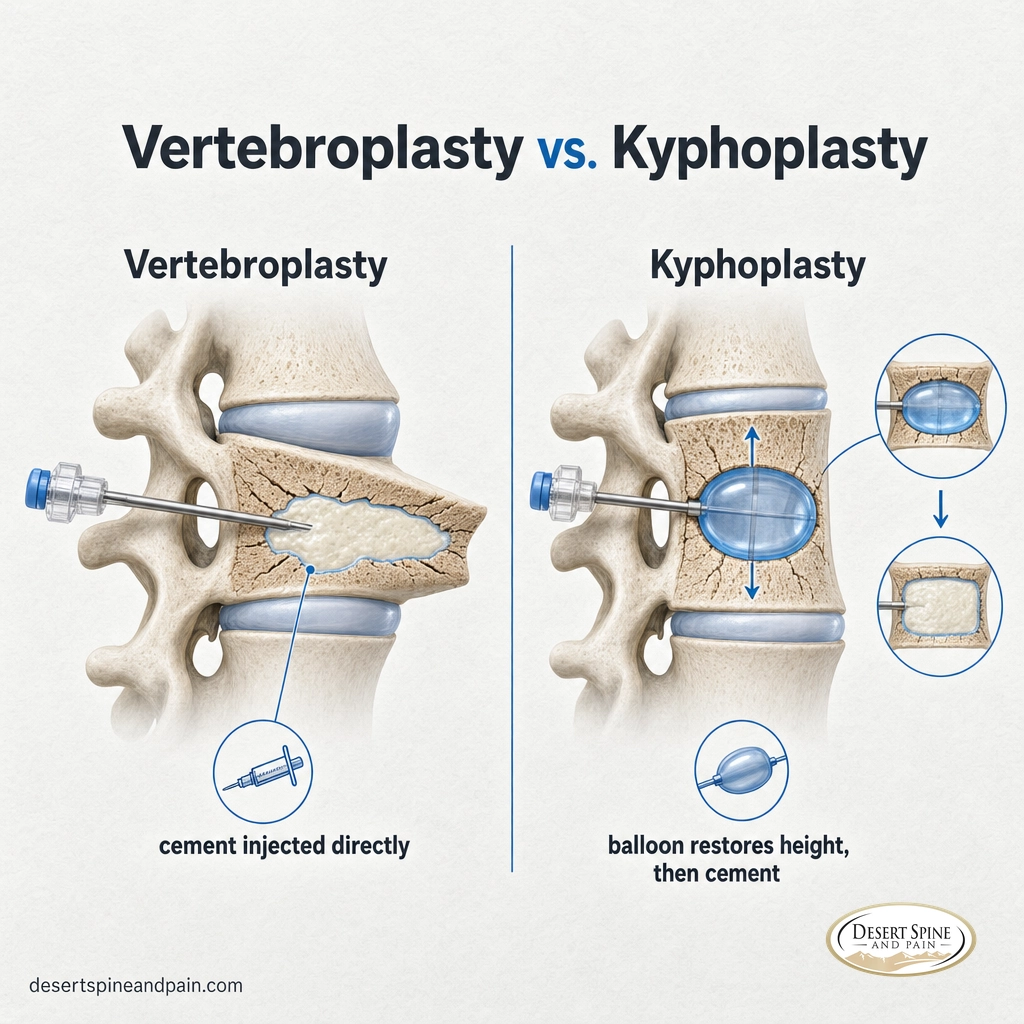
Kyphoplasty and vertebroplasty are two minimally invasive procedures that treat the same problem: a painful vertebral compression fracture, usually caused by osteoporosis. Both work by injecting medical bone cement into the broken vertebra through a needle, which hardens in minutes and stops the painful micro-motion of the fracture. The difference comes down to a single extra step. Kyphoplasty inflates a small balloon inside the vertebra first, to carve out a cavity and lift the collapsed bone back toward its original height, then fills that space with cement. Vertebroplasty skips the balloon and injects the cement directly. That one distinction shapes everything else that follows, including which fractures each suits best, what the cement does, and the small differences in risk. This guide explains how each procedure works, what the research actually shows, and how a spine surgeon chooses between them.
Quick definition. Vertebroplasty is a procedure that stabilizes a fractured vertebra by injecting bone cement directly into it through a needle. Kyphoplasty (balloon kyphoplasty) does the same but first inflates a balloon inside the bone to create a cavity and partially restore lost height before the cement goes in. Both are percutaneous, meaning they are done through a tiny skin puncture, not an open incision.
- Same goal, one difference. Both inject bone cement to stabilize a vertebral compression fracture and relieve pain. Kyphoplasty adds a balloon step first; vertebroplasty does not.
- Pain relief is comparable. Pooled research finds no meaningful difference in pain or disability scores between the two procedures.
- Kyphoplasty restores more structure. It tends to regain more vertebral height and correct the forward-bend (kyphotic) angle better, because the balloon lifts the collapsed bone before the cement locks it in place.
- Kyphoplasty leaks less cement. A large meta-analysis found roughly 38% lower odds of cement leakage with kyphoplasty, and most leaks of either kind cause no symptoms at all.
- Vertebroplasty is faster and simpler. With no balloon and no cavity to create, it is a quicker, lower-cost procedure.
- The choice is about the fracture, not the brand name. Fracture age, shape, and the amount of height loss decide which procedure fits, which is why an imaging-based evaluation by a spine specialist matters more than the label.

What's in This Guide
- Kyphoplasty vs. Vertebroplasty at a Glance
- The Problem Both Fix: Vertebral Compression Fractures
- What Is Vertebroplasty?
- What Is Kyphoplasty?
- The Core Difference: The Balloon
- Head-to-Head: How They Compare
- Kyphoplasty vs. Vertebroplasty: Full Comparison
- What the Research Actually Says
- Who Is a Candidate, and How a Surgeon Chooses
- The Verdict: Which Is Better?
- Common Questions
- Sources
Kyphoplasty vs. Vertebroplasty at a Glance
Vertebroplasty (Percutaneous Vertebroplasty)
- Injects bone cement directly into the fractured vertebra through a needle
- No balloon, no cavity: the cement fills the existing spaces in the broken bone
- Stabilizes the vertebra in its current shape; does not aim to restore height
- Faster and lower cost, with a slightly higher reported rate of cement leakage
- The original cement-stabilization procedure, in use since the 1980s
Kyphoplasty (Balloon Kyphoplasty)
- Inflates a small balloon inside the vertebra first to create a cavity
- The balloon lifts the collapsed bone, partially restoring height and reducing the forward wedge
- Cement is then placed into the controlled cavity at lower pressure
- Tends to restore more height and leak less cement, at the cost of an extra step and higher cost
- Developed later specifically to add height restoration and leak control
The Problem Both Fix: Vertebral Compression Fractures
To understand the two procedures, it helps to picture what they are repairing. A vertebral compression fracture happens when the front of a vertebra, the block-shaped bone that stacks to form the spine, collapses under load. In healthy bone this takes major trauma. In bone thinned by osteoporosis it can happen with something as small as a cough, a sneeze, a misstep, or lifting a grocery bag. The vertebra wedges forward into a slightly flattened shape, which can cause sudden, sharp back pain and, over time, a stooped posture.
These fractures are far more common than most people realize, and many are never diagnosed because the pain is mistaken for an ordinary backache.
Most compression fractures heal on their own with time, activity modification, pain control, and treatment of the underlying osteoporosis. Kyphoplasty and vertebroplasty are considered when the pain is severe and disabling, when it is not settling with conservative care, or when imaging shows a fresh, unhealed fracture driving the pain. They are not used for a fracture that is not causing symptoms. You can read more about the broader category of these injuries on the spinal conditions overview, and about non-surgical options on the conservative care page.
Source: American Family Physician: Vertebral Compression Fractures in the Elderly | Mayo Clinic: Osteoporosis
What Is Vertebroplasty?
Vertebroplasty was the first of the two procedures, introduced in the 1980s. It is elegantly simple. With the patient positioned face down and the area numbed, usually with light sedation, the physician uses live X-ray guidance (fluoroscopy) to pass a thin needle through a small puncture in the skin, through the pedicle (a bony bridge on the back of the vertebra), and into the fractured vertebral body. Medical-grade bone cement, polymethylmethacrylate or PMMA, is then injected directly into the broken bone, where it spreads through the cracks and spaces and hardens within minutes.
That hardened cement acts like an internal cast. It stops the tiny painful movements at the fracture and bears load so the fragile bone does not have to. Many patients feel relief quickly, often within a day. There is no balloon and no attempt to change the vertebra's shape. The goal is to stabilize the fracture where it sits. Because it is the simpler of the two, vertebroplasty is generally faster and less expensive. The tradeoff is that cement is injected at higher pressure into bone that has no prepared cavity, which is the main reason it carries a somewhat higher reported rate of cement escaping the vertebra. Desert Spine and Pain details the procedure on its vertebroplasty treatment page.
What Is Kyphoplasty?
Kyphoplasty, more precisely balloon kyphoplasty, starts exactly the same way: face down, numbed, a thin needle guided into the fractured vertebra under fluoroscopy. Then it adds the step that defines it. Before any cement goes in, a small balloon (called a bone tamp) is threaded through the needle into the vertebra and gently inflated. The inflating balloon does two things at once. It pushes the collapsed end plates apart, lifting the vertebra back toward its normal height and reducing the forward wedge angle, and it carves out a clean cavity in the soft fractured bone.
The balloon is then deflated and removed, leaving a hollow space. Cement is placed into that prepared cavity at lower pressure, where it fills the void and locks in the regained height as it hardens. The name captures the intent: kypho refers to kyphosis, the forward curve that a wedged vertebra creates, and the procedure is designed to counter it. The extra step means a slightly longer, more involved, and more costly procedure, but it buys two things vertebroplasty does not target: height restoration and a controlled, lower-pressure cement fill. The full procedure is described on the balloon kyphoplasty treatment page, and we cover it in depth in our full explainer on what kyphoplasty is.
Source: Journal of Orthopaedic Surgery and Research (2018) meta-analysis | Mayo Clinic: Osteoporosis and fragility fractures
The Core Difference: The Balloon
Strip away the terminology and the whole comparison comes down to one question: does the procedure try to put the vertebra back into shape before stabilizing it, or does it stabilize it as is? Kyphoplasty uses a balloon to recover height and make a cavity. Vertebroplasty does not. Everything else, including the differences in leakage, height, and cost, flows directly from that one choice.
The balloon matters most when a fracture is fresh and the collapse is recent, because newly broken bone can still be lifted. In an older fracture that has already begun to heal in a wedged position, the balloon has far less to work with, and the height advantage shrinks. This is a big reason the decision is driven by the specific fracture rather than a blanket rule. Lowering the pressure needed to place the cement, because it flows into an open cavity rather than being forced through intact fractured bone, is also what gives kyphoplasty its edge on containing cement.
Myth: "Kyphoplasty is just a newer, better vertebroplasty, so always pick kyphoplasty." That is not what the evidence shows. On the outcomes patients care about most, pain and the ability to function, the two perform about the same. Kyphoplasty wins on restoring structure and containing cement, which genuinely matters for some fractures, but it costs more and adds a step that is not always needed. The better procedure is the one that fits the fracture in front of the surgeon, not the one with the newer reputation.
Head-to-Head: How Kyphoplasty and Vertebroplasty Compare
When both procedures could technically treat the same osteoporotic compression fracture, these are the criteria that actually separate them. The strongest evidence comes from a 2018 systematic review and meta-analysis that pooled 16 studies comparing balloon kyphoplasty with percutaneous vertebroplasty.
Pain Relief and Function
This is the headline finding, and it surprises people: the two procedures relieve pain and restore function about equally. The 2018 meta-analysis found no significant difference in pain scores on the visual analog scale (VAS) or in disability on the Oswestry Disability Index (ODI) between the groups. In plain terms, a patient is not likely to hurt less or move better just because they had one procedure rather than the other.
Edge: Even. Pooled VAS pain scores (weighted mean difference 0.04) and ODI disability scores (weighted mean difference -1.30) showed no meaningful difference between kyphoplasty and vertebroplasty.
Height and Spinal Alignment
Here kyphoplasty pulls ahead by design. Because the balloon lifts the collapsed bone before the cement sets, kyphoplasty restored more vertebral body height and produced a greater reduction in the kyphotic wedge angle than vertebroplasty in the pooled data. For a patient with a fresh, significantly wedged fracture, that structural correction can matter for posture and for how load is shared across the spine, though whether it changes long-term outcomes is still debated.
Edge: Kyphoplasty for restoring vertebral height and correcting the forward wedge angle, especially in fresh fractures.
Cement Leakage
Cement leakage means some cement escapes the boundary of the vertebra during injection. It is the most-discussed difference between the procedures. Because kyphoplasty places cement into a prepared cavity at lower pressure, it leaks less often. The 2018 meta-analysis found kyphoplasty carried roughly 38% lower odds of leakage.
The important context: the large majority of cement leaks cause no symptoms at all. Most are tiny, found only on imaging, and never noticed by the patient. Serious problems from leakage, such as cement pressing on a nerve or traveling to the lungs, are rare. A single-center study of 896 kyphoplasty patients put the point in numbers.
Bone cement displacement after kyphoplasty (896 patients)
Most cement displacement caused no symptoms. Source: single-center study of 896 kyphoplasty patients (PMC, 2022).Edge: Kyphoplasty for a lower rate of cement leakage, with the caveat that most leaks of either procedure are harmless.
Source: Journal of Orthopaedic Surgery and Research (2018) meta-analysis | Incidence of symptomatic bone cement displacement after kyphoplasty, single-center study of 896 patients (PMC)
Speed, Complexity, and Cost
Vertebroplasty has fewer moving parts. No balloon, no cavity creation, fewer instruments, and usually a shorter procedure, which generally translates to lower cost. Kyphoplasty's extra step adds time and expense, and the balloon and related hardware are not free. For a patient or payer weighing value, vertebroplasty is the leaner option when height restoration is not the goal.
Edge: Vertebroplasty for a faster, simpler, lower-cost procedure.
Recovery
Recovery is similar for both. Each is minimally invasive and typically done as an outpatient through a needle puncture rather than an incision, so there is no surgical wound to heal. Many patients experience significant pain relief within the first day or two and go home the same day, then return to normal activity over the following days to weeks as guided by their physician. Both are, in the broader picture, part of a minimally invasive approach to spine care.
Edge: Even. Both are outpatient, needle-based procedures with fast, comparable recovery.
Kyphoplasty vs. Vertebroplasty: Full Comparison
| Criterion | Vertebroplasty | Kyphoplasty | Typical edge |
|---|---|---|---|
| Core technique | Cement injected directly into the fracture | Balloon inflated first, then cement into the cavity | Depends on the fracture |
| Height restoration | Not a goal; stabilizes as is | Designed to regain height and reduce wedge | Kyphoplasty |
| Pain relief & function | Significant relief for the right fracture | Significant relief for the right fracture | Even |
| Cement leakage | Higher reported rate (higher pressure) | Lower rate (RR 0.62 vs. vertebroplasty) | Kyphoplasty |
| Spinal alignment | Less wedge correction | Greater reduction in kyphotic angle | Kyphoplasty |
| Procedure time & cost | Shorter, lower cost | Longer, higher cost (extra step and hardware) | Vertebroplasty |
| Recovery | Outpatient, fast | Outpatient, fast | Even |
| Best suited for | Stabilizing a painful fracture when height loss is minor or fixed | Fresh, significantly wedged fractures where height can be recovered | Problem-specific |

What the Research Actually Says
An honest comparison has to address a real controversy in this field, because patients researching these procedures will run into it. Cement augmentation for compression fractures has been studied hard, and the results have been genuinely mixed, which is why guidance has shifted over the years.
In 2009, two influential masked, placebo-controlled trials published in the New England Journal of Medicine (Buchbinder and colleagues, and the INVEST trial by Kallmes and colleagues) found that vertebroplasty was no more effective than a sham procedure for pain. Those results prompted real caution about whether the cement itself was doing the work.
Later trials that enrolled patients differently told a different story. The VAPOUR trial, published in The Lancet in 2016, studied patients with acute fractures of less than six weeks and severe pain, used a truer placebo, and found vertebroplasty did outperform the sham procedure. Other trials, such as VERTOS IV, again found no significant advantage over sham. The through-line most experts draw is that patient selection is everything: these procedures appear to help most when the fracture is fresh, confirmed on MRI, and causing severe pain, and help least when it is older or only mildly symptomatic.
What this means for a patient. The debate is largely about who benefits, not about which of the two procedures to use. When a fracture genuinely calls for cement augmentation, the kyphoplasty-versus-vertebroplasty decision is a secondary, technical one. The first and more important question is whether the fracture should be treated with cement at all, which is exactly the judgment a spine specialist makes from your symptoms, timeline, and imaging.
Source: Buchbinder et al., randomized trial of vertebroplasty, NEJM (2009) | Kallmes et al., INVEST trial, NEJM (2009) | Clark et al., VAPOUR trial, The Lancet (2016)
Who Is a Candidate, and How a Surgeon Chooses
Neither procedure is a first move. Most compression fractures are given a chance to heal with conservative care first. Cement augmentation enters the conversation when specific conditions line up.
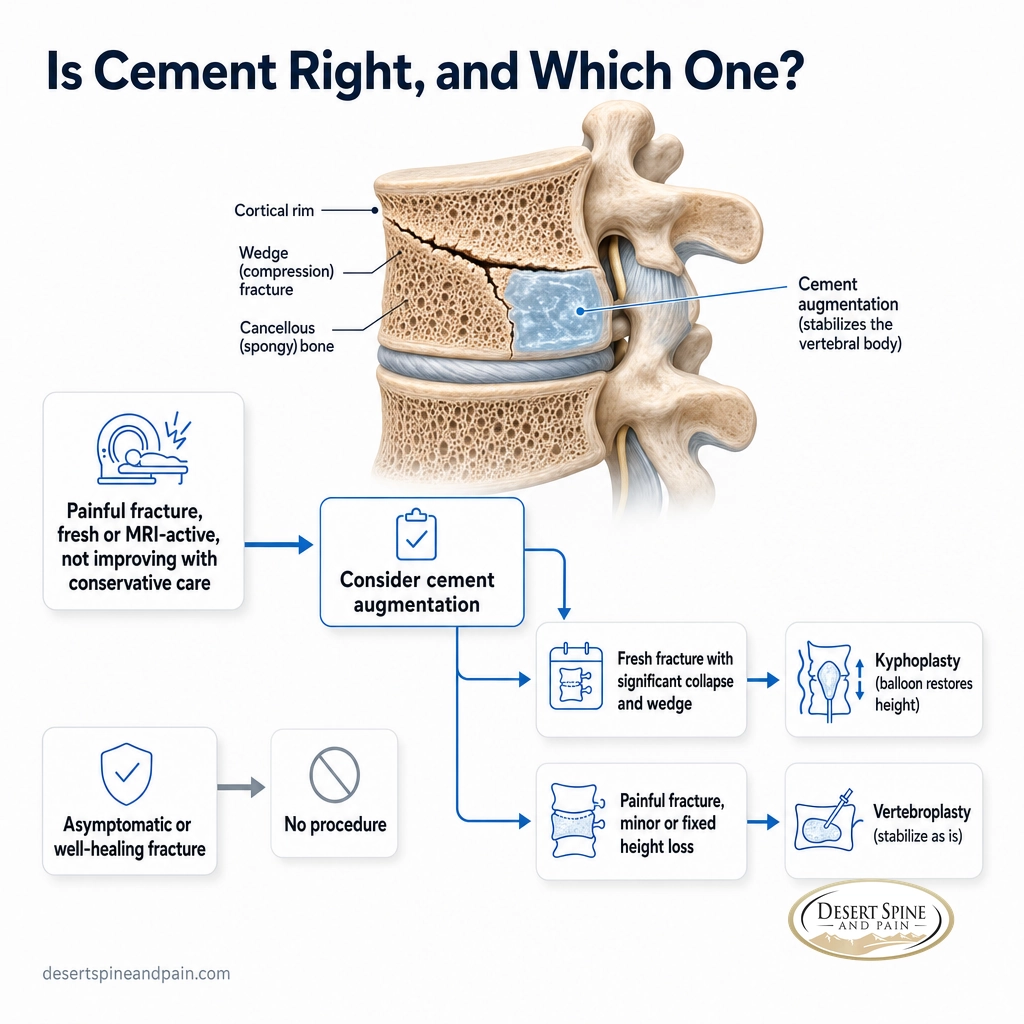
You are more likely to be a candidate for either procedure if:
- You have a painful vertebral compression fracture confirmed on imaging, ideally a fresh or unhealed fracture shown active on MRI.
- The pain is severe and disabling, and it has not improved with a reasonable course of conservative care (rest, activity modification, pain medication, bracing).
- The fracture is from osteoporosis, a benign lesion, or certain spinal tumors rather than a stable, painless old fracture.
- You do not have an active infection, a bleeding disorder, or an asymptomatic fracture, each of which is a reason not to proceed.
Once augmentation is the plan, the choice between the two is a technical, fracture-specific judgment:
- Kyphoplasty is favored when the fracture is fresh and significantly wedged, so recovering height and correcting the forward angle is worthwhile, or when minimizing cement leakage is a particular priority.
- Vertebroplasty is reasonable when the goal is only to stabilize a painful fracture, height loss is minor or already fixed, and a faster, lower-cost procedure is preferred.
This is a decision best made by a surgeon who performs both and who starts with the least invasive effective option. You can compare a related operation in kyphoplasty versus corpectomy, a far larger reconstruction reserved for very different fractures.
Explore vertebral compression fracture repair
Source: American Family Physician: Vertebral Compression Fractures in the Elderly | Journal of Orthopaedic Surgery and Research (2018) meta-analysis
The Verdict: Which Is Better?
There is no single winner, and any article that crowns one is oversimplifying. For the outcomes that matter most to patients, pain relief and getting back to normal life, the two procedures perform about the same. Where they differ is structure and safety margin: kyphoplasty restores more height, corrects the wedge angle better, and leaks less cement, which genuinely counts for a fresh, significantly collapsed fracture. Vertebroplasty answers back with speed, simplicity, and lower cost when the aim is purely to stabilize a painful break.
The real decision is made at the MRI, by matching the procedure to the specific fracture and, before that, by confirming the fracture should be treated with cement at all. That is a judgment best made by a spine specialist who performs both, who treats surgery as a last resort rather than a first option, and who will tell you honestly when watchful waiting is the smarter path.
Desert Spine and Pain is a Phoenix, Arizona practice led by Dr. David L. Greenwald, MD, FACS, a board-certified surgeon who is both a spine surgeon and a neurosurgeon. Patients travel from across the Greater Phoenix area and beyond for this level of care, and every plan starts with a careful look at whether a procedure is needed at all.
Book a consultation or second opinion
Common Questions About Kyphoplasty and Vertebroplasty
What is the main difference between kyphoplasty and vertebroplasty?
Is kyphoplasty better than vertebroplasty?
Does kyphoplasty or vertebroplasty restore height to a collapsed vertebra?
How long does recovery take after kyphoplasty or vertebroplasty?
Are kyphoplasty and vertebroplasty safe? What are the risks?
Sources and Methodology
Sources and Methodology
This guide summarizes established clinical references and peer-reviewed research on balloon kyphoplasty and percutaneous vertebroplasty for vertebral compression fractures. Comparative figures for pain, disability, height restoration, and cement leakage are drawn from a 2018 systematic review and meta-analysis pooling 16 studies, and are presented as general reference, not individual predictions. The evidence on whether cement augmentation outperforms placebo is genuinely mixed and is summarized honestly above. This is educational information, not medical advice. Decisions about diagnosis and treatment should be made with a qualified spine specialist after an in-person evaluation and review of your imaging.
- Wang H, et al. (2018): Balloon kyphoplasty versus percutaneous vertebroplasty for osteoporotic vertebral compression fracture: a meta-analysis and systematic review. Journal of Orthopaedic Surgery and Research 13:264
- Single-center study of symptomatic and asymptomatic bone cement displacement after percutaneous kyphoplasty in 896 patients (PMC)
- Buchbinder R, et al. (2009): A randomized trial of vertebroplasty for painful osteoporotic vertebral fractures. New England Journal of Medicine 361:557-568
- Kallmes DF, et al. (2009): A randomized trial of vertebroplasty for osteoporotic spinal fractures (INVEST). New England Journal of Medicine 361:569-579
- Clark W, et al. (2016): Safety and efficacy of vertebroplasty for acute painful osteoporotic fractures (VAPOUR): a multicentre, randomised, double-blind, placebo-controlled trial. The Lancet 388:1408-1416
- Old JL, Calvert M (2004): Vertebral Compression Fractures in the Elderly. American Family Physician 69(1):111-116
- Mayo Clinic: Osteoporosis