

What Does ACDF Mean? Anterior Cervical Discectomy and Fusion Explained
ACDF stands for anterior cervical discectomy and fusion, a neck surgery in which a surgeon removes a damaged cervical disc through the front of the neck to relieve pressure on a pinched nerve or the spinal cord, then fuses the two neighboring vertebrae into one solid, stable segment. It is one of the most common and well-studied spine operations, and understanding what each word means makes the whole procedure far less intimidating. This guide breaks the term down piece by piece, then walks through how ACDF works, what it treats, how it compares to a cervical disc replacement, and what recovery really looks like.
- ACDF means anterior (front of the neck), cervical (the neck spine), discectomy (removing the disc), and fusion (joining two vertebrae into one bone).
- The surgeon works through a small incision at the front of the neck, removes the worn or herniated disc pressing on a nerve, fills the gap with a spacer, and secures it with a small plate and screws while the bone fuses.
- It treats neck and arm problems like a herniated cervical disc, pinched nerve (radiculopathy), spinal cord pressure (myelopathy), and cervical stenosis when non-surgical care has not worked.
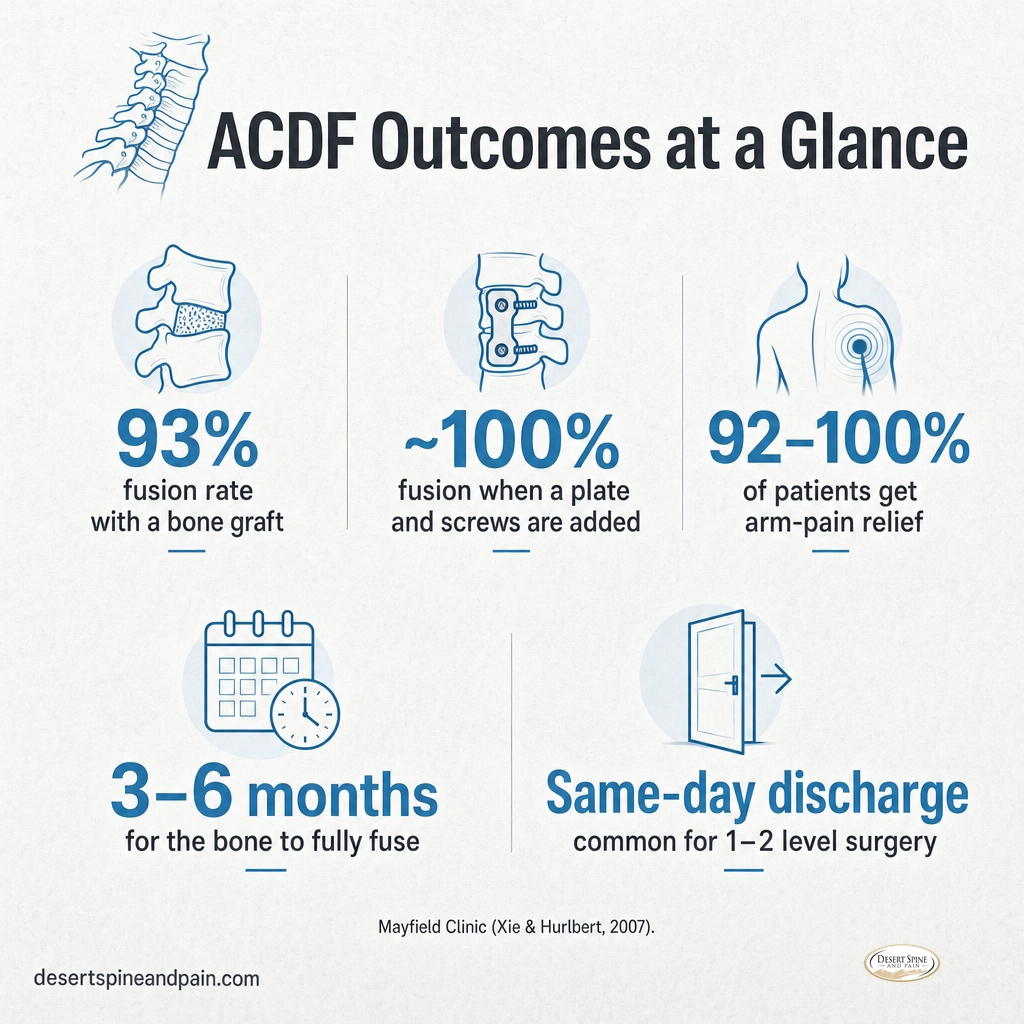
- Fusion succeeds in about 93% of cases with a bone graft, and close to 100% when a plate is added, with arm-pain relief reported in 92% to 100% of patients.
- The main alternative is a motion-preserving cervical disc replacement, which keeps the segment moving instead of fusing it. The right choice depends on your anatomy, not on which name sounds better.

What's in This Guide
What ACDF Stands For, Word by Word
Medical abbreviations are easier to trust once you can read them. ACDF is just four descriptive words stacked together, and each one tells you something concrete about the operation.
A is for Anterior. The surgeon reaches the spine from the front of your neck, not the back. Working from the front means gently moving the windpipe, food pipe, and muscles aside rather than cutting through the thick muscles at the back of the neck, which is one reason the approach is well tolerated.
C is for Cervical. The cervical spine is the neck, the top seven vertebrae (labeled C1 through C7). ACDF treats problems in this region, most often at the lower levels (C5-C6 and C6-C7) where wear and tear is most common.
D is for Discectomy. A discectomy is the removal of a spinal disc, the soft cushion that sits between two vertebrae. When that disc herniates or dries out and collapses, it can press on a nerve root or the spinal cord. Taking it out removes the source of the pressure.
F is for Fusion. Once the disc is gone, the empty space is filled and the two vertebrae are encouraged to grow together into a single solid bone. That is the fusion. It restores height, stabilizes the segment, and prevents the bones from grinding together.
Put plainly, an ACDF is a front-of-the-neck operation that takes out a problem disc and then joins the bones above and below it. Everything else about the procedure, from the hardware used to the recovery timeline, follows from those four ideas. You can see how it fits into the broader menu of neck operations on the ACDF procedure page.
Source: Mayfield Clinic: Anterior cervical discectomy and fusion (ACDF) | Mayo Clinic: Cervical spondylosis
How ACDF Works, Step by Step
An ACDF usually takes one to three hours and follows the same logical sequence every time. Picture building a stable bridge where a worn-out span used to be.
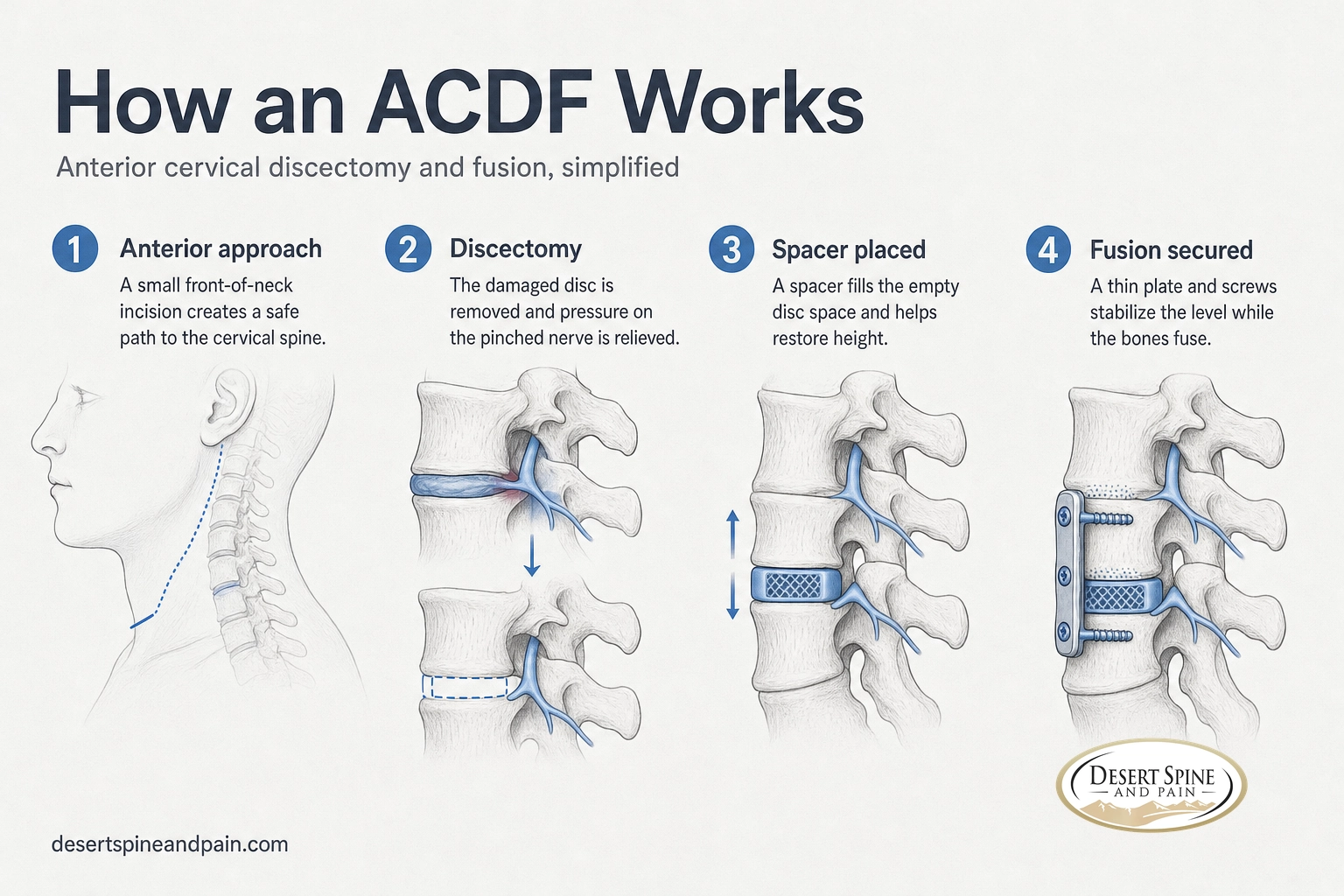
- Reaching the spine. Under general anesthesia, the surgeon makes a small incision, often around two inches, on one side of the front of the neck. The soft tissues are gently moved aside to expose the front of the cervical spine. Live X-ray (fluoroscopy) confirms the exact level before anything is removed.
- Removing the disc (the discectomy). The damaged disc is taken out, and any bone spurs or disc fragments pressing on a nerve root or the spinal cord are cleared away. This is the decompression step, the part that actually relieves the pinched nerve.
- Filling the gap. The empty disc space is filled with a spacer that restores the normal height between the vertebrae. This is usually a small cage or a block of bone graft, sometimes using your own bone, donor bone, or a synthetic substitute.
- Securing the fusion. A thin metal plate and screws are often fixed to the front of the vertebrae to hold everything steady while the bones grow together. Over the following months, the two vertebrae fuse into one solid unit.
The plate is not what makes the segment permanently stable. It is a temporary scaffold that holds the alignment while your own bone bridges the gap. Many ACDFs are candidates for minimally invasive techniques that use smaller openings and spare more of the surrounding tissue.
Source: Mayfield Clinic: ACDF procedure steps
What Conditions ACDF Treats
ACDF is almost always considered only after non-surgical options, such as physical therapy, medication, or conservative spine care, have failed to relieve the problem. When surgery is on the table, these are the issues it most often addresses:
- Herniated cervical disc. When the soft center of a disc pushes out and presses on a nerve root, it can cause pain, numbness, or weakness running into the shoulder, arm, or hand. Removing the disc removes the pressure.
- Cervical radiculopathy (a pinched nerve). This is the classic cause of arm pain that starts in the neck. ACDF is one of the most reliable ways to decompress the affected nerve root.
- Cervical myelopathy (spinal cord pressure). When the spinal cord itself is squeezed, it can cause clumsiness, balance trouble, or problems with fine hand movements. This is a more serious situation, and timely decompression matters.
- Degenerative disc disease and bone spurs. Age-related wear can collapse a disc and grow spurs that crowd the nerves. ACDF clears the spurs and restores height.
- Cervical stenosis at the disc level. When the space around the cord or nerves narrows at a disc, an ACDF can reopen it.
The common thread is a problem that lives at the disc space and can be reached from the front. If the pressure sits squarely behind a vertebral body instead, a different operation such as a corpectomy may be needed, a distinction covered in our guide to corpectomy versus ACDF. To understand the difference between a pinched nerve and cord compression, see cervical myelopathy versus radiculopathy.
Source: Mayo Clinic: Cervical spondylosis and myelopathy | American Association of Neurological Surgeons: patient conditions and treatments
ACDF vs. Cervical Disc Replacement
The term most often confused with ACDF is cervical disc replacement, also called cervical artificial disc replacement. Both start the same way, from the front of the neck, by removing the damaged disc. The difference is what happens next.
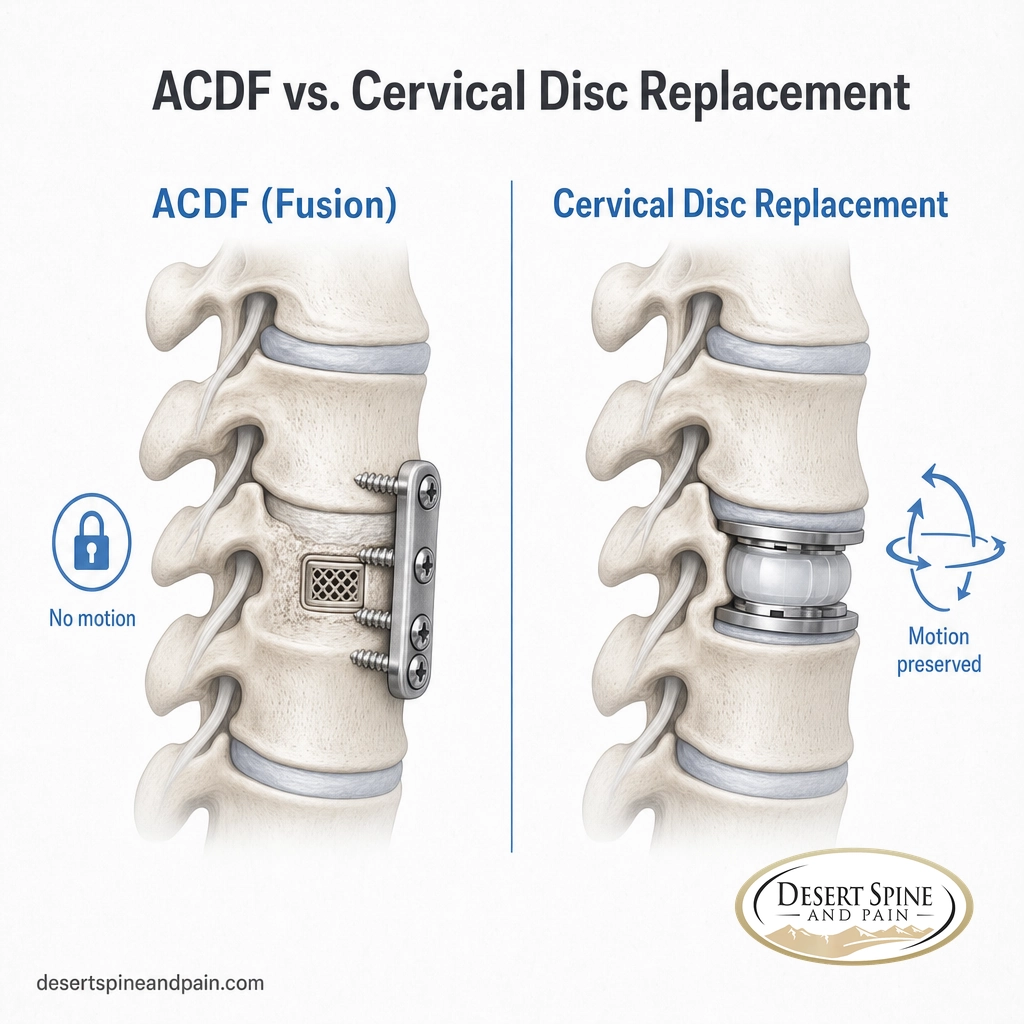
With an ACDF, the disc space is fused, so that one segment no longer moves. With a cervical disc replacement, an artificial disc is placed in the gap so the segment keeps bending and rotating. Preserving motion at one level is thought to put less long-term stress on the discs above and below it, though fusion remains the more proven, versatile option and is the right answer for many patients.
| Feature | ACDF (fusion) | Cervical disc replacement |
|---|---|---|
| What is removed | The damaged cervical disc | The damaged cervical disc |
| What fills the space | A cage or bone graft, plus a plate and screws | An artificial (prosthetic) disc |
| Motion at that level | Fused, so motion stops at that segment | Preserved, so the segment keeps moving |
| Best suited for | Most disc problems, multi-level disease, instability, bone spurs | Select single or two-level cases with good bone quality |
| Track record | Decades of data, the standard anterior neck operation | Newer, strong results in carefully chosen patients |
Myth: "Fusion will leave my neck stiff and I will lose most of my motion." A single-level fusion removes motion only at that one segment, out of the many that make up your neck. Most people do not notice a meaningful loss of overall neck movement after a one-level ACDF, and relieving a pinched nerve or cord usually improves function far more than the small amount of segmental motion given up. Multi-level fusions do reduce motion more, which is one reason a surgeon weighs disc replacement in the right single-level cases.
Neither operation is universally better. The decision rests on how many levels are involved, the quality of your bone and facet joints, and whether the spine is stable. You can read more about the motion-preserving option on the cervical disc replacement page, and about the traditional approach on the cervical fusion page.
Source: American Association of Neurological Surgeons | Mayo Clinic: Cervical spondylosis
Success Rates and Outcomes
ACDF has one of the longest and strongest track records in spine surgery. Two numbers matter most to patients: does the bone actually fuse, and does the pain go away. The evidence is reassuring on both.
Cervical fusion success, by technique
Adding a plate and screws pushes fusion rates close to 100%. Source: Mayfield Clinic (Xie & Hurlbert, 2007).These are averages across large groups, not a guarantee for any one person. Fusion success and symptom relief depend on the diagnosis, the number of levels, the surgeon's technique, and factors within your control, such as not smoking during healing. Arm pain from a pinched nerve often eases quickly, while numbness or weakness that has been present a long time can take more time to recover.
Source: Mayfield Clinic: ACDF outcomes and fusion rates

Single-Level vs. Multi-Level ACDF
ACDF is not one fixed operation. It can be done at a single disc level or across two, three, or more adjacent levels, depending on how much of the spine is involved. The more levels that are fused, the bigger the operation and, generally, the longer and more careful the recovery.
A single-level ACDF is the most common version and usually the most straightforward: shorter surgery, often same-day discharge, and the quickest return to activity. Multi-level ACDFs decompress more of the spine but tend to carry a modestly higher rate of swallowing difficulty and a somewhat longer recovery, because more of the neck is being worked on and fused. When many levels are affected, your surgeon may discuss alternatives or combinations to get the safest, most complete decompression with the fewest levels fused.
Source: Oh LJ et al., Dysphagia rates in single- and multiple-level ACDF, Journal of Spine Surgery (2020)
Recovery After ACDF
Recovery scales with the size of the operation, but a single-level or two-level ACDF is known for being relatively quick as spine surgeries go.
- Going home. Many one-level and two-level patients go home the same day. Larger or multi-level surgeries may involve an overnight stay.
- The first two weeks. Expect activity restrictions: no lifting more than about five pounds, no bending or twisting the neck, no driving until your surgeon clears you, and absolutely no smoking or nicotine, which interferes with fusion.
- Weeks four to six. Most people are easing back into light, normal activity by this point. A soft collar may be used mainly for comfort rather than rigid support.
- Three to six months. This is how long the bone graft typically takes to fully fuse the vertebrae into one solid unit. X-rays are used along the way to confirm the fusion is progressing.
Those are general timelines, not a schedule that fits everyone. Age, overall health, the number of levels, and your job all shift the picture. Follow your own surgeon's instructions over any general guide, including this one.
Source: Mayfield Clinic: ACDF recovery and restrictions
Risks and Complications
ACDF is considered safe and is performed routinely, but like any surgery it carries risks. Because it is done through the front of the neck, near the windpipe and the nerve to the voice box, the most common issues are temporary difficulty swallowing (dysphagia) and hoarseness. Most of this is short-lived and settles within weeks to a few months.
Other, less common risks include the bone graft shifting (reported in roughly 1% to 2% of cases), hardware problems, incomplete fusion (nonunion), and, rarely, nerve or spinal cord injury. Persistent hoarseness or swallowing difficulty that does not resolve is uncommon, affecting fewer than 1 in 250 patients. Over the longer term, fusing a segment can place extra stress on the discs next to it, a phenomenon called adjacent segment disease, which is part of why motion-preserving options exist for suitable patients.
The biggest risk factor is one you control: smoking. Nicotine starves the healing bone of blood supply. Fusion fails in about 40% of smokers compared with roughly 8% of non-smokers. Stopping smoking before and after surgery is one of the single most effective things a patient can do to help the fusion take. Source: Mayfield Clinic (Bose, 2001)
Source: Oh et al., Journal of Spine Surgery (2020) | Mayfield Clinic: ACDF complications and smoking
Is ACDF Right for You?
Knowing what ACDF means is the easy part. Knowing whether you actually need it, and whether it is the best option for your specific anatomy, is the decision that matters. A few principles help:
- Surgery is rarely the first step. For most neck and arm pain, conservative care comes first. ACDF enters the conversation when the problem is structural, confirmed on MRI, and has not responded to non-surgical treatment, or when spinal cord compression makes waiting risky.
- The imaging drives the plan. Where the pressure sits, how many levels are involved, and whether the spine is stable determine whether an ACDF, a disc replacement, or another operation is the right tool.
- The surgeon matters. Complex cervical decisions are best made by a specialist who performs these operations regularly, starts with the least invasive effective option, and will tell you honestly when surgery is not needed.
Desert Spine and Pain is a Phoenix, Arizona practice led by Dr. David L. Greenwald, MD, FACS, a board-certified surgeon who is both a spine surgeon and a neurosurgeon, dual expertise that is especially valuable for cervical spine decisions. Patients travel from across the Greater Phoenix area and beyond for this level of surgical care, and every plan begins with a careful look at whether surgery is needed at all.
See all cervical spine surgery options
Book a consultation or second opinion
Related Spine Terms
- Discectomy: removal of a spinal disc, the "D" in ACDF. See how it compares in corpectomy versus discectomy.
- Cervical fusion: joining two or more neck vertebrae into one solid bone, the "F" in ACDF. Learn more on the cervical fusion page.
- Cervical disc replacement: a motion-preserving alternative to fusion that uses an artificial disc.
- Radiculopathy: a pinched nerve root, the classic cause of neck-related arm pain.
- Myelopathy: pressure on the spinal cord itself, explained in myelopathy versus radiculopathy.
- Corpectomy: removal of an entire vertebral body when a disc-level operation cannot reach the problem, covered in corpectomy versus ACDF.
- Minimally invasive spine surgery: techniques that use smaller openings to spare surrounding tissue, described on the minimally invasive surgery page.
Common Questions About ACDF
What does ACDF stand for?
Is ACDF a major surgery?
How long does it take to recover from ACDF?
What is the success rate of ACDF?
What is the difference between ACDF and cervical disc replacement?
Sources
Sources and Methodology
This guide summarizes established clinical references and peer-reviewed research on anterior cervical discectomy and fusion (ACDF). Fusion, outcome, and complication figures are drawn from clinical patient-education sources and meta-analyses and are presented as general reference, not individual predictions. It is educational information, not medical advice. Decisions about diagnosis and treatment should be made with a qualified spine specialist after an in-person evaluation and review of your imaging.
- Mayfield Clinic: Anterior cervical discectomy and fusion (ACDF) patient guide (citing Xie & Hurlbert, 2007; Bose, 2001)
- Oh LJ, et al. (2020): Dysphagia rates in single- and multiple-level anterior cervical discectomy and fusion surgery: a meta-analysis. Journal of Spine Surgery 6(3):581-590
- Mayo Clinic: Cervical spondylosis
- American Association of Neurological Surgeons: patient conditions and treatments