

What Is an Annular Tear? How It Differs From a Herniated Disc
Annular tear, in plain terms: An annular tear is a crack or fissure in the annulus fibrosus, the tough outer ring of a spinal disc that surrounds its soft inner core. It can cause back or neck pain on its own, and when the tear lets the inner material push out, it becomes a herniated disc.
If an MRI report or a doctor has mentioned an annular tear, it is natural to wonder how serious it is and whether it is the same thing as a herniated disc. The two are closely related but not identical. An annular tear is damage to the tough outer wall of a spinal disc. A herniated disc is what can happen next, when the soft center pushes out through that damaged wall. This guide explains what an annular tear is, how it differs from a herniated disc and a bulging disc, why many tears cause no symptoms at all, and how they are evaluated and treated.
- An annular tear (also called an annular fissure) is a crack in the annulus fibrosus, the layered outer ring of a spinal disc.
- A herniated disc occurs when the soft inner nucleus pushes out, usually through a radial annular tear, so a tear often comes first.
- Annular tears tend to cause central, aching back or neck pain, while a herniated disc more often pinches a nerve and causes radiating pain, numbness, or weakness.
- Annular tears and other disc changes are very common on MRI in people who have no pain at all, so imaging findings are read alongside symptoms, never alone.
- Most annular tears are managed without surgery, starting with the least invasive effective care.
What's in This Guide
What Is an Annular Tear?
To understand an annular tear, it helps to picture how a spinal disc is built. Each disc that sits between two vertebrae has two parts: a soft, gel-like center called the nucleus pulposus, and a strong outer wall called the annulus fibrosus. The annulus is made of many concentric layers of tough fibers, a little like the rings of an onion or the plies of a radial tire, and its job is to contain that gel center and cushion the spine as you move.
An annular tear is a crack or fissure in that outer wall. On a radiology report it is often called an annular fissure, which is the preferred term because it does not assume the crack came from a single injury. Many tears develop slowly as the disc ages and dries out. What makes a tear able to hurt is anatomy: the outer portion of the annulus contains small nerve endings, so a fissure that reaches that zone can produce pain directly from the disc, called discogenic pain, even when no spinal nerve is being pinched.
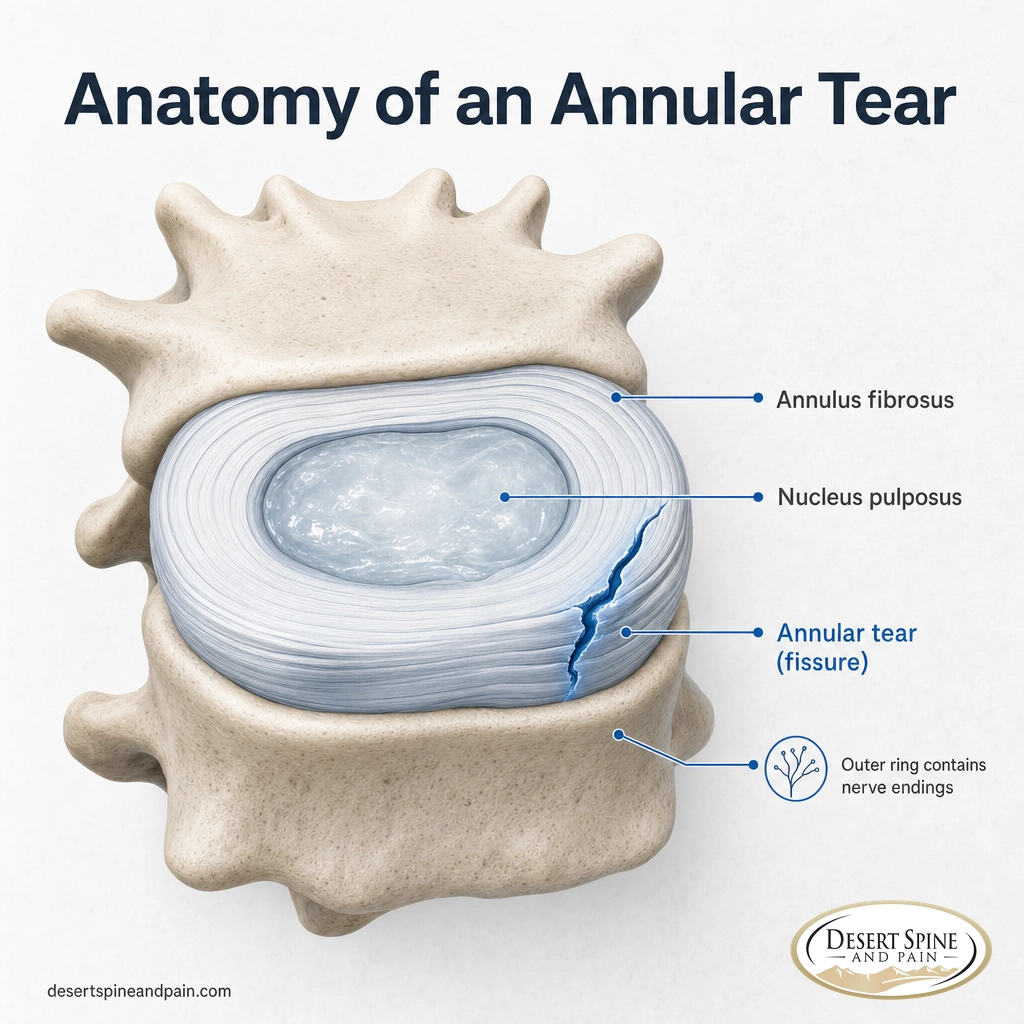
That is the key idea to carry into the rest of this guide: an annular tear is damage to the disc wall itself. Whether it causes pain, and whether it ever leads to a herniation, depends on how deep the tear runs and where it sits.
Source: American Academy of Orthopaedic Surgeons: Herniated Disk in the Lower Back | Fardon et al., Lumbar Disc Nomenclature version 2.0 (PubMed)
Annular Tear vs. Herniated Disc
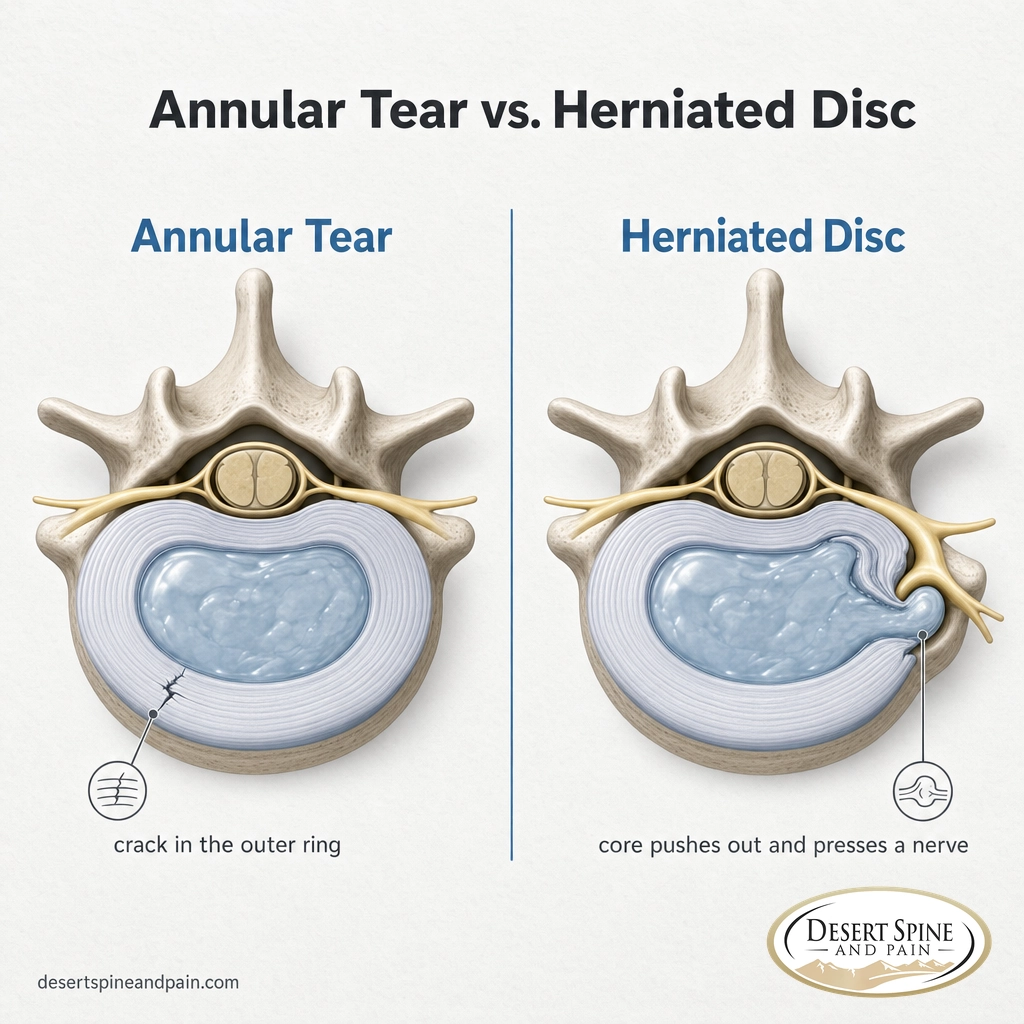
This is the comparison that confuses people most, and the distinction is simpler than it sounds. An annular tear is a crack in the disc wall. A herniated disc is what can happen when that crack lets the soft nucleus push out beyond the normal edge of the disc. In other words, a tear is usually the first step, and a herniation is a possible next step, not the same event.
| Feature | Annular Tear | Herniated Disc |
|---|---|---|
| What it is | A crack or fissure in the annulus fibrosus, the outer ring | The inner nucleus pushing out beyond the disc's normal edge |
| What moves | Nothing displaces; the ring is cracked but the core usually stays contained | Disc material displaces out, often through a radial tear |
| Typical pain | Deep, central ache in the back or neck (discogenic), worse with sitting or bending | Often radiating pain down an arm or leg, with possible numbness or weakness |
| Nerve compression | Not on its own, unless the tear progresses to a herniation | Common, and the usual reason for radiating symptoms |
| Relationship | Can exist on its own and often comes first | Usually needs an annular tear so the core has a path to escape |
A useful way to picture it: the annular tear is a crack in a sealed container, while a herniated disc is the filling squeezing out through that crack and pressing on something nearby. The same disc can show a tear with no herniation, a tear that later herniates, or a herniation that has clearly broken through the wall.
Myth: "An annular tear means a disc has slipped." Discs do not slip. An annular tear is a crack in the disc wall, and the disc stays in its normal position. Only when inner material pushes through does it become a herniation, and even then the disc itself has not slid out of place. The casual phrase "slipped disc" describes neither one accurately.
Annular Tear vs. Bulging Disc
A bulging disc is a third thing people mix in, and it is different again. A bulge is when a disc spreads outward broadly around much of its circumference, usually as a gradual part of aging, without the core breaking through. A tear is a specific crack in the wall; a bulge is a wide, even outward spread of the disc edge. A disc can bulge without a significant tear, and it can tear without bulging.
Source: Mayo Clinic: Herniated disk | AAOS OrthoInfo herniated disk overview
Types of Annular Tears
Not all annular tears are the same. The standard spine nomenclature describes three patterns, based on the direction the fissure runs through the layered wall:
- Radial tears. These run from the inner core outward through the layers of the annulus. Radial tears are the ones most associated with disc degeneration and with letting the nucleus escape, so they are the pattern most linked to herniation and to discogenic pain.
- Concentric tears. These are splits between the layers of the annulus, where adjacent rings separate from one another without a single crack running all the way through.
- Transverse (peripheral) tears. These are small tears near the outer edge, where the annulus attaches to the rim of the vertebra.
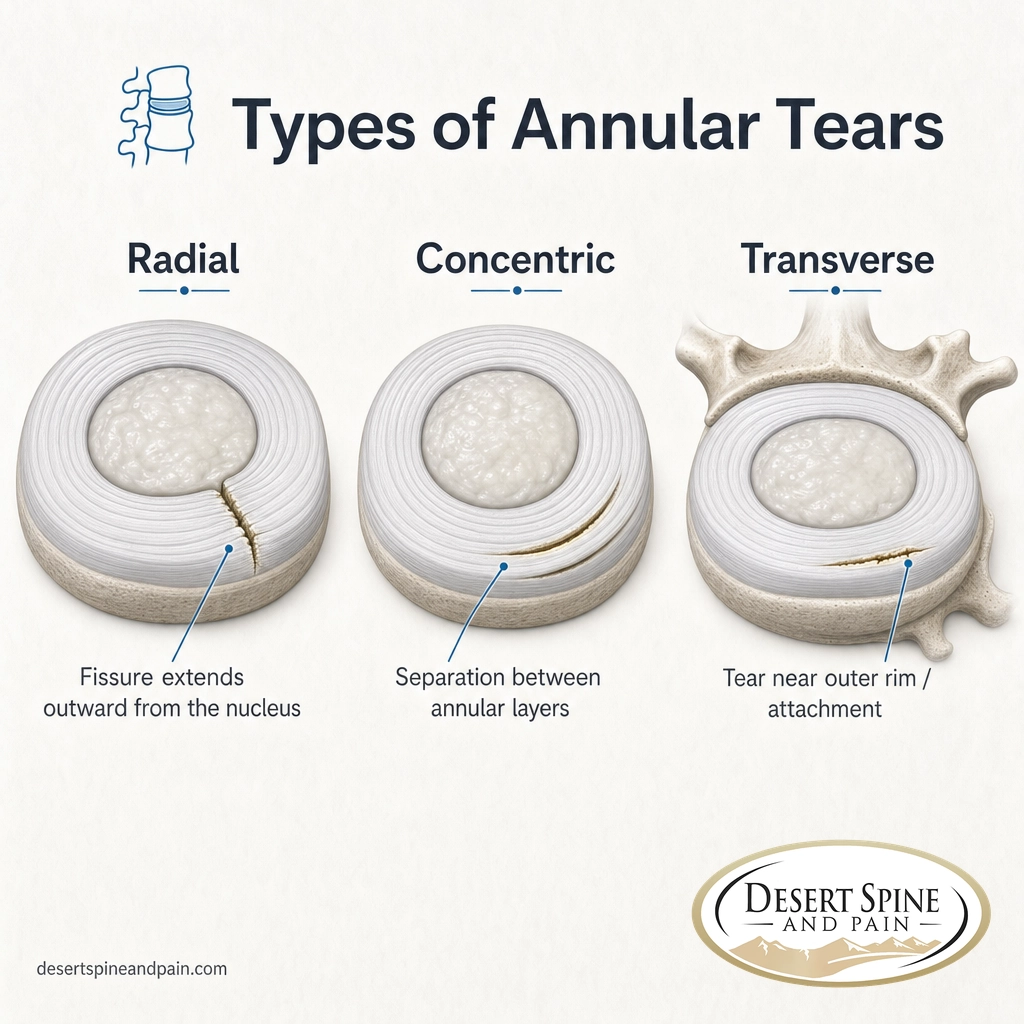
The type and depth matter because they shape what happens next. A deep radial tear that reaches the nerve-rich outer layer is more likely to cause pain or progress toward a herniation, while a small peripheral tear may never cause a symptom at all.
Source: Fardon et al., Lumbar Disc Nomenclature version 2.0, The Spine Journal (2014)
What Causes an Annular Tear, and How Common Are They?
The most common cause is time itself. As discs age they lose water and become less flexible, which is the process behind degenerative disc disease, and a stiffer, drier disc wall is easier to crack. Other contributors include repeated bending, lifting, and twisting, a single heavy strain or injury, and smoking, which reduces the already limited blood supply that discs rely on to stay healthy.
Here is the part that surprises many patients: disc findings like annular fissures are extremely common in people who have no back pain whatsoever. A large review of MRI studies in pain-free adults found that these changes rise steadily with age and are present in a sizable share of people at every decade of life.
Annular fissures follow the same pattern. In the same review, they were already present in a meaningful share of young adults with no symptoms and became more common with each decade, which tells us that a tear seen on a scan is often an age-related, silent finding rather than the automatic source of someone's pain.
Disc findings on MRI in people with NO back pain (by age 80)
Estimated prevalence of each finding on MRI in adults without back pain, by age 80. Source: Brinjikji et al., AJNR (2015).None of this means an annular tear cannot be the real source of someone's pain. It can be. It means the finding on the scan and the story of your symptoms have to be read together by an experienced clinician before anyone decides it is the culprit.
Source: Brinjikji et al., Systematic Literature Review of Imaging Features of Spinal Degeneration in Asymptomatic Populations, AJNR (2015) | AAOS OrthoInfo

Symptoms and When to See a Specialist
When an annular tear causes symptoms, the pain is usually axial, meaning it sits in the center of the low back or neck rather than shooting down a limb. It often feels like a deep ache that gets worse with sitting for long periods, bending forward, or activities that raise pressure inside the disc, such as coughing or sneezing. Many tears, as the data above shows, cause no symptoms at all.
A herniated disc tends to announce itself differently. Because displaced material can press on a nearby nerve root, the hallmark is radiating pain, numbness, tingling, or weakness that travels into an arm (from the neck) or down a leg (from the low back), the pattern commonly called sciatica when it affects the leg.
Seek urgent care for red flags. Progressive or severe weakness in an arm or leg, numbness around the groin or inner thighs, or any new loss of bladder or bowel control can signal serious nerve compression and should be evaluated immediately, not watched at home. These are uncommon, but they matter.
Outside those red flags, a good rule of thumb is to see a spine specialist when back or neck pain lasts more than a few weeks, keeps returning, or comes with any radiating symptoms, so the cause can be identified and the right care started.
Source: Mayo Clinic: Herniated disk symptoms | AAOS OrthoInfo
How Annular Tears Are Diagnosed and Treated
Diagnosis starts with your history and a physical exam, then usually an MRI, which can show a fissure and sometimes a bright spot in the back of the disc that radiologists associate with a painful tear. Imaging is interpreted alongside your symptoms, never as a standalone verdict, for the reasons the prevalence data makes clear.
Treatment almost always begins conservatively, in line with a least-invasive-first philosophy, and most people improve without surgery. A typical path can include:
- Activity modification and time. Short-term rest from aggravating movements, then a gradual return to activity, while the irritated disc settles.
- Guided physical therapy. A structured program (coordinated through trusted referral partners) that builds core and spinal support and improves mechanics, part of non-surgical spine care.
- Anti-inflammatory measures. Medication and other conservative steps aimed at calming the inflammation that drives discogenic pain.
- Targeted injections. When pain persists, an image-guided epidural steroid injection may help reduce inflammation around an irritated nerve.
- Surgery, only if needed. Surgery is reserved mainly for a tear that has progressed to a herniation compressing a nerve, with symptoms that do not respond to non-surgical care. A minimally invasive microdiscectomy is a common option in that situation.
Because the outer annulus has a limited blood supply, healing can be slower than in better-nourished tissues, so patience and a consistent plan matter. The goal is to calm symptoms, protect the disc, and avoid an escalation to a herniation where possible.
Source: AAOS OrthoInfo: treatment of disk problems | Mayo Clinic: Herniated disk diagnosis and treatment
How to Get Started
If an annular tear or a herniated disc has shown up on a scan, the most useful next step is a focused evaluation that connects the imaging to your actual symptoms and confirms what, if anything, needs treating. A thorough consult reviews your history, your exam, and your images together, and it is the right time to ask about conservative options and to get a second opinion before any surgery is considered.
Desert Spine and Pain is a Phoenix, Arizona practice led by Dr. David L. Greenwald, MD, FACS, a board-certified surgeon who is both a spine surgeon and a neurosurgeon, and it draws patients from across the Greater Phoenix area and beyond. Care always starts with the least invasive effective option and moves toward a procedure only when it is genuinely the best path.
Learn about annular disc tears at Desert Spine and Pain
Explore non-surgical spine care options
Book a consultation or second opinion
Common Questions About Annular Tears
What is an annular tear?
Is an annular tear the same as a herniated disc?
Can an annular tear heal on its own?
What does annular tear pain feel like?
Does an annular tear require surgery?
Related Spine Terms
- Annulus fibrosus: the tough, layered outer ring of a spinal disc, where an annular tear forms.
- Nucleus pulposus: the soft, gel-like center of the disc that can push out through a radial tear.
- Discogenic pain: pain coming from the disc itself, often from a tear reaching the nerve-rich outer annulus.
- Disc extrusion: a more advanced herniation where disc material has clearly pushed out beyond the wall.
- Degenerative disc herniation: a herniation that develops as part of age-related disc wear rather than a single injury.
- High-intensity zone (HIZ): a bright spot in the back of the disc on MRI that radiologists link to a painful annular tear.
- Minimally invasive spine surgery: surgical techniques used, when truly needed, to treat a herniation through small incisions.
Sources
Sources and Methodology
This guide summarizes established clinical references and peer-reviewed data on annular tears (annular fissures), herniated discs, and related disc conditions. Prevalence figures are drawn from a systematic review of MRI findings in people without back pain and are presented as general reference, not individual predictions. It is educational information, not medical advice. Decisions about diagnosis and treatment should be made with a qualified spine specialist after an in-person evaluation.
- Brinjikji et al. (2015): Systematic Literature Review of Imaging Features of Spinal Degeneration in Asymptomatic Populations, AJNR
- Fardon et al. (2014): Lumbar Disc Nomenclature, version 2.0, The Spine Journal (PubMed)
- American Academy of Orthopaedic Surgeons: Herniated Disk in the Lower Back
- Mayo Clinic: Herniated disk