
What Is SI Joint Fusion? How the Procedure Works
SI joint fusion, in plain terms: SI joint fusion is a surgery that permanently joins the sacroiliac (SI) joint, where the base of the spine meets the pelvis, so it stops moving and no longer causes pain. The surgeon places small titanium implants across the joint, usually through a minimally invasive incision. It is considered only after nonsurgical care has not worked.
If a surgeon has raised sacroiliac joint fusion as an option, it helps to understand exactly what it joins and why before deciding anything. The SI joints are the two strong joints that connect the triangular bone at the base of your spine, the sacrum, to the pelvis. When one of them becomes a pain source and nothing else has calmed it down, fusion stabilizes the joint so it can no longer move in a way that hurts. This guide walks through how the procedure works, who it is actually for, how it differs from a lumbar fusion and from the injections used to diagnose the problem, and what recovery looks like.
- SI joint fusion permanently joins the sacroiliac joint, between the sacrum and the pelvis, so a painful joint stops moving.
- It is most often done minimally invasively: titanium implants are placed across the joint through a small incision, usually as an outpatient, roughly one-hour procedure.
- The SI joint is the pain source in an estimated 14% to 22% of people with chronic low back or buttock pain, so confirming it as the true culprit comes first.
- It is not a lumbar (spine) fusion, and it is not the same as an SI joint injection, which is used to diagnose and temporarily treat the pain.
- Most patients walk the same day and return to normal activity around three to four months as the bone fuses.
What's in This Guide
How SI Joint Fusion Works
The goal of SI joint fusion is simple to state: stop a painful sacroiliac joint from moving. A healthy SI joint moves only a few degrees, acting as a shock absorber between the spine and the legs. When that small motion becomes a source of pain, fusion locks the joint so the irritating movement is gone and, over time, the bones grow together into one stable unit. Today this is most often done through a minimally invasive approach from the side of the hip.
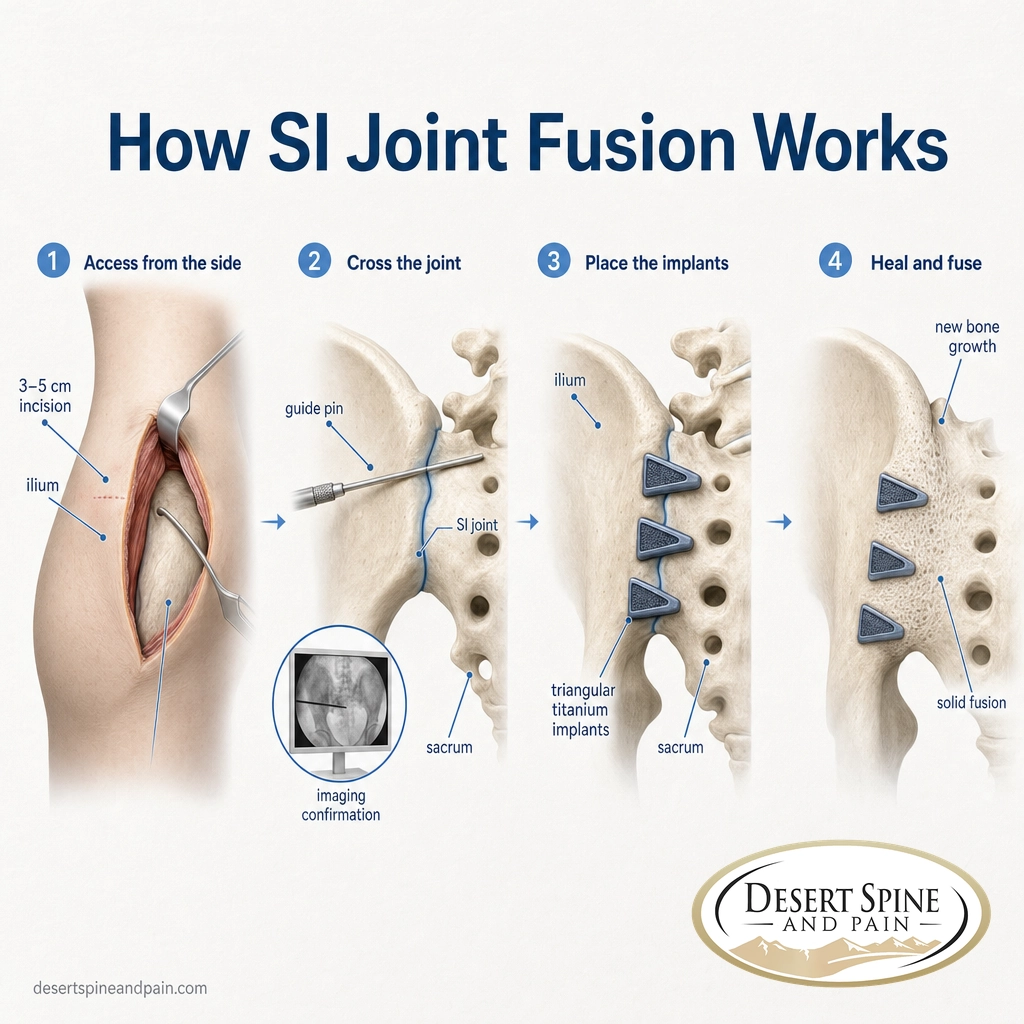
- Anesthesia and positioning. You are placed under general anesthesia and positioned face down, with the pelvis supported. The surgeon uses live imaging (fluoroscopy) or 3D navigation to see the joint and plan the exact path of each implant.
- The small incision. Rather than opening the joint, the surgeon makes a short incision, roughly 3 to 5 centimeters, over the side of the buttock and gently separates the tissue down to the outer surface of the pelvic bone (the ilium).
- Crossing the joint. A guide pin is passed across the SI joint, from the ilium into the sacrum, and its position is confirmed on imaging before anything permanent is placed. The channel for each implant is then prepared.
- Placing the implants. Triangle-shaped titanium implants are inserted across the joint, bridging the ilium and the sacrum. Typically two or three implants are used, sometimes with bone graft, to hold the joint still and encourage the bone to fuse.
- Closing up. Final imaging confirms the implants are well positioned, the small wound is irrigated and closed in layers, and most patients go home the same day.
Because the implants both stop the painful motion immediately and set the stage for the bones to knit together, fusion addresses the mechanical problem in one step. The whole operation often takes around an hour. As the bone grows across and around the implants over the following months, the joint becomes a solid, stable unit.
Source: Cleveland Clinic SI joint fusion overview | Peer-reviewed minimally invasive lateral-approach SI fusion technique
SI Joint Fusion vs. SI Joint Injections
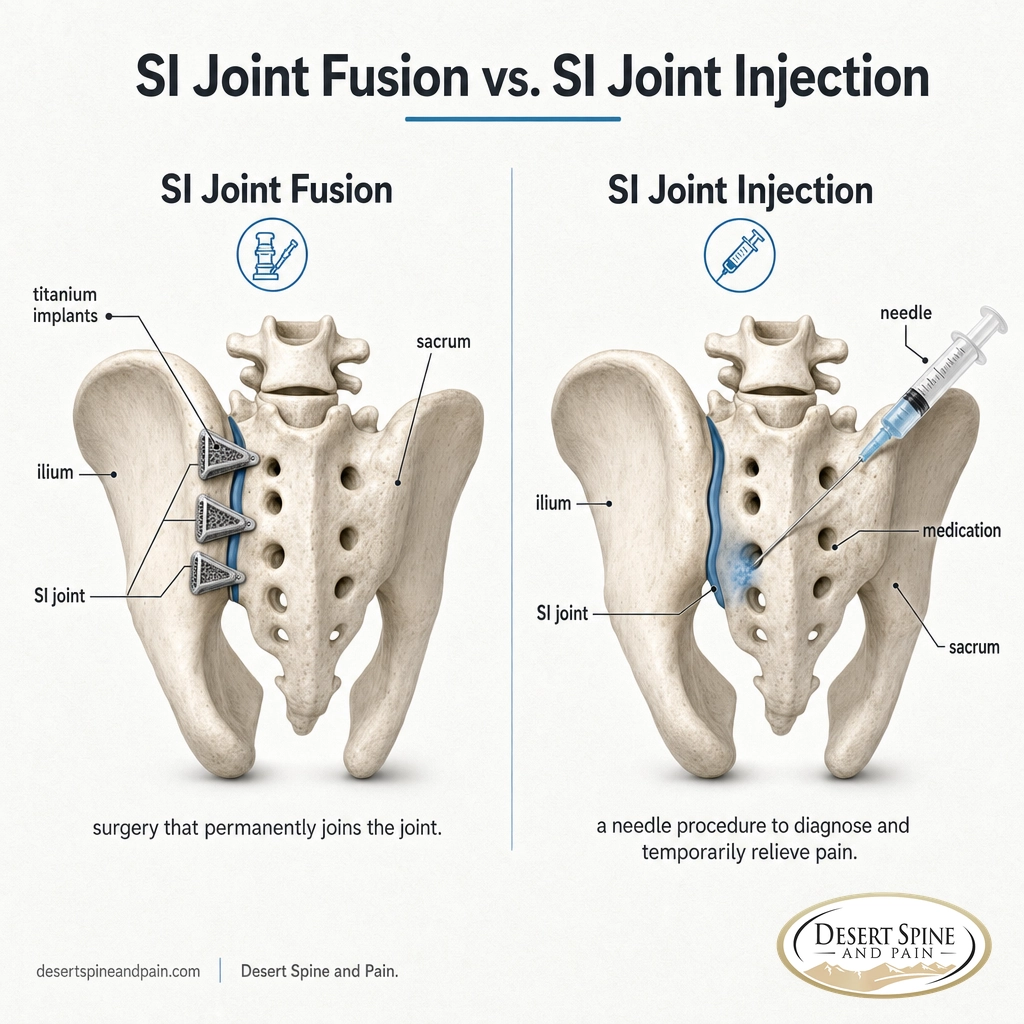
The single most common point of confusion is between SI joint fusion and an SI joint injection. They sound related, and both involve the same joint, but they do very different jobs. An injection is a needle procedure used to find and temporarily calm the pain; fusion is surgery meant to fix the mechanical problem for good. In fact, the injection usually comes first, because it helps prove the SI joint is the real source before anyone considers surgery.
| Feature | SI Joint Fusion | SI Joint Injection |
|---|---|---|
| What it is | Surgery that permanently joins the joint | A needle procedure that places anesthetic and/or steroid into the joint |
| Main purpose | Stop the painful motion for the long term | Confirm the SI joint as the pain source and give temporary relief |
| How long it lasts | Designed to be permanent | Temporary, from weeks to months |
| Where it fits in care | Considered only after nonsurgical care fails | An early diagnostic and conservative step |
| Recovery | A structured recovery over weeks to months | Usually back to routine the same or next day |
A useful way to think about it: the SI joint injection is both a test and a short-term treatment, while fusion is the structural repair chosen only when the joint keeps causing trouble. Many people never need the surgery at all, because conservative care or injections give them enough relief.
Myth: "SI joint fusion is just a lower-back (lumbar) fusion." It is not. A lumbar fusion joins vertebrae in the spine itself. SI joint fusion stabilizes the sacroiliac joint between the sacrum and the pelvis, a different joint entirely. Assuming they are the same leads patients to expect the wrong operation and the wrong recovery.
Source: Cleveland Clinic SI joint fusion overview
Who Is a Candidate for SI Joint Fusion
SI joint fusion is not a first step. At Desert Spine and Pain, the philosophy is the least invasive effective treatment first, and most SI joint pain never needs surgery. Fusion becomes the right tool only when two things are true: the SI joint has been confirmed as the genuine source of the pain, and that pain has not improved despite real nonsurgical effort. Because the SI joint can mimic disc and hip problems, confirming it matters as much as the surgery itself.
The usual path to becoming a candidate looks like this:
- The SI joint is confirmed as the culprit. A physical exam and an image-guided diagnostic injection are used to test the joint. When numbing the joint produces a clear, meaningful drop in pain (studies use a threshold of at least 50% relief), that strongly points to the SI joint as the source.
- Conservative care has been genuinely tried. Candidates have typically worked through months of nonsurgical options, which can include activity changes, anti-inflammatory medication, a course of physical therapy, and steroid injections, without lasting relief.
- Symptoms still limit daily life. Pain over the lower back, buttock, or hip that interferes with sitting, standing, walking, or sleep, and that keeps returning after conservative care, is what tips the balance toward surgery.
Because the decision rests on confirming the source and exhausting simpler options, a careful in-person evaluation is essential. For a closer look at how well the surgery tends to work once a patient is well selected, see our data roundup of SI joint fusion success rates and outcomes.
Source: International Journal of Spine Surgery: MIS SI joint fusion vs conservative management meta-analysis | Cleveland Clinic candidacy guidance

Types of SI Joint Fusion
"SI joint fusion" is a family of approaches rather than a single fixed operation. The main differences come down to the direction the surgeon works from and the type of implant used.
- Minimally invasive lateral approach. The most common technique today. Through a small incision on the side of the hip, triangle-shaped titanium implants are passed across the joint from the ilium into the sacrum, usually guided by live imaging or 3D navigation. It is prized for its small incision, limited soft-tissue disruption, and same-day discharge.
- Posterior and other approaches. Some systems place implants or allograft from the back of the joint rather than the side. The right approach depends on your anatomy and the surgeon's judgment.
- Open fusion. A traditional, larger-incision operation. It is used far less often now but may be appropriate in complex cases, such as trauma or deformity, where more extensive work is needed.
- Implant and graft choices. Depending on the system, the surgeon may use titanium implants alone or add bone graft to encourage the bone to knit together across the joint.
For most well-selected patients, the minimally invasive version of the procedure is the default, because it achieves stabilization with far less tissue disruption than open surgery.
Source: Peer-reviewed minimally invasive lateral-approach SI fusion technique
SI Joint Fusion Recovery Timeline
Recovery from a minimally invasive SI joint fusion is a gradual build, not a single finish line. Two things happen at once: the small incision and soft tissues heal in the first weeks, while the bone fuses across the joint over the following months. Knowing which is which keeps expectations realistic.
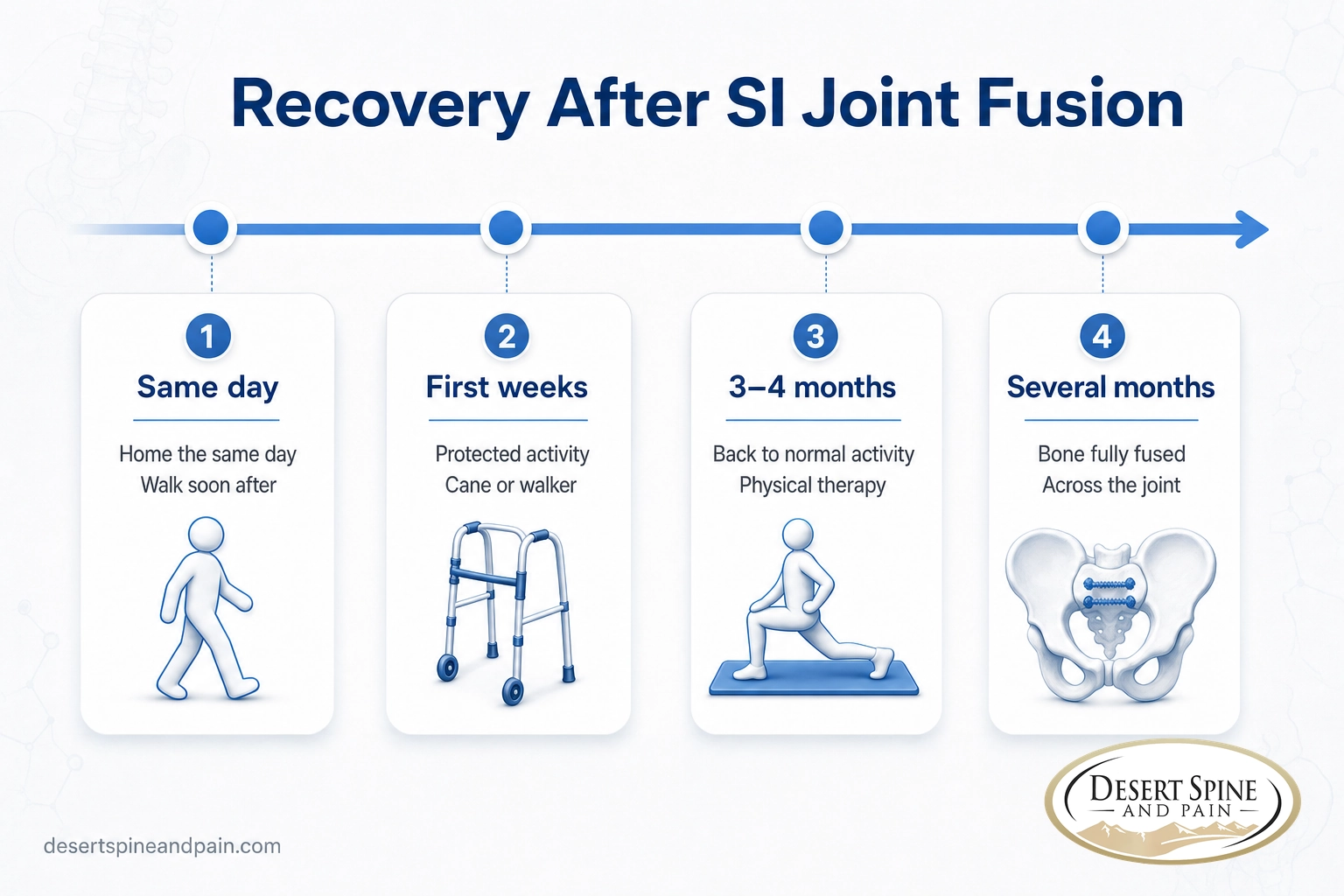
- The first day. Because it is usually outpatient, most patients go home the same day and are encouraged to stand and walk soon after surgery.
- First several weeks. Activity is kept protected. A cane or walker is commonly used to limit how much weight goes through the healing side, and heavy lifting and twisting are restricted while the joint settles.
- Three to four months. Most people are back to their usual physical activities, often after guided physical therapy to rebuild strength and stability around the pelvis.
- Several months and beyond. The bone continues to fuse across the joint until the segment is one solid unit, which is what makes the result durable.
Physical therapy during recovery is typically arranged by referral and plays an important role in rebuilding the muscles that support the pelvis. Because the SI joint normally moves only slightly, fusing it removes very little overall mobility, and day-to-day movement generally stays comfortable once healing is complete.
Source: Cleveland Clinic recovery guidance for SI joint fusion
How to Get Started
If SI joint fusion has been mentioned, the most useful next step is a focused evaluation that confirms whether the SI joint is truly the pain source and whether surgery is genuinely the best option, or whether injections or conservative care could still do the job. A thorough consult reviews your symptoms, your exam, and your imaging together, and it is the right time to ask about alternatives and to get a second opinion before any surgery.
Desert Spine and Pain is a Phoenix, Arizona practice led by Dr. David L. Greenwald, MD, FACS, who is board certified as both a spine surgeon and a neurosurgeon. Care always starts with the least invasive effective option and escalates to surgery only when it is genuinely the best path. You can read more about Dr. Greenwald's background and credentials before you decide.
Learn about SI joint fusion at Desert Spine and Pain
Explore minimally invasive SI joint fusion
Book a consultation or second opinion
Common Questions About SI Joint Fusion
What is SI joint fusion?
How is SI joint fusion done?
Who is a candidate for SI joint fusion?
Is SI joint fusion the same as a lumbar fusion?
How long is recovery after SI joint fusion?
Related Spine Terms
- Sacroiliac joint fusion: the surgery itself, which stabilizes the SI joint between the sacrum and pelvis.
- Minimally invasive SI fusion: the small-incision, implant-based version that is the default for most patients.
- SI joint injection: a needle procedure used to confirm the SI joint as the pain source and provide temporary relief.
- Lumbar fusion: joining vertebrae in the lower spine, a different operation on a different structure.
- Radiofrequency ablation: a nonsurgical option that uses heat to interrupt pain signals from certain joints.
- Sacroiliitis: inflammation of the SI joint, a common driver of the pain that fusion may address.
- Spinal fusion: the broader family of procedures that join bones so they heal into one unit.
Sources
Sources and Methodology
This guide summarizes established clinical references and peer-reviewed data on sacroiliac joint fusion. Prevalence and diagnostic figures are drawn from a systematic review and meta-analysis; procedure and recovery details reflect academic medical-center patient guidance and a peer-reviewed surgical technique. It is educational information, not medical advice. Decisions about surgery should be made with a qualified spine surgeon after an in-person evaluation.
- International Journal of Spine Surgery: Minimally Invasive SI Joint Fusion vs Conservative Management, Systematic Review and Meta-Analysis
- Cleveland Clinic: SI (Sacroiliac) Joint Fusion
- Minimally Invasive Sacroiliac Joint Fusion: A Lateral Approach Using Triangular Titanium Implants and Navigation
- Desert Spine and Pain: SI Joint Fusion Statistics (2026)