

Sciatica Research: Latest Findings and What They Mean
The short version: The current sciatica research is encouraging and, in places, surprising. Most sciatica, roughly 80 to 90 percent, resolves without surgery, usually within weeks. Staying active beats resting, the popular nerve-pain drug pregabalin performed no better than placebo in a major trial, and scans often show "abnormalities" in people with no pain at all. Surgery and injections still matter, but as tools for specific situations rather than defaults. Here is what the key findings say, and what each one means for your back and leg pain.
Sciatica research rarely makes headlines, but the quiet accumulation of good studies over the last two decades has changed what the best spine care looks like. Some of the most useful findings are the ones that overturned conventional wisdom: that rest is not the answer, that the obvious nerve-pain pill often fails, that an early scan can mislead as easily as it informs, and that surgery, though powerful, is not the finish line most people need. This guide pulls the strongest, most consistent findings into one place and, just as importantly, translates each into what it actually means if you are the one living with pain shooting down your leg.
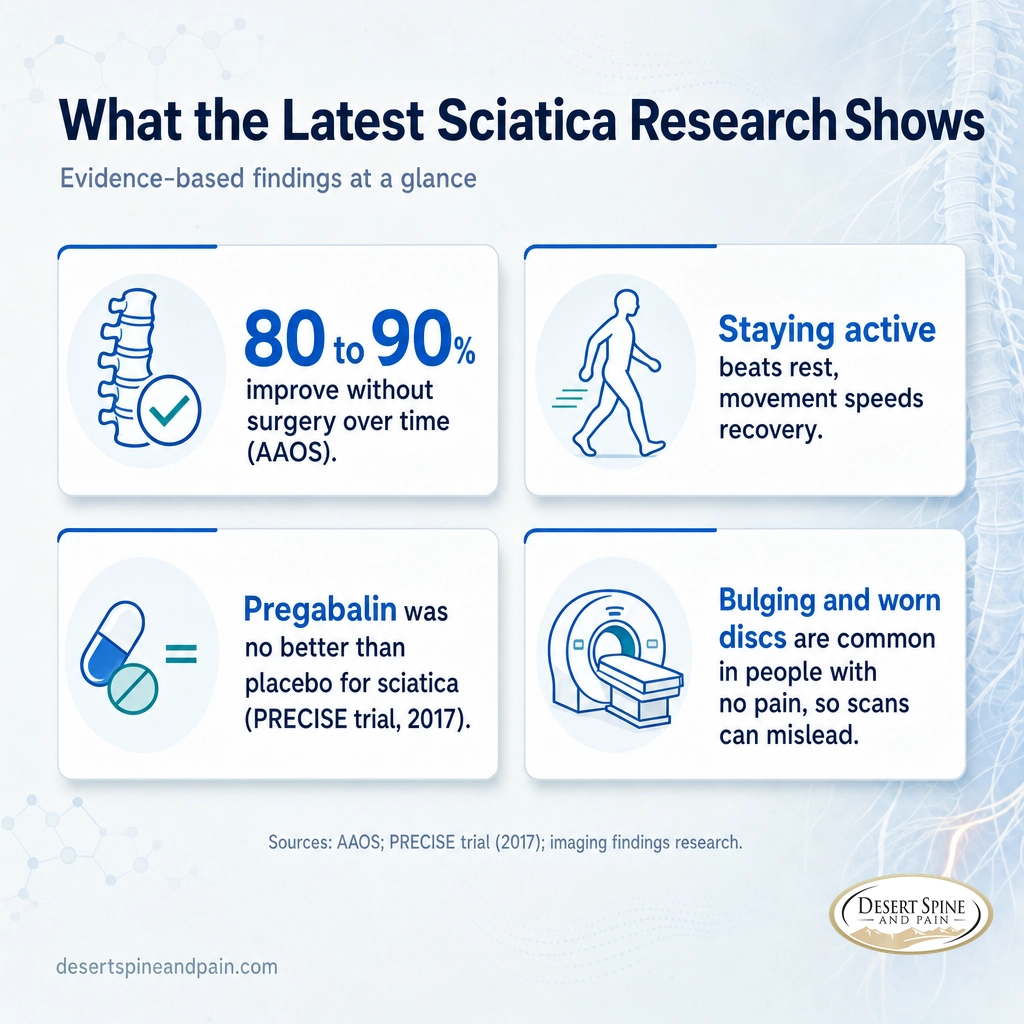
- Most sciatica heals without surgery. The American Academy of Orthopaedic Surgeons puts it at roughly 80 to 90 percent of people improving over time without an operation, usually within weeks.
- Movement beats rest. Current guidance is to stay as active as you can; gentle activity speeds recovery, while extended bed rest tends to slow it.
- The obvious drugs often disappoint. A landmark trial found pregabalin no better than placebo for sciatica, and simple paracetamol is unlikely to help, so modern guidelines have stepped back from routine use of both.
- Scans can mislead. Bulging and worn discs are common in people with no pain at all, so an early MRI without red flags often finds changes that are not the real cause of the symptoms.
- Surgery is faster, not necessarily better long term. For the right candidate, a microdiscectomy relieves leg pain sooner, but many people who choose conservative care reach a similar point given more time, making timing a personal decision unless red flags appear.

What's in This Guide
- Finding 1: Most Sciatica Resolves Without Surgery
- Finding 2: Movement Beats Rest
- Finding 3: The Nerve-Pain Drugs That Disappointed
- Finding 4: What Scans Can and Cannot Tell You
- Finding 5: Surgery vs. Conservative Care
- Finding 6: Where Injections Fit In
- What This Research Means for You
- Where Desert Spine and Pain Fits In
- Common Questions
- Sources
Finding 1: Most Sciatica Resolves Without Surgery
The single most important thing the research says about sciatica is also the most reassuring: the body heals most of these cases on its own. Sciatica happens when a nerve root in the lower spine, most often at the L4, L5, or S1 level, gets pinched or inflamed, usually by a herniated disc, and the pain travels along the sciatic nerve into the buttock and leg. Left to run its course with sensible conservative care, that irritation settles far more often than not.
The timeline matters as much as the odds. Most sciatica eases within a matter of weeks, which is why patience, not panic, is the right first response to a new flare. When you know the natural history, a few weeks of leg pain reads as a healing process underway rather than a sign that you need an operation.
What it means for you: If your sciatica is recent and gradually improving, the evidence supports giving it time with active conservative care before considering anything invasive. That does not mean ignoring it. It means the clock is usually on your side, and the goal early on is to stay comfortable and mobile while the nerve calms down. If you want the fuller picture of the timeline, our companion guide on how long sciatica usually lasts breaks down what to expect week by week, and our overview of what actually causes sciatica explains why the L5 and S1 levels drive most leg symptoms.
Source: AAOS OrthoInfo: Sciatica | Cleveland Clinic: Sciatica
Finding 2: Movement Beats Rest
For a long time the instinct with a painful back was to lie still and wait it out. The research turned that advice on its head. Studies and national guidance now agree that staying active is one of the most effective things a person with sciatica can do, and that prolonged bed rest tends to make recovery slower, not faster.
The United Kingdom's National Health Service, summarizing the evidence, advises people with sciatica to carry on with normal activities as much as possible and to start gentle exercise as soon as they can. It makes the point directly: movement, even when it is uncomfortable, is not harmful and can speed recovery. The nerve needs the surrounding muscles working and the spine moving through its normal range, not frozen in place.
Myth: rest is the best medicine for sciatica. It is one of the most persistent pieces of outdated advice in back care. Beyond a day or two of taking it easy during the worst of a flare, extended rest deconditions the muscles that support the spine and is linked to slower recovery. The evidence favors gentle, progressive movement, walking, and guided exercise over the couch. Staying active is treatment, not a risk.
What it means for you: Keep moving within the limits of your pain. Short walks, gentle stretching, and a return to daily routines as tolerated are not just safe, they are part of the recovery. A structured program makes this easier and safer, which is why guided physical therapy is a front-line option for sciatica that is not settling on its own.
Source: NHS: Sciatica | Cleveland Clinic: Sciatica self-care
Finding 3: The Nerve-Pain Drugs That Disappointed
Because sciatica is nerve pain, medications built for nerve pain looked like a natural fit. The most important drug trial in this area delivered a result that surprised a lot of clinicians, and it has reshaped prescribing.
The PRECISE trial, published in the New England Journal of Medicine in 2017, randomly assigned adults with sciatica to receive either pregabalin, a widely used nerve-pain drug sold as Lyrica, or a matching placebo. The finding was blunt: pregabalin did not reduce leg-pain intensity any more than the placebo did, at eight weeks or at one year, and the people taking it reported more side effects, including dizziness. In other words, a medication many patients were being given for exactly this problem was not beating a sugar pill, while adding risks of its own.
What changed because of it: On the strength of the PRECISE result and related evidence, modern low back pain and sciatica guidelines no longer recommend gabapentinoids such as pregabalin and gabapentin as a routine treatment. The NHS also notes that simple paracetamol on its own is unlikely to help sciatica, and that the evidence for anti-inflammatories like ibuprofen is mixed. The takeaway is not that no medication has any role, but that the obvious ones are weaker than their popularity suggested.
What it means for you: If you are on a nerve-pain drug for sciatica and it is not clearly helping, that is consistent with the evidence, and it is worth a conversation with your clinician rather than adding more on top. Medication for sciatica works best as a short-term aid chosen for your situation, alongside movement and time, not as the centerpiece of treatment. For the broader menu of what does and does not help, see our guide to how to treat sciatica.
Source: New England Journal of Medicine (Mathieson et al., 2017): PRECISE trial of pregabalin for sciatica | NHS: Sciatica medicines
Finding 4: What Scans Can and Cannot Tell You
When leg pain strikes, the natural request is for an MRI to "see what is wrong." The imaging research complicates that instinct in a way every sciatica patient should understand.
Large studies of spine imaging have repeatedly shown that the changes we associate with sciatica, bulging discs, disc degeneration, and similar findings, are extremely common in people who have no back or leg pain whatsoever, and that they grow more common with age. A frequently cited systematic review in the American Journal of Neuroradiology found disc degeneration and bulges in a large share of entirely pain-free adults, with the proportion rising steadily decade by decade. The practical problem is that a scan taken early can light up with "abnormalities" that are just the normal wear of a living spine, not the cause of today's pain.
Myth: a scan will always find the cause of my pain. An MRI shows structure, not pain. Because disc changes are so common in people with no symptoms, an early scan can point to a disc that looks dramatic but is not driving anything, which risks worry, unnecessary procedures, and treatment aimed at the wrong target. Imaging is most useful when it is timed and interpreted alongside your actual symptoms, not ordered reflexively on day one.
What it means for you: For new sciatica without red flags, it is usually reasonable to hold off on an MRI during the first several weeks while conservative care does its work. Imaging earns its place when there are warning signs, when the pain is not improving, or when you are weighing a targeted injection or surgery and need to know exactly which nerve root is involved and why. A scan should answer a specific question, not replace the exam.
Source: American Journal of Neuroradiology (Brinjikji et al., 2015): imaging findings in asymptomatic populations | NHS: Sciatica

Finding 5: Surgery vs. Conservative Care
If sciatica does not settle with time and conservative care, surgery enters the conversation, most often a microdiscectomy that removes the fragment of disc pressing on the nerve. Here the research offers a nuanced answer rather than a simple winner, and understanding it helps you make the decision on your own terms.
The landmark comparison is the Spine Patient Outcomes Research Trial, known as SPORT, published in JAMA in 2006, which compared surgery with nonoperative care for lumbar disc herniation. The consistent pattern from SPORT and the studies around it is that surgery relieves leg pain faster, giving quicker, more reliable early improvement, while both the surgical and nonsurgical groups tended to improve substantially over the longer term. Surgery buys speed; time, for many people, buys a similar destination.
| Approach | Speed of relief | Longer-term outcome | Best suited for |
|---|---|---|---|
| Conservative care (activity, physical therapy, time, selective medication) | Slower, gradual over weeks to months | Most people improve substantially; the large majority never need surgery | New or improving sciatica, no significant nerve weakness, no red flags |
| Microdiscectomy (minimally invasive surgery) | Faster, often marked early relief of leg pain | Very successful for leg pain; long-term results converge with conservative care for many | Disabling leg pain past about 3 months, or significant or progressing weakness |
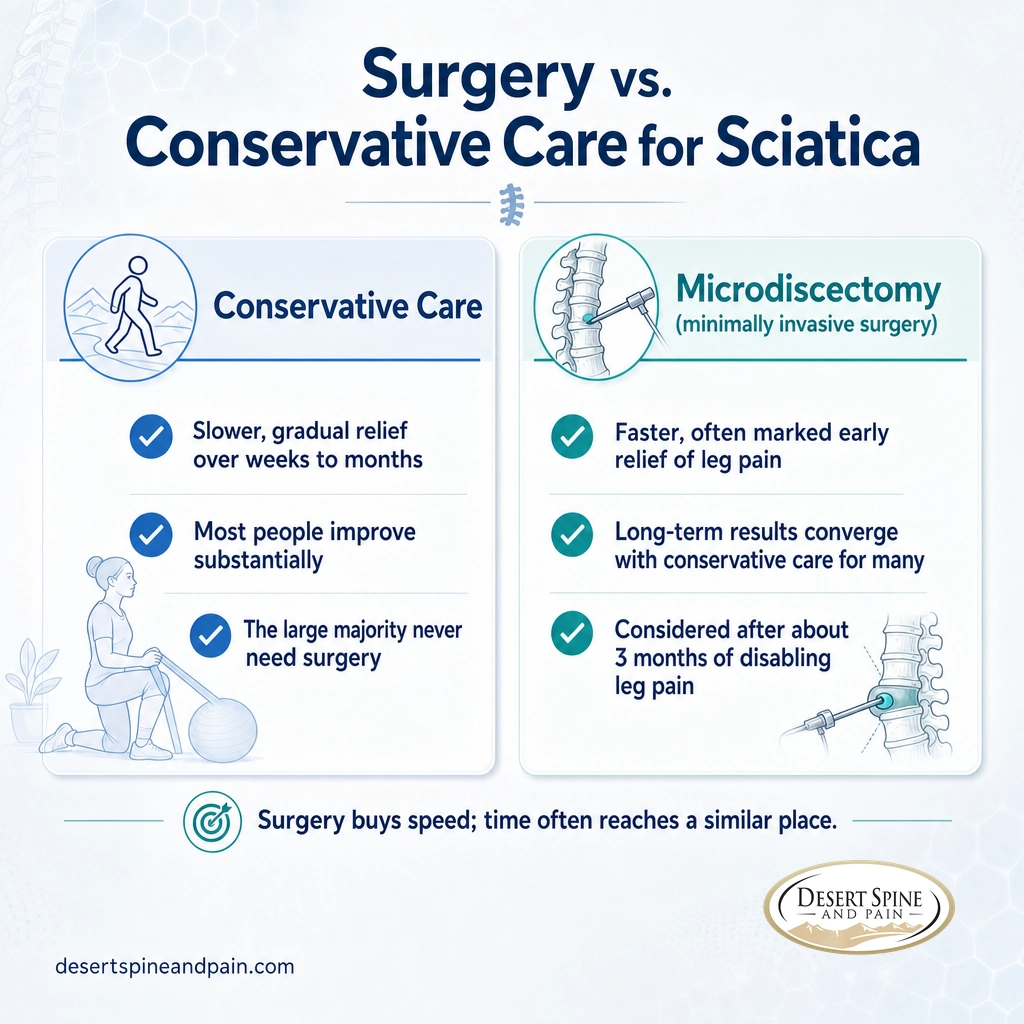
The American Academy of Orthopaedic Surgeons reflects this balance in its guidance, describing surgery as an option once disabling leg pain has persisted through three or more months of nonsurgical treatment, and noting that the operation is usually very successful at relieving pain, especially when most of the pain is in the leg rather than the back.
What it means for you: Unless you have red-flag symptoms or meaningful nerve weakness, there is rarely a need to rush to surgery. The choice is less "surgery or not" and more "sooner relief with a procedure, or a similar result with more patience," weighed against how much the pain is costing your work and life right now. When surgery is warranted, a lumbar microdiscectomy is a well-established, minimally invasive way to relieve the pressure directly.
Source: JAMA (Weinstein et al., 2006): SPORT trial, surgical vs nonoperative treatment for lumbar disc herniation | AAOS OrthoInfo: Sciatica surgery
Finding 6: Where Injections Fit In
Between conservative care and surgery sits the epidural steroid injection, which places anti-inflammatory medication around the irritated nerve root. The research puts it in clear perspective: it is a bridge, not a cure.
The weight of the evidence is that epidural steroid injections can provide meaningful short-term relief of radiating leg pain for appropriately selected patients, which can be valuable for calming a severe flare and buying time for the body to heal or for physical therapy to take hold. What they do not reliably do is change the long-term course or remove the underlying compression. The NHS lists an epidural injection among the specialist options offered for severe sciatica that has not responded to first-line care, which is exactly the role the data supports.
What it means for you: An injection is a reasonable step when pain is severe, is limiting your ability to move and participate in rehab, and has not eased with time and conservative measures. Set the expectation correctly: the goal is a window of relief to work through, not a permanent fix. Used that way, a well-timed epidural steroid injection can be a genuinely useful part of a larger plan.
Source: NHS: Sciatica treatments | AAOS OrthoInfo: Sciatica
What This Research Means for You
Put the findings together and a sensible, evidence-based path appears. For most people, new sciatica is a problem that time and movement will solve, so the early job is to stay active, manage the pain reasonably, and resist the urge to chase a scan or an operation before the clock has had its say. The treatments with the strongest records, staying active and guided rehabilitation, are also the least invasive. The more aggressive tools, injections and surgery, are powerful when matched to the right situation and timing, and underwhelming when used as a reflex.
The research is just as clear about the exceptions, and they matter. A minority of cases do not follow the gentle path, and a small number are genuine emergencies. Knowing which is which is the difference between watchful patience and a dangerous delay.
Seek emergency care immediately if you have any of these:
- Numbness in the saddle area, the inner thighs, groin, genitals, or buttocks.
- New loss of bladder or bowel control, including trouble starting to urinate, inability to urinate, or new incontinence.
- Severe or rapidly worsening weakness in one or both legs, especially sciatica affecting both legs at once.
These can signal cauda equina syndrome, a compression of the lower nerve roots that is a surgical emergency. Prompt treatment protects against permanent loss of leg, bladder, and bowel function. Do not wait these symptoms out, and do not drive yourself.
Short of an emergency, the signal to seek a planned evaluation is simple: sciatica that lasts beyond about six weeks, keeps coming back, is getting worse, or is interfering with your sleep, work, and daily life despite active care. At that point, a specialist can pinpoint which nerve root is involved and build a plan that starts with the least invasive option that fits.
Source: NHS: Sciatica emergency symptoms | Cleveland Clinic: Sciatica
Where Desert Spine and Pain Fits In
The research points to a particular kind of care: patient early, active rather than passive, and precise about when to escalate. That is exactly how a surgeon who treats the whole spine thinks about sciatica, and it is the opposite of rushing a nervous patient toward a scan and an operation.
Desert Spine and Pain is led by Dr. David L. Greenwald, MD, FAANS, FACS, who is board certified as both a spine surgeon and a neurosurgeon. That dual training covers the full picture behind sciatica, from the nerve root and the disc pressing on it to the bones around them, so one expert can read your symptoms and imaging together, tell you which findings are actually driving your leg pain, and build a plan that leads with conservative care and reserves injections and surgery for the cases that genuinely need them.
Serving the Greater Phoenix, Arizona area, Desert Spine and Pain welcomes out-of-network patients and partners with personal injury attorneys and their clients. If your sciatica has outlasted the weeks the research says it usually takes to settle, a focused consultation is the fastest way to learn which nerve is involved and what the evidence recommends next.
Explore nonsurgical options for sciatica and nerve pain
Meet Dr. David L. Greenwald, MD, FAANS, FACS
Book a consultation or second opinion
Common Questions About Sciatica Research
What does the latest research say about sciatica?
Do most people with sciatica need surgery?
Why don't nerve-pain medications like pregabalin work well for sciatica?
Should I get an MRI for sciatica right away?
When does sciatica become a medical emergency?
Sources
Sources and Methodology
This article summarizes peer-reviewed research and guidance from major medical institutions on the natural history, treatment, and imaging of sciatica. Recovery figures reflect published estimates from the American Academy of Orthopaedic Surgeons and the Cleveland Clinic; the drug findings come from the randomized PRECISE trial; the imaging point draws on systematic-review data on asymptomatic populations; and the surgery comparison reflects the Spine Patient Outcomes Research Trial and subsequent evidence. Findings are presented for orientation, and individual cases vary. This is educational information, not medical advice. Any new, severe, or worsening pain, numbness, or weakness should be evaluated by a qualified physician in person, and the emergency symptoms described above need immediate care.
- American Academy of Orthopaedic Surgeons (AAOS) OrthoInfo: Sciatica.
- Cleveland Clinic: Sciatica.
- National Health Service (NHS): Sciatica.
- Mathieson S, et al. Trial of Pregabalin for Acute and Chronic Sciatica (PRECISE). New England Journal of Medicine, 2017.
- Brinjikji W, et al. Systematic Literature Review of Imaging Features of Spinal Degeneration in Asymptomatic Populations. American Journal of Neuroradiology, 2015.
- Weinstein JN, et al. Surgical vs Nonoperative Treatment for Lumbar Disk Herniation: The Spine Patient Outcomes Research Trial (SPORT). JAMA, 2006.