

How Much Does Radiofrequency Ablation (RFA) Cost? A 2026 Price Breakdown
Spinal radiofrequency ablation (RFA) for back or neck pain typically costs between $732 and $5,962 when you pay cash, with a national average near $3,596 for a facility-based procedure and about $1,130 when it is done in a physician's office, according to the MDsave medical marketplace. With insurance, your share depends on your plan, your deductible, how many nerve levels are treated, and whether the procedure is office-based or done at a surgery center or hospital.
| Price point | Cash-pay cost | What it reflects |
|---|---|---|
| Low end | ~$732 | In-office, single level, one side |
| In-office average | ~$1,130 | Physician-office setting, no facility fee |
| Facility average | ~$3,596 | Surgery center or hospital, facility fee added |
| High end | ~$5,962 | Multiple levels, both sides, hospital setting |
| Non-negotiated estimate | ~$6,444 | Typical sticker price before cash or insurance discounts |
Figures are national cash-pay ranges from MDsave for facet joint RFA. This guide covers RFA for spine, back, and neck pain, not cardiac or vein ablation, which are different procedures with different costs.
- Cash-pay spinal RFA runs about $732 to $5,962, averaging roughly $3,596 (facility) or $1,130 (in-office) on MDsave.
- The single biggest price lever is setting: a hospital or surgery center adds a facility fee that an office procedure does not.
- Price also climbs with the number of nerve levels treated and whether one or both sides are done, since each additional level is billed separately.
- Medicare and most insurers require two diagnostic medial branch blocks, each giving 80% or more relief, before covering the first RFA (per Medicare LCD L38773).
- Coverage caps RFA at two sessions per spinal area per 12 months, and a repeat needs 50% or more relief for at least six months.
- Relief typically lasts 6 to 12 months and sometimes up to two years, which is central to whether the cost pays off.
What's in This Guide
What Radiofrequency Ablation Costs in 2026
Radiofrequency ablation, also called radiofrequency neurotomy or facet denervation, uses heat to interrupt the small medial branch nerves that carry pain signals from arthritic facet joints in the spine. For chronic back and neck pain, it sits in the middle of the cost ladder: more expensive than a single injection, far less than spine surgery.
The clearest real-world pricing comes from cash-pay data. On the MDsave marketplace, where providers list upfront prepaid prices, a facet joint RFA ranges from about $732 to $5,962, with a national average around $3,596. The same marketplace lists an estimated non-negotiated national average of roughly $6,444, which is closer to what an uninsured patient might see on an itemized hospital bill before any discount.
Those numbers describe the procedure day itself. They do not include the diagnostic blocks most patients need first, or the consultation and imaging that come before it. We break those add-ons down in the hidden costs and insurance sections below, because for many patients they matter as much as the headline price.
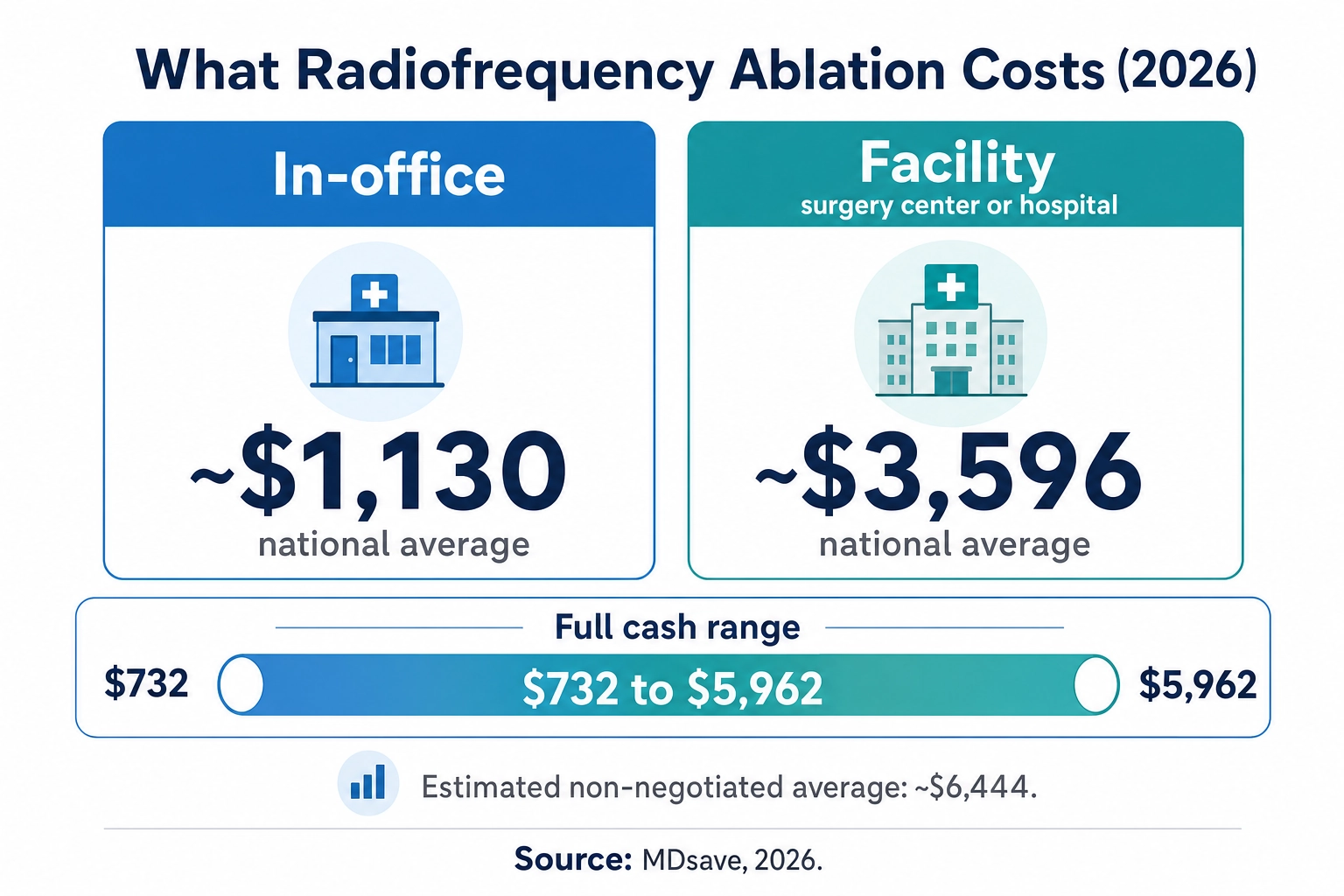
Source: MDsave national cash-price data (facility) | MDsave in-office RFA pricing
See radiofrequency ablation at our Phoenix practiceWhat Factors Affect the Cost?
The wide price range is not random. A handful of specific, predictable variables decide where your bill lands. Understanding them is the difference between a surprise invoice and a number you can plan around.
Number of nerve levels treated
Facet joint RFA is billed by the level and by region of the spine. The first treated level in the lumbar or sacral spine uses one billing code, and every additional level uses an add-on code (the same structure applies in the cervical and thoracic spine). Treating three levels costs meaningfully more than treating one, because each level is a separately billed destruction of a nerve.
One side versus both sides
Facet joints sit on both the left and right of the spine. If your pain is bilateral, the physician may ablate nerves on both sides, which roughly doubles the number of billed levels for that session. A unilateral, single-level RFA is at the low end of the range; a bilateral, multi-level RFA is at the high end.
Where it is performed
Setting is the single largest swing factor. A physician-office procedure carries only the professional fee. An ambulatory surgery center or hospital outpatient department adds a separate facility fee, which is why the same procedure averages about $1,130 in an office versus $3,596 in a facility on MDsave. Sedation, if used, and the complexity of image guidance also nudge the total.
Cash-Pay RFA: In-Office vs. Facility (National Averages)
Source: MDsave national cash-pay averages, 2026. The gap is mostly the facility fee.Imaging, anesthesia, and insurance status
RFA is done under live X-ray (fluoroscopy) guidance, which is part of the procedure cost. Light sedation, when offered, can add an anesthesia charge. Finally, whether you are in-network, out-of-network, or uninsured changes what you actually pay, sometimes more than any clinical factor. Out-of-network care can be the right choice for access to a specific surgeon, but it requires understanding your plan's reimbursement in advance.
Source: MDsave cash-pay data | Medicare facet joint intervention policy (billing by level)
Explore our interventional pain treatment optionsWhat You Pay by Setting
Because setting drives so much of the price, it helps to see the three common environments side by side. The clinical procedure is the same in each; what changes is the overhead billed around it.
| Setting | Typical cash range | What's included | Best for |
|---|---|---|---|
| Physician office | ~$732–$3,175 | Professional fee, fluoroscopy, no separate facility fee | Straightforward single or limited-level RFA; lowest cost |
| Ambulatory surgery center | ~$2,000–$5,000 | Professional fee plus facility fee; sedation available | Patients who want sedation or have multi-level, bilateral treatment |
| Hospital outpatient | ~$3,500–$5,962+ | Professional fee plus the highest facility fee; full hospital resources | Complex cases or patients with other medical needs |
The office and high-end figures above are anchored to MDsave's published cash ranges; the mid ranges reflect where surgery-center pricing typically falls between them. If cost is a priority and you are an appropriate candidate, an office-based procedure is usually the most economical path, and a good practice will tell you honestly whether your case can be handled that way.
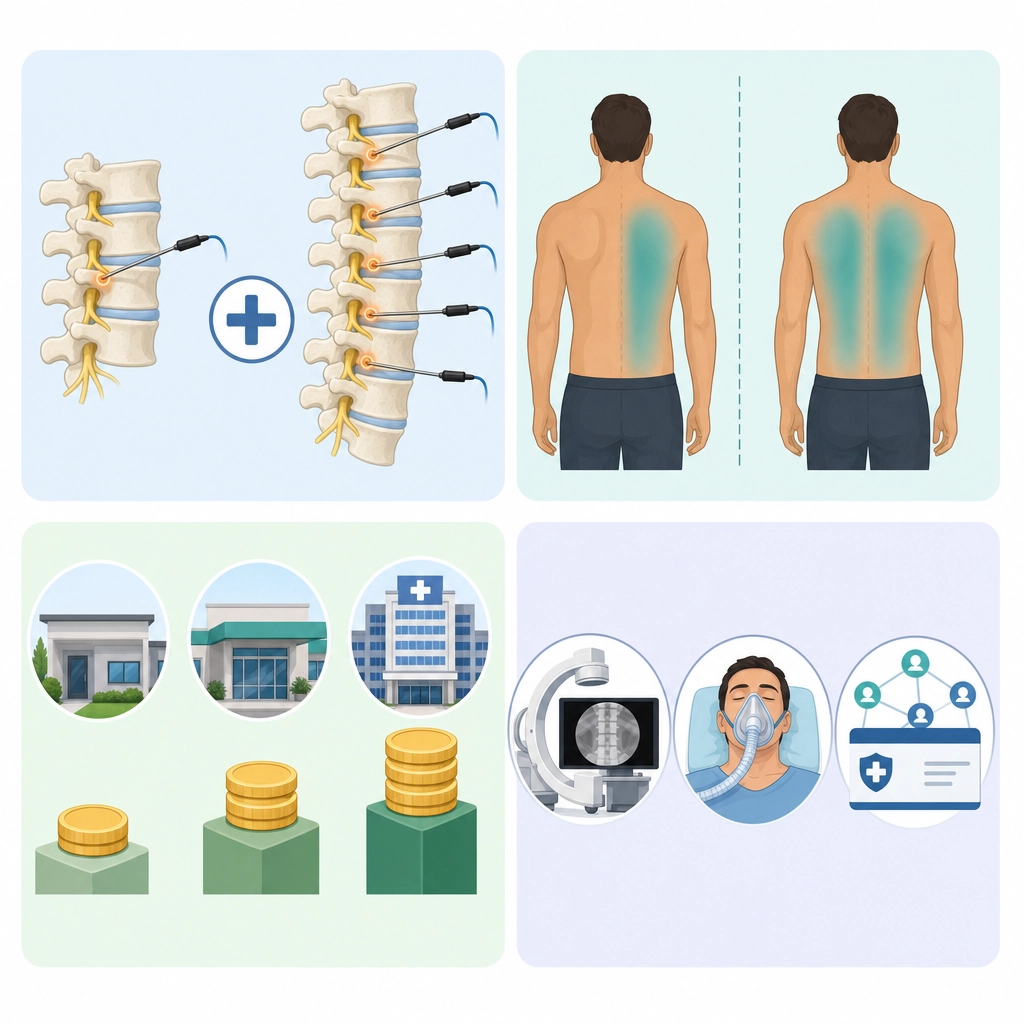
Source: MDsave in-office RFA pricing ($732–$3,175) | MDsave facility RFA pricing (to $5,962)

Hidden Costs to Watch For
The procedure-day price is only part of the picture. These are the add-ons that catch patients off guard, and the ones worth asking about before you schedule.
Not usually. Before the first ablation is covered, insurers require diagnostic medial branch blocks, which are separate billable procedures. Treating both sides or several levels multiplies the base price. And an office quote will not include a facility fee that a surgery center or hospital would add. Always ask whether the number you were given is all-inclusive, and what specifically is left out.
- Diagnostic medial branch blocks. Most patients need two of these test injections first to confirm the facet joints are the pain source. Each is billed separately from the RFA itself. These are the same family as diagnostic medial branch nerve blocks, and skipping them usually means the RFA will not be covered.
- Additional levels and both sides. Each extra nerve level and each additional side adds a billed charge on top of the first level.
- Facility fee. A surgery center or hospital adds this on top of the physician fee; an office does not.
- Imaging and sedation. Fluoroscopy is standard. Optional sedation adds an anesthesia charge.
- Deductible and out-of-network status. If your deductible is not met, you may pay the full allowed amount. Out-of-network care changes reimbursement and should be clarified up front.
Source: Medicare LCD L38773, facet joint interventions
Review conservative, non-invasive options firstInsurance and Medicare Coverage
Facet joint RFA is widely covered when it is medically necessary, but coverage comes with specific hoops. Medicare's local coverage determination (LCD L38773) is the most detailed and is mirrored by many commercial plans, so it is a good map of what to expect.
First, you need a documented history of chronic axial pain (at least three months) that has not responded to conservative care. Then comes the key step for cost: you must have at least two diagnostic medial branch blocks, and each one must produce a consistent 80% or more reduction of your main pain, before the first RFA is covered. Those two blocks are separate procedures with their own costs.
Because the diagnostic path is built into coverage, the true cost of "getting to" a covered RFA includes those blocks and the office visits around them. The upside is that this workup also protects you from paying for a procedure that was unlikely to help: if the diagnostic blocks do not relieve your pain, the facet joints probably are not the source, and RFA would not have worked anyway.
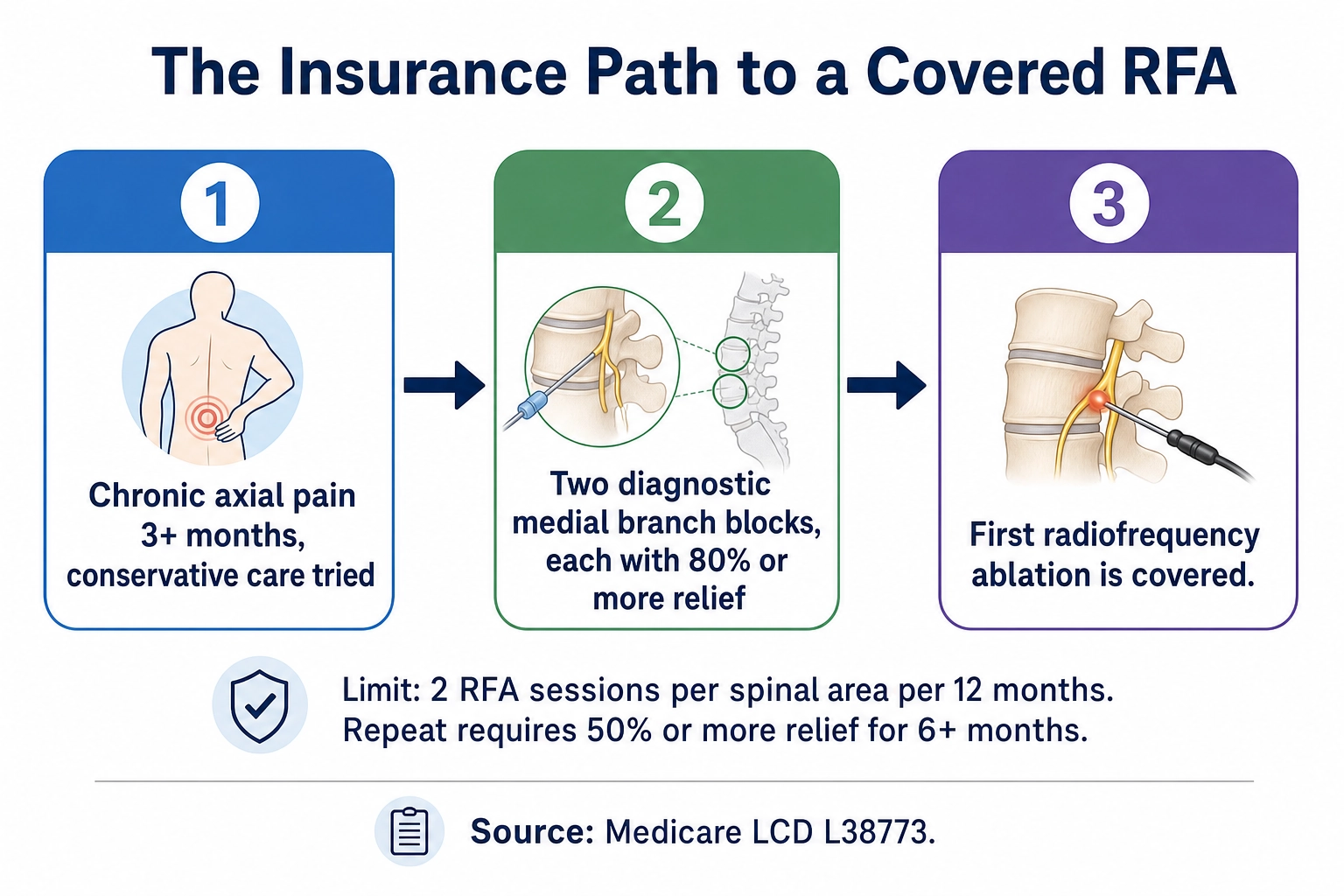
Source: First Coast Service Options, Medicare facet joint LCD L38773
Is RFA Worth the Cost?
The honest answer is that it depends on whether you are a good candidate, and the price should be weighed against both the alternatives and the duration of relief. Cleveland Clinic reports that RFA relief typically lasts 6 to 12 months, and sometimes up to about two years, because the treated nerves slowly regrow. Spread a $1,130 to $3,596 procedure across a year of reduced pain and it can compare favorably to the running cost of medication, repeated injections, missed work, and reduced function.
The research is genuinely mixed, and a transparent guide should say so. A U.S. cost-utility analysis by Manchikanti and colleagues estimated about $5,446 per quality-adjusted life year for lumbar radiofrequency neurotomy, a figure many health economists consider reasonable. On the other hand, the Dutch MINT randomized trials, published in Value in Health, found that radiofrequency denervation added to a standard exercise program was not cost-effective from a societal perspective for chronic low back pain. A Cochrane review has also rated the overall evidence as low quality. The takeaway is not that RFA fails, but that candidate selection is everything: the diagnostic blocks exist precisely to identify the patients for whom it is most likely to pay off.
Combining two verifiable figures puts the price in perspective. Taking MDsave's in-office national average of about $1,130 and Cleveland Clinic's typical relief window of 6 to 12 months yields a cost of roughly $94 to $188 per month of meaningful pain relief for an appropriately selected patient, before insurance. For a facility-based procedure near the $3,596 average, that is about $300 to $600 per month. Those monthly figures, not the sticker price alone, are the right way to compare RFA against the recurring cost of medication, injections, or time lost to pain. Calculation and interpretation original to Desert Spine and Pain, based on MDsave (2026) pricing and Cleveland Clinic duration data. This is general information, not financial or medical advice.
For a deeper look at who responds and how durable relief tends to be, see our companion report on radiofrequency ablation success rates and outcomes. And if your pain turns out to stem from a problem RFA cannot address, it helps to understand where spine surgery costs sit by comparison.
Source: Cleveland Clinic, radiofrequency ablation | MINT trials, Value in Health (2020)
Meet Dr. David L. Greenwald, MD, FACSHow to Get an Accurate Quote
A trustworthy estimate is specific to your spine, your plan, and your setting. Here is what to prepare and what to ask so the number you are quoted is the number you pay.
- Your diagnosis and which spinal region is involved (cervical, thoracic, or lumbar/sacral).
- How many levels and whether one or both sides are likely to be treated.
- Your insurance card, deductible status, and whether the provider is in or out of network.
- Records of prior conservative care and any diagnostic blocks you have already had.
- Is this quote all-inclusive (professional fee, facility fee, imaging, and sedation)?
- Will the procedure be done in your office, a surgery center, or a hospital, and how does that change the price?
- How many diagnostic blocks will I need first, and what do those cost?
- What is my estimated out-of-pocket amount after insurance, including out-of-network reimbursement if applicable?
- How many levels and sides are you planning to treat?
At Desert Spine and Pain, a Phoenix practice led by board-certified surgeon Dr. David L. Greenwald, MD, FACS, who is both a spine surgeon and a neurosurgeon, the team verifies your benefits, explains costs up front, and assists out-of-network patients and those referred by personal injury attorneys with the paperwork. The philosophy is least-invasive-effective care first, so you are only steered toward RFA if the diagnostic picture says you are likely to benefit.
Request a cost estimate: (602) 566-9500Radiofrequency Ablation Cost: Summary Pricing Table (2026)
| Cost variable | Figure | Source |
|---|---|---|
| Cash-pay range (facility RFA) | $732–$5,962 | MDsave, 2026 |
| Cash-pay national average (facility) | ~$3,596 | MDsave, 2026 |
| Cash-pay range (in-office RFA) | $732–$3,175 | MDsave, 2026 |
| Cash-pay national average (in-office) | ~$1,130 | MDsave, 2026 |
| Estimated non-negotiated national average | ~$6,444 | MDsave, 2026 |
| Diagnostic blocks required before coverage | 2 (each 80%+ relief) | Medicare LCD L38773 |
| Covered RFA sessions per area, per 12 months | 2 maximum | Medicare LCD L38773 |
| Repeat RFA threshold | 50%+ relief for 6+ months | Medicare LCD L38773 |
| Typical duration of relief | 6–12 months (up to ~2 years) | Cleveland Clinic |
| Cost per QALY, lumbar RF neurotomy | ~$5,446 | Manchikanti et al., Pain Physician |
| Cost per QALY, lumbar facet nerve blocks | ~$4,664 | Manchikanti et al., Pain Physician |
Frequently Asked Questions
How much does radiofrequency ablation cost?
Does insurance cover radiofrequency ablation?
Why is radiofrequency ablation cheaper in a doctor's office than a hospital?
How long does radiofrequency ablation relief last, and is it worth the cost?
What hidden costs come with radiofrequency ablation?
Methodology & Sources
How we compiled this guide
Cash-pay pricing reflects live listings on the MDsave medical marketplace for facet joint radiofrequency ablation, captured in 2026, including both the facility procedure (range $732 to $5,962, national average about $3,596) and the in-office procedure (range $732 to $3,175, national average about $1,130). Coverage rules are drawn from the Medicare Local Coverage Determination for Facet Joint Interventions for Pain Management (LCD L38773), as summarized by the Medicare Administrative Contractor First Coast Service Options, which specifies the two-diagnostic-block requirement at 80% or more relief, the limit of two RFA sessions per spinal area per rolling 12 months, and the repeat-procedure threshold of 50% or more relief for at least six months.
Duration-of-relief figures are from Cleveland Clinic. Cost-effectiveness figures come from peer-reviewed research: a U.S. cost-utility analysis by Manchikanti and colleagues (average cost per QALY of about $5,446 for lumbar radiofrequency neurotomy and $4,664 for lumbar facet joint nerve blocks) and the Dutch MINT randomized clinical trials published in Value in Health (2020). Prices are national cash-pay figures and are not a quote; actual cost depends on region, provider, setting, number of levels, sides treated, and insurance. This article is general information and not medical or financial advice.
- MDsave, Radiofrequency Ablation and Radiofrequency Ablation (In-Office) procedure pricing (2026)
- Medicare LCD L38773, Facet Joint Interventions for Pain Management (First Coast Service Options)
- Cleveland Clinic, Radiofrequency Ablation treatment overview
- Manchikanti L, et al. Cost utility analysis of lumbar facet joint interventions, Pain Physician
- Juch JNS, et al. Cost-Effectiveness of Radiofrequency Denervation (MINT trials), Value in Health, 2020
You are welcome to cite these figures with attribution to the original primary sources named above (MDsave, Medicare LCD L38773, Cleveland Clinic, Pain Physician, and Value in Health). When referencing the Desert Spine and Pain cost-per-month-of-relief analysis, please attribute the calculation to Desert Spine and Pain. This article is general information and not medical or financial advice.