
Radiofrequency Ablation Statistics (2026): Success Rates, Duration, and Outcomes Data
Radiofrequency ablation (RFA) succeeds in roughly 70% to 85% of well-selected patients with lumbar facet joint pain, with relief typically lasting 6 to 12 months. It is now considered a standard-of-care option for facet-mediated chronic back pain when diagnostic blocks confirm the pain source. Here is what the 2026 data says about how well RFA works, how long it lasts, and what makes the difference between success and disappointment.
Key Takeaways
- 70% to 85% success for lumbar facet joint pain in well-selected patients (defined as 50%+ pain reduction).
- Relief typically lasts 6 to 12 months, with many studies reporting a 9 to 12 month window before nerves regenerate.
- Success rate varies by location: lumbar 70-85%, cervical 65-75%, SI joint 65-80%.
- Patient selection is everything: a positive diagnostic medial branch block (50-80% relief) is the strongest predictor of success.
- Facet joints cause up to 30% of chronic low back pain cases, defining the candidate population.
- Durable and repeatable: one long-term cohort showed 58% functional and 53% pain improvement at a median 39-month follow-up, with no complications.
- Relief builds gradually: most patients notice improvement in 10 to 14 days, full benefit in 2 to 4 weeks.
What's in This Guide
01 Success Rates by Location and Condition
Radiofrequency ablation uses heat to interrupt pain signals from specific nerves, most often the medial branch nerves that carry pain from arthritic facet joints. Success rates are strong when the target is correctly identified.
Reported success rates cluster by anatomical target. Lumbar facet RFA leads at 70% to 85%, helped by the relatively controlled anatomy of the lower back and the precision of modern technique. Cervical procedures range from 65% to 75% and demand exceptional precision given the delicate structures involved. Sacroiliac joint ablation reports 65% to 80% improvement when the joint is properly identified as the pain source. Across all locations, success is generally defined as at least 50% pain reduction.
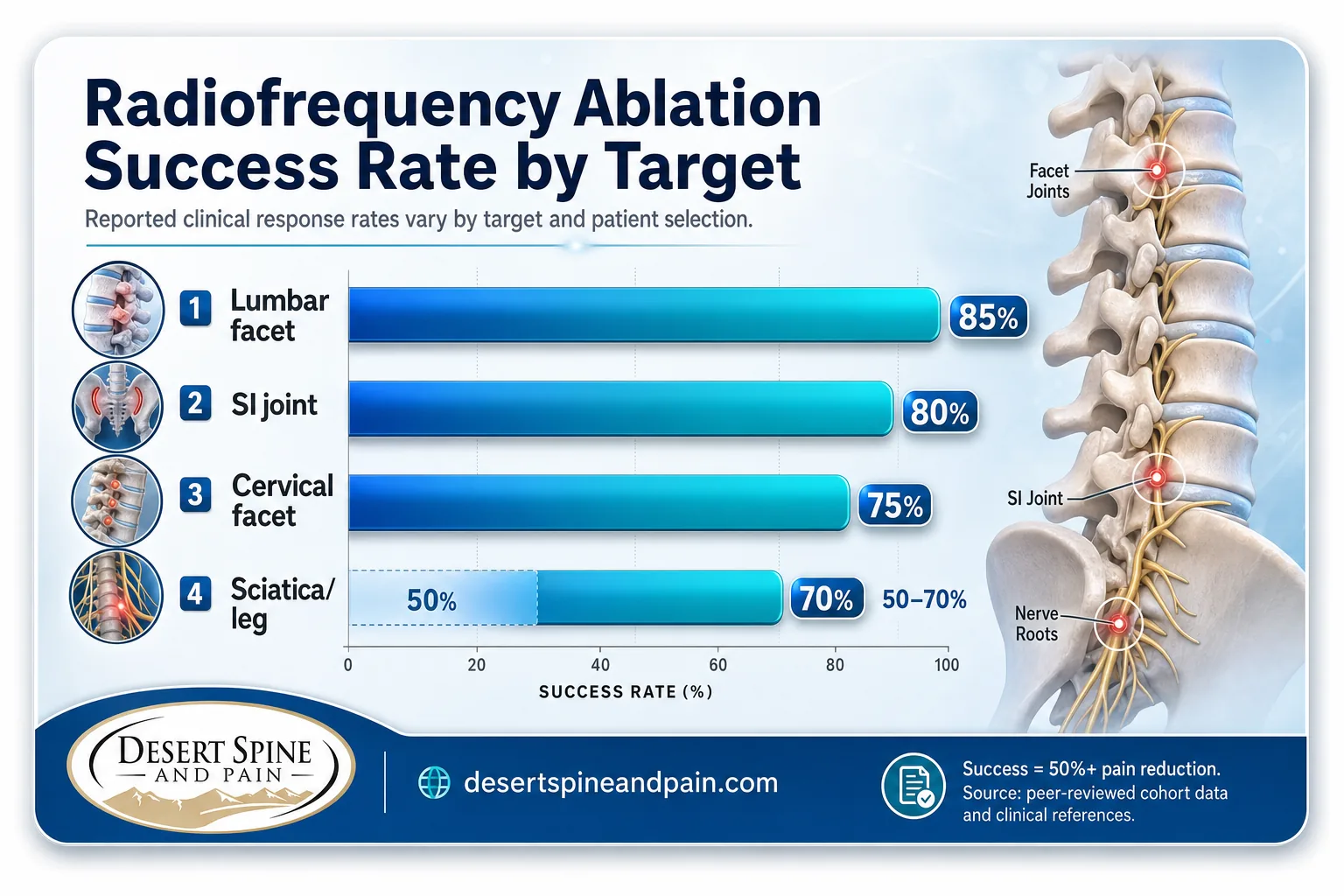
Radiofrequency Ablation Success Rate by Target
Context matters for interpreting these numbers: facet joint pain accounts for as many as 30% of all chronic low back pain cases, so RFA addresses a large and well-defined slice of the back-pain population. But it is not a universal fix, and matching the procedure to the correct diagnosis is what drives the high end of these ranges.
Source: Access Pain Solutions (clinical reference) | PMC, lumbar facet RFA long-term outcomes
See how radiofrequency ablation works
02 How Long Relief Lasts
Because RFA works by interrupting nerves that eventually regenerate, relief is durable but not permanent, and the data gives clear benchmarks.
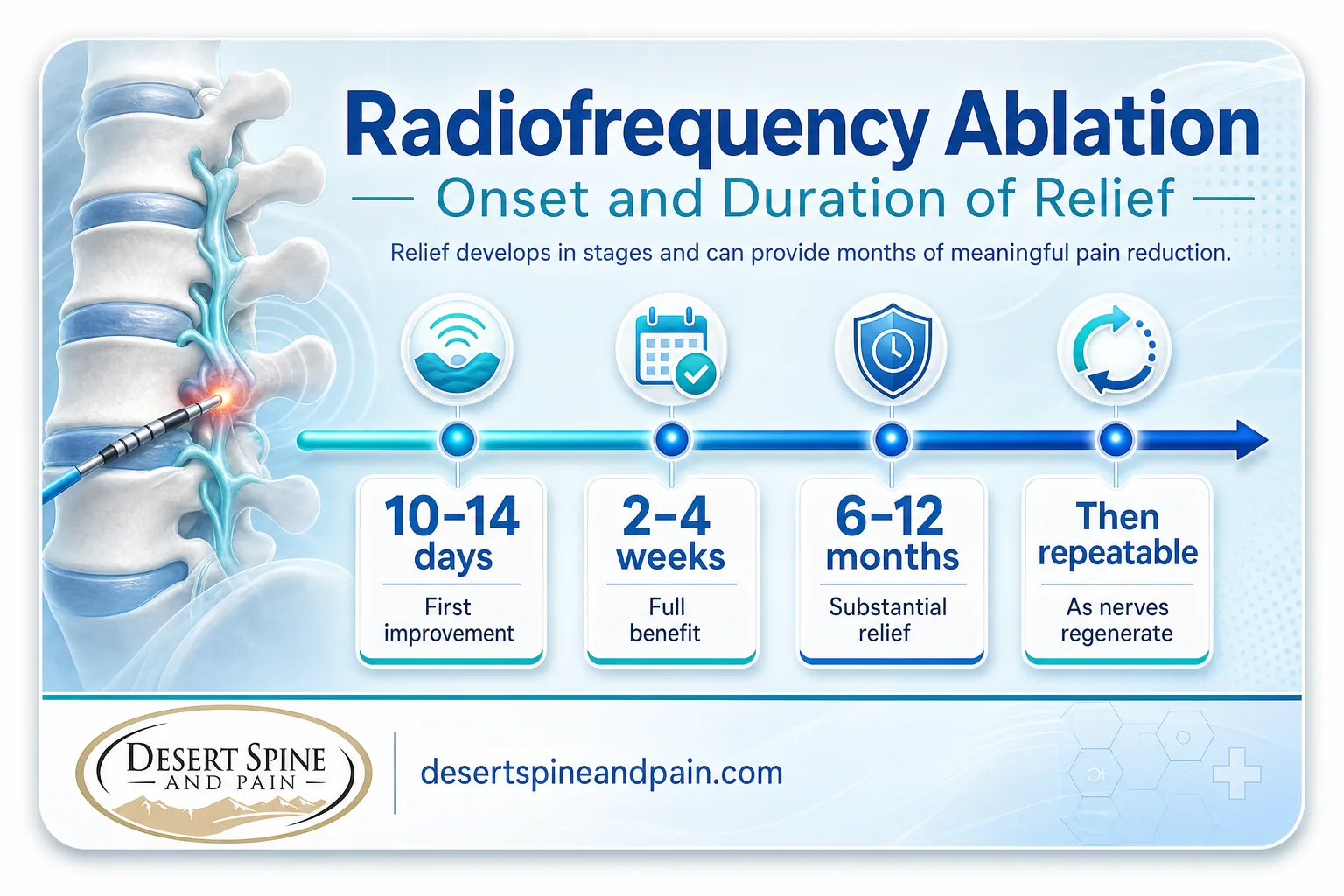
Most patients with medial branch (facet) ablation experience 6 to 12 months of substantial relief, with many clinical sources reporting a 9 to 12 month window. Relief is not instant: improvement usually begins within 10 to 14 days, and full benefit develops over 2 to 4 weeks as post-procedure inflammation subsides. A minority of patients notice a brief increase in soreness during the first week, which typically resolves on its own.
Myth: "When the pain comes back, radiofrequency ablation has failed."
Return of pain is expected, not a failure. The treated nerves regenerate over months, which is why relief is measured in a 6 to 12 month window rather than as a cure. The important detail: RFA can usually be safely repeated when pain returns, and prior success is a strong predictor of future success. Many patients use it as a sustainable, repeatable part of long-term pain management. Outcomes vary by individual, and a consultation is the right place to plan a personal approach.
Source: Regenerative Institute (clinical reference) | Access Pain Solutions
Explore the full range of interventional pain care
03 What Predicts a Good Outcome
The single biggest factor in RFA success is not the procedure itself, it is the diagnostic work that comes before it.
The strongest predictor of RFA success is a positive diagnostic medial branch block: a temporary numbing injection that confirms the facet joint is the true pain source. Patients who get 50% to 80% relief from that block are the best candidates. This is why diagnosis-first care is not a formality; it is the mechanism that separates a 70-85% success population from a coin flip.
Selection also explains why real-world numbers vary. One prospective study reported a 76% success rate at 7 to 21 days, which then declined to 32% at 6 months and 22% at 1 year, a reminder that follow-up window and patient selection dramatically change the headline figure. By contrast, studies that rigorously confirm the pain generator first report far more durable results.
Desert Spine and Pain Analysis: Why Diagnosis Drives the Range
Combining two findings from the literature, a real-world early success rate of 76% dropping to 22% at one year in a mixed-selection cohort, versus 95.8% of patients reporting 80%+ block relief in a rigorously selected cohort, shows that the wide 22% to 85% spread in published results is largely a selection story, not a technology story. The procedure performs; the diagnosis determines who it performs for.
Formula: Contrast of selection rigor: mixed cohort (76% to 22% over 1 year) vs. block-confirmed cohort (95.8% with 80%+ pre-procedure block relief).
Calculation and interpretation original to Desert Spine and Pain. Source figures: PMC prospective facet denervation study and the RAPID real-world RFA study.
Source: PMC, factors determining RF denervation success | RAPID real-world RFA study (PMC)
Learn about diagnostic medial branch blocks
04 Long-Term and Real-World Outcomes
Beyond short-term success rates, longer studies show RFA can deliver durable functional gains and reduce medication use, not just pain scores.
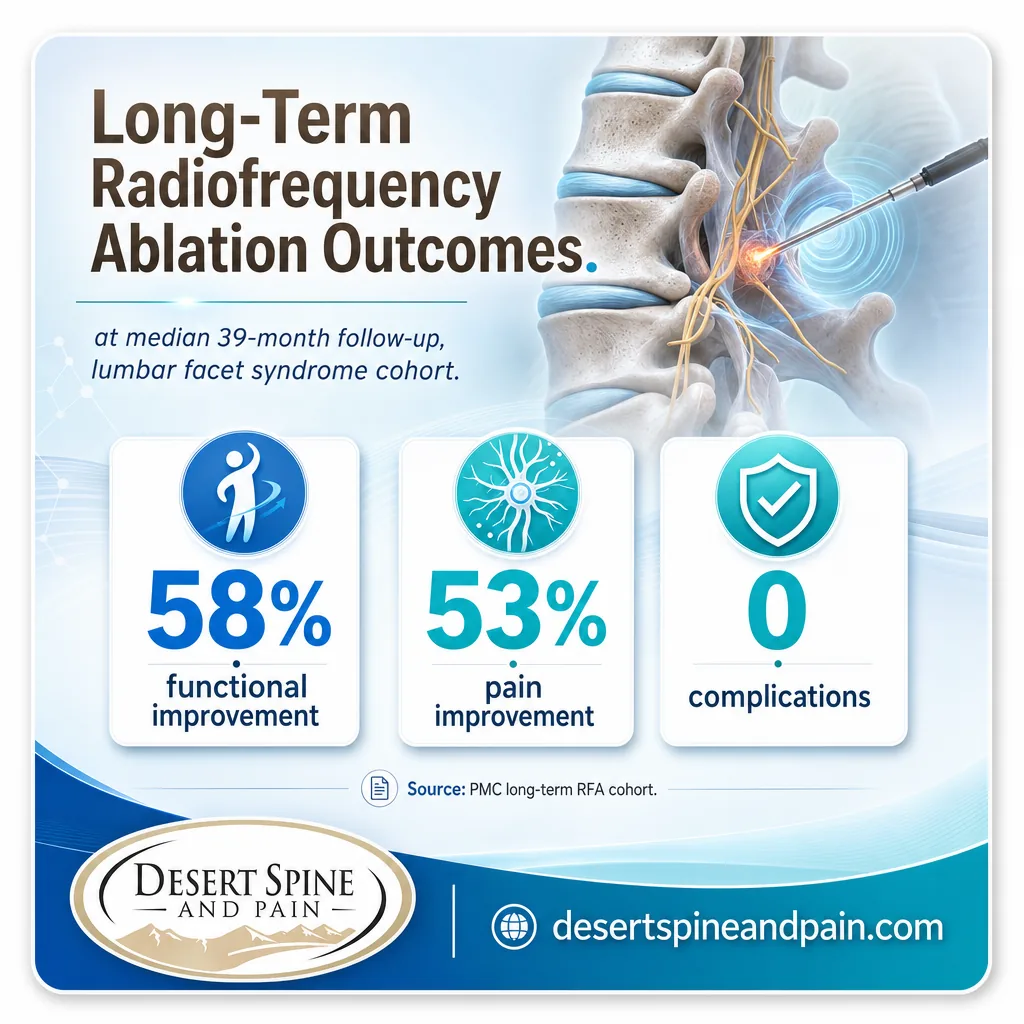
A long-term study of patients with lumbar facet syndrome, all of whom had greater than 75% relief from diagnostic blocks before treatment, found durable results at a median 39-month follow-up: 58% had at least 50% functional improvement and 53% had at least 50% pain improvement, alongside a meaningful reduction in medication use and no complications. Real-world evidence reinforces this. In the RAPID study of 193 patients with lumbar facet syndrome, more than 80% had endured back pain for at least two years and over 85% had moderate-to-crippling disability at baseline, exactly the difficult, long-suffering population that most needs durable options.
The 2026 evidence picture is nuanced. A systematic review of sham-controlled trials published in early 2026 emphasized that studies vary widely in technique and patient selection, which makes pooled averages difficult, and reinforces that outcomes hinge on matching the right RFA technique to the right pain generator. For patients, that complexity is an argument for specialist evaluation, not against the procedure.
Source: PMC, long-term RFA outcomes for lumbar facet syndrome | Journal of Pain Research, systematic review (Feb 2026)
Meet Dr. Greenwald, spine surgeon and neurosurgeon
05 Safety and Where RFA Fits
Radiofrequency ablation sits high on the interventional side of the least-invasive-first ladder, a minimally invasive option that can delay or avoid surgery for the right patient.
RFA is an outpatient procedure with a very low complication rate, same-day discharge, and minimal recovery compared to surgery, which is why it is often described as an effective middle-ground option. Candidacy generally requires pain lasting more than six months that has not responded to conservative treatments such as medication, physical therapy (by referral), or chiropractic care, plus a positive diagnostic block.
Where Radiofrequency Ablation Sits in the Ladder
- Conservative first: non-opioid medication, bracing, physical therapy by referral.
- Interventional, including RFA: diagnostic blocks confirm the target, then ablation for durable relief; a candidate for facet, SI, and select nerve pain.
- Surgery only when warranted: minimally invasive through complex spine surgery, when the structural problem requires it.
Because Dr. Greenwald is both a spine surgeon and a neurosurgeon, Desert Spine and Pain can move a patient across this entire ladder without a handoff, and can recognize early when RFA is likely to hold versus when a case genuinely needs surgical planning.
This is general information, not individual medical advice. Whether RFA fits a specific case depends on an examination and diagnostic workup.
Source: Regenerative Institute (clinical reference) | RAPID real-world RFA study
Review conservative, non-invasive care
06 All the Numbers in One Table
| Statistic | Figure | Source | Year |
|---|---|---|---|
| Lumbar facet RFA success rate | 70-85% | Clinical references / cohort data | 2026 |
| Cervical facet RFA success rate | 65-75% | Clinical reference | 2026 |
| SI joint RFA success rate | 65-80% | Clinical reference | 2026 |
| Sciatica/leg ablation success | 50-70% | Clinical reference | 2026 |
| Typical relief duration | 6-12 months | Clinical references | 2026 |
| Commonly reported relief window | 9-12 months | Clinical reference | 2026 |
| Time to first improvement | 10-14 days | Clinical reference | 2026 |
| Full benefit develops | 2-4 weeks | Clinical reference | 2026 |
| Predictive diagnostic block relief | 50-80% | Regenerative Institute / PMC | 2026 |
| Early success (7-21 days), prospective | 76% | PMC prospective study | 2026 |
| Success at 6 months (mixed cohort) | 32% | PMC prospective study | 2026 |
| Success at 1 year (mixed cohort) | 22% | PMC prospective study | 2026 |
| Functional improvement, 39-mo median | 58% | PMC long-term cohort | 2026 |
| Pain improvement, long-term | 53% | PMC long-term cohort | 2026 |
| Complications in long-term cohort | 0 | PMC long-term cohort | 2026 |
| Facet joints as share of chronic LBP | up to 30% | PMC / peer-reviewed | 2026 |
| RAPID study patients enrolled | 193 | RAPID study (PMC) | 2026 |
| RAPID patients with 2+ yr back pain | >80% | RAPID study (PMC) | 2026 |
07 Frequently Asked Questions
What is the success rate of radiofrequency ablation for back pain?
How long does radiofrequency ablation relief last?
How soon does radiofrequency ablation start working?
What predicts whether radiofrequency ablation will work?
Is radiofrequency ablation safe?
Methodology & Sources
Figures in this article draw on peer-reviewed journals and clinical references. Long-term and prospective outcome data come from PMC-indexed studies: a long-term cohort of lumbar facet syndrome patients (median 39-month follow-up), a prospective study of factors determining RF denervation success, and the RAPID real-world RFA study (193 patients). A 2026 systematic review of sham-controlled trials published in the Journal of Pain Research provides the current evidence context. Success-rate ranges by anatomical location and duration figures are drawn from clinical references synthesizing this literature; these are presented as ranges because published results vary substantially by technique, follow-up window, and patient selection.
Success is generally defined as at least 50% pain reduction. Because RFA outcomes depend heavily on patient selection and diagnostic confirmation, single-figure "success rates" can be misleading; ranges reflect the real spread in the evidence.
Media & press: Journalists and researchers may cite these statistics with attribution to Desert Spine and Pain and a link to this page. The Desert Spine and Pain Analysis box contains original calculation and interpretation.
Talk to a Phoenix Spine and Pain Specialist
Desert Spine and Pain is led by Dr. David L. Greenwald, MD, FACS, a board-certified surgeon who is both a spine surgeon and a neurosurgeon. The practice serves out-of-network patients across Greater Phoenix and partners with personal injury attorneys, offering 24/7 concierge response for their clients. Care follows a least-invasive-first philosophy, from conservative treatment through interventional pain management to complex spine surgery.
Call (602) 566-9500 to book a consultation.