

Nerve Block Statistics (2026): Diagnostic Accuracy, Relief Rates, and Outcomes Data
Nerve blocks play a dual role in spine care: they confirm where pain is coming from and they treat it. Diagnostic accuracy is strong when controlled comparative blocks are used, with facet joints identified as the source of pain in roughly 31% of chronic low back cases. But a single block carries a false-positive rate near 30%, which is why technique matters. Here is what the 2026 data says about how accurate nerve blocks are, how much relief they provide, and where they fit in treatment.
Key Takeaways
- Facet joints cause roughly 31% of chronic low back pain (range 21% to 41%) when confirmed by controlled diagnostic blocks.
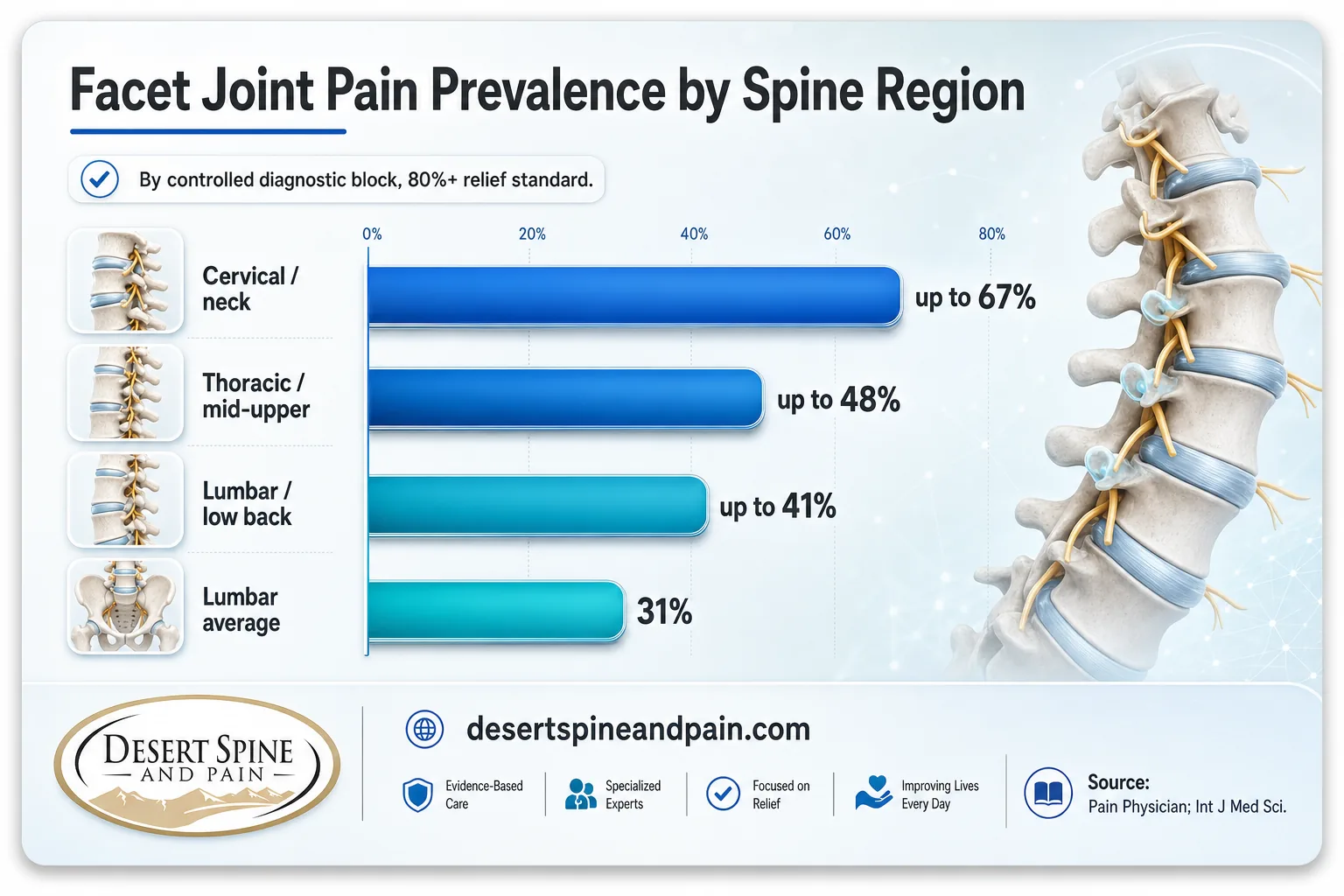
- Cervical facet pain prevalence is 36% to 67%, and thoracic facet pain 34% to 48%, by diagnostic block criteria.
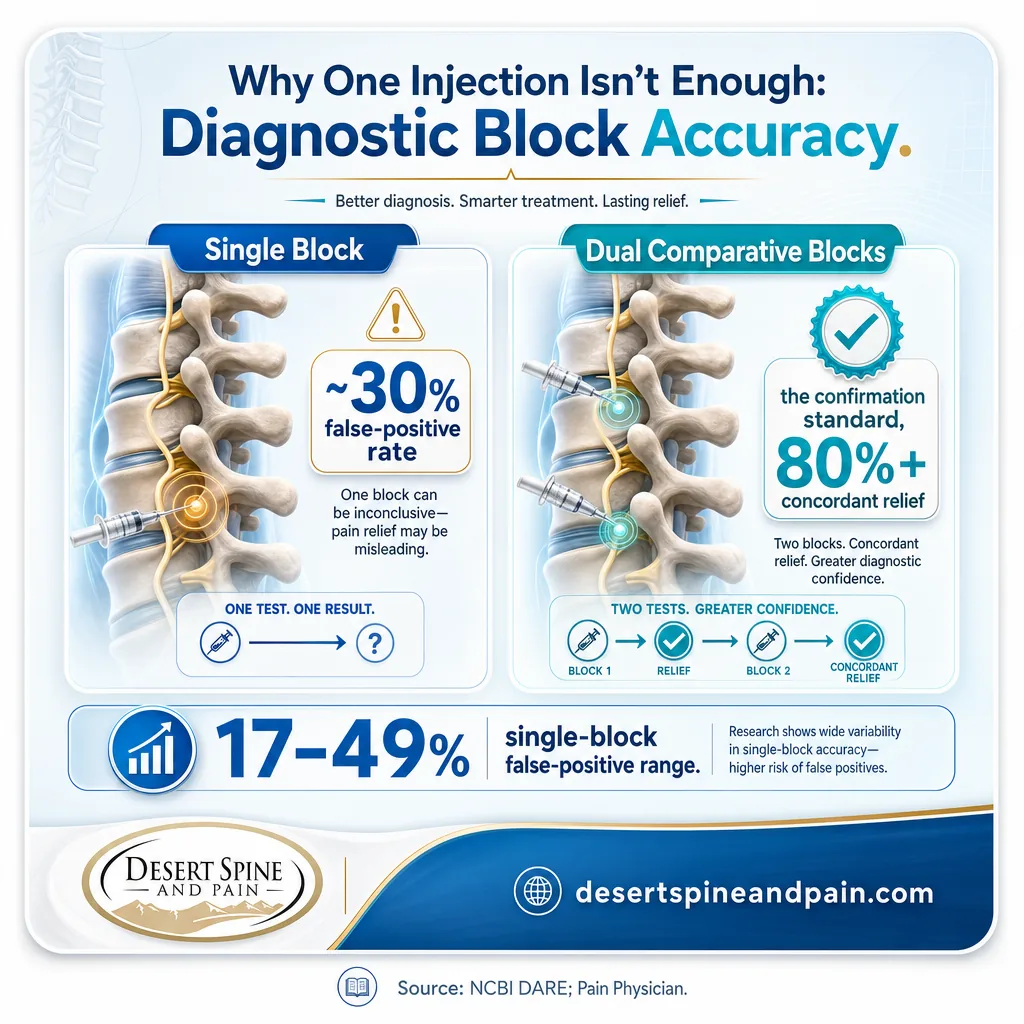
- A single diagnostic block has a ~30% false-positive rate (range 17% to 49%), so dual comparative blocks are the standard.
- Diagnostic evidence is Level I for lumbar facet joint nerve blocks, the strongest evidence category.
- Therapeutic blocks work: a randomized thoracic trial reported improvement in about 90% of participants at 12 months.
- Relief is often repeatable: long-term trials show durable benefit with a small number of blocks over two years.
- Blocks guide bigger decisions: a strong block response (80%+) is the key predictor of radiofrequency ablation success.
What's in This Guide
01 The Dual Role of Nerve Blocks
A nerve block injects local anesthetic, sometimes with a steroid, near a specific nerve to interrupt pain signals. What makes blocks unusual among pain procedures is that they do two jobs at once.
The diagnostic role is often the more valuable one. Because clinical exams and imaging frequently cannot pinpoint which structure is generating chronic spinal pain, a controlled block that temporarily numbs a specific nerve, and reproducibly relieves the pain, is one of the few reliable ways to confirm the source. The therapeutic role delivers relief in its own right and often sets up a longer-lasting procedure. Systematic reviews rate the diagnostic accuracy of lumbar facet joint nerve blocks as Level I, the strongest evidence category, with cervical and thoracic blocks at Level II.
Source: Pain Physician, best-evidence systematic appraisal | NCBI, systematic assessment of facet joint interventions
See how nerve blocks work
02 Facet Joint Pain Prevalence by Region
One of the most useful things nerve-block research has established is just how often the facet joints, rather than discs or nerves, are the true source of spinal pain.
Using controlled comparative local anesthetic blocks with 80% or more pain relief as the standard, lumbar facet joints have been identified as the source of chronic low back pain in an average of 31% of patients (range 21% to 41%). One updated chronic-pain-model assessment found a lumbar prevalence of 34.1%, and a cervical assessment found 49.3%. Cervical facet joint pain prevalence ranges widely, from 36% to 67%, and thoracic facet joint pain from 34% to 48%. These numbers define the candidate population for facet-targeted treatments, and they explain why so much interventional pain care centers on the medial branch nerves that serve these joints.
Source: Int J Med Sci, lumbar facet RCT (prevalence data) | Pain Physician, cervical facet prevalence
Learn about medial branch nerve blocks
03 Diagnostic Accuracy and False-Positive Rates
The credibility of a nerve block as a diagnostic tool depends on how it is performed, and this is where the data delivers its most important practical lesson.
A single diagnostic block is prone to false positives: the overall rate is about 30%, ranging from 17% to 49% depending on the study and spine region. That is why controlled, comparative blocks, using two different anesthetics on separate occasions and requiring concordant relief, are considered the standard for confirming facet joint pain. This distinction is not academic. Acting on a single positive block risks treating the wrong target; confirming with a controlled comparative approach sharply improves accuracy.
Myth: "If one injection made my pain better, that proves what's causing it."
A single positive block is helpful but not definitive. With a false-positive rate near 30%, roughly one in three single-block "confirmations" can be misleading. That is why careful specialists often use controlled comparative blocks before committing to a longer-lasting procedure. The extra rigor is what protects patients from treating the wrong pain source. This is general information, not a substitute for a personal evaluation.
Source: Pain Physician, prevalence and false-positive assessment | NCBI DARE, false-positive meta-analysis
Meet Dr. Greenwald, spine surgeon and neurosurgeon
04 Therapeutic Relief and Durability
Beyond diagnosis, therapeutic nerve blocks provide real relief, and the higher-quality trials show it can be durable when blocks are repeated appropriately.
Randomized controlled trials with two-year follow-up have shown that therapeutic medial branch blocks, with or without steroids, produce meaningful improvement in pain, function, psychological status, and return-to-work status. In a randomized double-blind active-controlled thoracic trial, about 90% of participants showed significant pain relief and functional improvement at 12 months. Systematic reviews give a "strong" recommendation for therapeutic lumbar facet joint nerve blocks and radiofrequency neurotomy, while noting weaker evidence for intra-articular injections.
Desert Spine and Pain Analysis: The Diagnostic Value Behind the Relief
Combining two Tier 1 findings, a facet-pain prevalence near 31% in chronic low back pain against a single-block false-positive rate near 30%, shows why the same procedure that treats pain is also a precision instrument. When roughly a third of chronic low back pain is facet-mediated and roughly a third of single blocks mislead, the controlled comparative block is what closes the gap between "probably" and "confirmed" before a durable treatment is chosen.
Formula: ~31% facet-pain prevalence and ~30% single-block false-positive rate together justify controlled comparative blocks as the confirmation standard.
Calculation and interpretation original to Desert Spine and Pain. Source figures: Pain Physician and Int J Med Sci facet prevalence and false-positive data.
Source: PMC, thoracic medial branch block RCT (2-year) | PubMed, lumbar facet nerve block RCT
Explore the full range of interventional pain care
05 Blocks as a Gateway to Longer-Lasting Relief
One of the most important roles of a nerve block is what it enables next: it identifies the patients most likely to benefit from radiofrequency ablation, which can extend relief far longer.
Research consistently shows that patients who achieve strong relief from controlled diagnostic blocks, commonly 80% or more, are the best candidates for radiofrequency ablation, which can provide 6 to 12 months of relief per treatment. One study found that a somewhat less strict block criterion (80% to 99% relief) produced outcomes similar to the strictest 100% standard, suggesting practical selection thresholds can work well. The block, in other words, is not just a treatment; it is the decision point that makes durable relief possible.
Where Nerve Blocks Sit in the Ladder
- Conservative first: non-opioid medication, bracing, physical therapy by referral.
- Diagnostic and therapeutic blocks: confirm the pain source and provide relief, guiding what comes next.
- Radiofrequency ablation or surgery: for confirmed facet pain, ablation extends relief; surgery is reserved for structural problems that require it.
Because Dr. Greenwald is both a spine surgeon and a neurosurgeon, Desert Spine and Pain can interpret a block result with the full context of what might come next, from ablation to, when truly warranted, surgery, without a referral handoff.
This is general information, not individual medical advice. Whether a nerve block is appropriate, and what it means for next steps, depends on a full evaluation.
Source: PMC, block selection paradigms for ablation | PMC, prognostic block selection criteria
See how radiofrequency ablation extends relief
06 All the Numbers in One Table
| Statistic | Figure | Source | Year |
|---|---|---|---|
| Lumbar facet pain prevalence (avg) | 31% | Int J Med Sci / Pain Physician | 2026 |
| Lumbar facet pain prevalence (range) | 21-41% | Pain Physician systematic review | 2026 |
| Lumbar prevalence (chronic-pain model) | 34.1% | Pain Physician (2020) | 2026 |
| Cervical facet pain prevalence | 36-67% | Pain Physician appraisal | 2026 |
| Cervical prevalence (chronic-pain model) | 49.3% | Pain Physician (2020) | 2026 |
| Thoracic facet pain prevalence | 34-48% | Pain Physician appraisal | 2026 |
| Single-block false-positive rate (overall) | ~30% | NCBI DARE meta-analysis | 2026 |
| Single-block false-positive range | 17-49% | Pain Physician / DARE | 2026 |
| Cervical false-positive rate | 25.6% | Pain Physician (2020) | 2026 |
| Diagnostic evidence level, lumbar | Level I | Pain Physician appraisal | 2026 |
| Diagnostic evidence level, cervical/thoracic | Level II | Pain Physician appraisal | 2026 |
| Thoracic block improvement at 12 mo | ~90% | PMC RCT (Manchikanti) | 2026 |
| Therapeutic trial follow-up | 2 years | Int J Med Sci RCT | 2026 |
| Cervical block relief duration (bupivacaine) | ~55 days (50%+) | Pain Physician (2020) | 2026 |
| Block relief predicting ablation success | 80%+ | PMC cohort studies | 2026 |
| Ablation relief unlocked per treatment | 6-12 months | Clinical references | 2026 |
| Mean therapeutic blocks over 2 years | ~5-6 | Int J Med Sci RCT | 2026 |
07 Frequently Asked Questions
What is a nerve block and what is it used for?
How accurate are diagnostic nerve blocks?
How common is facet joint pain as a cause of back and neck pain?
How long does relief from a therapeutic nerve block last?
Why do I need a nerve block before radiofrequency ablation?
Methodology & Sources
All figures trace to Tier 1 peer-reviewed sources. Facet joint pain prevalence and diagnostic false-positive rates come from randomized controlled trials and systematic reviews published in Pain Physician, the International Journal of Medical Sciences, and the NCBI DARE quality-assessed review database, using controlled comparative local anesthetic blocks with 80%+ pain relief as the criterion standard. Therapeutic outcome data come from randomized, double-blind controlled trials with 2-year follow-up (Manchikanti et al.). Diagnostic evidence levels reflect best-evidence systematic appraisals. Block-to-ablation selection data come from PMC-indexed cohort studies evaluating prognostic block paradigms.
Prevalence and false-positive figures vary by spine region, study population, and diagnostic criteria; ranges are presented alongside averages. Because much of the highest-quality evidence comes from a concentrated group of investigators, figures are described as reflecting the current published evidence base available in 2026.
Media & press: Journalists and researchers may cite these statistics with attribution to Desert Spine and Pain and a link to this page. The Desert Spine and Pain Analysis box contains original calculation and interpretation.
Talk to a Phoenix Spine and Pain Specialist
Desert Spine and Pain is led by Dr. David L. Greenwald, MD, FACS, a board-certified surgeon who is both a spine surgeon and a neurosurgeon. The practice serves out-of-network patients across Greater Phoenix and partners with personal injury attorneys, offering 24/7 concierge response for their clients. Care follows a least-invasive-first philosophy, from conservative treatment through interventional pain management to complex spine surgery.
Call (602) 566-9500 to book a consultation.