
Who Performs Nerve Ablation? The Specialists Behind the Procedure
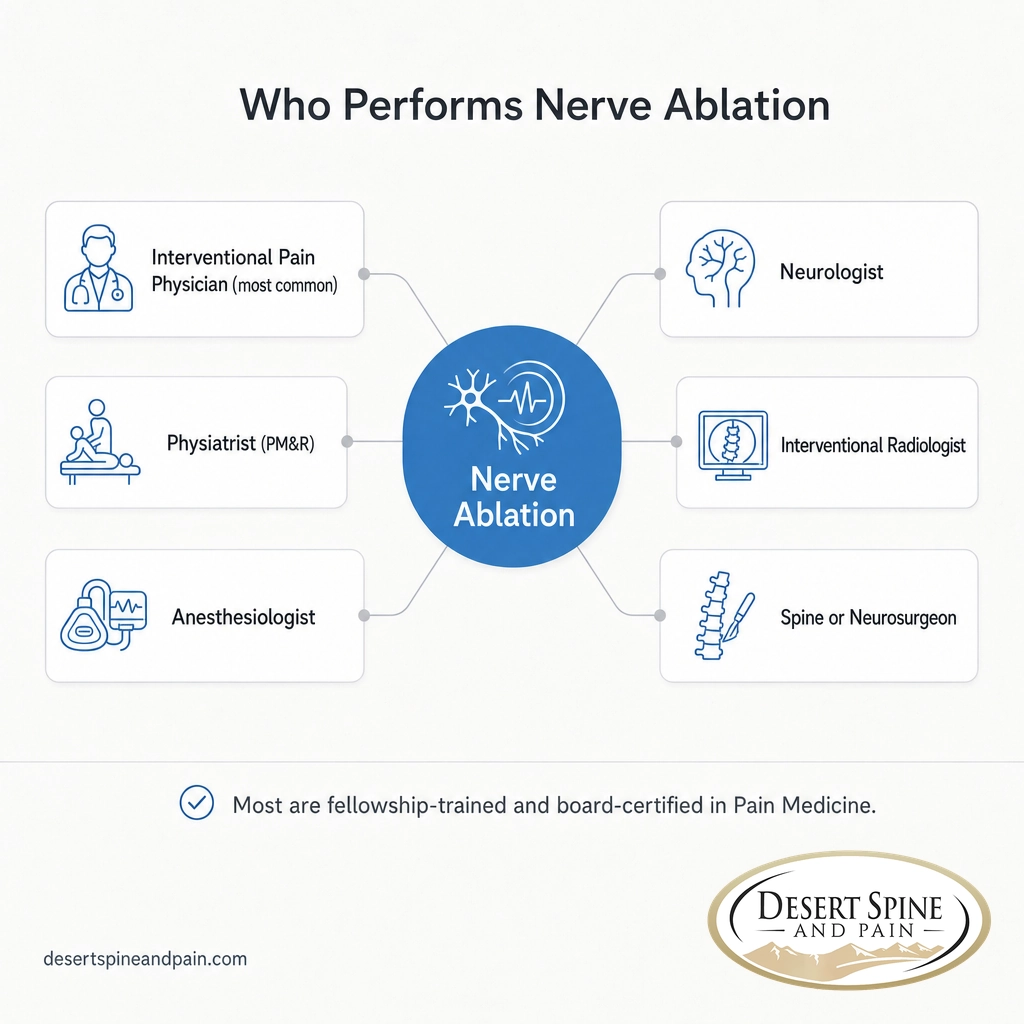
Nerve ablation is performed by a specialist who treats pain for a living: most often an interventional pain physician, and in many spine practices a physiatrist, anesthesiologist, neurologist, interventional radiologist, or spine surgeon with advanced pain training. It is an office-based, image-guided procedure, not something a general practitioner performs. Choosing a provider who is fellowship-trained, board-certified, and selective about who is a candidate is the single biggest factor in whether you get lasting relief.
Quick definition: Nerve ablation (also called radiofrequency ablation, radiofrequency neurotomy, or rhizotomy) is a minimally invasive procedure that uses heat from a thin, needle-like probe to disable a specific nerve so it can no longer send pain signals. It is used for chronic joint and spine pain when temporary treatments stop working.
- Who does it: fellowship-trained, board-certified pain specialists, most commonly interventional pain physicians, plus physiatrists, anesthesiologists, neurologists, interventional radiologists, and some spine surgeons.
- Where: an outpatient office or procedure suite, guided by live X-ray (fluoroscopy). Not a hospital-stay surgery.
- First step: a diagnostic nerve block confirms the pain source. If it does not give meaningful relief, ablation is usually not recommended.
- How long it lasts: typically six to 12 months; the nerve can regrow, and the procedure can be repeated.
- What matters most: the provider's training and patient selection, not just access to the equipment.
What's in This Guide
What Nerve Ablation Is and How It Works
Nerve ablation treats pain at its source. When a nerve keeps relaying pain from a worn joint or an irritated spinal structure, a specialist can heat that nerve with a small probe so it stops carrying the signal. The pain quiets down even though the underlying joint has not changed.
A simple way to picture it: think of a faulty wire that keeps setting off an alarm. You can keep silencing the alarm with medication, or you can interrupt the one wire that keeps tripping it. Nerve ablation interrupts the wire. The most common target in spine care is the small medial branch nerves that serve the facet joints, the paired joints at the back of the spine that let you bend and twist.
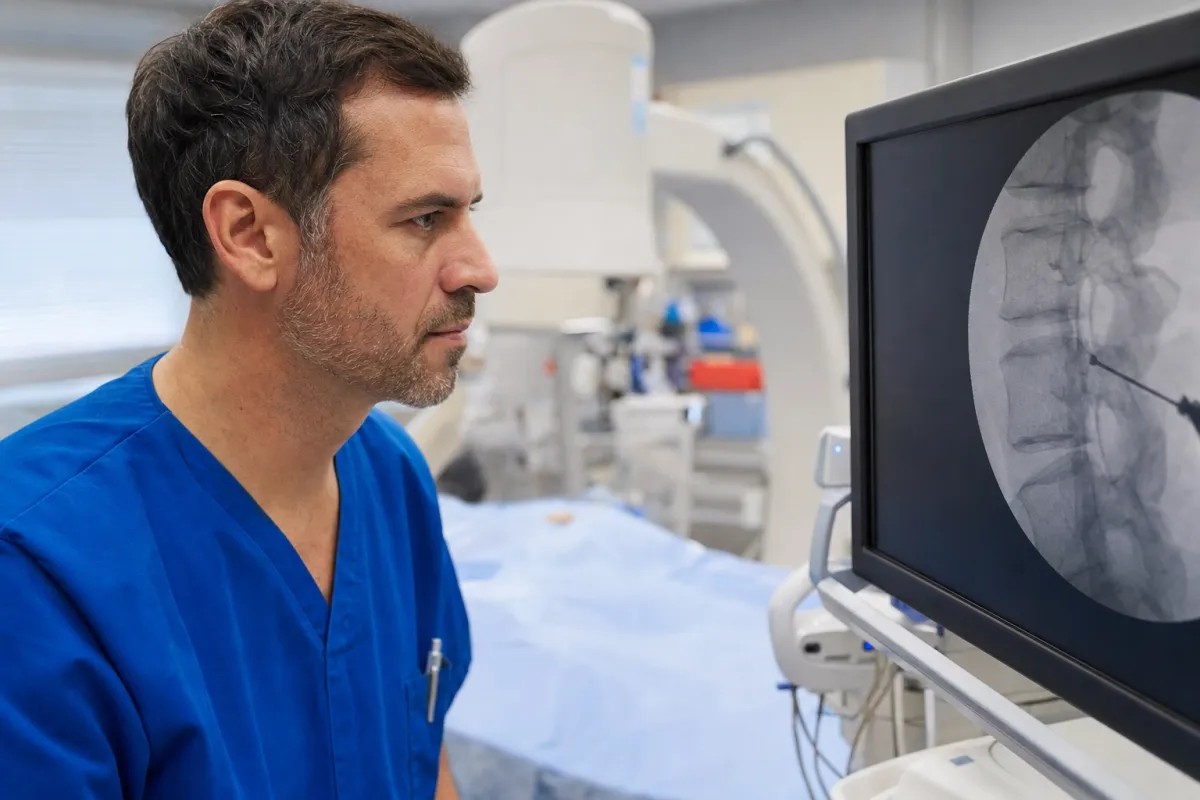
The spine's facet joints are a frequent source of ongoing back and neck pain, which is why they are the most common target for ablation.
Ablation does not require a hospital stay. It is done in an outpatient setting with local anesthetic and, usually, light sedation, using live X-ray to place the probe precisely. Relief is not instant: it often builds over one to three weeks as the treated nerve settles.
Source: Mayo Clinic | Cleveland Clinic
Who Performs Nerve Ablation
There is no single specialty that owns nerve ablation. What the qualified providers share is advanced, fellowship-level training in diagnosing and treating pain. Mayo Clinic puts it plainly: radiofrequency neurotomy is usually done by a doctor who specializes in treating pain. Here are the clinicians who most often perform it.
| Provider | Background | Typical role in nerve ablation |
|---|---|---|
| Interventional pain physician | Pain Medicine fellowship after anesthesiology, PM&R, or neurology | The most common provider; performs image-guided spine and joint ablation routinely |
| Physiatrist (PM&R) | Physical medicine and rehabilitation, often with a pain fellowship | Common in spine and musculoskeletal clinics; strong focus on function |
| Anesthesiologist | Anesthesiology with pain subspecialty training | The traditional route into interventional pain; expert in nerve targeting |
| Neurologist | Neurology, sometimes with pain training | Performs ablation when a nerve-related pain condition is the focus |
| Interventional radiologist | Radiology with image-guided procedure training | Often performs joint and tumor-related ablation under imaging |
| Spine or neurosurgeon | Orthopedic spine surgery or neurosurgery | Offers ablation within a full spine program, from conservative care to surgery |
The through-line is training, not title. A board-certified pain specialist from any of these paths is doing the same core procedure, built on the same skills: reading imaging, targeting a precise nerve, and knowing when the patient is a good candidate. In a complete spine practice, the person who performs your ablation may also be the one who can advise on nerve blocks and, if needed, surgical options, so your whole plan stays under one roof.
Source: Mayo Clinic | American Board of Anesthesiology
See our radiofrequency ablation careHow to Tell If Your Provider Is Qualified
Because several specialties perform ablation, credentials vary more than most patients expect. Pain Medicine is a recognized subspecialty certified under the American Board of Medical Specialties, with the exam administered by the American Board of Anesthesiology and open to physicians from anesthesiology, PM&R, neurology, and other base boards. That certification, plus an accredited pain fellowship, is the clearest signal that a provider does this work to a national standard.
Do not assume every clinic meets the same bar. A 2022 study in the Journal of Pain Research found that a meaningful share of clinicians performing lumbar radiofrequency ablation had neither completed a pain fellowship at an accredited program nor held current Pain Medicine board certification. The equipment is widely available; the training is not. It is reasonable, and smart, to ask directly about both.
Four questions worth asking before you schedule:
- Are you board-certified in Pain Medicine, and did you complete a pain fellowship? This is the baseline.
- Will you confirm the pain source with a diagnostic block first? A careful provider does not ablate a nerve they have not tested.
- How many of these do you perform, and for my specific problem? Experience with your target area matters.
- What happens if it does not work, or the pain comes back? You want a provider who can take the next step, not just refer you out.
Source: American Board of Medical Specialties
Meet Dr. David L. Greenwald, MD, FACSNerve Ablation vs. Nerve Block
This is the most common confusion, and it matters because the two go together. A nerve block is usually the test; nerve ablation is the treatment. Your provider numbs the suspected nerve with an anesthetic injection. If your pain drops significantly, that nerve is confirmed as the culprit, and ablation becomes a sensible next step. If the block does not help, ablation is unlikely to help either.
| Feature | Nerve block | Nerve ablation |
|---|---|---|
| Main purpose | Diagnostic (and short-term relief) | Therapeutic (longer-term relief) |
| What it does | Numbs the nerve with medication | Heats and disables the nerve |
| How long it lasts | Hours to a few weeks | Typically 6 to 12 months |
| When it is used | First, to confirm the pain source | After a successful block confirms the target |
| Repeatable | Yes | Yes, if the nerve regrows |
In spine care, the diagnostic step is often a medial branch nerve block, which targets the small nerves feeding the facet joints. Many providers want to see meaningful relief from one or two of these blocks before moving to ablation.
Source: Cleveland Clinic

The Step-by-Step Process
Done well, nerve ablation is methodical. The steps below are what a careful, well-trained provider follows from your first visit through recovery.
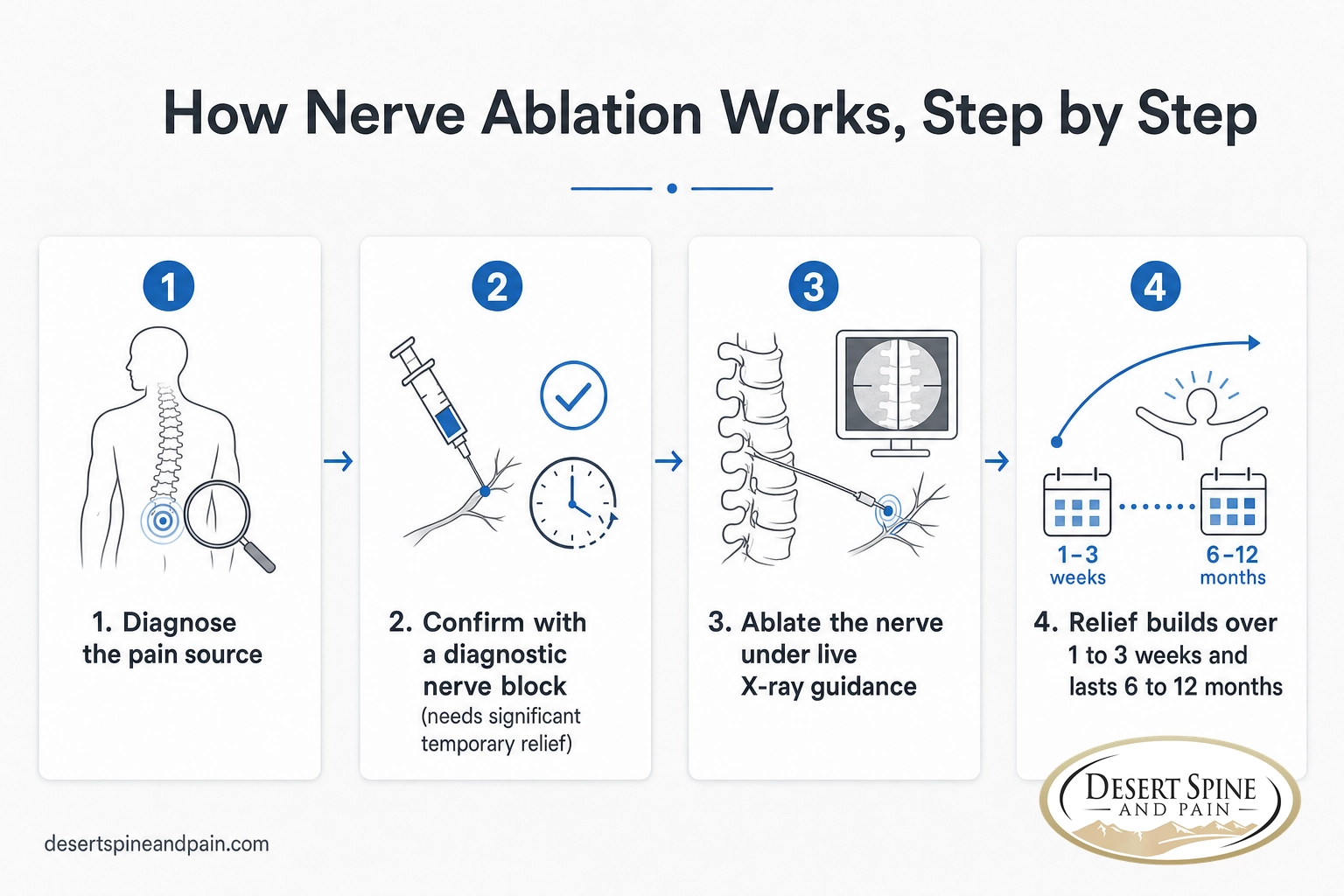
- Diagnose the pain source. Your specialist reviews your history, exam, and imaging to pinpoint which joint or nerve is most likely driving the pain.
- Confirm with a diagnostic block. A numbing injection on the suspected nerve tests the theory. Significant temporary relief points to a good ablation target; little relief usually means ablation is not the answer.
- Perform the ablation under imaging. With the target confirmed, the provider uses live X-ray to place a thin probe against the nerve and delivers controlled heat for a short time.
- Recover and feel the benefit build. It is an outpatient procedure; most people go home the same day. Relief typically develops over one to three weeks and then lasts months.
Serious complications are uncommon. The treated area can be sore for a few days, and on rare occasions there is temporary numbness or a short-lived increase in pain before relief sets in. A qualified provider reviews these with you ahead of time and matches the procedure to the right candidate, which is where patient selection, more than technique alone, earns its keep.
Source: Cleveland Clinic
Types of Nerve Ablation
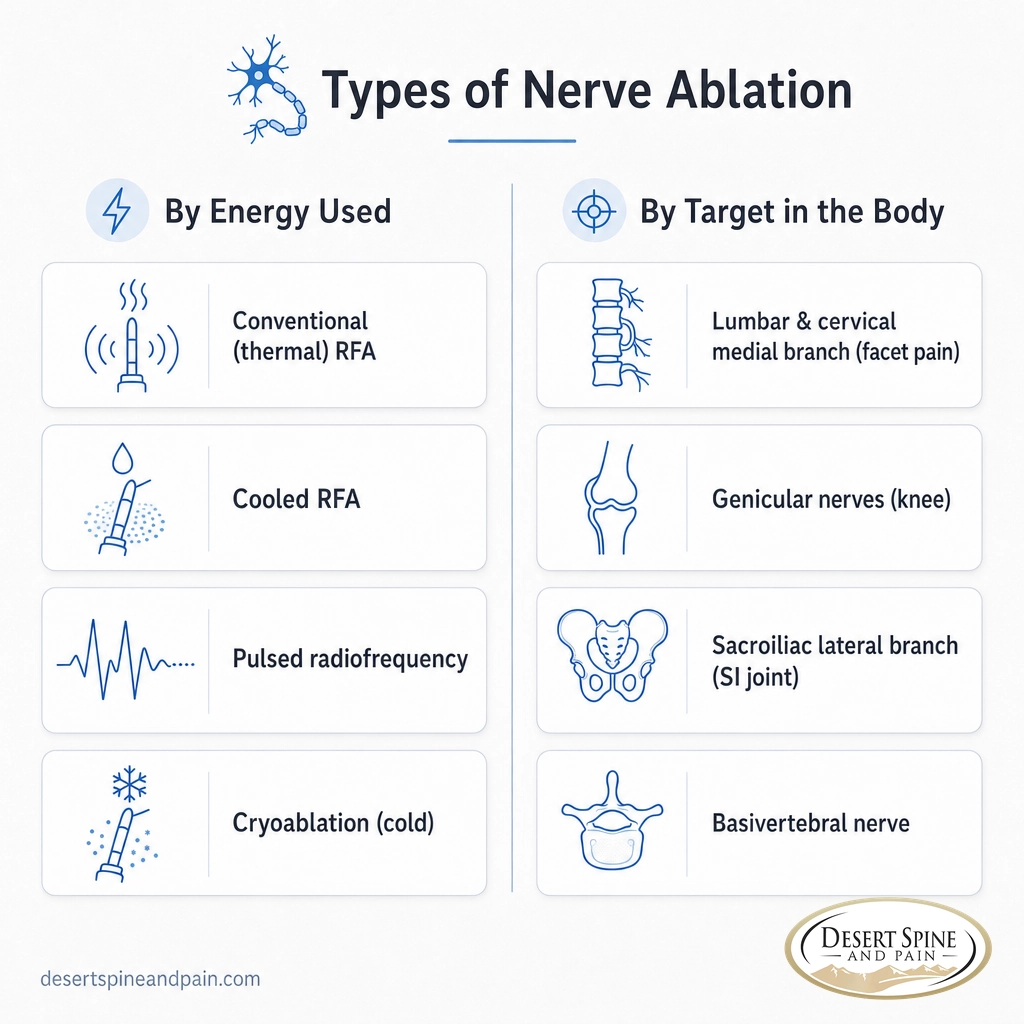
"Nerve ablation" is a family of related techniques. Providers choose among them based on the nerve being treated and the energy that works best for it. Knowing the names helps you understand your own treatment plan.
By energy used
- Conventional (thermal) radiofrequency ablation: steady heat disables the nerve. The standard approach for facet-related spine pain.
- Cooled radiofrequency ablation: circulating water lets the probe treat a larger area, often used for knee and sacroiliac joint pain.
- Pulsed radiofrequency: lower-energy pulses calm a nerve without fully destroying it, sometimes chosen near sensitive nerves.
- Cryoablation (cryoneurolysis): extreme cold, rather than heat, interrupts the nerve.
By target in the body
- Lumbar and cervical medial branch: for facet-joint back and neck pain, the most common spine use.
- Genicular nerves: for chronic knee pain.
- Sacroiliac (lateral branch): for pain from the SI joint.
- Basivertebral nerve: for a specific type of pain arising from the vertebral endplates.
The right choice depends on an accurate diagnosis, which loops back to the first rule of this procedure: the provider's judgment comes before the probe. If your back pain has lingered, it helps to first understand when back pain is considered chronic and which spinal nerves map to your symptoms.
Why the Right Provider Matters for Spine Pain
Nerve ablation is only as good as the plan around it. The best outcomes come from a provider who can diagnose the true pain source, confirm it before treating, and, if ablation is not the full answer, guide you to the next appropriate step without starting over somewhere new.
At Desert Spine and Pain in Phoenix, that continuum sits with one practice. Dr. David L. Greenwald, MD, FACS is board-certified and both a spine surgeon and a neurosurgeon, which means your pain is evaluated across the full range of options, from the least invasive ablation and stimulation procedures through advanced surgery, with the least-invasive effective treatment considered first. Many patients travel from outside the Greater Phoenix area for exactly this caliber of care, and the practice also works closely with personal injury attorneys and their clients.
If you are weighing nerve ablation, the right first move is a conversation with a specialist who performs it and can confirm whether you are a candidate.
Book a ConsultationCommon Questions
Who performs nerve ablation?
What kind of doctor does radiofrequency ablation for back pain?
Is nerve ablation the same as a nerve block?
How long does relief from nerve ablation last?
What credentials should a nerve ablation provider have?
Related Terms
- Radiofrequency ablation (RFA): the heat-based form of nerve ablation used most often in spine care. See our radiofrequency ablation page.
- Medial branch block: a diagnostic injection that confirms facet-joint pain before ablation. See medial branch nerve blocks.
- Nerve block: a numbing injection used to locate the pain source. See our nerve blocks overview.
- Facet joints: the paired joints at the back of the spine that are the most common ablation target.
- Rhizotomy / radiofrequency neurotomy: other names for the same spinal nerve ablation procedure.
- Interventional pain management: the field of image-guided, minimally invasive pain procedures. See our pain treatments.
Methodology and Sources
This guide draws on primary medical and board-certification sources. Procedure facts (how ablation works, imaging guidance, the role of the diagnostic block, duration of relief and nerve regrowth, and risks) are from Mayo Clinic and Cleveland Clinic. Provider-credentialing facts are from the American Board of Medical Specialties and the American Board of Anesthesiology. The facet-joint prevalence figure is from a peer-reviewed 2018 review in Insights into Imaging. The finding on variable provider credentials is from a 2022 study in the Journal of Pain Research. This article is educational and is not individual medical advice; treatment decisions should be made with a qualified specialist.
- Mayo Clinic: Radiofrequency Neurotomy
- Cleveland Clinic: Radiofrequency Ablation
- American Board of Medical Specialties: Subspecialty Certificates
- American Board of Anesthesiology
- Perolat et al., Insights into Imaging (2018): Facet joint syndrome
- Abd-Elsayed et al., Journal of Pain Research (2022): International Survey on the Practice of Lumbar Radiofrequency Ablation