

When Is Back Pain Considered Chronic?
Chronic back pain, in plain terms: Back pain is considered chronic once it lasts longer than 12 weeks, roughly three months, even after the original injury has had time to heal. Shorter episodes are called acute or subacute. The 12-week mark matters because long-lasting pain is evaluated and treated differently from a short flare-up.
If your back has been hurting for weeks and you are starting to wonder whether this is just a slow recovery or something more lasting, the question of when pain becomes "chronic" is a fair one, and the answer is more precise than most people expect. Clinicians sort back pain by how long it lasts, and the dividing line for chronic is 12 weeks. Reaching that mark does not mean the pain is permanent or that something is seriously wrong, but it does change how the pain should be looked at. This guide explains exactly when back pain is considered chronic, how acute, subacute, and chronic pain differ, why the calendar is only part of the picture, what causes pain to persist, and when it is time to see a spine specialist.
- Back pain is considered chronic once it lasts longer than 12 weeks (about three months), the threshold used by the National Institutes of Health.
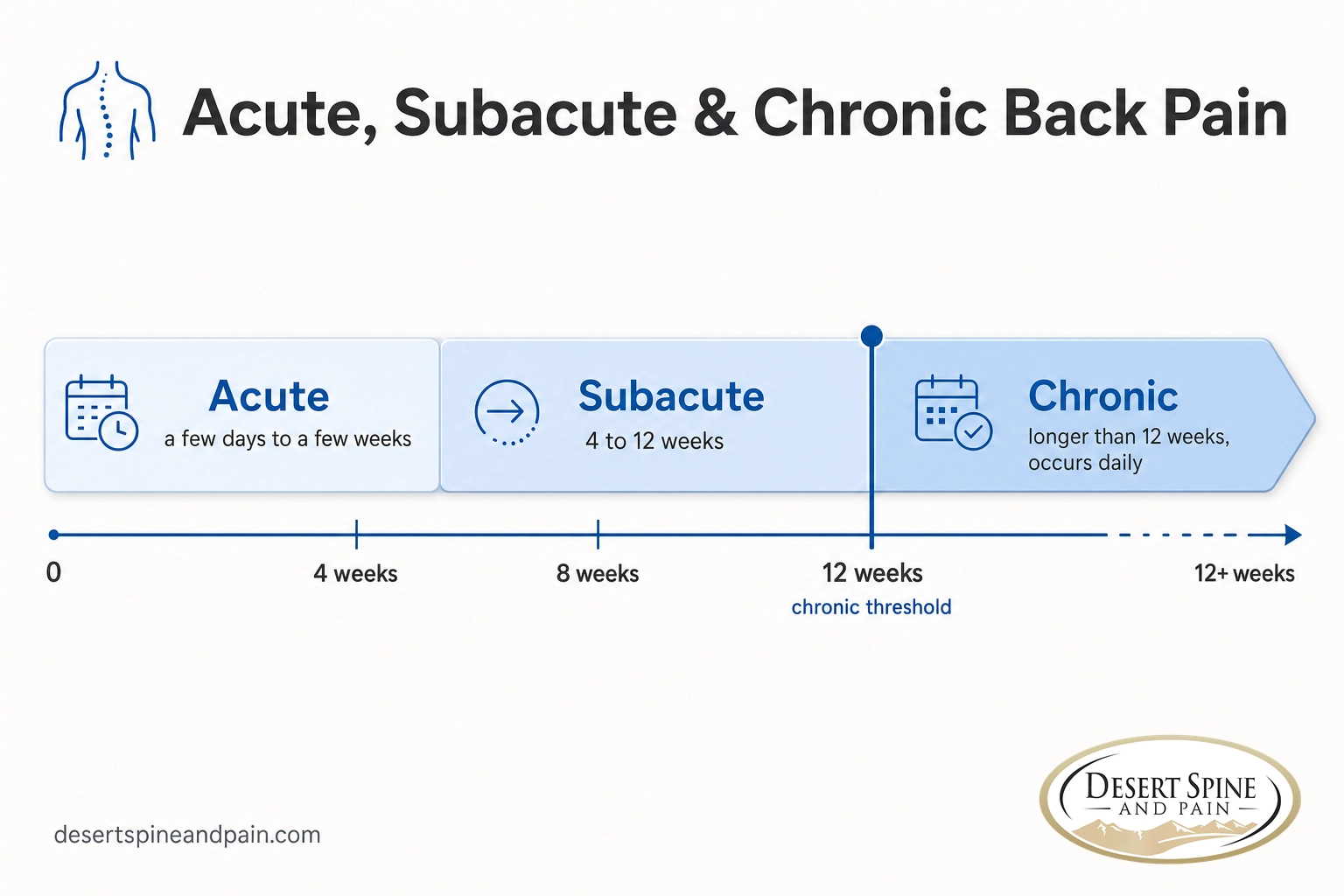
- Acute pain lasts days to a few weeks, subacute pain lasts about 4 to 12 weeks, and chronic pain lasts beyond 12 weeks and tends to recur.
- Chronic does not mean permanent, and it does not automatically mean a serious cause; most back pain is non-specific, with no single structural source.
- Some sources use a six-month cutoff, so the label on a report can vary, but three months is the most widely used threshold.
- Pain that lasts more than a few weeks, keeps returning, or radiates into a limb is worth having evaluated, and a few red-flag symptoms call for urgent care.
What's in This Guide
- The 12-Week Threshold: When Back Pain Is Chronic
- Acute vs. Subacute vs. Chronic Back Pain
- Why the Calendar Is Not the Whole Story
- How Common Is Chronic Back Pain?
- What Causes Back Pain to Become Chronic?
- When Should You See a Specialist?
- How Chronic Back Pain Is Treated
- How to Get Started
- Common Questions
- Related Spine Terms
- Sources
The 12-Week Threshold: When Back Pain Is Chronic
The short answer is a number: 12 weeks. Back pain is classified as chronic once it has lasted longer than about three months. That is the definition used by the National Institute of Arthritis and Musculoskeletal and Skin Diseases, part of the National Institutes of Health, which describes chronic back pain as pain that lasts longer than 12 weeks and occurs daily.
Why draw a line at all? Because duration tells a clinician something important. Most back pain is self-limited, meaning it settles on its own as irritated muscles, joints, or discs calm down. When pain outlasts that normal healing window, it signals that something is keeping the pain going, whether that is an ongoing structural problem or a change in how the nervous system is processing pain signals. The label is not about severity on any single day; it is about persistence over time, and persistence is what prompts a different, more thorough approach to diagnosis and treatment.
One nuance worth knowing: not every source uses exactly the same cutoff. The 12-week or three-month mark is the most common and is the one the NIH uses, but some clinicians and older references set the chronic threshold for low back pain at six months. So if one report calls your pain chronic and another does not, the difference may simply be which definition the provider is using, not a disagreement about your actual condition.
Source: National Institute of Arthritis and Musculoskeletal and Skin Diseases: Back Pain | World Health Organization: Low Back Pain fact sheet
Acute vs. Subacute vs. Chronic Back Pain
Chronic is the last of three stages, and the clearest way to understand it is to see all three side by side. The categories are defined purely by how long the pain has lasted, which is why the same back injury can move from one stage to the next over time.
| Stage | How Long It Lasts | What It Usually Looks Like |
|---|---|---|
| Acute | A few days to a few weeks | Comes on suddenly, often after a strain or awkward movement, and typically improves as the tissue heals |
| Subacute | About 4 to 12 weeks | Can begin suddenly or build gradually; it has lasted beyond a simple flare-up but has not yet crossed the chronic mark |
| Chronic | Longer than 12 weeks | Lasts beyond three months and tends to occur daily or keep returning, even after any initial injury has healed |
A helpful way to picture it: acute pain is the alarm that goes off when tissue is injured, and it usually switches off once the tissue mends. Subacute is the in-between zone where most people are still recovering but recovery is taking longer than expected. Chronic is when the pain has stayed switched on past the point where healing alone explains it. That shift, from a healing problem to a persistence problem, is exactly why the timeline matters.
Myth: "Chronic back pain means permanent back pain." Chronic describes how long pain has lasted, not whether it can improve. Many people whose pain has passed the 12-week mark get substantially better once the right cause is identified and treated. Crossing into the chronic category is a reason to look more carefully, not a sentence.
Source: NIAMS (NIH): acute, subacute, and chronic back pain definitions
Why the Calendar Is Not the Whole Story
The 12-week rule is the official answer, but living with back pain is rarely as tidy as a stopwatch. Two situations trip people up, and both are worth understanding.
The first is pain that outlasts the injury. Chronic pain can continue either because of an ongoing condition or because it persists after an injury has already healed. In the second case, the back tissue may look fine on exam, yet the pain is real, because the nervous system has become more sensitive and keeps sending pain signals. This is why a scan that looks unremarkable does not mean the pain is imagined; it means the source is being driven by something other than fresh tissue damage.
The second is pain that keeps coming back. Back pain is often recurrent, flaring up, settling, and returning weeks or months later. A pattern of repeated episodes that never fully resolve can meet the chronic definition even if no single flare lasts a full three months, and it deserves the same careful look as steady, day-after-day pain.
The practical takeaway: if your back pain has lasted more than about 12 weeks, keeps returning in waves, or has stuck around well after an injury that should have healed, it is reasonable to treat it as chronic and have it properly evaluated, regardless of how any single day feels.
Source: Cedars-Sinai: Chronic Back Pain | NIAMS (NIH): Back Pain
How Common Is Chronic Back Pain?
If your pain has become chronic, you are far from alone. Back pain is one of the most common health problems in the world, and the numbers behind it are striking.
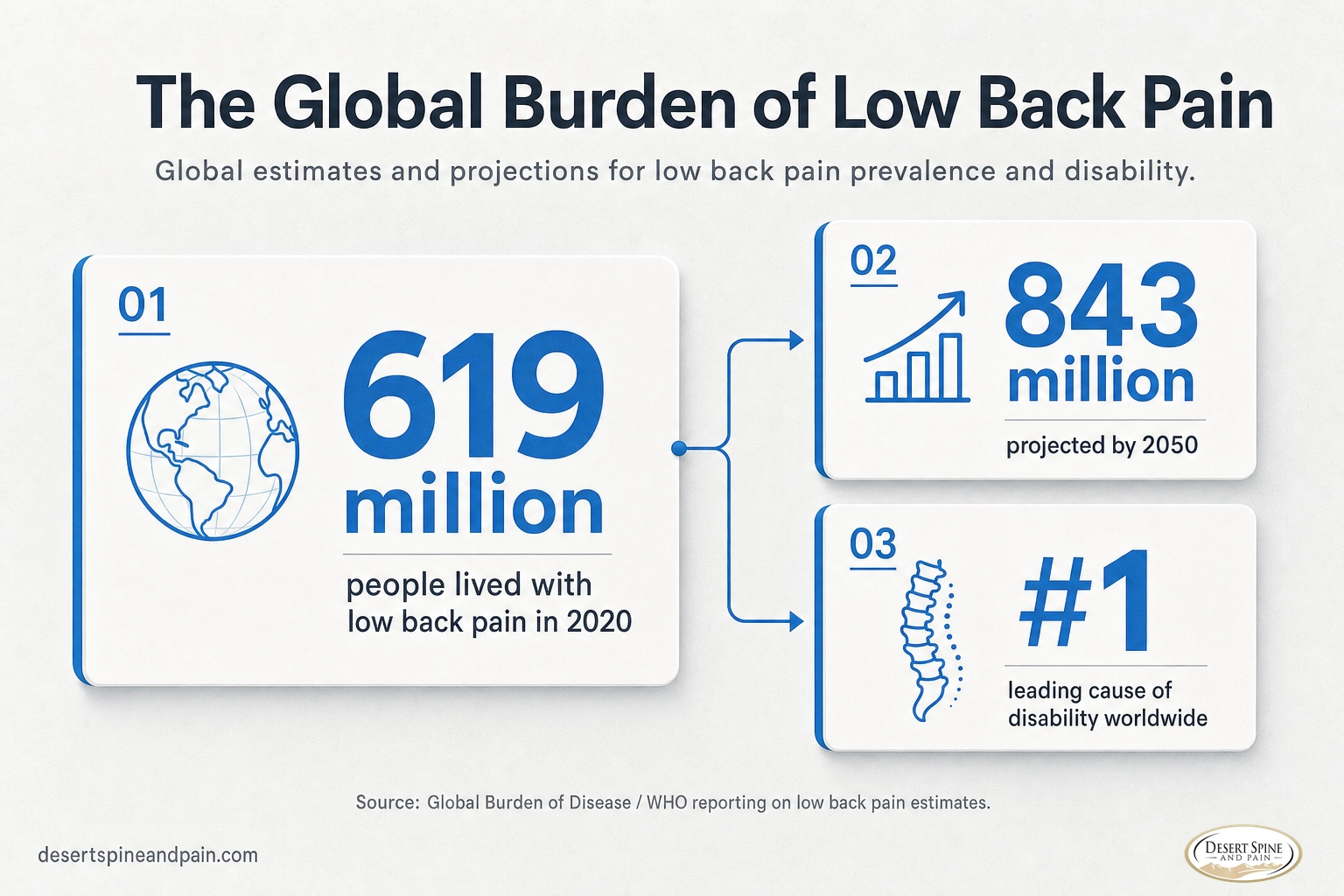
Low back pain is not just common; it is the single leading cause of disability worldwide, meaning it keeps more people from full daily activity than any other health condition. The World Health Organization notes that most people will experience low back pain at some point in their lives, that cases peak around ages 50 to 55, and that women are affected more often than men.
Persistent pain in general rises sharply with age, which helps explain why chronic back pain becomes more likely over time. In the United States, the share of adults living with chronic pain of any type climbs steadily from early adulthood into the senior years.
U.S. adults with chronic pain (any type) by age, 2023
Percentage of U.S. adults who had chronic pain (pain on most days or every day in the past 3 months), by age group. Source: CDC NCHS Data Brief No. 518 (2023).Overall, the CDC reports that 24.3% of U.S. adults, nearly one in four, had chronic pain in 2023, and 8.5% had high-impact chronic pain that frequently limited their daily life or work. Back pain is consistently among the most common sources of that pain, which is part of why the condition carries such a large burden.
Source: World Health Organization: Low Back Pain fact sheet | CDC NCHS Data Brief No. 518: Chronic Pain in U.S. Adults, 2023
What Causes Back Pain to Become Chronic?
When pain crosses the 12-week line, the natural question is why. The honest answer is that in most cases no single structural villain is found: the World Health Organization estimates that about 90% of low back pain is non-specific, meaning there is no identifiable disease or clear structural cause. For these cases, factors like deconditioning, stress, poor sleep, and a sensitized nervous system all play a role in keeping pain going.
In the remaining share, a specific spinal condition is driving the pain, and these are the ones a specialist looks hardest to identify because they often respond to targeted treatment. Common structural causes of persistent back pain include:
- Disc problems. A herniated disc can press on a nerve and produce lasting pain, while degenerative disc disease describes the gradual, age-related wear that can leave a disc painful over the long term.
- Narrowing of the spinal canal. Spinal stenosis crowds the nerves as the canal narrows, often causing pain that builds with standing or walking.
- Pinched or irritated nerves. When a low-back nerve is compressed, it can trigger sciatica, pain that radiates down the leg and can persist until the nerve pressure is relieved.
- Arthritis and joint wear. Facet joint arthritis and other degenerative changes in the spine are a frequent source of ongoing, activity-related back pain.
Identifying which of these, if any, applies is the whole point of a focused evaluation. A finding on a scan only matters when it lines up with your actual symptoms, so an experienced clinician reads your history, your exam, and your imaging together before deciding what is driving pain that has become chronic.
Source: World Health Organization: Low Back Pain fact sheet | Mayo Clinic: Back pain causes

When Should You See a Specialist?
You do not need to wait a full three months to get help. As a practical rule, back pain is worth having evaluated when it lasts more than a few weeks without improving, keeps returning, or comes with pain, numbness, tingling, or weakness that radiates into a leg or arm, which can signal a nerve being pinched. Getting ahead of persistent pain often means simpler, less invasive treatment.
Seek urgent care for red flags. A small number of symptoms call for immediate evaluation rather than watchful waiting: severe or progressively worsening weakness in a leg or arm, numbness around the groin or inner thighs, new loss of bladder or bowel control, back pain with unexplained fever or weight loss, or pain following a significant fall or accident. These are uncommon, but they can indicate a problem that should not wait.
Outside those red flags, the reassuring reality is that reaching the chronic stage is a cue to investigate, not a cause for panic. A thorough spine evaluation can pinpoint what is keeping the pain going and open up treatment options that short, self-limited pain never requires.
Source: Mayo Clinic: Back pain, when to see a doctor | NIAMS (NIH): Back Pain
How Chronic Back Pain Is Treated
Chronic back pain is treated in steps, and the guiding principle at a well-run spine practice is to start with the least invasive option that can work and escalate only when it is genuinely needed. Most people never reach the surgical end of that ladder.
- Conservative, non-surgical care first. This is the foundation: activity modification, guided physical therapy coordinated through trusted referral partners, and anti-inflammatory measures that calm an irritated back and rebuild support. These make up the bulk of non-invasive spine care.
- Interventional pain procedures. When pain persists, targeted, image-guided options such as injections, nerve blocks, and nerve ablation can reduce inflammation and quiet pain signals. These sit in the middle of the ladder as part of a focused interventional pain management plan.
- Surgery, only when it is the best path. If a clear structural cause is compressing a nerve and has not responded to non-surgical care, a procedure, often minimally invasive, may be the right next step. Surgery is reserved for the situations that truly call for it, never the default.
The order matters. Matching the treatment to the stage and the cause is how chronic back pain gets better without doing more than necessary, and it is why a careful diagnosis comes before any treatment decision.
Source: National Institute of Neurological Disorders and Stroke: Back Pain | Mayo Clinic: Back pain diagnosis and treatment
How to Get Started
If your back pain has crossed, or is approaching, the 12-week mark, the most useful next step is a focused evaluation that connects what you are feeling to what is actually happening in your spine, so you know whether the pain is non-specific or driven by a treatable condition.
Desert Spine and Pain is a Phoenix, Arizona practice led by Dr. David L. Greenwald, MD, FACS, a board-certified surgeon who is both a spine surgeon and a neurosurgeon, and one of the top surgeons in the country. Patients come from across the Greater Phoenix area, and from outside it, for this level of expertise. Care always begins with the least invasive effective option and moves toward a procedure only when it is clearly the best path for you.
Learn about chronic back pain care at Desert Spine and Pain
Explore interventional pain management options
Book a consultation or second opinion
Common Questions About Chronic Back Pain
When is back pain considered chronic?
What is the difference between acute and chronic back pain?
Is chronic back pain permanent?
Why does some back pain become chronic?
When should I see a doctor for chronic back pain?
Related Spine Terms
- Acute back pain: pain that comes on suddenly and typically lasts only a few days to a few weeks.
- Subacute back pain: pain lasting about 4 to 12 weeks, the stage between acute and chronic.
- Non-specific low back pain: back pain with no single identifiable structural cause, which accounts for roughly 90% of cases.
- Lower back pain: pain in the lumbar region, the most common location for both acute and chronic back pain.
- Sciatica: radiating pain down the leg caused by irritation or compression of a low-back nerve.
- Discogenic pain: pain that originates from a spinal disc itself, a common contributor to lasting back pain.
- Central sensitization: a state in which the nervous system amplifies pain signals, helping explain pain that outlasts a healed injury.
Sources
Sources and Methodology
This guide summarizes established clinical references and public-health data on how back pain is classified by duration and on the burden of low back pain. Definitions of acute, subacute, and chronic back pain are drawn from U.S. National Institutes of Health sources. Prevalence and burden figures are drawn from the World Health Organization and the U.S. Centers for Disease Control and Prevention and are presented as general reference, not individual predictions. This is educational information, not medical advice. Decisions about diagnosis and treatment should be made with a qualified spine specialist after an in-person evaluation.
- National Institute of Arthritis and Musculoskeletal and Skin Diseases (NIH): Back Pain
- National Institute of Neurological Disorders and Stroke (NIH): Back Pain
- World Health Organization: Low Back Pain fact sheet (2023)
- CDC NCHS Data Brief No. 518: Chronic Pain and High-impact Chronic Pain in U.S. Adults, 2023
- Cedars-Sinai: Chronic Back Pain
- Mayo Clinic: Back pain