

What Is Kyphoplasty? How It Treats Spinal Compression Fractures
Kyphoplasty, in plain terms: Kyphoplasty is a minimally invasive procedure that repairs a painful vertebral compression fracture. A surgeon inflates a small balloon inside the collapsed vertebra to create a cavity and restore some height, then fills it with bone cement that hardens to stabilize the bone and relieve pain. It is usually an outpatient procedure.
If a spine specialist has raised kyphoplasty, it usually means a vertebra in your back has cracked and collapsed, and the pain has not settled with rest and medication. The name comes from "kyphos," the Greek word for the forward hunch that compression fractures can cause, and the goal of the procedure is to shore up the broken bone before that hunch and the pain take hold. This guide explains what kyphoplasty is, how the balloon-and-cement procedure actually works, the fractures it treats, how it differs from vertebroplasty, who is a good candidate, and what recovery and risks look like.
- Kyphoplasty is a minimally invasive repair for a painful vertebral compression fracture: a balloon creates a cavity and restores some height, then bone cement fills and stabilizes the vertebra.
- The fractures it treats are most often caused by osteoporosis, and sometimes by a spinal tumor or trauma.
- It differs from vertebroplasty, which injects cement directly without first inflating a balloon to make a cavity.
- It is usually an outpatient procedure finished within about an hour, and many patients feel pain relief within a day or two.
- It is considered when conservative care has not worked, ideally within about eight weeks of the fracture, and serious complications are uncommon.

What's in This Guide
How Kyphoplasty Works
Kyphoplasty is a form of vertebral augmentation, which simply means reinforcing a broken vertebra from the inside. It is done through a tiny skin incision rather than open surgery, with the patient lying face down and the surgeon using live x-ray imaging to guide every step. No stitches are needed afterward. The core sequence is short and consistent.
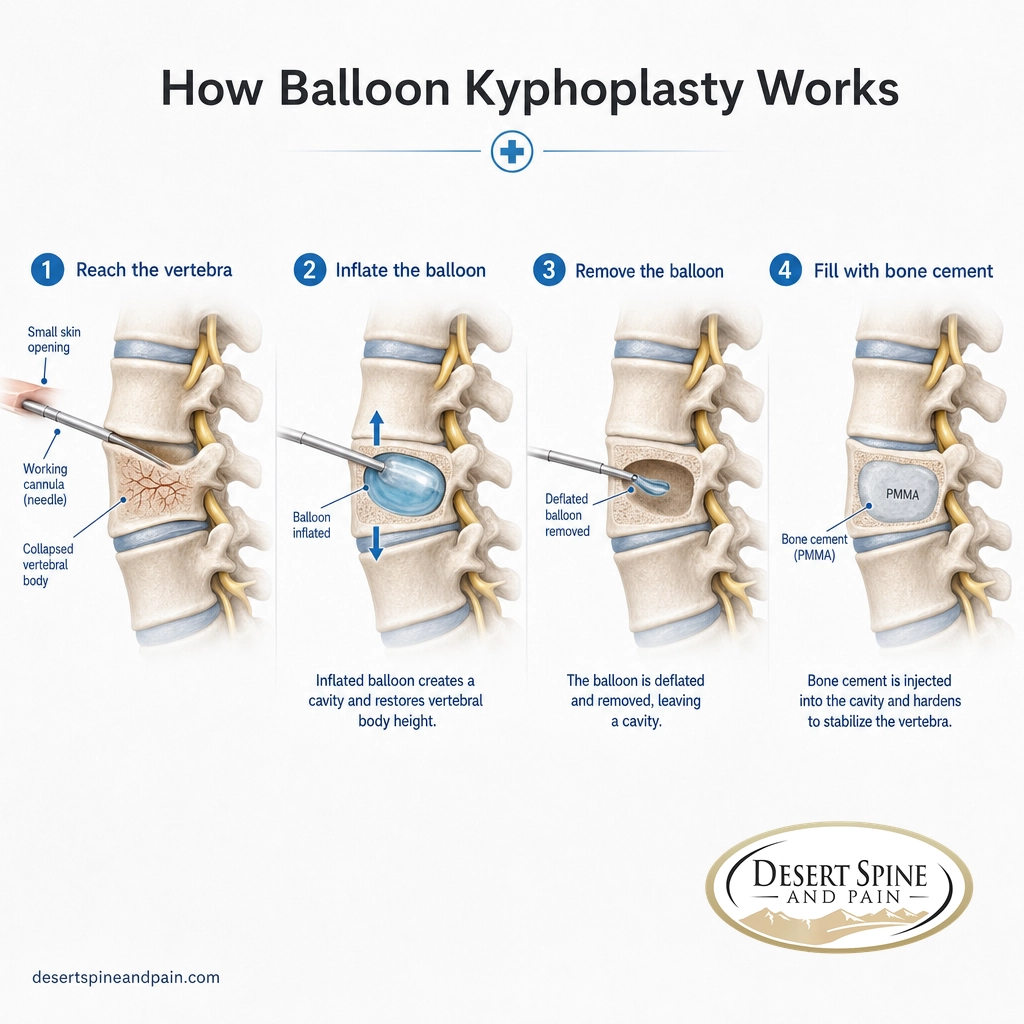
- Anesthesia and positioning. The skin over the fracture is numbed with local anesthetic, usually with moderate sedation. Some patients need general anesthesia. You lie face down so the surgeon has a direct path to the back of the spine.
- Reaching the vertebra. Guided by imaging, the surgeon passes a hollow needle through a small opening in the skin and into the collapsed vertebral body.
- Inflating the balloon. A small balloon is threaded through the needle and gently inflated inside the bone. This is the step unique to kyphoplasty: the balloon creates a cavity and restores some of the height the fracture took away.
- Placing the cement. The balloon is removed, and the cavity is filled with bone cement called polymethylmethacrylate, or PMMA.
- Hardening and stabilizing. The cement sets quickly, typically within about 20 minutes, turning the fractured vertebra back into a solid, supportive block. That internal support is what relieves the fracture pain.
A helpful way to picture it: the fractured vertebra is like a crushed soda can. The balloon gently pushes the walls back toward their original shape, and the cement is poured in as an internal cast that holds that shape permanently. Because the cement provides immediate mechanical support, many patients notice a difference soon after the procedure.
Source: RadiologyInfo.org (RSNA/ACR): Vertebroplasty and Kyphoplasty | American Association of Neurological Surgeons: Vertebral Compression Fractures
What Kyphoplasty Treats: Compression Fractures
Kyphoplasty treats a vertebral compression fracture, often shortened to VCF. This is a break in which the front of a vertebra collapses into a wedge shape, shortening the spine and, over time, producing the stooped posture the procedure is named for. These fractures are far more common than many people realize, and most are tied to weakened bone.
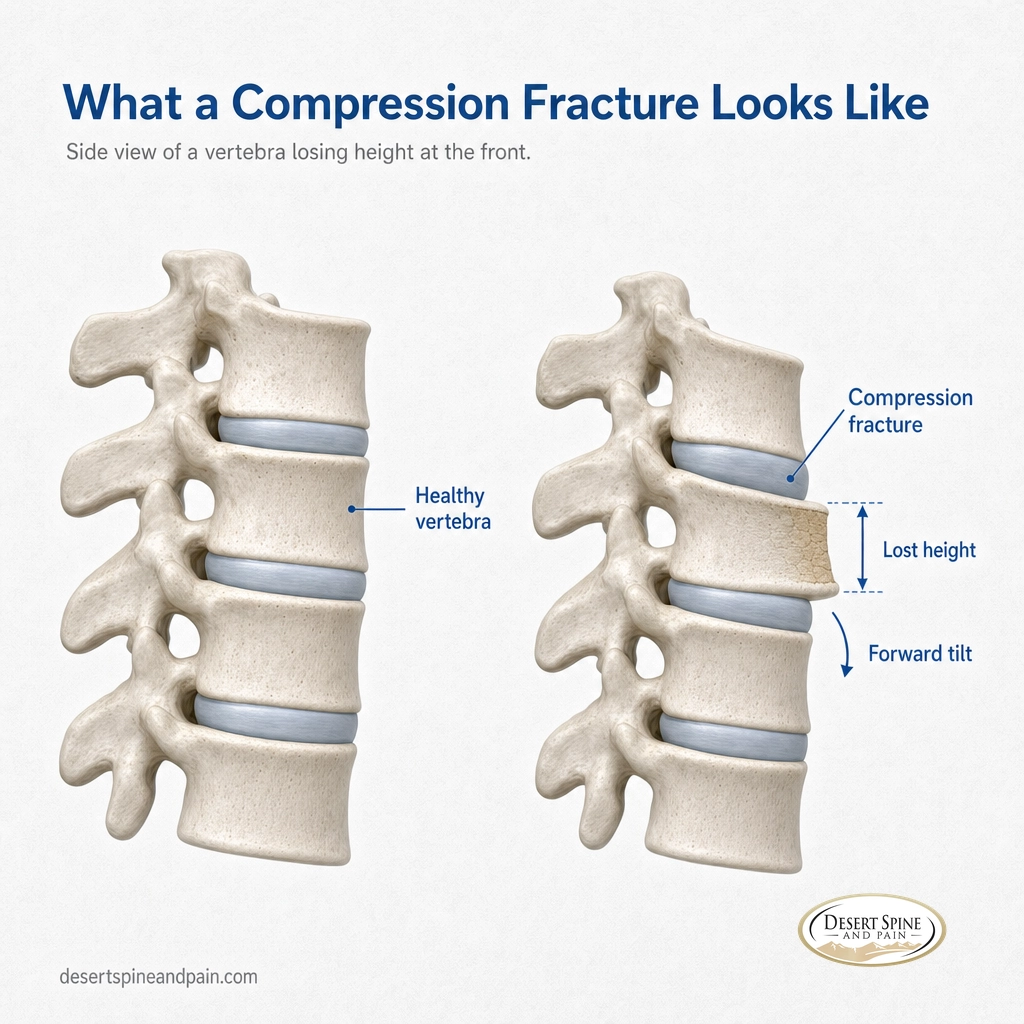
Osteoporosis is the leading cause. When bone thins enough, an everyday movement like stepping out of the shower or a hard sneeze can be enough to fracture a vertebra. The risk is concentrated in older adults, and especially in women after menopause.
Who develops vertebral compression fractures
Estimated share affected by a vertebral compression fracture in the U.S. Source: American Association of Neurological Surgeons.Not every compression fracture needs a procedure. Many settle with time and conservative care. But a VCF also raises the odds of the next one, which is part of why a painful, unhealed fracture is taken seriously rather than simply waited out.
Beyond osteoporosis, kyphoplasty is also used for compression fractures caused by a spinal tumor or cancer that has spread to the spine, by long-term steroid use, or by trauma. In younger patients with little or no injury, a spine specialist will look carefully for an underlying cause such as a tumor. For the broader picture of what causes these breaks, see the Desert Spine and Pain overview of spine conditions, and the detailed data in our vertebral compression fracture statistics.
Source: American Association of Neurological Surgeons: Vertebral Compression Fractures | RadiologyInfo.org: common uses of vertebral augmentation
Kyphoplasty vs. Vertebroplasty
The question patients ask most is how kyphoplasty differs from vertebroplasty. The two are closely related and are often discussed together as vertebral augmentation. Both stabilize a fractured vertebra with bone cement, both are minimally invasive and image-guided, and both aim to relieve fracture pain. The difference is one extra step.
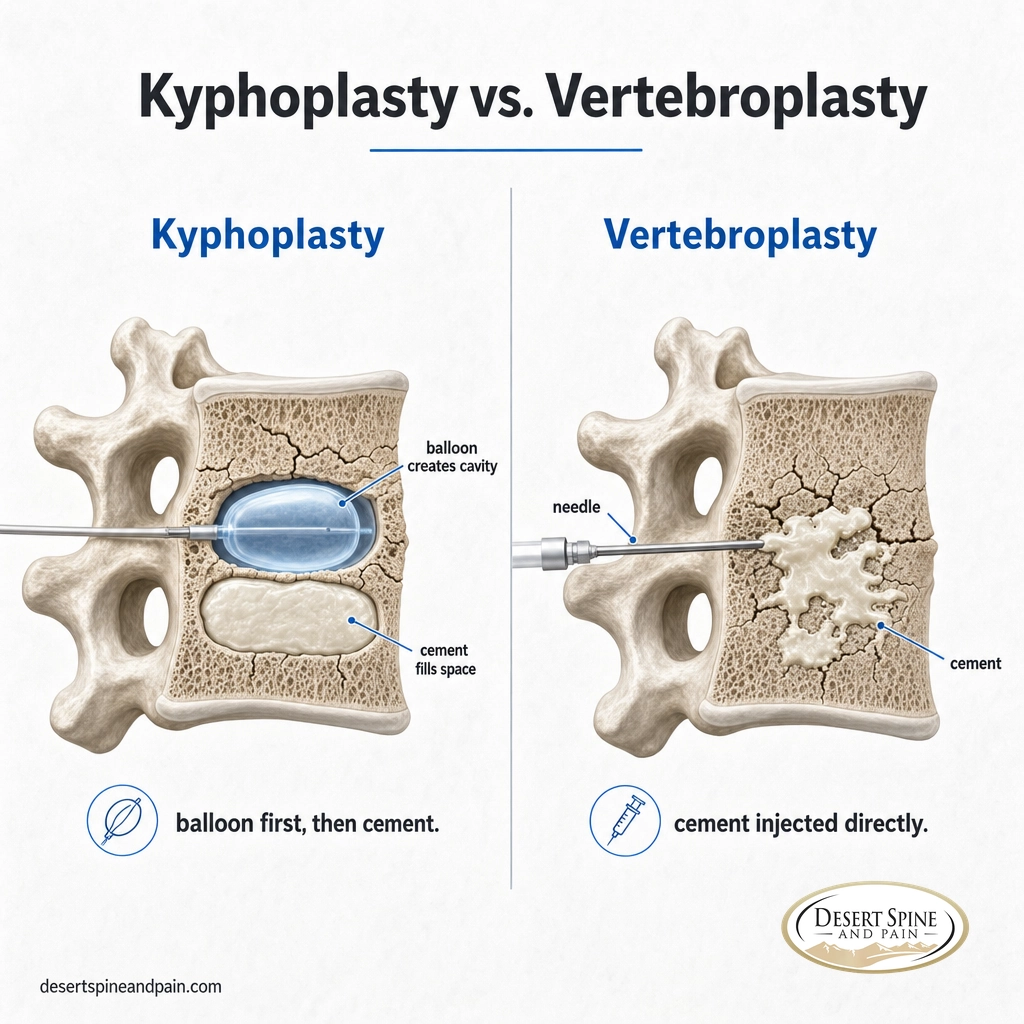
| Feature | Kyphoplasty | Vertebroplasty |
|---|---|---|
| Balloon step | Yes, a balloon inflates to create a cavity first | No balloon |
| Height restoration | Can restore some lost vertebral height | Mainly stabilizes in the collapsed position |
| How cement goes in | Into the cavity the balloon created | Injected directly into the fractured bone |
| Shared goal | Stabilize the fracture, support the vertebra, and relieve pain | |
Because kyphoplasty makes a cavity first, it lets the surgeon place cement in a more controlled space and can recover some of the height the fracture lost. Vertebroplasty is simpler and just as effective at stabilizing the bone in the right cases. The best choice depends on the fracture, its shape, and the surgeon's judgment, which is why both options are reviewed together in a consultation. You can read more about the alternative in our guide to vertebroplasty outcomes.
Myth: "Kyphoplasty will straighten my spine back to normal." It will not. Kyphoplasty can restore some lost height and ease pain, but it is not designed to correct an established spinal curve or to reverse osteoporosis. Its job is to stabilize the broken vertebra. Preventing the next fracture still depends on treating the underlying bone disease.
Source: RadiologyInfo.org: Vertebroplasty and Kyphoplasty

Who Is a Candidate for Kyphoplasty?
At Desert Spine and Pain, the philosophy is the least invasive effective treatment first, and that applies here. Kyphoplasty is usually considered only after conservative care has been given a fair chance, not as the automatic first move. The usual starting point is a few weeks of rest, a back brace, pain medication, and, for osteoporosis, bone-strengthening treatment.
Good candidates generally share a few features. The fracture is recent and still painful, the pain has not responded to conservative care, and imaging confirms the fracture is the source of the pain. Timing matters: the procedure works best when done relatively early.
Just as important is knowing when kyphoplasty is not the answer. It is generally not used for fractures that have already healed, fractures more than a year old, or vertebrae that have collapsed by roughly 80 to 90 percent. It is also not a treatment for herniated discs, arthritis pain, or chronic back pain from other causes, and it is not a preventive step for people who have not fractured. When pressure on the spinal cord comes from the bone itself rather than a simple fracture, a different operation such as a vertebral corpectomy may be the better fit.
Because the decision rests on your symptoms, your exam, and your actual imaging read together, a careful in-person evaluation is essential. For the full range of options the practice offers for broken vertebrae, see the vertebral repair treatments page.
Source: American Association of Neurological Surgeons: candidacy and exclusions | RadiologyInfo.org: when augmentation is used
Pain Relief, Recovery, and Outcomes
For the right patient, one of the appeals of kyphoplasty is how quickly recovery moves. Because it is minimally invasive and the cement provides immediate support, most people are up and moving the same day rather than facing a long hospital stay.
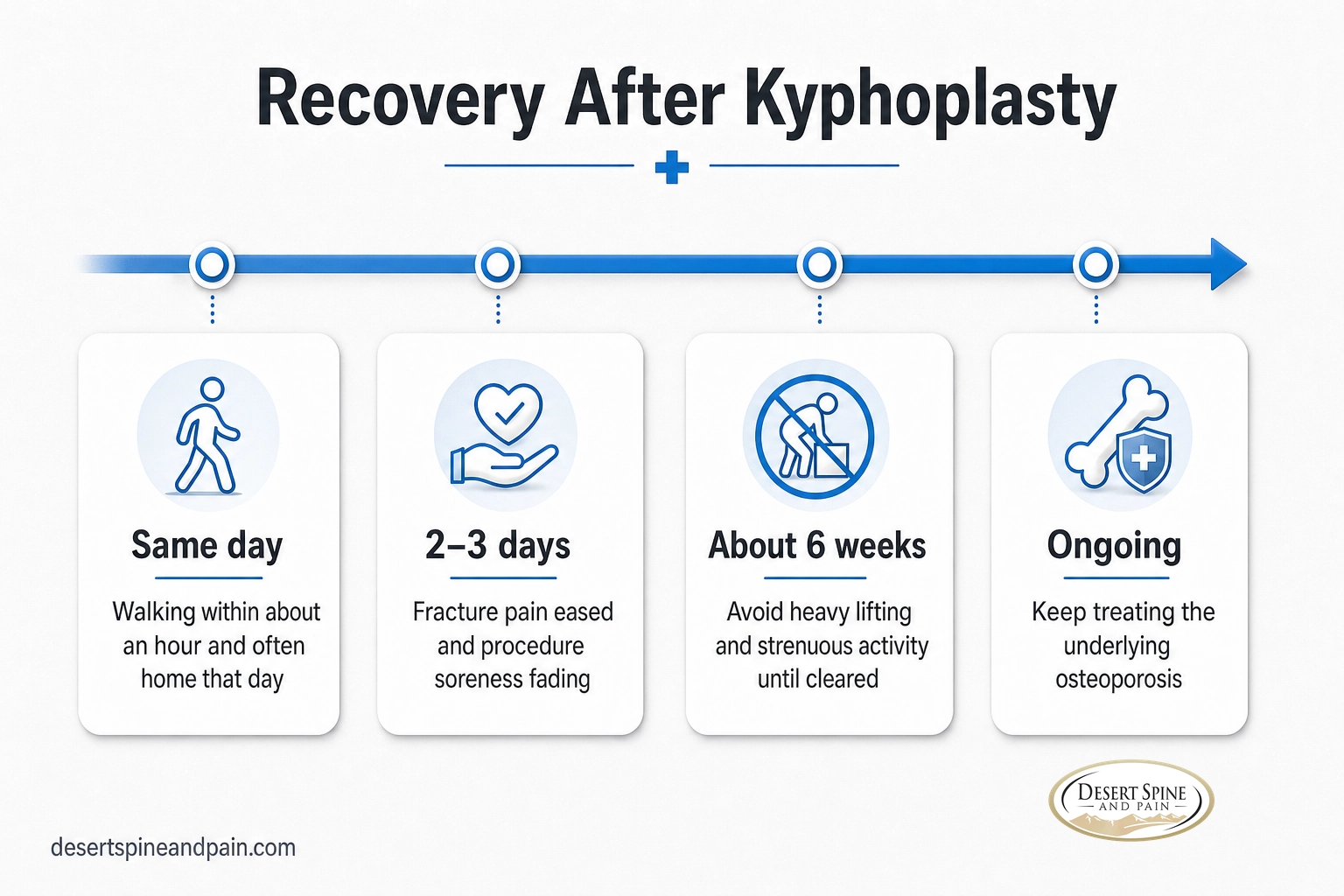
- The same day. Patients can usually walk about an hour after the procedure. Many go home the same day, though some are kept for observation.
- First few days. Pain from the fracture is often eliminated or reduced within about two days, and the soreness from the procedure itself typically fades within two to three days.
- First six weeks. Normal light activity resumes quickly, but strenuous activity and heavy lifting should wait until cleared, generally at least six weeks.
- Ongoing. Treating the underlying osteoporosis continues well beyond the procedure, because kyphoplasty fixes one fracture but does not strengthen the rest of the spine.
Outcomes are generally good, and a large share of patients report meaningful pain relief. That said, no procedure helps everyone, and results depend on the fracture, the timing, and the underlying bone health. Guided physical therapy, when needed, is arranged by referral during recovery. For a fuller look at reported results, see our kyphoplasty statistics.
Source: RadiologyInfo.org: outcomes and recovery | American Association of Neurological Surgeons: recovery guidance
Risks and Complications
Any procedure near the spine carries some risk, but kyphoplasty is considered low-risk, and serious complications are uncommon. Understanding the real risks, rather than vague fears, helps put the decision in perspective.
The most talked-about risk is cement leakage. A small amount of cement can escape the vertebra, and most of the time this causes no problem. It becomes a concern only if cement reaches the spinal canal or the blood vessels of the lungs, which is uncommon. A separate consideration is that a new compression fracture can occur in a nearby vertebra afterward, partly because the underlying osteoporosis is still present.
Other risks are rare. Infection serious enough to need antibiotics occurs in fewer than one in 1,000 procedures, and paralysis is extremely rare. As with any spine procedure, outcomes track closely with how carefully the case is selected and performed. Dr. David L. Greenwald, MD, FACS is board certified as both a spine surgeon and a neurosurgeon, training built around exactly this kind of precise, image-guided spine work.
Source: RadiologyInfo.org: risks of vertebral augmentation | American Association of Neurological Surgeons: complication rates
How to Get Started
If a compression fracture has been found, or if kyphoplasty has already been suggested, the most useful next step is a focused evaluation that confirms whether the fracture is truly the source of the pain and whether kyphoplasty, vertebroplasty, or continued conservative care is the right path. A thorough consult reviews your symptoms, your exam, and your imaging together, and it is the right time to ask about alternatives and, before any procedure, to get a second opinion.
Desert Spine and Pain is a Phoenix, Arizona practice led by Dr. David L. Greenwald, MD, FACS, and it draws patients from across the Greater Phoenix area and beyond for spine care. Care always starts with the least invasive effective option and moves to a procedure only when it is genuinely the best path. Procedures are performed by Dr. Greenwald at affiliated surgical facilities. You can reach the practice at (602) 566-9500.
Learn about kyphoplasty at Desert Spine and Pain
Explore spine surgery and vertebral repair options
Book a consultation or second opinion
Common Questions About Kyphoplasty
What is kyphoplasty used for?
What is the difference between kyphoplasty and vertebroplasty?
How long does a kyphoplasty take and is it outpatient?
How soon does kyphoplasty relieve pain?
Is kyphoplasty safe?
Related Spine Terms
- Vertebroplasty: the closely related augmentation that injects cement directly, without the balloon step.
- Vertebral compression fracture (VCF): the wedge-shaped collapse of a vertebra that kyphoplasty is designed to treat.
- Osteoporosis: the bone-thinning disease behind most compression fractures, which continues to need treatment after a kyphoplasty.
- PMMA bone cement: polymethylmethacrylate, the fast-setting cement that stabilizes the fractured vertebra.
- Vertebral corpectomy: a larger operation that removes a vertebral body, used when the problem is bigger than a simple fracture.
- Vertebral augmentation: the umbrella term covering both kyphoplasty and vertebroplasty.
- Kyphosis: the forward hunch of the spine that untreated compression fractures can cause.
Sources
Sources and Methodology
This guide summarizes established clinical references on kyphoplasty, vertebroplasty, and vertebral compression fractures. Incidence and prevalence figures, complication rates, and candidacy guidance are drawn from the American Association of Neurological Surgeons and from RadiologyInfo.org, the patient-information service of the Radiological Society of North America and the American College of Radiology. The roughly 75% mobility figure is reported for vertebroplasty, which shares the cement-stabilization step used in kyphoplasty. All figures are presented as general reference, not as individual predictions, and timeframes and outcomes vary by patient, fracture, and underlying bone health. This is educational information, not medical advice. Decisions about any procedure should be made with a qualified spine specialist after an in-person evaluation.