
Vertebroplasty Statistics (2026): Success Rates, Cement Leakage, and vs Kyphoplasty
Vertebroplasty stabilizes a painful vertebral compression fracture by injecting bone cement, producing rapid pain relief that can drop pain scores from about 7 to under 1. Simpler and faster than kyphoplasty, it is backed by strong modern randomized trials, with cement leakage as its main, usually harmless, complication.
- Vertebroplasty produces rapid pain relief, with one study showing pain scores falling from about 6.8 to under 1.
- Cement leakage is the most common complication, reported in roughly 18 to 20 percent of cases, usually without symptoms.
- Studies found no significant difference in cement leakage risk between vertebroplasty and kyphoplasty.
- Modern randomized trials (VAPOUR, VERTOS IV, VERTOS V) support vertebroplasty for acute and chronic osteoporotic fractures.
- A 2025 propensity-matched analysis found vertebroplasty had more short-term complications and earlier opioid use, while kyphoplasty had a modestly higher later-fracture risk.
- Kyphoplasty restores more height, but vertebroplasty is simpler, faster, and lower cost.
- Vertebral compression fractures affect an estimated 1.5 million U.S. adults per year, making these procedures widely relevant.
What's in This Guide
1What Vertebroplasty Is
Percutaneous vertebroplasty (PVP) is a minimally invasive procedure that treats painful vertebral compression fractures by injecting bone cement directly into the fractured vertebra through a small needle, stabilizing it under fluoroscopic guidance. Unlike kyphoplasty, it does not use a balloon to create a cavity first.
Vertebroplasty and kyphoplasty are the two main vertebral augmentation techniques. Vertebroplasty is the older and simpler of the pair, and it remains widely used because it is quick, effective for pain, and lower in cost. Understanding its statistics means looking at both its strong pain results and the trial controversy that once surrounded it.
Our Phoenix practice, led by board-certified neurosurgeon and spine surgeon Dr. David L. Greenwald, MD, FACS, uses vertebral augmentation to restore comfort and mobility for appropriate patients with painful compression fractures.
Explore vertebroplasty in PhoenixSource: Percutaneous vertebroplasty and kyphoplasty, StatPearls NIH
2Pain Relief and the Trial Evidence
Vertebroplasty's core strength is fast, substantial pain relief. Its evidence base is unusual because early trials questioned it, then better-designed trials vindicated it for the right patients.
The trial story matters. Two 2009 placebo-controlled trials found no benefit and cast doubt on vertebroplasty, but they were later criticized for enrolling patients with older, less painful fractures. Subsequent, better-targeted trials, VAPOUR for acute severe fractures and VERTOS IV and V, showed clear and durable benefits in pain and quality of life. The lesson was not that vertebroplasty fails, but that it works when the right patient is chosen.
Learn about vertebral repair optionsSource: Efficacy and complications of VP and KP (280 patients), PMC | VP randomized-trial evidence, StatPearls NIH
3Cement Leakage and Complications
The signature complication of vertebroplasty is cement leakage, and understanding it correctly, common on imaging but rarely symptomatic, is essential to reading the safety data.
Cement Leakage: Common on Imaging, Rarely Symptomatic
Most cement leakage causes no symptoms. Sources: 280-patient study; multilevel augmentation study.
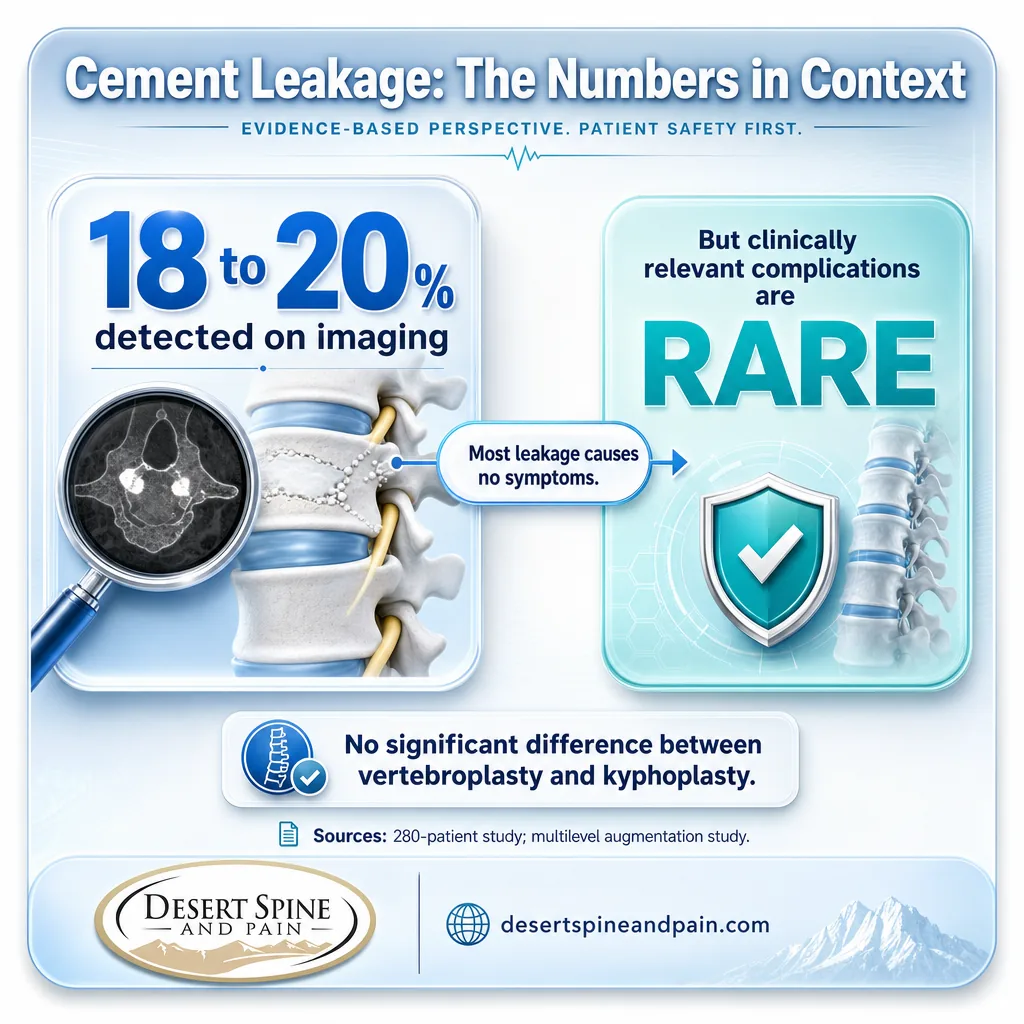
The nuance is important: cement leakage appears in roughly one in five cases on imaging, but the overwhelming majority is asymptomatic and harmless. Serious events, such as cement reaching the veins or spinal canal, are uncommon. The 280-patient analysis found no significant difference in leakage risk between vertebroplasty and kyphoplasty, and concluded clinically relevant complications of both are rare.
Meet Dr. GreenwaldSource: Cement leakage analysis (280 patients), PMC
4Vertebroplasty vs Kyphoplasty
The most practical question for compression-fracture patients is which augmentation procedure to choose. The data shows a genuine trade-off rather than a clear winner.
The trade-off is real: vertebroplasty is simpler, faster, and lower cost, while kyphoplasty restores more height, better prevents collapse, and had a lower short-term complication profile in the 2025 propensity-matched study, though a modestly higher risk of later fractures. Neither dominates. For a straightforward painful acute fracture, vertebroplasty is often ideal, while significant height loss or deformity may favor kyphoplasty.
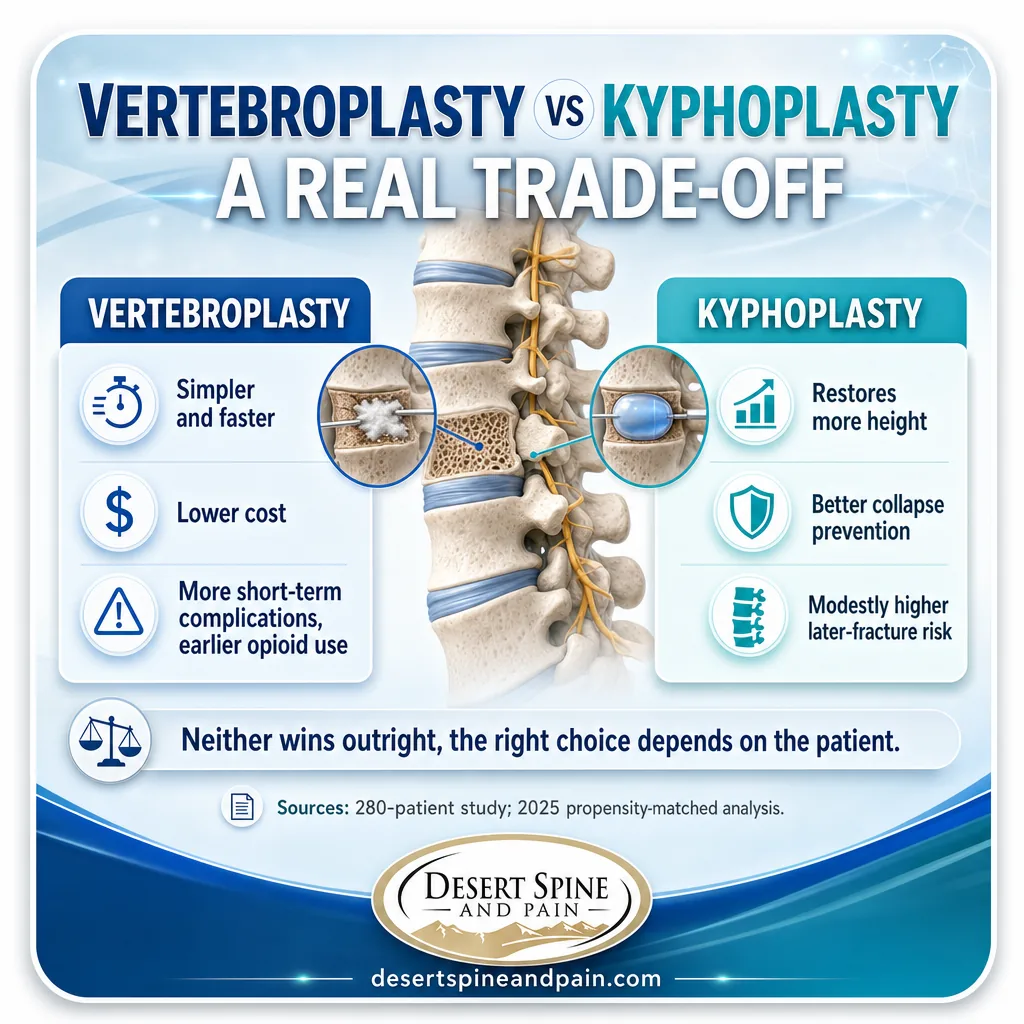
The evidence does not support that. Vertebroplasty and kyphoplasty both relieve pain rapidly with rare serious complications, and each has its own strengths, vertebroplasty for simplicity and speed, kyphoplasty for height restoration and collapse prevention. The 2025 data even shows each has a different complication pattern. The right choice depends on the fracture, the anatomy, and the patient, which is a decision an experienced surgeon makes case by case.
Source: VP vs KP collapse and leakage comparison, PMC
5Why Patient Selection Matters
The single clearest lesson from the vertebroplasty literature is that selecting the right patient, and the right timing, determines whether the procedure succeeds.
The early negative trials failed largely because they enrolled the wrong patients, those with older, less painful fractures, while the positive VAPOUR and VERTOS trials succeeded by targeting genuinely painful acute fractures. Timing matters too, with earlier intervention improving height restoration and reducing adjacent fractures. This is why a careful diagnosis, confirming that the fracture is the true pain source and treating it promptly, is the foundation of a good result.
Vertebroplasty's history is a lesson in patient selection. The same procedure that appeared to fail in early trials proved highly effective once trials targeted the right patients, those with genuinely painful acute fractures treated in a timely way. That is the core message: augmentation is not a procedure to apply reflexively, but a precise tool that rewards accurate diagnosis and good timing. Getting that judgment right is where surgical experience translates directly into relief. Interpretation original to Desert Spine and Pain.
Desert Spine and Pain works with out-of-network patients of every kind and partners closely with personal injury attorneys, offering 24/7 concierge response and documentation coordination for injured clients, including those with traumatic compression fractures.
See conservative care optionsSource: VP patient selection and timing evidence, StatPearls NIH
Summary Table: Vertebroplasty Statistics 2026
| Statistic | Figure | Source | Year |
|---|---|---|---|
| Annual U.S. vertebral compression fractures | 1.5 million | Propensity-matched VP vs KP | 2025 |
| VCF prevalence by age 80 | ~40% | Propensity-matched VP vs KP | 2025 |
| Pain score (VAS) before vs after, VP | 6.8 to 0.8 | 280-patient VP/KP study | 2024 |
| Pain score before vs late follow-up (multilevel) | 8.4 to 2.2 | Multilevel VP/KP study | 2024 |
| Cement leakage rate (280-patient) | 19.3% | 280-patient VP/KP study | 2024 |
| Cement leakage rate (multilevel) | 18% | Multilevel VP/KP study | 2024 |
| VP vs KP cement leakage difference | Not significant | 280-patient VP/KP study | 2024 |
| Vertebral collapse control | KP > VP | 280-patient VP/KP study | 2024 |
| Short-term complications and opioid use | Higher with VP | Propensity-matched VP vs KP | 2025 |
| Later fracture risk | Modestly higher with KP | Propensity-matched VP vs KP | 2025 |
| ODI before vs after (multilevel) | 70.7 to 33.6 | Multilevel VP/KP study | 2024 |
| Supporting randomized trials | VAPOUR, VERTOS IV, V | StatPearls, NIH | 2025 |
Frequently Asked Questions
What is the success rate of vertebroplasty?
What is the most common complication of vertebroplasty?
Is vertebroplasty better than kyphoplasty?
Does vertebroplasty work for osteoporotic fractures?
How quickly does vertebroplasty relieve pain?
Methodology & Sources
How we compiled these statistics
Every figure traces to a Tier 1 primary source: randomized controlled trials, propensity-matched database studies, and peer-reviewed clinical analyses. Pain, leakage, and complication figures reflect differences in fracture type, technique, and follow-up length. The vertebroplasty-versus-kyphoplasty comparison draws on head-to-head and matched studies. All statistics describe populations, not any individual patient.
Primary sources referenced:
- Efficacy and complication rates of percutaneous vertebroplasty and kyphoplasty (280 patients), PMC
- Comparative long-term outcomes of vertebroplasty versus kyphoplasty: propensity-matched analysis, 2025
- Single-session multilevel vertebroplasty and kyphoplasty: safety and efficacy, Journal of Turkish Spinal Surgery
- Percutaneous vertebroplasty and kyphoplasty (VAPOUR, VERTOS IV and V trial evidence), StatPearls, NIH
- Unilaterally extrapedicular versus transpedicular kyphoplasty: randomized controlled study, PMC
This article is educational and is not individual medical advice. For guidance specific to your spine condition, consult a qualified spine surgeon. No outcome can be guaranteed.
Journalists and researchers may cite these statistics with attribution to Desert Spine and Pain and a link to this page. Please attribute the underlying figures to their original Tier 1 sources as listed above. For expert commentary on vertebroplasty data from a board-certified neurosurgeon and spine surgeon, contact Desert Spine and Pain at (602) 566-9500.