

Kyphoplasty Statistics (2026): Pain Relief, Height Restoration, and Safety
Kyphoplasty is a minimally invasive procedure that stabilizes a painful vertebral compression fracture with bone cement, providing rapid pain relief that often drops pain scores from about 8 to 3 within a day. Beyond pain, it restores lost vertebral height and, importantly, enables the early mobilization that helps lower the elevated mortality risk these fractures carry.
- Kyphoplasty produces rapid pain relief, with average pain scores dropping from about 8.2 to 3.2 the day after surgery.
- It restores vertebral height, reducing kyphosis from about 12.9 to 6.5 degrees (roughly a 28 percent height gain) in one study.
- Vertebral augmentation achieves symptomatic relief in roughly 73 to 90 percent of patients.
- In a 1,932-patient database study, the overall complication rate was 8.6 percent, with 30-day mortality of 2.1 percent in this frail population.
- Surgical treatment relieved pain far faster than bracing (4.5 versus 10 weeks) and reduced fracture progression (4.8 versus 29.7 percent).
- Vertebral compression fractures carry a mortality rate about 2.5 times higher than in people without them, which augmentation helps address through early mobility.
- Kyphoplasty prevents further vertebral collapse more effectively than vertebroplasty in comparative data.
What's in This Guide
1What Kyphoplasty Treats
Kyphoplasty is a vertebral augmentation procedure for painful vertebral compression fractures (VCFs), most often caused by osteoporosis, and sometimes by tumors. A balloon is inflated inside the collapsed vertebra to create a cavity and restore height, then bone cement is injected to stabilize it.
Vertebral compression fractures are a serious, often underappreciated problem in older adults. They cause chronic pain, loss of height and posture, reduced mobility, and a meaningfully higher risk of death. Kyphoplasty aims to interrupt that cascade by relieving pain quickly and getting patients moving again.
Our Phoenix practice, led by board-certified neurosurgeon and spine surgeon Dr. David L. Greenwald, MD, FACS, uses vertebral augmentation to restore comfort and mobility for appropriate patients with painful compression fractures.
Explore kyphoplasty in PhoenixSource: Kyphoplasty and mortality review, IJSS | Vertebral augmentation, StatPearls NIH
2Pain Relief and Success Rates
The most immediate benefit of kyphoplasty is fast, substantial pain relief, which is why it is so valuable for patients immobilized by a painful fracture.
A retrospective analysis of 280 patients concluded that both kyphoplasty and vertebroplasty provide rapid and significant pain relief with rare clinically relevant complications. The speed matters enormously: for an elderly patient in severe pain and unable to move, restoring the ability to stand within a day can be the difference between recovery and a downward spiral of immobility.
Learn about vertebral repair optionsSource: Efficacy of vertebroplasty and kyphoplasty (280 patients), PMC | Instrumented kyphoplasty results, PMC
3Height and Kyphosis Restoration
What sets kyphoplasty apart from simpler cement injection is its ability to restore vertebral height and correct the forward-bending deformity (kyphosis) that compression fractures cause.
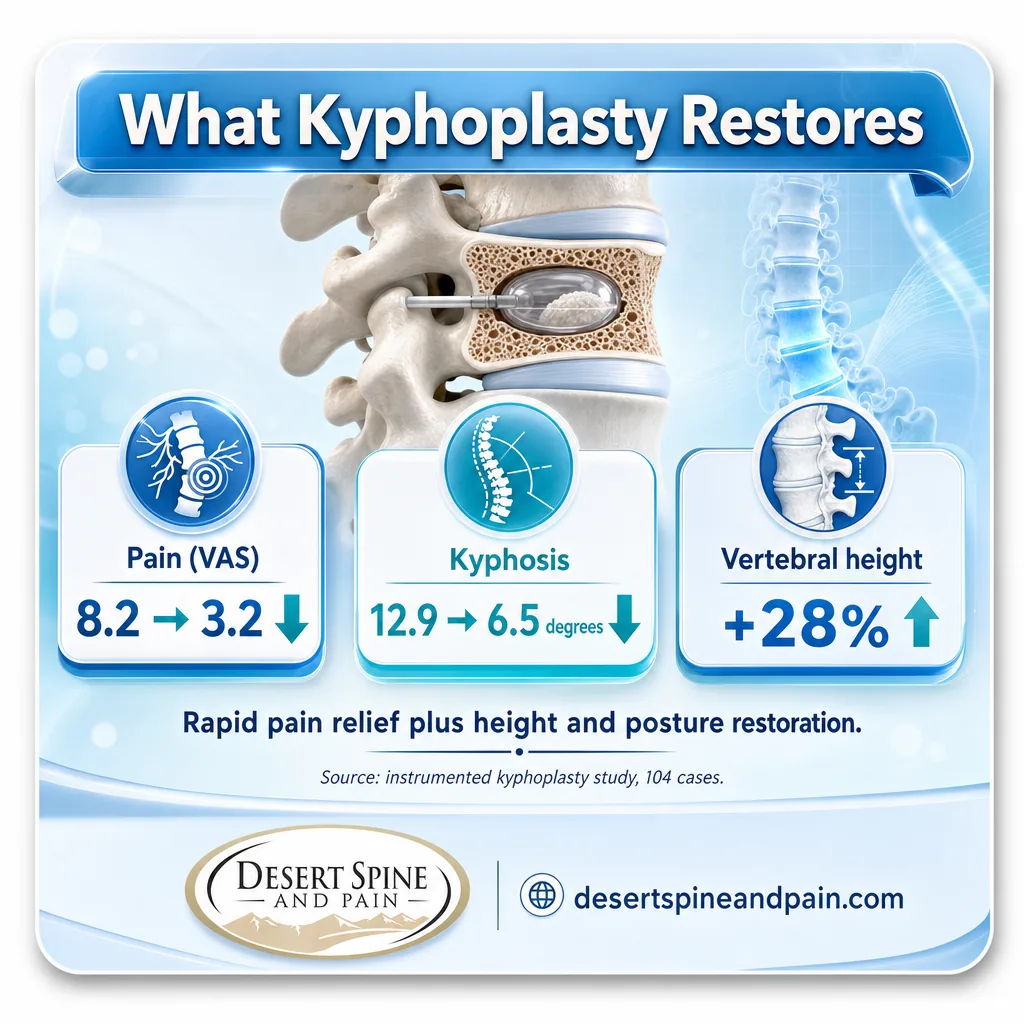
Restoring height and reducing kyphosis is not merely cosmetic. Excess forward curvature after multiple compression fractures impairs breathing, balance, and mobility, and raises the risk of further fractures. By reducing kyphosis from about 13 to 6.5 degrees and recovering roughly a quarter of lost height, kyphoplasty helps preserve posture and function. Restoration of lumbar lordosis was also observed, further supporting spinal balance.
Meet Dr. GreenwaldSource: Instrumented kyphoplasty clinical and radiological results, PMC
4Complications and Mortality
Kyphoplasty is generally safe, and understanding its complication and mortality data requires remembering that it treats a frail, elderly, high-risk population.
The key context is that the 2.1 percent 30-day mortality reflects the health of the patients, those with high ASA class and kidney impairment, rather than the procedure being dangerous. In fact, the evidence points the other way: vertebral augmentation has been shown to lower mortality compared with conservative management, because it enables the early movement that prevents deadly complications of bed rest like pneumonia and blood clots.
A 2.1 percent 30-day mortality figure can sound alarming until you understand who these patients are: often very elderly, frail, and medically complex. Vertebral compression fractures alone raise mortality about 2.5-fold. The relevant comparison is not kyphoplasty versus nothing, but kyphoplasty versus prolonged immobility, and on that comparison augmentation lowers mortality by getting patients moving. Context, not the raw number, tells the real story.
Source: Complications and mortality after VP/KP (1,932 cases), PMC | Vertebral augmentation, StatPearls NIH
5Kyphoplasty vs Conservative Care
A central question is whether augmentation beats bracing and waiting alone. Recent comparative data increasingly supports the procedure for appropriate patients.
In a 573-case study, augmentation relieved pain in less than half the time of bracing (4.5 versus 10 weeks) and dramatically reduced fracture progression (4.8 versus 29.7 percent), without increasing new or adjacent fractures. Combined with the mortality benefit from early mobilization, the evidence supports augmentation for patients whose pain and immobility are significant, while conservative care remains reasonable for milder fractures.
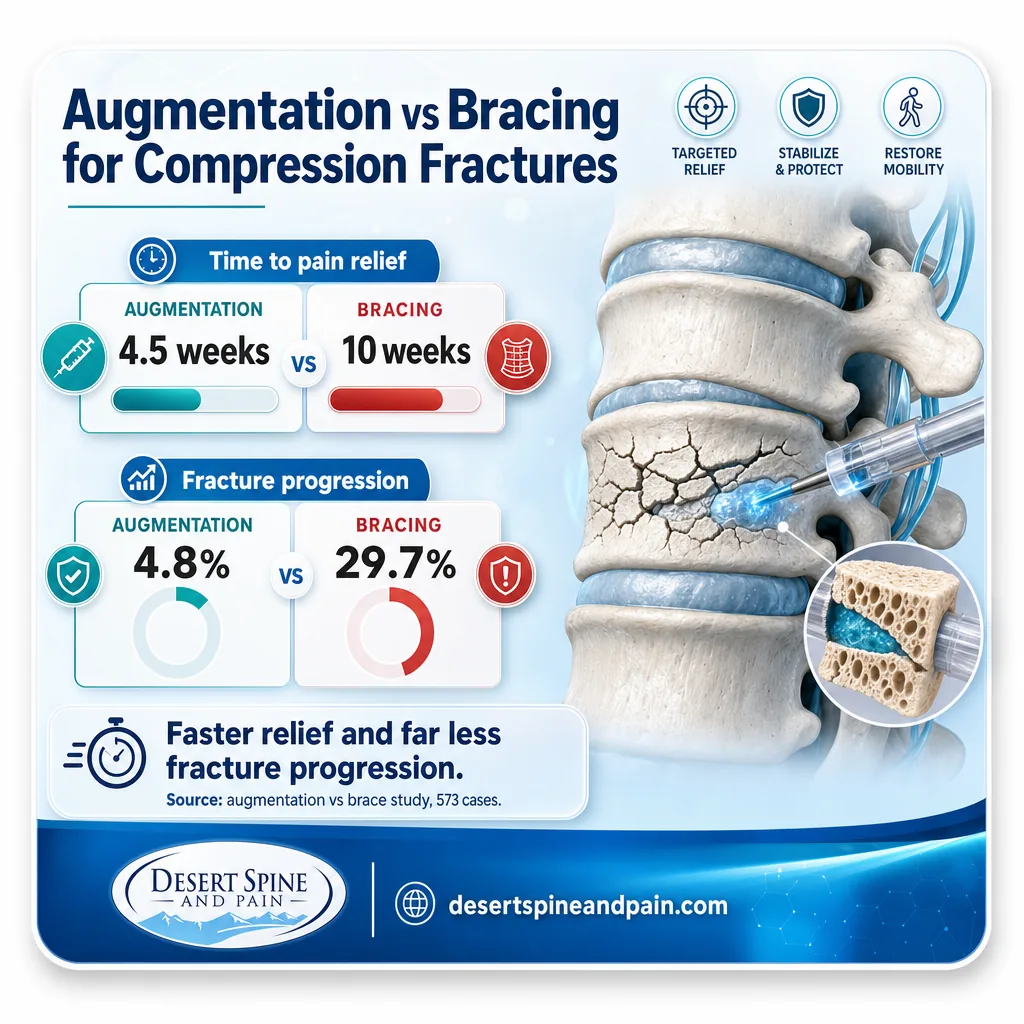
The kyphoplasty data reframes success around mobility rather than pain alone. Faster pain relief (4.5 versus 10 weeks), less fracture progression (4.8 versus 29.7 percent), and lower mortality all trace to one mechanism: getting a frail patient upright and moving before immobility causes its own complications. For the elderly, restoring mobility quickly is not a comfort measure, it is a survival measure, which is why timely, appropriate augmentation matters so much. Interpretation original to Desert Spine and Pain.
Desert Spine and Pain works with out-of-network patients of every kind and partners closely with personal injury attorneys, offering 24/7 concierge response and documentation coordination for injured clients, including those with traumatic compression fractures.
See conservative care optionsSource: Vertebral augmentation vs brace (573 cases), PMC
Summary Table: Kyphoplasty Statistics 2026
| Statistic | Figure | Source | Year |
|---|---|---|---|
| Annual U.S. vertebral compression fractures | 750,000 | IJSS review | 2018 |
| Pain score (VAS) before vs after | 8.2 to 3.2 | Instrumented kyphoplasty study | 2019 |
| Symptomatic relief rate | 73 to 90% | Peer-reviewed compilation | 2026 |
| Kyphosis before vs after (degrees) | 12.9 to 6.5 | Instrumented kyphoplasty study | 2019 |
| Vertebral height gain | 28% | Instrumented kyphoplasty study | 2019 |
| Adjacent disc degeneration at follow-up | 16.3% | Instrumented kyphoplasty study | 2019 |
| Overall complication rate | 8.6% | ACS-NSQIP (1,932 cases) | 2022 |
| Minor complications | 2.7% | ACS-NSQIP (1,932 cases) | 2022 |
| Major complications | 4.9% | ACS-NSQIP (1,932 cases) | 2022 |
| 30-day mortality | 2.1% | ACS-NSQIP (1,932 cases) | 2022 |
| VCF mortality vs no fracture | 2.5x higher | IJSS review | 2018 |
| Time to pain relief, augmentation vs brace | 4.5 vs 10 wk | Augmentation vs brace study | 2023 |
| Fracture progression, augmentation vs conservative | 4.8% vs 29.7% | Augmentation vs brace study | 2023 |
| Repeat augmentation at 2 years | ~14.8% | TriNetX propensity-matched study | 2025 |
Frequently Asked Questions
What is the success rate of kyphoplasty?
Does kyphoplasty restore vertebral height?
How safe is kyphoplasty?
Does kyphoplasty reduce mortality?
How is kyphoplasty different from vertebroplasty?
Methodology & Sources
How we compiled these statistics
Every figure traces to a Tier 1 primary source: national surgical databases, large propensity-matched cohorts, and peer-reviewed clinical studies. Pain, height, and complication figures reflect differences in fracture type, patient health, and follow-up length. Mortality figures must be read in the context of a frail, elderly population. All statistics describe populations, not any individual patient.
Primary sources referenced:
- Incidence and risk factors for complications and mortality after vertebroplasty or kyphoplasty (1,932 cases), ACS-NSQIP, PMC
- Comparative long-term outcomes of vertebroplasty versus kyphoplasty: propensity-matched analysis (15,056 patients), TriNetX, PMC
- Vertebral compression fractures: pain relief, progression, and new fracture rate comparing augmentation with brace (573 cases), PMC
- Efficacy and complication rates of vertebroplasty and kyphoplasty (280 patients), PMC
- Vertebral compression fractures treated by instrumented kyphoplasty: clinical and radiological results, PMC
- Vertebral augmentation, StatPearls, NIH; kyphoplasty and mortality review, International Journal of Spine Surgery
This article is educational and is not individual medical advice. For guidance specific to your spine condition, consult a qualified spine surgeon. No outcome can be guaranteed.
Journalists and researchers may cite these statistics with attribution to Desert Spine and Pain and a link to this page. Please attribute the underlying figures to their original Tier 1 sources as listed above. For expert commentary on kyphoplasty data from a board-certified neurosurgeon and spine surgeon, contact Desert Spine and Pain at (602) 566-9500.