

Neck Pain Statistics (2026): Prevalence, Whiplash, and Global Burden
Neck pain affected an estimated 203 million people worldwide in 2020, and 60% to 80% of people will experience it in their lifetime. It is the fourth leading cause of disability globally, and a major consequence of car crashes, where up to 40% of whiplash injuries become chronic. Here is the 2026 data, from primary sources only.
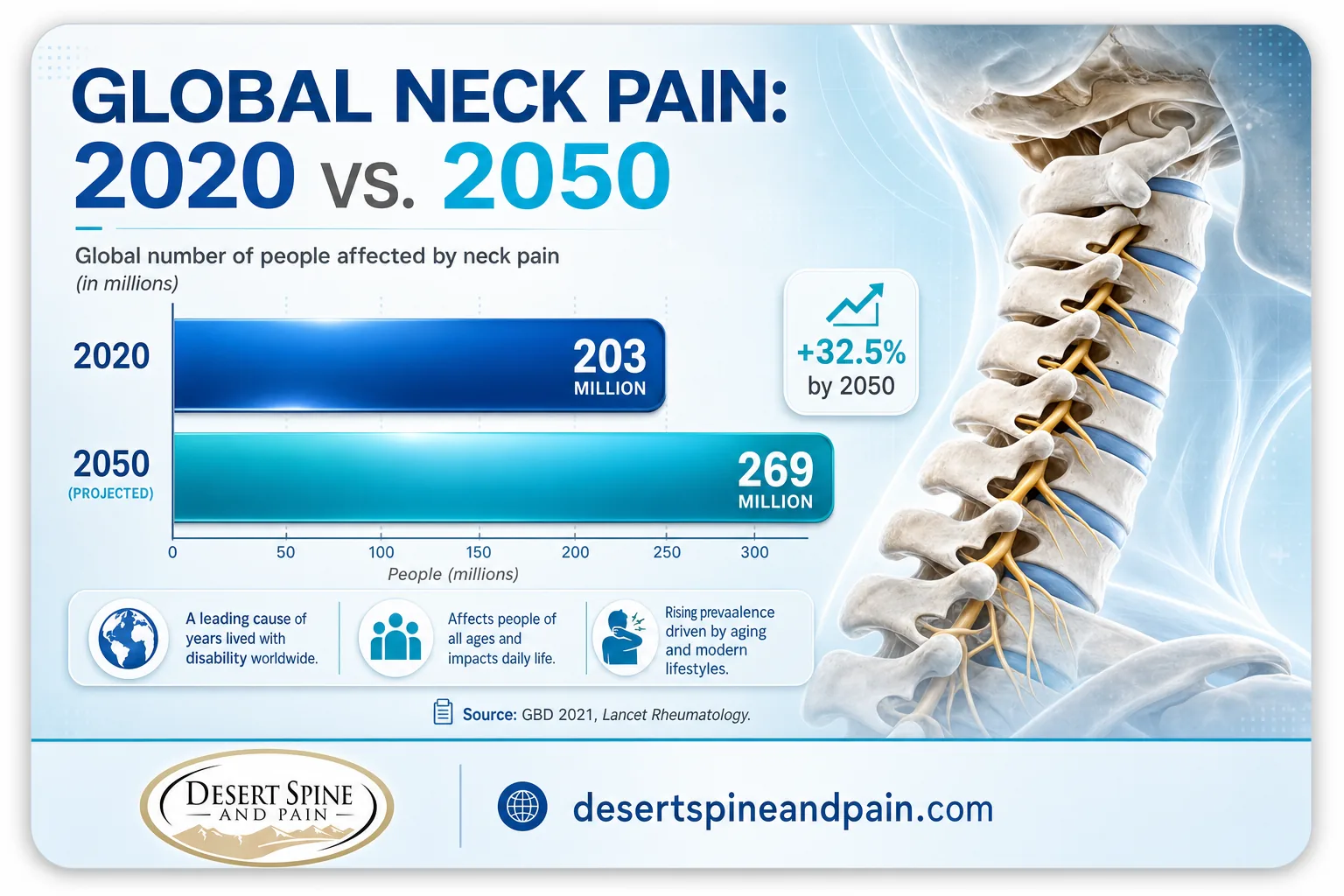
- 203 million people worldwide had neck pain in 2020, projected to reach 269 million by 2050 (GBD 2021).
- 60% to 80% of people experience neck pain at some point in their lives.
- Neck pain is the 4th leading cause of years lived with disability worldwide.
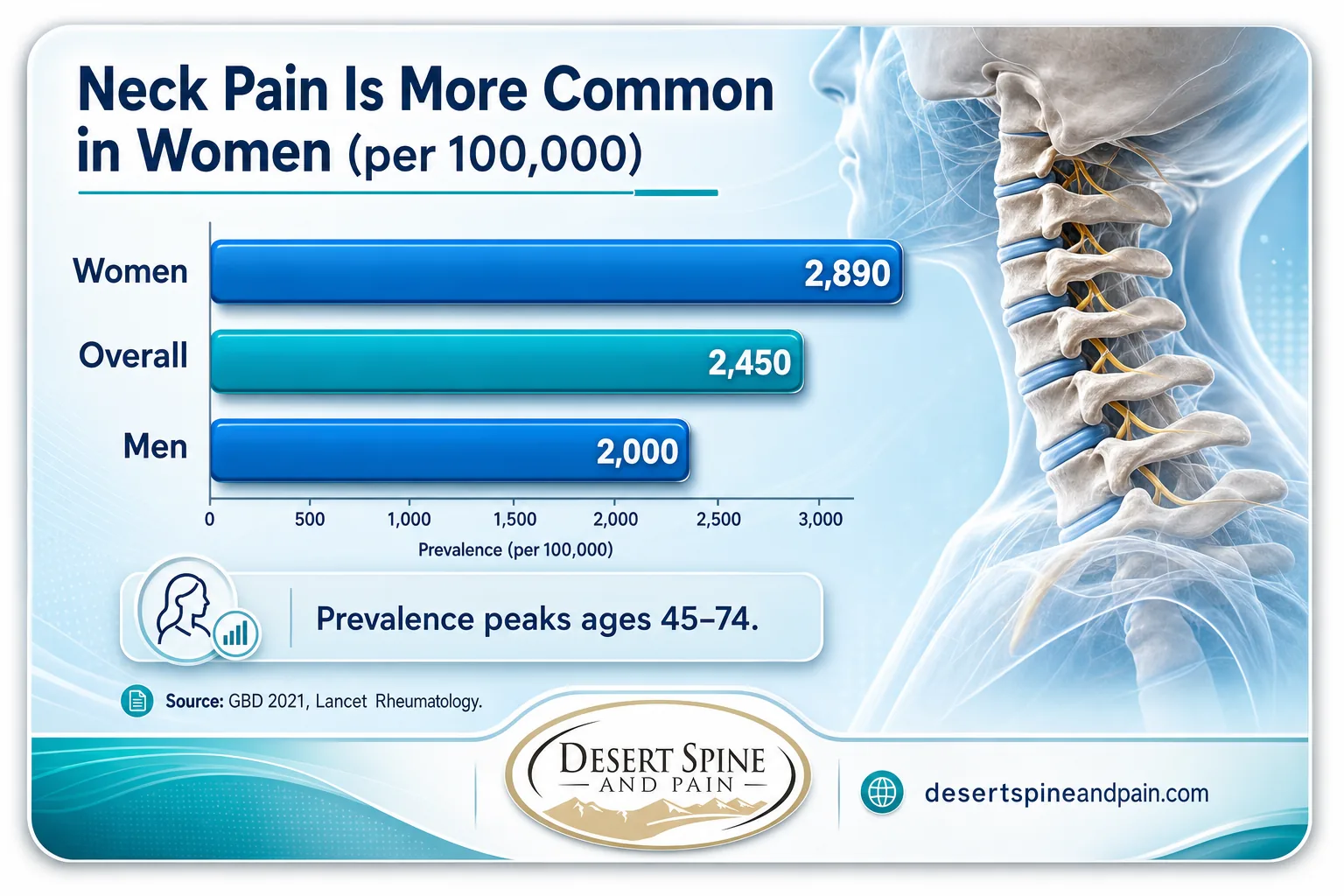
- Women are affected more than men, with a prevalence rate of 2,890 vs. 2,000 per 100,000.
- Roughly 869,000 crash-related cervical spine injuries are treated in U.S. hospitals each year.
- 15% to 40% of acute whiplash neck pain becomes chronic after a collision.
- The cervical facet joint is the most common source of chronic post-whiplash neck pain.
What's in This Guide
1 How Common Neck Pain Is
Neck pain is defined in the Global Burden of Disease study as pain in the cervical spine region, with or without pain radiating into the arms, lasting at least 24 hours. By that measure it is one of the most common musculoskeletal conditions in the world.
Beyond the 203 million people affected at any point in 2020, the lifetime numbers are striking: an estimated 60% to 80% of people will experience neck pain, and roughly half will endure some degree of recurring or frequent neck pain. The one-year incidence falls between about 10.4% and 21.3%. For the broader spine picture, including how neck pain compares to back pain, see our roundup of back pain statistics.
If neck pain is limiting your movement, disrupting sleep, or radiating into your arms, a specialist evaluation can identify the cause and the least-invasive effective treatment.
Explore the spine conditions we treatSource: Institute for Health Metrics and Evaluation (GBD 2021) | The Lancet Rheumatology (GBD 2021 Neck Pain)
2 Neck Pain and Disability
Neck pain is not just common. It is genuinely disabling, and it ranks among the top global contributors to years lived with disability, the standard measure of how much a condition impairs daily life.
The global age-standardized prevalence rate of neck pain was about 2,450 per 100,000 population, and the years-lived-with-disability rate about 244 per 100,000. Notably, the age-standardized prevalence rate stayed essentially flat between 1990 and 2020, a change of just 0.2%. That means the growing burden is driven by a larger, older population rather than a rising individual risk. Neck pain causes are multifactorial, including muscle strain, poor posture, degenerative disc and joint changes, and injury from collisions or sports.
Myth: "Neck pain always means a serious spinal problem."
Most neck pain is mechanical and multifactorial, and many episodes improve with conservative care and a return to gentle activity. That said, neck pain radiating into the arms, or accompanied by numbness, weakness, or tingling, can signal cervical nerve involvement that warrants evaluation. The point is not to panic over neck pain, nor to ignore warning signs, but to get an accurate assessment. A surgeon who is also a neurosurgeon is uniquely positioned to tell the difference between a self-limited strain and a nerve problem that needs attention.
Source: The Lancet Rheumatology (GBD 2021 Neck Pain) | Systematic review, MVC and future neck pain
See conservative, non-invasive care options3 Age and Sex Patterns
Neck pain follows clear demographic patterns. It affects women more than men, and it concentrates in the middle and later working years.
Globally, women had a higher age-standardized prevalence rate of neck pain, 2,890 per 100,000 compared with 2,000 for men, with prevalence peaking between 45 and 74 years of age in both sexes. This female predominance carries into injury as well: persistent neck pain after a whiplash injury has been reported to be more common in women by roughly a 70:30 ratio. Delayed recovery after neck injury is associated with female gender, older age, high initial pain intensity, and any neurologic deficit.
Source: The Lancet Rheumatology (GBD 2021 Neck Pain)
Meet Dr. Greenwald: spine surgeon and neurosurgeon4 Whiplash and Car Crashes
For many people, neck pain starts in a car crash. Whiplash, the rapid back-and-forth motion of the neck during a collision, is one of the most common injuries in motor vehicle accidents, and it carries real medical and legal significance.
Research analyzing national crash and hospital data estimates roughly 869,000 traffic crash-related cervical spine injuries are treated in U.S. hospitals each year, including about 841,000 whiplash sprain and strain injuries, 23,500 fractures, 2,800 disc injuries, and 2,800 spinal cord injuries. Cervical whiplash is the most common injury after a collision, affecting up to 83% of occupants, and one case-control study across nine U.S. states found that 45% of patients with chronic neck pain attributed their pain to a motor vehicle collision.
Why this matters for personal injury cases
Neck injuries from collisions sit at the intersection of medicine and law. Accurate diagnosis, clear documentation, and timely specialist care all matter for the patient's recovery and for the strength of a personal injury claim. Desert Spine and Pain works closely with personal injury attorneys, offering 24/7 concierge response, fast scheduling, and expert partnership for their clients, backed by a surgeon who is both a spine surgeon and a neurosurgeon. If you or a client has neck pain after a crash, call (602) 566-9500.
Source: Accident Analysis and Prevention (crash cervical injury estimates) | AAPM&R KnowledgeNow, Cervical Whiplash
Personal injury support: (602) 566-95005 When Whiplash Becomes Chronic
Most whiplash improves, but a substantial minority does not. Understanding when acute neck pain becomes chronic, and where the pain comes from, points directly to the treatments that help.
Following a motor vehicle collision, an estimated 15% to 40% of patients with acute neck pain develop chronic neck pain, and prognosis studies indicate about 50% of injured people still experience neck pain a year later. Crucially, the cervical facet joint is the most common source of chronic neck pain after whiplash, followed by disc-related pain. This is why targeted interventional procedures matter: when facet joints are the pain generator, diagnostic medial branch blocks can confirm it, and radiofrequency ablation can provide lasting relief without surgery.
Desert Spine and Pain Analysis: The Chronic Whiplash Funnel
Two Tier 1 figures show how a common injury produces a lasting problem. Whiplash affects up to 83% of collision occupants, and 15% to 40% of acute cases become chronic. Applied to the roughly 841,000 whiplash injuries treated in U.S. hospitals each year, even the low end of that chronic range implies well over 100,000 new chronic whiplash cases annually from hospital-treated injuries alone, before counting the many collision injuries never seen in an emergency department. That is a large, treatable population for whom facet-targeted interventional care is often the answer.
Formula: hospital-treated whiplash injuries (~841,000) multiplied by the low-end chronic transition rate (15%). Calculation and interpretation original to Desert Spine and Pain. Sources: Accident Analysis and Prevention; chronic whiplash evidence review.
Source: Chronic whiplash and whiplash-associated disorders review | Systematic review, MVC and future neck pain
Learn about medial branch nerve blocks6 The 2050 Outlook
Like most musculoskeletal conditions, neck pain is projected to grow in absolute terms as the global population expands and ages.
By 2050, the global number of neck pain cases is projected to reach 269 million, a 32.5% increase from 2020. Decomposition analysis shows population growth as the primary driver, followed by population aging. Because the underlying rate is stable, this is fundamentally a story of demographics: more people, living longer, means more neck pain to treat, and a continued need for the full range of care from conservative management through advanced surgery when required.
Source: The Lancet Rheumatology (GBD 2021 Neck Pain) | Institute for Health Metrics and Evaluation
Explore spine surgery options7 Every Statistic in One Table
| Statistic | Figure | Source | Year |
|---|---|---|---|
| Global neck pain cases | 203 million | GBD 2021 / Lancet Rheumatology | 2020 |
| Projected global cases by 2050 | 269 million | GBD 2021 / Lancet Rheumatology | 2050 |
| Projected increase 2020–2050 | +32.5% | GBD 2021 / Lancet Rheumatology | 2050 |
| Global age-standardized prevalence rate | 2,450 per 100,000 | GBD 2021 / Lancet Rheumatology | 2020 |
| Female prevalence rate | 2,890 per 100,000 | GBD 2021 / Lancet Rheumatology | 2020 |
| Male prevalence rate | 2,000 per 100,000 | GBD 2021 / Lancet Rheumatology | 2020 |
| Rank as cause of years lived with disability | #4 globally | GBD / peer-reviewed | 2024 |
| Lifetime prevalence of neck pain | 60–80% | Peer-reviewed (GBD youth analysis) | 2025 |
| One-year incidence | 10.4–21.3% | Peer-reviewed | 2025 |
| Peak prevalence age range | 45–74 | GBD 2021 / Lancet Rheumatology | 2020 |
| U.S. crash-related cervical spine injuries/yr | ~869,000 | Accident Analysis and Prevention | 2020 |
| Whiplash sprain/strain injuries/yr (hospital) | ~841,000 | Accident Analysis and Prevention | 2020 |
| Occupants reporting neck pain after collision | Up to 83% | AAPM&R KnowledgeNow | 2024 |
| Acute whiplash becoming chronic | 15–40% | Whiplash evidence review | 2007 |
| Neck-injured still in pain at 1 year | ~50% | Systematic review/meta-analysis | 2019 |
| Top source of chronic post-whiplash pain | Cervical facet joint | Whiplash evidence review | 2007 |
| Annual U.S. whiplash economic burden | $3.9 billion | AAPM&R KnowledgeNow | 2024 |
| Chronic neck pain attributed to a car crash | 45% | Nine-state case-control study | 2024 |
Frequently Asked Questions
How common is neck pain?
Is neck pain a leading cause of disability?
How often does whiplash lead to chronic neck pain?
How many neck injuries come from car crashes each year?
Is neck pain more common in women or men?
Methodology and Sources
Every statistic in this article is drawn from a Tier 1 primary source: a government agency, a peer-reviewed study, or a major research institution. No blog-to-blog citations are used. Where estimates vary by methodology, ranges are shown rather than a single figure.
Primary sources:
- The Lancet Rheumatology / GBD 2021 Neck Pain Collaborators: global, regional, and national burden of neck pain, 1990-2020, with projections to 2050.
- Institute for Health Metrics and Evaluation (IHME): GBD neck pain analysis and summary.
- Accident Analysis and Prevention: estimating traffic crash-related cervical spine injuries in the U.S.
- AAPM&R KnowledgeNow: cervical whiplash prevalence, economic burden, and chronic pain sources.
- Peer-reviewed evidence review (PubMed): chronic whiplash and whiplash-associated disorders, facet joint as pain source.
- Systematic review and meta-analysis (PMC): exposure to a motor vehicle collision and future neck pain.
- Peer-reviewed GBD youth analysis: lifetime prevalence and one-year incidence ranges.
This article is for general educational purposes and is not individual medical advice. Statistics describe populations, not any one person. If you have neck pain, especially after an injury or with arm symptoms, consult a qualified provider for evaluation.
Media and press: Journalists and researchers are welcome to cite these statistics with attribution to the original primary source named alongside each figure, and a link to this page as the compiled reference. For commentary from a board-certified spine surgeon and neurosurgeon, contact Desert Spine and Pain in Phoenix, Arizona at (602) 566-9500.