

Causes of Back Pain: Demographics and Statistics (2026)
Most back pain has no single cause, but the measurable risk factors tell a clear story. Occupational strain, smoking, and high body weight together account for about 39% of low back pain disability, and while workplace and smoking risks are falling, obesity-linked back pain is rising fast, especially among women. Here is the 2026 data, from primary sources only.
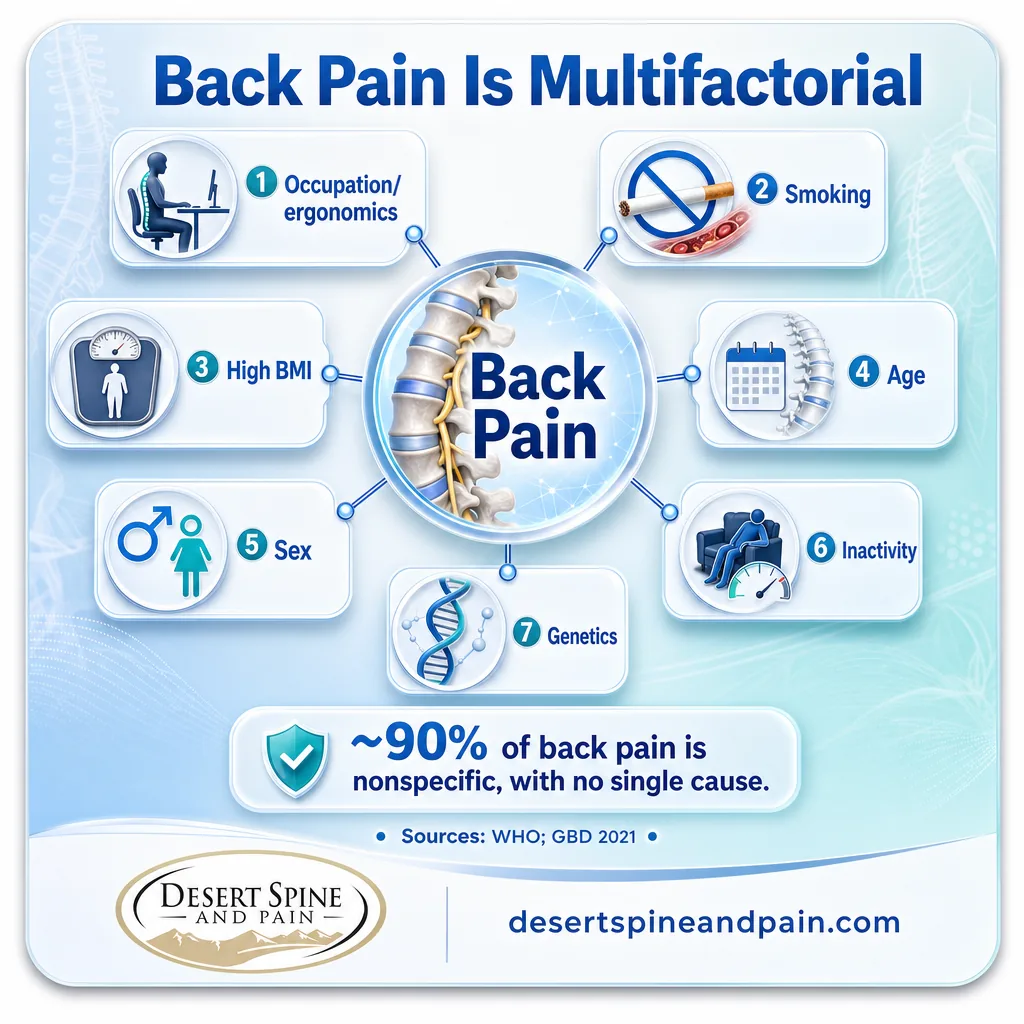
- About 90% of back pain is nonspecific and multifactorial, with no single structural cause.
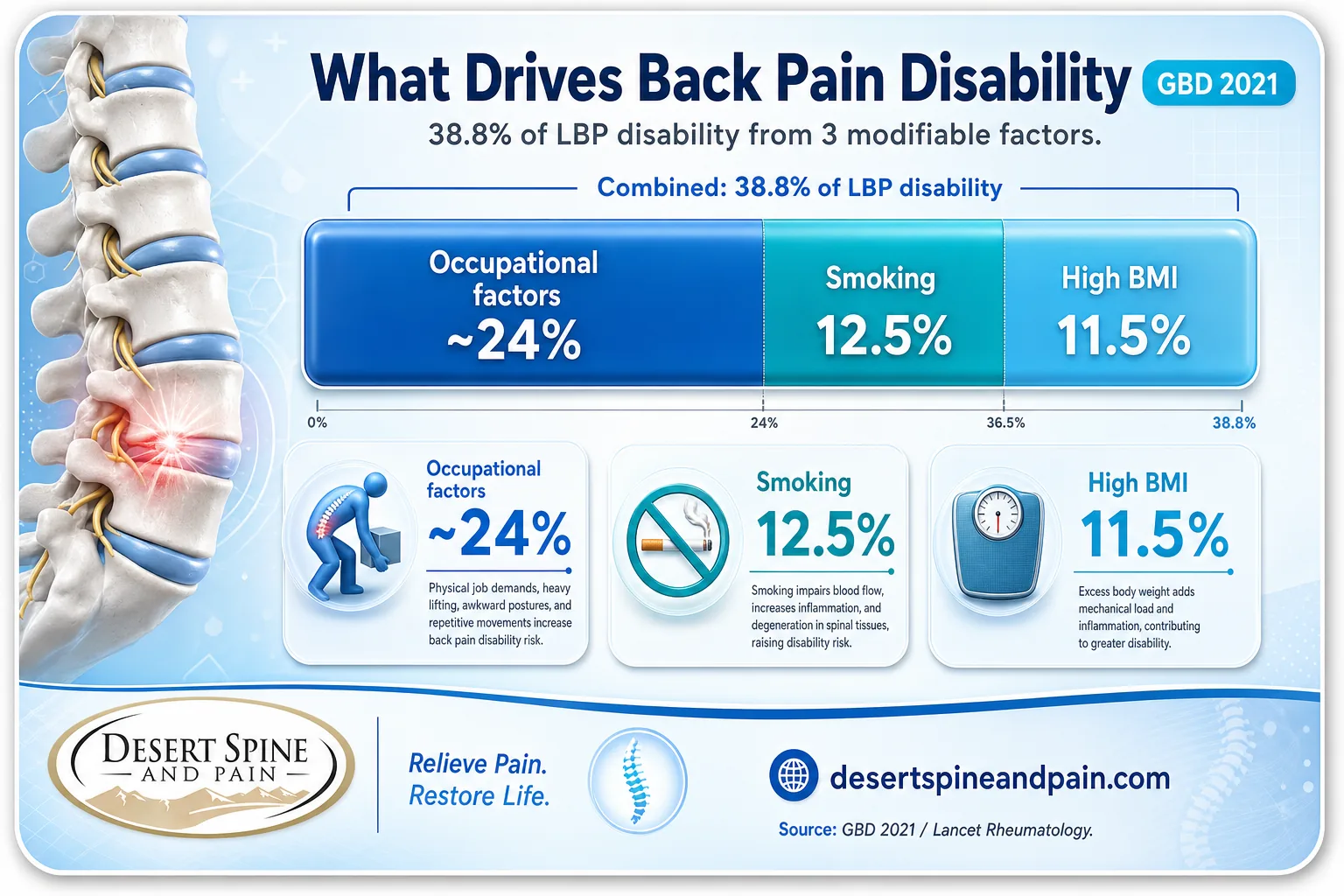
- 38.8% of low back pain disability traces to occupation, smoking, and high BMI combined (GBD 2021).
- Occupational and ergonomic factors are the largest single contributor, at nearly one-quarter of the burden.
- Smoking accounts for 12.5% and high BMI for 11.5% of low back pain disability.
- Addressing all three could cut the low back pain burden by about 39% (IHME).
- Obesity-linked back pain is rising fastest, up 37% among women since 1990.
- Back pain is more common in women than men across all age groups.
What's in This Guide
1 Why Most Back Pain Has No Single Cause
Before listing risk factors, an important truth: most back pain cannot be pinned to one clear structural culprit. It is what clinicians call nonspecific, arising from a mix of mechanical, lifestyle, and individual factors acting together.
Because roughly 90% of back pain is nonspecific, understanding causes means understanding risk factors, the things that raise the odds of developing back pain and of it becoming disabling. For the prevalence picture overall, see our roundup of back pain statistics. This article focuses on what drives back pain and who is most affected.
If you want to understand what is driving your back pain, a specialist evaluation can sort the modifiable factors from the structural ones and guide the right plan.
Explore the spine conditions we treatSource: World Health Organization | StatPearls (NCBI Bookshelf)
2 The Three Big Modifiable Risk Factors
The Global Burden of Disease study quantified how much of low back pain disability can be attributed to modifiable risk factors. Three stand out, and together they explain a large share of the burden.
According to the GBD 2021 analysis, a total of 38.8% of years lived with disability from low back pain were attributed to occupational factors, smoking, and high BMI. Researchers concluded that if society could directly address these three, it could cut the burden of low back pain by about 39%. That is a striking figure: it means a large fraction of the world's leading cause of disability is linked to factors that are, in principle, changeable.
Share of Low Back Pain Disability by Modifiable Risk Factor (GBD 2021)
Source: The Lancet Rheumatology (GBD 2021 attributable risk) | Institute for Health Metrics and Evaluation
See conservative, non-invasive care options3 Occupation and Ergonomics
Work is the single largest measurable driver of back pain disability. The physical demands of a job, and the postures it forces, matter enormously.
Nearly one-quarter of years lived with disability from low back pain are attributed to occupational ergonomic factors, which include prolonged sitting or standing, bending, and lifting. Work exposures such as lifting, awkward postures, vibration, and physically demanding tasks are associated with increased risk, though researchers note that independent causal relationships have not been fully proven. Encouragingly, the occupational contribution has declined about 12% globally since 1990, likely reflecting shifts in the nature of work and better ergonomics, even as it remains the largest single factor.
Source: The Lancet Rheumatology (GBD 2021) | Arthritis Care & Research (LBP risk factor trends)
Explore interventional pain management4 Smoking and Body Weight
Two lifestyle factors independently raise back pain risk: smoking and excess body weight. Both are associated not only with developing back pain but with it becoming persistent.
Back pain prevalence rises with smoking intensity: one national analysis found a relative risk of 1.47 for people reporting 50 or more pack-years, and this association was strongest in those under 45, where the relative risk reached 2.33. Smoking is thought to damage the microcirculation that nourishes spinal discs and joints and to weaken bone, though the exact mechanism is not settled. For body weight, a European population study found obesity increased the odds of chronic low back pain by about 1.72 times, and high BMI is associated with higher disability levels, with odds ratios around 1.39 in men and 1.45 in women.
Myth: "Back pain is just bad luck or bad genes."
Genetics and chance play a role, but the data show that a large share of back pain risk is linked to changeable factors: how physically demanding your work is, whether you smoke, and your body weight. That is empowering rather than discouraging. It means lifestyle changes and workplace adjustments can meaningfully lower risk, and it means back pain disability is not a fixed sentence written by your DNA.
Source: Lifestyle and low-back pain (smoking and obesity study) | BMI and chronic low back pain, European Health Survey
Meet Dr. Greenwald: spine surgeon and neurosurgeon5 The Shifting Risk Landscape
The causes of back pain are not static. Over the past three decades, the mix of risk factors has shifted in a way that has major implications for prevention.
A 2025 analysis of Global Burden of Disease data from 1990 to 2021 found a clear shift. The disability burden from occupational factors and smoking has declined, by 12% and 21% respectively, thanks in part to changing work and anti-smoking policies. But the burden linked to high body mass index has risen at an alarming rate, up 37% among women and by more than 300% in lower-income regions. In short, as two traditional causes recede, obesity is emerging as the fastest-growing driver of back pain disability worldwide.
Desert Spine and Pain Analysis: The Obesity Crossover
The trend data point to a turning point. Smoking's contribution to low back pain disability fell 21% and occupational factors fell 12% since 1990, while high-BMI disability rose 37% among women and over 300% in low-income regions. The direction is unmistakable: the dominant modifiable cause of back pain is shifting from the workplace and the cigarette toward body weight. For prevention, that means weight and metabolic health are becoming as central to spine health as ergonomics once were.
Interpretation based on directional risk-factor trends. Calculation and interpretation original to Desert Spine and Pain. Sources: Arthritis Care & Research (GBD 1990–2021 trend analysis); IHME.
Source: Arthritis Care & Research (Roberts et al., 2025)
Learn about diagnostic nerve testing6 Sex, Age, and Income Patterns
Beyond individual risk factors, back pain follows consistent demographic patterns. Some groups carry a heavier burden than others.
Globally, low back pain is more prevalent in women than men in every age group, a pattern reinforced by the finding that obesity-related back pain is rising fastest among women. Prevalence rises with age, peaking around age 85. Socioeconomic status matters too: lower-income groups tend to experience more back pain, attributed to more labor-intensive work and more limited access to care. These patterns mean prevention and treatment strategies work best when they account for the whole person, their work, their health, and their circumstances, not just their spine.
Source: Institute for Health Metrics and Evaluation | Arthritis Care & Research
Book a consultation: (602) 566-95007 Every Statistic in One Table
| Statistic | Figure | Source | Year |
|---|---|---|---|
| Back pain that is nonspecific/multifactorial | ~90% | WHO | 2023 |
| LBP disability from 3 modifiable factors combined | 38.8% | GBD 2021 / Lancet | 2021 |
| LBP disability from occupational factors | ~24% | GBD 2021 / Lancet | 2021 |
| LBP disability from smoking | 12.5% | GBD 2021 / Lancet | 2021 |
| LBP disability from high BMI | 11.5% | GBD 2021 / Lancet | 2021 |
| Potential burden reduction if all 3 addressed | ~39% | IHME | 2023 |
| Relative risk, back pain with heavy smoking | 1.47 | Lifestyle/LBP study | 1989 |
| Relative risk, heavy smoking under age 45 | 2.33 | Lifestyle/LBP study | 1989 |
| Odds ratio, chronic LBP with obesity | 1.72 | European Health Survey | 2020 |
| Odds ratio, high LBP disability with high BMI (men) | 1.39 | Arthritis Care & Research | 2025 |
| Odds ratio, high LBP disability with high BMI (women) | 1.45 | Arthritis Care & Research | 2025 |
| Change in occupational LBP burden since 1990 | −12% | Arthritis Care & Research | 2025 |
| Change in smoking LBP burden since 1990 | −21% | Arthritis Care & Research | 2025 |
| Rise in high-BMI LBP disability among women | +37% | Arthritis Care & Research | 2025 |
| Rise in obesity-attributed LBP, low-income regions | +308% | Arthritis Care & Research | 2025 |
| Sex pattern | Women > men, all ages | GBD 2021 / IHME | 2020 |
| Age of peak prevalence | 85 | GBD 2021 / IHME | 2020 |
Frequently Asked Questions
What are the main causes of back pain?
What percentage of back pain is preventable?
Does smoking cause back pain?
Who is most at risk for back pain?
Is obesity-related back pain increasing?
Methodology and Sources
Every statistic in this article is drawn from a Tier 1 primary source: a government agency, a peer-reviewed study, or a major research institution. No blog-to-blog citations are used. Where estimates vary by methodology, ranges and effect sizes are shown with their context.
Primary sources:
- The Lancet Rheumatology / GBD 2021: attributable-risk analysis of low back pain, with the occupational, smoking, and BMI decomposition.
- Institute for Health Metrics and Evaluation (IHME): commentary on modifiable risk factors and the potential 39% burden reduction.
- Arthritis Care & Research (Roberts et al., 2025): global trends in low back pain risk factors, 1990-2021, including the rising role of obesity.
- Peer-reviewed lifestyle study (PubMed): smoking and obesity relative risks for back pain.
- European Health Survey secondary analysis (PMC): BMI and chronic low back pain odds.
- World Health Organization: nonspecific nature of most low back pain.
- StatPearls (NCBI Bookshelf): specific versus nonspecific back pain.
This article is for general educational purposes and is not individual medical advice. Statistics describe populations, not any one person. Risk factors raise or lower probability; they do not determine any individual's outcome. If you have back pain, consult a qualified provider for evaluation.
Media and press: Journalists and researchers are welcome to cite these statistics with attribution to the original primary source named alongside each figure, and a link to this page as the compiled reference. For commentary from a board-certified spine surgeon and neurosurgeon, contact Desert Spine and Pain in Phoenix, Arizona at (602) 566-9500.