
When Is SI Joint Fusion Necessary?
SI joint fusion becomes necessary when three things are true at the same time: a diagnostic injection confirms the sacroiliac (SI) joint is the source of your pain, a real course of conservative treatment has not relieved it, and the pain still limits your daily life. For most patients, fusion is the last step, not the first one.
Quick answer: Fusion is reserved for confirmed, treatment-resistant SI joint pain. If an image-guided numbing injection into the joint relieves your pain, physical therapy and injections have been tried without lasting success, and the pain still keeps you from everyday activities, you may be a candidate. If the joint has not been confirmed as the source, or you have not completed conservative care, surgery is usually not appropriate yet.
- Fusion is a last resort. It is considered only after conservative care fails for confirmed SI joint pain.
- Confirmation is non-negotiable. Surgeons want three or more positive provocation tests plus an image-guided injection that relieves pain by about 75 percent.
- The SI joint is a hidden culprit. It accounts for an estimated 15 to 30 percent of low back pain, and it is frequently overlooked.
- Severity matters. Candidates usually have pain that measurably limits work, sleep, and daily activities, not mild or intermittent discomfort.
- Minimally invasive is the norm. Most modern SI joint fusions are done through a small incision, with open surgery reserved for trauma, tumor, or infection.
What Is in This Guide
- What the SI joint does and what goes wrong
- The three conditions that must be true before fusion
- How doctors confirm the SI joint is the problem
- SI joint injection vs. SI joint fusion
- Who is a candidate, and who is not
- Minimally invasive vs. open SI joint fusion
- How to find out if you need SI joint fusion
- Common questions about SI joint fusion
- Related spine topics
What the SI Joint Does, and What Goes Wrong
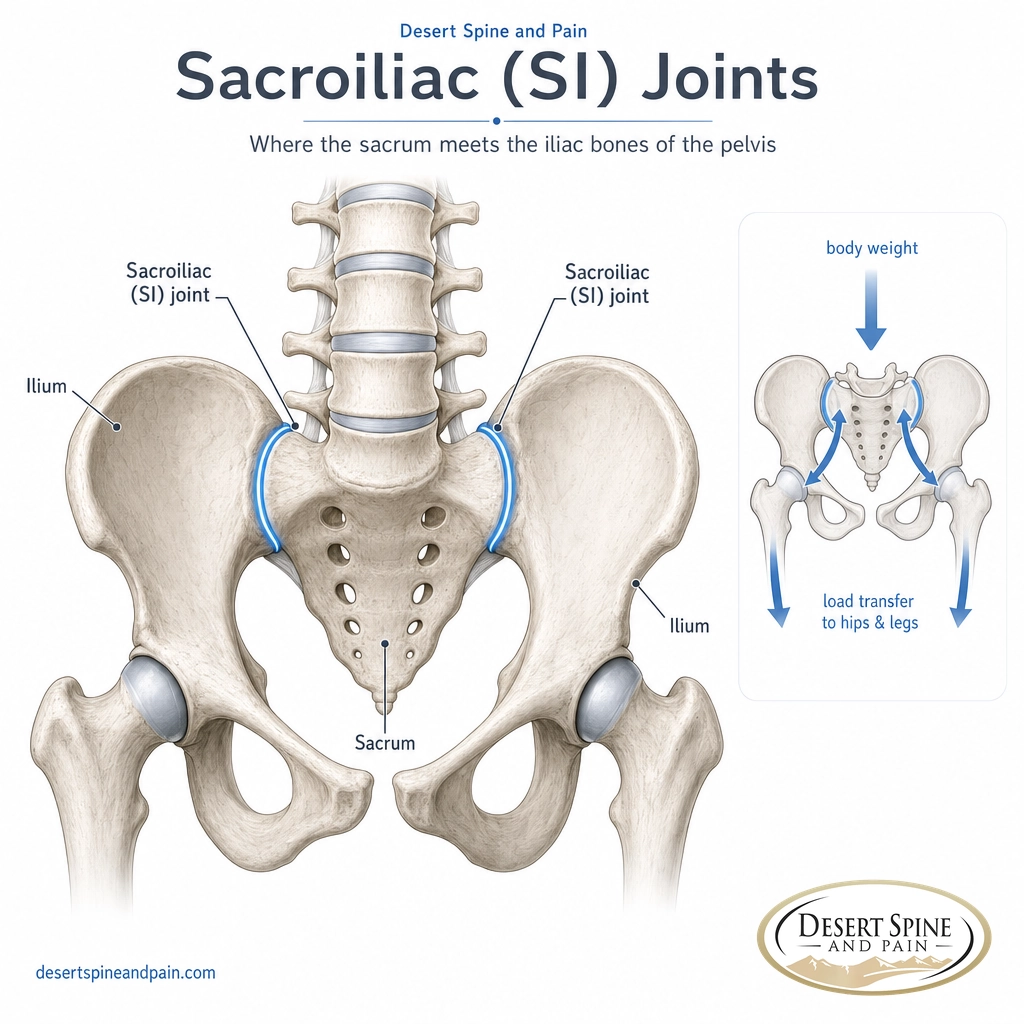
The sacroiliac joints sit where the base of your spine (the sacrum) meets the pelvis, one on each side, just below the small of your back. They are strong, low-motion joints held together by thick ligaments. Their job is to transfer the load of your upper body into your hips and legs and to absorb shock when you walk, stand, or lift.
Think of the SI joint less like a hinge and more like a tightly packed shock absorber. It is not built to move much. When the ligaments are injured, loosened, or worn, the joint can move abnormally or become inflamed, and that generates a deep, one-sided pain in the lower back, buttock, or hip that often worsens with sitting, standing from a chair, or climbing stairs.
The frustrating part is how easily SI joint pain is missed. It mimics a disc problem or sciatica, so patients can spend months chasing the wrong diagnosis.
What triggers SI joint pain? A specific inciting event explains roughly 40 to 50 percent of cases. Common ones include:
- Falls and motor vehicle accidents (sudden impact through the pelvis)
- Pregnancy and childbirth (hormone-driven ligament laxity)
- Prior lumbar spinal fusion (extra stress transferred to the SI joint below)
- Arthritis or degeneration of the joint
- Leg-length difference or repetitive one-sided loading
Other cases build gradually with no single trigger. Either way, the cause matters, because fusion is aimed at a mechanically painful, confirmed joint, not at general back pain.
Source: ASRA Pain Medicine, Sacroiliac Joint Pain review
The Three Conditions That Must Be True Before Fusion
Responsible spine surgeons do not offer SI joint fusion based on symptoms alone. Three boxes have to be checked first. If any one of them is missing, fusion is premature.
1 The SI joint is confirmed as the pain source
Because SI joint pain copies other conditions, it has to be proven, not assumed. That means a positive physical exam and, critically, a diagnostic injection that numbs the joint and relieves the pain. Without that confirmation, there is no target for surgery.
2 Conservative treatment has genuinely failed
Fusion is considered only after non-surgical care has been tried and has not given lasting relief. That includes activity modification, anti-inflammatory medication, physical therapy, and often therapeutic injections. A typical physical therapy course runs about 4 to 10 weeks before a surgeon will say conservative care has failed.
3 The pain is severe enough to limit your life
Candidates generally have pain that measurably interferes with daily living, work, sleep, or the ability to sit and stand comfortably, not mild or occasional discomfort. Surgery is weighed against how much the pain is actually taking from you.
Myth: "My SI joint hurts, so I probably need a fusion." Not true. The large majority of SI joint pain is managed successfully without surgery. Fusion is reserved for the smaller group whose pain is confirmed, treatment-resistant, and disabling. Pain alone is a reason to get evaluated, not a reason to operate.
Source: ASRA Pain Medicine, Sacroiliac Joint Pain review
How Doctors Confirm the SI Joint Is Really the Problem
Confirmation is the single most important step in deciding whether fusion is necessary. It usually has three parts.
1. Provocation tests. During the exam, the physician stresses the joint in specific ways (maneuvers such as distraction, compression, thigh thrust, Gaenslen, and FABER). No single test is reliable on its own, but when three or more are positive together, the combination points strongly at the SI joint.
2. Imaging to rule out other sources. X-rays, MRI, or CT help exclude a herniated disc, hip arthritis, or lumbar stenosis. Importantly, imaging rarely proves SI joint pain by itself. It mainly rules out the competition. A disc problem and an SI joint problem can even coexist.
3. The diagnostic injection (the deciding test). An image-guided injection places numbing medicine directly into the joint. If your usual pain drops by about 75 percent during the time the anesthetic is working, the SI joint is confirmed as the generator. Some protocols repeat the block or use a 70 percent threshold with two injections for extra certainty.
Why the injection is the gold standard: a single diagnostic SI joint block has a reported positive predictive value around 87 percent. In plain terms, when the numbing injection clearly relieves your pain, there is a high likelihood the SI joint is genuinely the cause, which is exactly what a surgeon needs to know before recommending fusion. The same SI joint injection can double as treatment, not just a test.
Source: ASRA Pain Medicine, Sacroiliac Joint Pain review
SI Joint Injection vs. SI Joint Fusion
These two get confused constantly, and the difference is central to understanding when fusion is necessary. An injection is used first, for diagnosis and often for relief. Fusion is a surgical fix reserved for when injections and other conservative care stop working.
| SI Joint Injection | SI Joint Fusion | |
|---|---|---|
| What it is | Image-guided medication placed into the joint | Surgery that permanently stabilizes the joint with implants |
| Main purpose | Confirm the pain source and reduce inflammation | Stop motion in a confirmed, painful joint |
| When it is used | Early, as diagnosis and conservative treatment | Later, after conservative care has failed |
| Lasting? | Temporary to intermediate relief | Designed to be permanent |
| Invasiveness | Non-surgical, outpatient | Surgical, usually minimally invasive |
A good way to read the table: the injection answers the question, and fusion acts on the answer. If injections relieve your pain but the relief never lasts and your life is still limited, that pattern is one of the clearest signals that fusion may be warranted.

Who Is a Candidate, and Who Is Not
Pulling the criteria together, here is the practical picture surgeons and insurers use.
You are more likely to be a candidate if:
- A diagnostic injection confirmed the SI joint as your pain source
- You completed a real course of conservative care without lasting relief
- Your pain is moderate to severe and limits daily activities
- Imaging has reasonably ruled out other primary causes
- The pain is localized to the SI joint region, not spread across the body
You are usually not a candidate (yet) if:
- The SI joint has not been confirmed as the source with an injection
- You have not completed or documented conservative treatment
- Your pain is mild, intermittent, or still improving on its own
- You have a widespread pain condition such as fibromyalgia, where a single-joint fix is unlikely to resolve the problem
- An untreated issue elsewhere (hip, lumbar spine) better explains the pain
This is also why a careful second look matters. If you have been told you need fusion but the joint was never confirmed with an injection, that is a reasonable moment to pause and ask for clarity from a board-certified brain and spine surgeon.
Minimally Invasive vs. Open SI Joint Fusion
If fusion is the right call, the next question is how it is done. Most SI joint fusions today are minimally invasive, performed through a small incision with specialized implants that stabilize the joint and encourage the bones to fuse.
Open surgery is the exception. It is generally reserved for specific situations: severe pelvic trauma with a fractured pelvis, tumors involving the sacrum, or infection in or around the joint. For ordinary degenerative or post-injury SI joint pain, the minimally invasive approach is the standard.
The evidence behind minimally invasive fusion is strong. In a multicenter randomized trial, patients who had minimally invasive SI joint fusion improved far more than those who continued non-surgical management.
6-Month Pain Improvement: Minimally Invasive SI Fusion vs. Non-Surgical Care (INSITE RCT, 100-point pain scale)
Mean reduction in SI joint pain at 6 months. Gains held durable to 24 months. Source: Polly et al., INSITE RCT, Int J Spine Surg 2016.The takeaway is not that everyone should rush to surgery. It is that when fusion is genuinely necessary (a confirmed, treatment-resistant joint), the modern minimally invasive procedure has a well-documented track record. You can read more about the minimally invasive SI joint fusion approach and who it suits.
Source: Polly et al., Two-Year Outcomes (INSITE RCT), International Journal of Spine Surgery 2016
Explore SI Joint Fusion Options
How to Find Out if You Need SI Joint Fusion
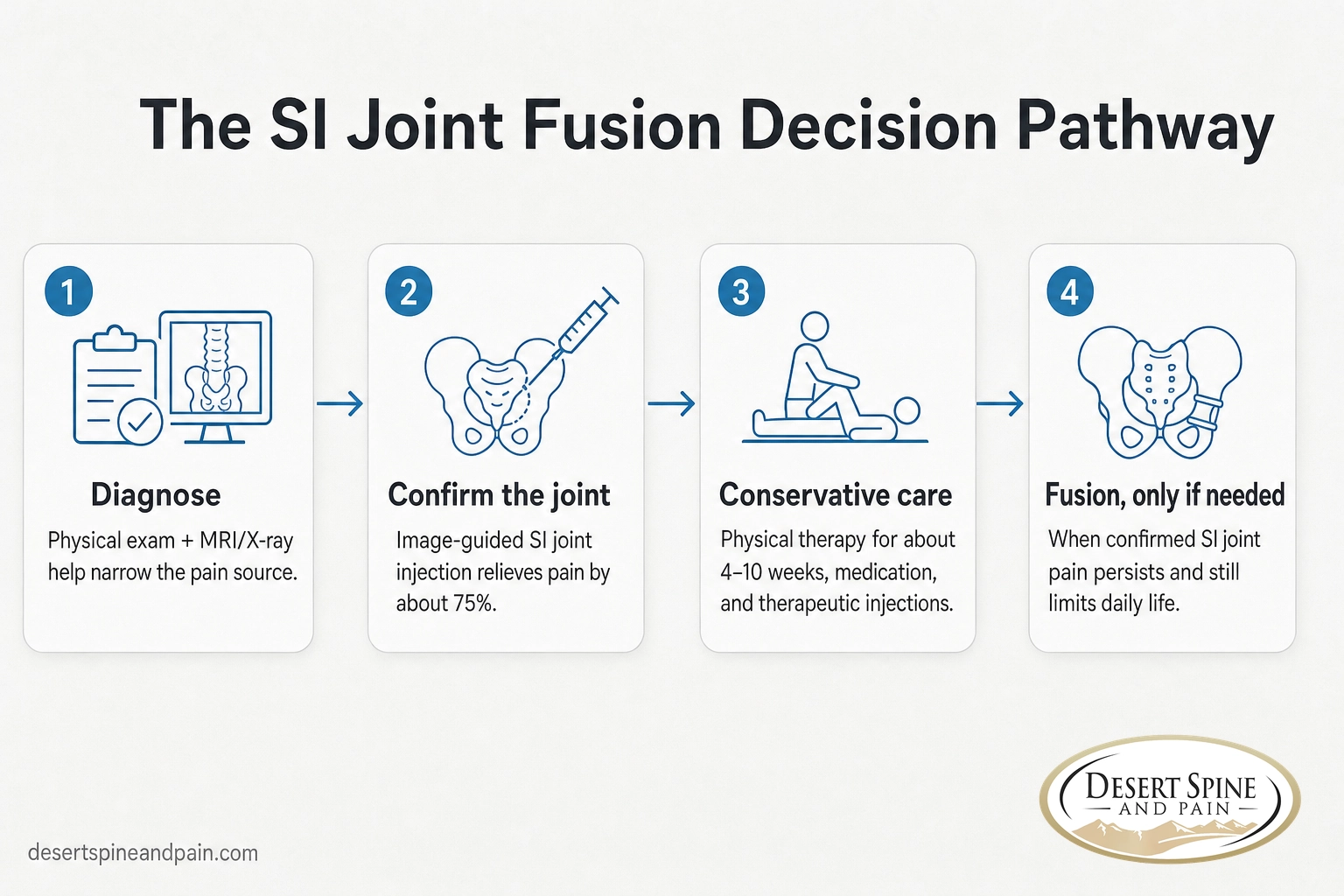
You do not have to figure out whether fusion is necessary on your own. The decision follows a clear, stepwise path, and most patients never reach the surgical end of it.
- Get an accurate diagnosis. A focused exam plus provocation testing and imaging to narrow the source.
- Confirm the joint. An image-guided diagnostic SI joint injection to prove the SI joint is the generator.
- Exhaust conservative care. Physical therapy, medication, activity changes, and therapeutic injections through interventional pain management.
- Reassess. If confirmed pain persists and still limits your life, discuss fusion. If not, keep managing it non-surgically.
At Desert Spine and Pain in Phoenix, board-certified brain and spine surgeon Dr. David L. Greenwald, MD, FACS evaluates SI joint pain from conservative treatment through, when truly needed, minimally invasive fusion, so the decision is driven by your diagnosis, not by a default to surgery. If you are unsure whether your pain is coming from the SI joint, or whether fusion is really necessary, a consultation and a confirming workup will give you a clear answer.
Common Questions About SI Joint Fusion
Can SI joint pain be treated without fusion surgery?
How do doctors confirm the SI joint is causing my pain?
Who is not a candidate for SI joint fusion?
Is SI joint fusion the same as spinal fusion?
How long should I try conservative treatment before considering fusion?
Related Spine Topics
- Why would you need spinal fusion surgery: how spinal fusion differs from SI joint fusion and when it is recommended.
- Sacroiliac joint injections: the diagnostic and therapeutic injection used to confirm and treat SI joint pain.
- Minimally invasive spine surgery: the small-incision approach used for most modern SI joint fusions.
- Spine conditions: other sources of lower back and buttock pain that can mimic SI joint pain.
- Interventional pain management: the non-surgical treatments tried before fusion is considered.
Sources and Methodology
This article draws on peer-reviewed clinical literature and a randomized controlled trial. Prevalence, diagnostic thresholds, and treatment sequencing come from a pain-medicine review; surgical outcome figures come from the INSITE randomized trial.
- ASRA Pain Medicine, Sacroiliac Joint Pain: A Problem-Based Learning Discussion (2022)
- Polly DW et al., Two-Year Outcomes From a Randomized Controlled Trial of Minimally Invasive Sacroiliac Joint Fusion (INSITE), International Journal of Spine Surgery 2016
Figures are reported as published by the cited sources. This content is educational and is not a substitute for an individual evaluation by a qualified spine specialist.