
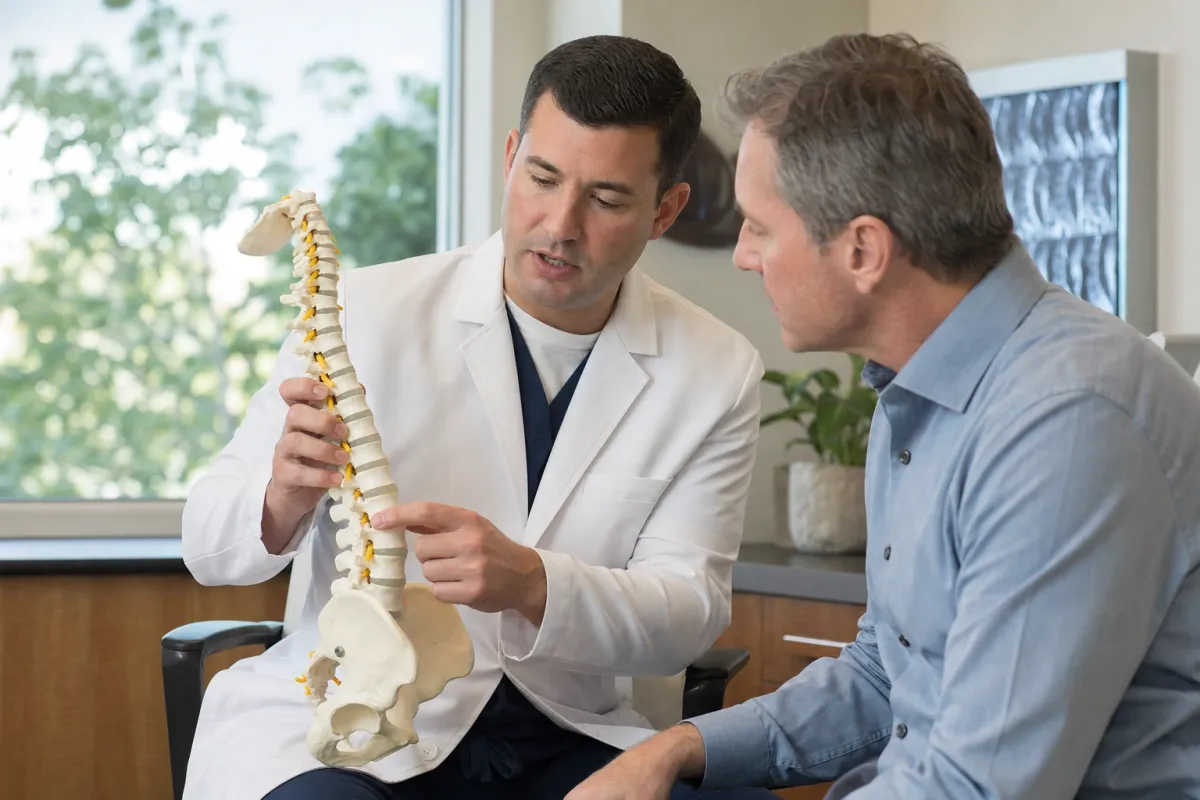
Why Would You Need Spinal Fusion Surgery?
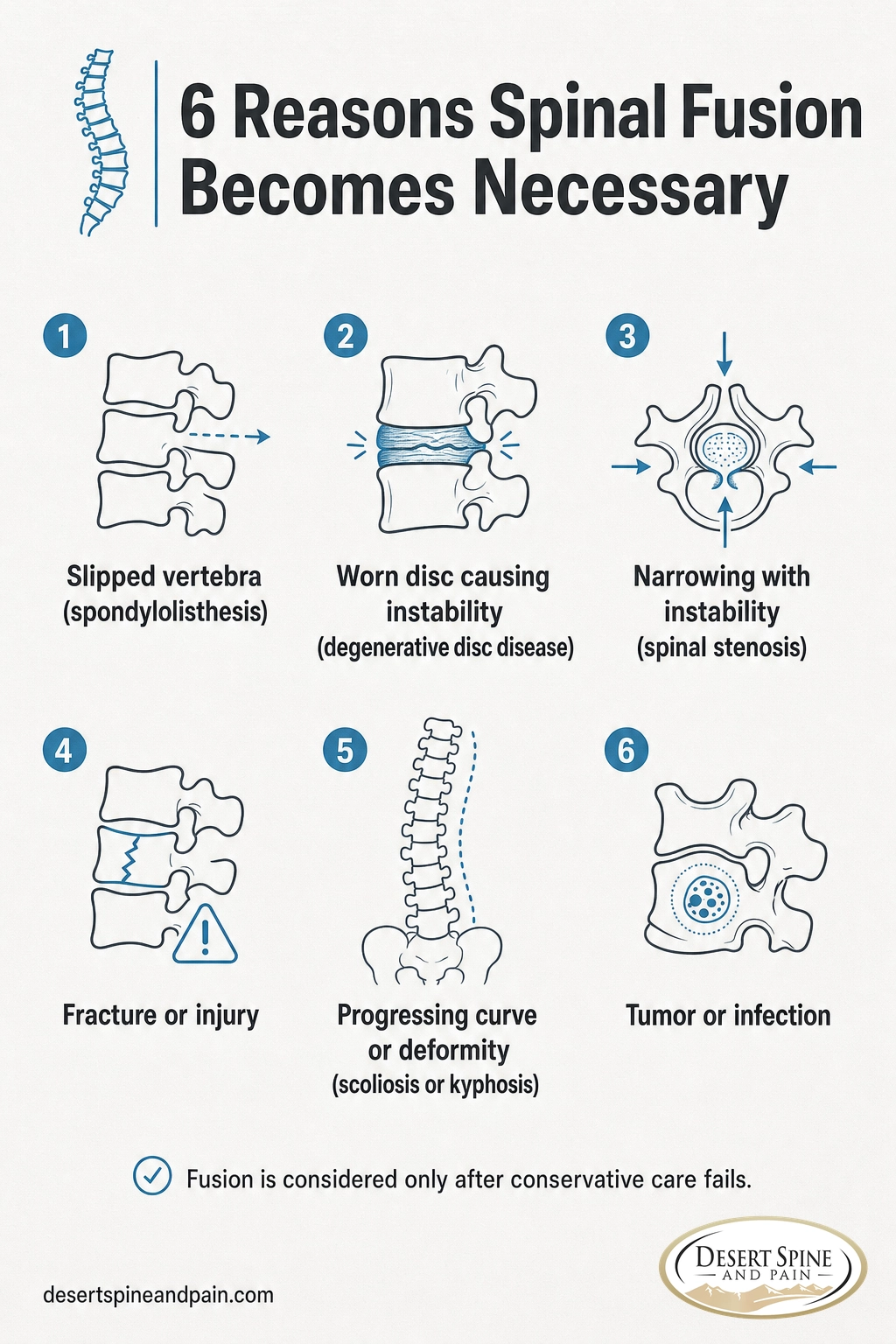
You would need spinal fusion surgery when a segment of your spine is unstable, or when a nerve is being compressed by a problem that non-surgical care has not fixed, and permanently joining the affected vertebrae is the most reliable way to stop the pain or protect the nerve. That covers a specific set of conditions: a slipped vertebra, a worn-out disc causing instability, narrowing with instability, a fracture, a progressing deformity, or a tumor or infection. The reassuring part is that most back pain never reaches this point.
Quick Check: Could fusion be in your future?
If three or more of these describe you, it is worth getting a proper spine evaluation:
- Back or leg pain that has not improved after months of physical therapy, medication, and injections.
- Pain that gets worse when you stand or walk and eases when you sit or lean forward.
- A scan that shows a slipped vertebra (spondylolisthesis), instability, or narrowing of the spinal canal.
- Numbness, tingling, or weakness that travels down one or both legs.
- A sense that your spine "gives way" or that your symptoms are slowly getting worse, not better.
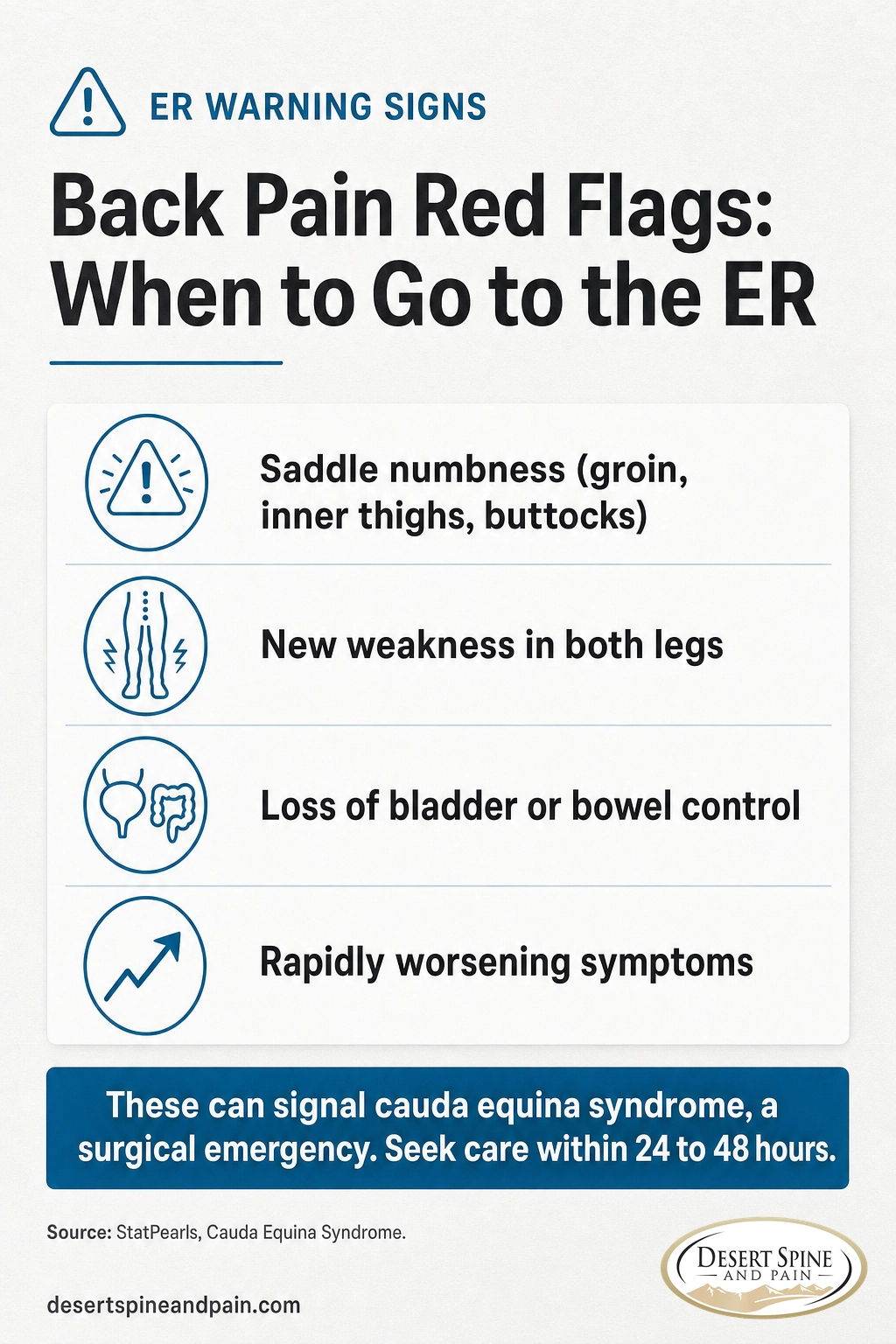
Stop and get emergency care now if you have new numbness around the groin or inner thighs, new weakness in both legs, or any loss of bladder or bowel control. Those are red flags, not reasons to wait.
- Fusion is needed when the spine is unstable or a nerve is compressed by a structural problem that conservative care has not resolved.
- The common reasons are spondylolisthesis, degenerative disc disease with instability, spinal stenosis with instability, fractures, deformity (scoliosis or kyphosis), and tumors or infection.
- About 80 percent of adults have low back pain in their lifetime, but only a small fraction ever need any spine surgery.
- Spinal fusion volume in the U.S. rose 70 percent, from 287,600 to 488,300 procedures a year between 2001 and 2011, so it is common, but not automatic.
- A true emergency is cauda equina syndrome, which needs surgery within 24 to 48 hours.
- Fusion should be a last resort after physical therapy, medication, and injections, and only when the pain source is confirmed.
What's in This Guide
- What Spinal Fusion Actually Does
- Reason 1: A Vertebra Has Slipped Out of Place
- Reason 2: A Worn-Out Disc Is Causing Instability
- Reason 3: Narrowing That Also Leaves the Spine Unstable
- Reason 4: A Fracture or Injury Has Destabilized Your Spine
- Reason 5: A Curve or Deformity Is Getting Worse
- Reason 6: A Tumor or Infection Has Damaged the Bone
- What Happens If You Ignore the Warning Signs
- When You Do Not Need Fusion
- What to Do Next
- Frequently Asked Questions
What Spinal Fusion Actually Does
Spinal fusion permanently joins two or more vertebrae into a single, solid unit so they no longer move against each other. Surgeons remove the damaged disc or joint, add a bone graft, and secure the segment with screws and rods while the bone grows together over the following months. Full healing of the fusion can take six months to a year.
There are two problems fusion is designed to solve. The first is instability, where a segment moves more than it should and that abnormal motion irritates nerves, ligaments, and muscles. The second is a situation where freeing a trapped nerve requires removing so much bone or disc that the segment would be left unstable afterward. In both cases, stopping the motion is the point. If your main problem is only a pinched nerve and the segment is stable, you may need decompression without fusion. Understanding which problem you have is the whole game, and it is why the evaluation before surgery matters more than almost anything that happens in the operating room.
See how lumbar fusion works at Desert Spine and PainSource: WebMD, Spinal Fusion Facts | AAOS OrthoInfo, Low Back Pain
Reason 1: A Vertebra Has Slipped Out of Place
This is spondylolisthesis, where one vertebra slides forward over the one beneath it. Day to day, you might notice back pain and stiffness that is worse with standing or walking and better when you sit or lean on a cart. Pain often spreads into the buttocks or the back of the thighs, and your hamstrings may feel tight.
Why it matters: when a vertebra slips, the segment is unstable by definition, and that slip can narrow the space where nerves exit. Left alone, a progressing slip can turn an annoying ache into constant leg pain and weakness.
What it probably indicates: a defect or wear in the small joints and supporting structures that normally keep the vertebra aligned. Imaging that shows the slip widening when you bend forward and back is a strong sign the segment is genuinely unstable.
What to do about it: start with physical therapy focused on core stability, activity changes, and sometimes an injection. Fusion enters the conversation when the slip is unstable or progressing and conservative care has not helped. Research on degenerative spondylolisthesis with stenosis found that surgically treated patients kept significantly greater pain relief and function than those treated without surgery through four years of follow-up.
Learn more about spine conditions we treatSource: Weinstein et al., SPORT 4-year results, PMC
Reason 2: A Worn-Out Disc Is Causing Instability
Degenerative disc disease is the gradual wearing down of the cushions between your vertebrae. It is a normal part of aging for many people and does not always cause pain. The version that leads toward fusion is the one where a collapsed, worn disc stops doing its job as a shock absorber and the segment starts moving abnormally.
Why it matters: if the disc can no longer hold the segment steady, every bend and twist loads the nearby joints and nerves. That is often felt as deep, aching low back pain that flares with activity and may send pain into the legs.
What it probably indicates: that the pain is coming from mechanical instability at a specific level, not just from the disc looking worn on a scan. This distinction is critical, because many people have worn discs on imaging and no pain at all.
What to do about it: the first line is almost always non-surgical, including physical therapy, anti-inflammatory medication, and targeted injections to confirm the pain source. When a confirmed unstable level keeps causing disabling pain despite months of that care, fusion can stabilize it. When the segment is stable, a motion-preserving option such as artificial disc replacement may be a better fit than fusion.
Explore non-surgical spine care firstSource: NINDS, Back Pain
Reason 3: Narrowing That Also Leaves the Spine Unstable
Spinal stenosis is a narrowing of the spinal canal that squeezes the nerves inside. The classic experience is leg pain, heaviness, or cramping that comes on when you walk or stand and eases when you sit or bend forward, often called neurogenic claudication.
Why it matters: narrowing itself is usually treated by decompression, which means removing the bone and tissue pressing on the nerves. Fusion is added when that decompression would remove so much supporting bone that the segment becomes unstable, or when stenosis is combined with a slip or a deformity.
What it probably indicates: that your symptoms come from compressed nerves, and that the structure around those nerves may not be stable enough to decompress without reinforcement.
What to do about it: many patients with stenosis do well with physical therapy and injections for a long time. The decision between decompression alone and decompression with fusion is one of the most important calls your surgeon makes, and it depends on whether instability is part of your picture. At our Phoenix practice, board-certified neurosurgeon and spine surgeon Dr. David L. Greenwald weighs that question carefully and favors the least invasive option that will actually hold.
See how we treat spinal stenosisSource: AAOS OrthoInfo, Low Back Pain | SPORT degenerative spondylolisthesis analysis, PMC

Reason 4: A Fracture or Injury Has Destabilized Your Spine
A vertebral fracture from a car accident, a fall, or a sports injury can leave the spine unable to safely carry load. Osteoporosis can also cause compression fractures with far less force. When a fracture makes a segment unstable, fusion restores the structure so the bone can heal in the right position.
Why it matters: an unstable fracture near the spinal cord or nerve roots is dangerous. Stabilizing it protects the nerves and lets you heal, rather than risking a shifting bone that could cause new injury.
What it probably indicates: structural damage that bracing alone cannot control. Some fractures are stable and heal in a brace; others clearly are not and need surgical stabilization.
What to do about it: acute injuries with new weakness, numbness, or loss of function need immediate evaluation. For personal-injury patients, getting an accurate read on whether a fracture is stable is also central to the medical and legal picture, which is why thorough imaging and an experienced surgeon matter from day one. For certain compression fractures, a smaller procedure such as kyphoplasty may be the answer instead of fusion.
Explore minimally invasive spine surgery optionsSource: WebMD, Spinal Fusion Facts
Reason 5: A Curve or Deformity Is Getting Worse
Scoliosis (a sideways curve) and kyphosis (an excessive forward rounding) can progress to the point where the spine needs to be realigned and held in place. In adults, degenerative scoliosis can also cause nerve compression and pain as the curve pinches nerves.
Why it matters: a curve that keeps worsening can affect posture, balance, nerve function, and in severe cases breathing. Fusion straightens the curve as much as is safely possible and stops it from progressing further.
What it probably indicates: that bracing and conservative measures are no longer controlling the curve, or that the deformity is now driving nerve symptoms.
What to do about it: monitoring, physical therapy, and bracing come first, especially for milder curves. Surgery is considered when a curve is large, clearly progressing, or causing neurological symptoms that will not settle. The goal is a stable, balanced spine, not perfection.
Talk through surgical options for spinal deformitySource: Ramsay Health, Why You Might Need Spinal Fusion
Reason 6: A Tumor or Infection Has Damaged the Bone
A tumor or an infection in the spine can destroy bone and threaten the stability of a segment and the safety of the spinal cord. When that happens, surgery often includes fusion to rebuild and stabilize the area after the tumor or infected tissue is addressed.
Why it matters: these are serious, less common causes, but they change the urgency and the plan. Stabilizing the spine protects neurological function while the underlying problem is treated.
What it probably indicates: a process that has gone beyond pain management and is now a structural and sometimes life-safety issue.
What to do about it: unexplained night pain, fever with back pain, a history of cancer, or rapidly worsening symptoms deserve prompt medical evaluation. These situations are handled by a surgical team, and fusion is one part of a larger treatment plan.
Explore our full range of spine surgerySource: WebMD, Spinal Fusion Facts
What Happens If You Ignore the Warning Signs
The vast majority of back pain is not dangerous, and waiting a few weeks to see if it settles is reasonable for a routine flare. But a specific set of symptoms means the nerves at the base of your spine may be severely compressed, a condition called cauda equina syndrome. The warning signs are numbness around the groin, inner thighs, or buttocks (saddle numbness), new weakness in both legs, and loss of bladder or bowel control. If you have these, go to an emergency department immediately.
Outside of true emergencies, the cost of ignoring a real structural problem is usually not sudden, it is slow. Nerve compression that continues for a long time can lead to lasting numbness or weakness. And pain that is never properly diagnosed tends to become chronic.
The point is not that every ache needs a surgeon. It is that recognizable, worsening, or red-flag symptoms should be evaluated rather than endured, because the right diagnosis early is what keeps a fixable problem from becoming a permanent one.
Learn about spinal decompression surgerySource: NINDS, Back Pain | StatPearls, Cauda Equina Syndrome, NCBI Bookshelf
When You Do Not Need Fusion
Just as important as knowing when fusion is necessary is knowing when it is not. Spinal fusion volume in the United States grew sharply over the last two decades, which makes a careful, conservative-first approach more important, not less.
You very likely do not need fusion if your pain is new, improving, or has not been through a real course of non-surgical treatment yet. Medication, physical therapy, activity changes, and injections resolve the large majority of back problems. Fusion also is not the automatic answer for a worn disc seen on a scan when that disc is not actually causing instability, because many painless spines look worn on imaging.
Not true. Many patients who are told they need fusion can be treated with decompression alone, a motion-preserving disc replacement, or a minimally invasive procedure that stabilizes far less of the spine. The best surgeons reach for the smallest effective intervention and reserve fusion for segments that genuinely need to be stabilized. If fusion is recommended, it is reasonable, and smart, to ask whether a less extensive option would work and to get a second opinion.
This is exactly why choosing a surgeon who also offers conservative and minimally invasive care matters. A practice that only performs surgery has little to offer if the honest answer is "you do not need an operation yet."
Compare fusion with artificial disc replacementSource: AHRQ HCUP Statistical Brief #171 | AAOS OrthoInfo, Low Back Pain
What to Do Next
If you recognize yourself in several of the reasons above, the next step is not to book surgery, it is to get an accurate diagnosis. The single biggest factor in whether any spine operation succeeds is confirming the true source of your pain and matching the right procedure to it. A thorough evaluation, the correct imaging, and an honest conversation about non-surgical options come first.
Desert Spine and Pain is a Phoenix spine and pain practice led by Dr. David L. Greenwald, MD, FACS, a board-certified spine surgeon and neurosurgeon who treats the full range of care, from conservative and interventional pain management to minimally invasive and complex fusion. That means you get a straight answer about whether you actually need fusion, and if you do, the least invasive version that will work.
Book a consultation: (602) 566-9500Frequently Asked Questions
Why would you need spinal fusion surgery?
Does back pain always lead to spinal fusion?
What is the difference between spinal fusion and decompression surgery?
When is spinal fusion an emergency?
Can you avoid spinal fusion surgery?
Methodology & Sources
How we compiled this guide
The reasons and signs described here reflect established clinical indications for spinal fusion as described by orthopedic and neurosurgical patient-education sources and peer-reviewed literature. Statistics trace to Tier 1 primary sources: the National Institute of Neurological Disorders and Stroke (NINDS) for low back pain prevalence and chronicity, the Agency for Healthcare Research and Quality (AHRQ) Healthcare Cost and Utilization Project for procedure volume trends, peer-reviewed cauda equina literature for emergency figures, and the Spine Patient Outcomes Research Trial (SPORT) for surgical versus non-operative outcomes. This article is educational and is not individual medical advice. Whether fusion is right for a specific person depends on imaging, symptoms, and a full clinical evaluation by a qualified spine surgeon. No outcome can be guaranteed.
Primary sources referenced:
- NINDS (National Institute of Neurological Disorders and Stroke), Back Pain
- AHRQ Healthcare Cost and Utilization Project (HCUP), Statistical Brief #171, Operating Room Procedure Trends
- Weinstein et al., Surgical versus Nonoperative Treatment for Lumbar Degenerative Spondylolisthesis, SPORT 4-year results (PMC)
- StatPearls, Cauda Equina Syndrome, NCBI Bookshelf
- AAOS OrthoInfo, Low Back Pain
- WebMD, Spinal Fusion Facts
- Ramsay Health, Why You Might Need Spinal Fusion Surgery
Journalists and researchers may cite this guide with attribution to Desert Spine and Pain and a link to this page. Please attribute the underlying figures to their original Tier 1 sources as listed above. For expert commentary on spine surgery decisions from a board-certified neurosurgeon and spine surgeon, contact Desert Spine and Pain at (602) 566-9500.