
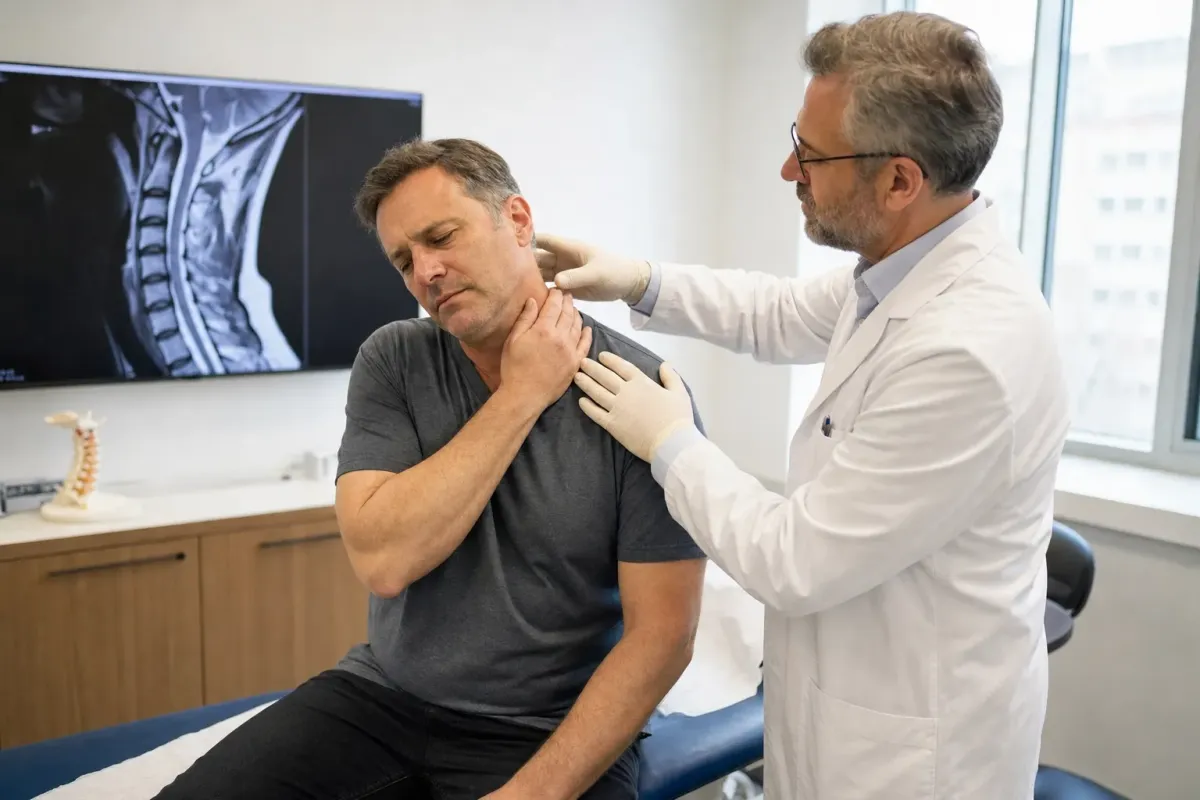
What Type of Doctor Should You See for Cervical Radiculopathy?
The short answer: For most people, start with your primary care physician or a physiatrist (a physical medicine and rehabilitation doctor); they diagnose cervical radiculopathy, begin non-surgical treatment, and refer you onward if needed. Move to an orthopedic spine surgeon or a neurosurgeon if you have warning signs or if conservative care has not worked after about six weeks.
A pinched nerve in the neck can send sharp, burning pain, tingling, or weakness down your shoulder and arm, and the first practical question is usually a simple one: who do I actually call? The confusing part is that several different specialists treat cervical radiculopathy, and the right one depends on your symptoms, how long they have lasted, and whether surgery is even on the table. This guide walks through each type of doctor, what each one does, who they are best for, and a clear framework for deciding who to see first, and when to escalate.
- Most people should start with a primary care physician or a physiatrist (PM&R), not a surgeon; the majority of cervical radiculopathy improves without an operation.
- Six kinds of doctors treat this condition: primary care, physiatrists, neurologists, interventional pain physicians, orthopedic spine surgeons, and neurosurgeons.
- Red-flag symptoms (progressive weakness, clumsy hands, trouble walking) mean you should see a spine surgeon promptly rather than waiting.
- Clinicians typically consider a surgical opinion after about six weeks of symptoms that have not responded to focused non-surgical care.
- For neck surgery, what matters most is surgeon experience and spine focus; a surgeon trained in both spine surgery and neurosurgery covers the whole spectrum.
What's in This Guide
- What Cervical Radiculopathy Is
- The 6 Types of Doctors Who Treat Cervical Radiculopathy
- Specialist Comparison at a Glance
- Which Doctor Should You See First?
- Red Flags: When to Skip Ahead to a Surgeon
- How Cervical Radiculopathy Is Diagnosed
- The Treatment Ladder: Least Invasive First
- Why One Expert Across the Whole Spine Matters
- Common Questions
- Related Spine Terms
- Sources
What Cervical Radiculopathy Is
Cervical radiculopathy is the medical term for a compressed or irritated nerve root in the neck. When a herniated disc, a bone spur, or age-related narrowing presses on one of the nerves branching off the spinal cord, the symptoms travel along that nerve's path: pain, numbness, pins-and-needles, or weakness that often radiates from the neck into the shoulder, arm, or hand. It is what most people mean when they say "pinched nerve in the neck."
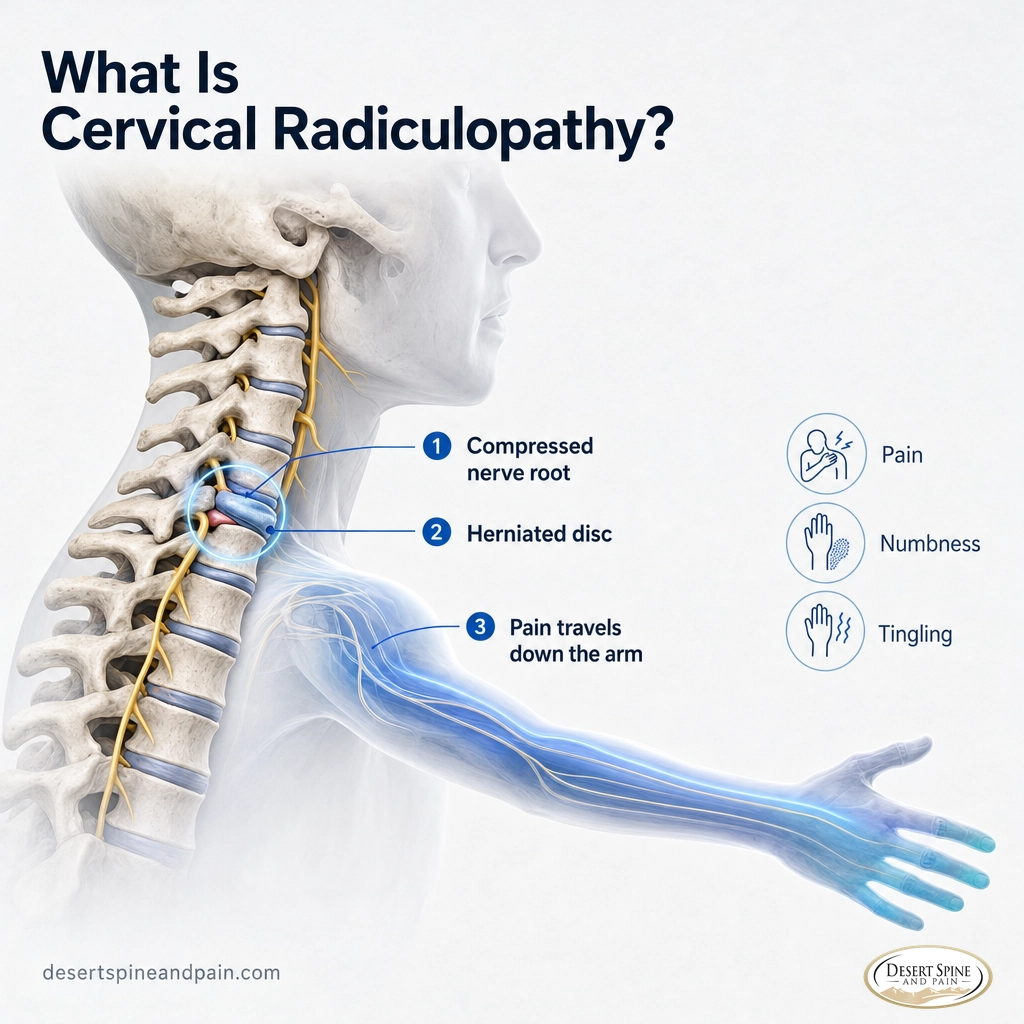
It is more common than many people expect, and, just as importantly, it usually gets better. Understanding both facts helps you pick the right doctor instead of jumping straight to the most aggressive option.
The same body of research shows the condition peaks between ages 50 and 54, and that the C7 nerve root is the one most often involved, followed by C6. That pattern is why so many cases produce symptoms down the back of the arm into the middle fingers. For a deeper look at a common underlying cause, see our explainer on how an annular tear differs from a herniated disc.
Multiple patient-education sources from major medical institutions agree: the majority of people with cervical radiculopathy improve over time and do not need surgery. That single fact reshapes the "which doctor" question, because for most people the first visit is about confirming the diagnosis and starting treatment, not booking an operating room.
Source: American Family Physician: Cervical Radiculopathy, nonoperative management | OrthoInfo (AAOS): Cervical Radiculopathy (Pinched Nerve)
The 6 Types of Doctors Who Treat Cervical Radiculopathy
Several specialties overlap here, which is exactly why the choice feels confusing. Here is what each doctor actually does for a pinched nerve in the neck, and who each one fits best.
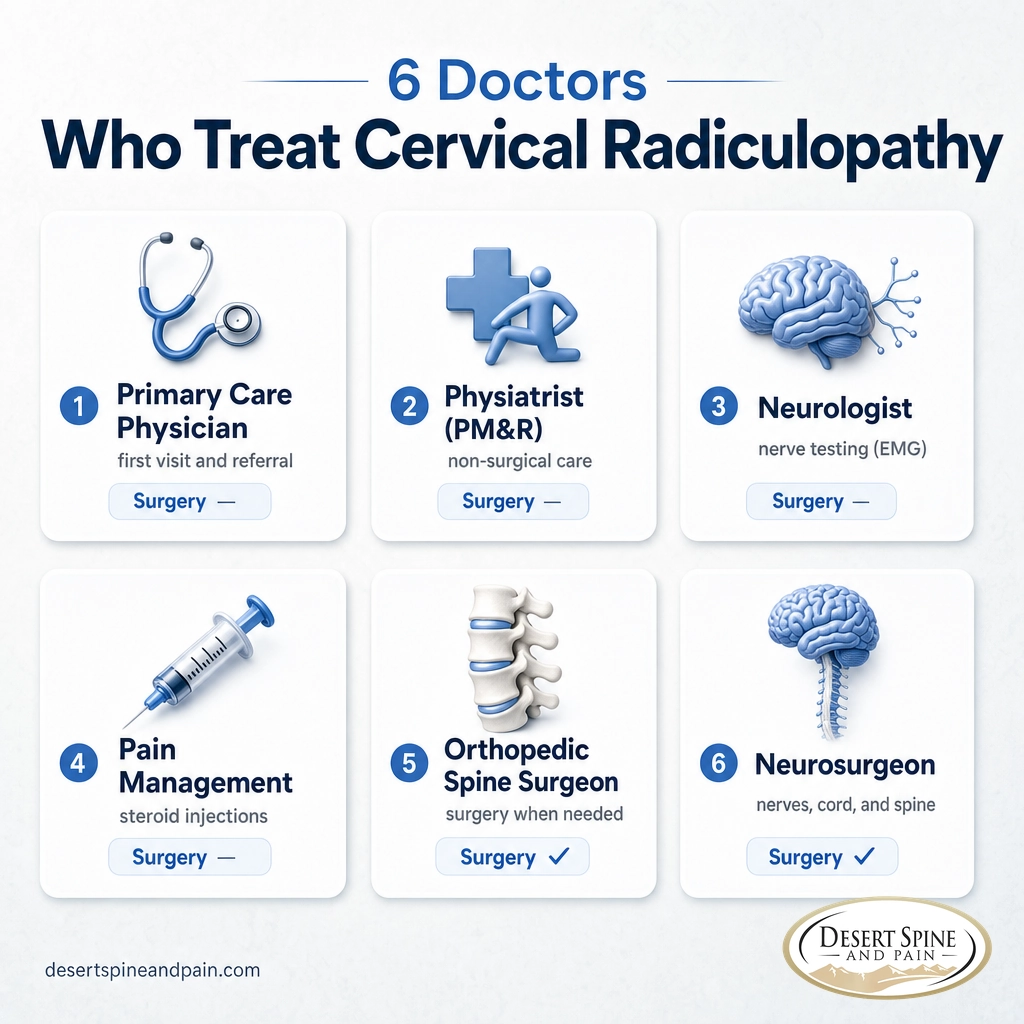
1. Primary Care Physician (PCP)
Your family doctor or internist is a reasonable first stop for new neck and arm symptoms. A PCP can take your history, do a basic neurological exam, start anti-inflammatory medication, advise on activity, and order initial imaging. If the symptoms are mild and recent, this is often all you need to get the ball rolling, and your PCP decides whether to refer you to a specialist.
Best for: New, mild, or recent symptoms with no red flags, and anyone who wants a coordinated referral to the right specialist.
2. Physiatrist (Physical Medicine & Rehabilitation)
A physiatrist, or PM&R physician, specializes in diagnosing and treating musculoskeletal and nerve conditions without surgery. For many spine patients this is the ideal first specialist: physiatrists confirm the diagnosis, build a non-surgical treatment plan, perform or order diagnostic injections, coordinate physical therapy, and refer you to a surgeon only if it becomes necessary. They are often faster to book than a surgeon.
Best for: Persistent neck-and-arm pain without red flags, and anyone who wants a quarterback for non-surgical care.
3. Neurologist
Neurologists specialize in the nervous system: the brain, spinal cord, and nerves. They are especially useful for pinning down which nerve is involved and ruling out other nerve conditions, using tools like electromyography (EMG) and nerve conduction studies. A neurologist diagnoses and manages medically, but does not perform spine surgery.
Best for: Unclear diagnoses, symptoms that could be more than a pinched nerve, or when nerve testing is needed to confirm the level.
4. Interventional Pain Management Physician
Pain management specialists (often physiatrists or anesthesiologists with extra training) focus on controlling nerve pain, frequently with image-guided procedures. For cervical radiculopathy, the most relevant tool is the epidural steroid injection, which places anti-inflammatory medication near the irritated nerve root to calm symptoms while the body heals.
Best for: Pain that is limiting your life but has not crossed into surgical territory, as a bridge between basic care and a surgical decision.
5. Orthopedic Spine Surgeon
An orthopedic surgeon who sub-specializes in the spine treats the bones, discs, and joints of the neck and can perform surgery when it is warranted. Importantly, a good spine surgeon still starts with non-surgical options and only recommends an operation when the evidence supports it.
Best for: Severe, persistent, or worsening symptoms; a clear structural problem on imaging; or conservative care that has failed.
6. Neurosurgeon
Neurosurgeons are trained to operate on the brain, spinal cord, and the nerves themselves, which makes them a natural fit for nerve compression in the neck. For cervical radiculopathy specifically, an experienced neurosurgeon can both diagnose the problem and perform the decompression or fusion if surgery is needed.
Best for: Nerve or spinal-cord compression, any sign of spinal cord involvement, and complex cases where the margin for error is small.
Source: Cleveland Clinic: Cervical Radiculopathy (Pinched Nerve) | Cervical Spine Research Society: What Is Radiculopathy?
Specialist Comparison at a Glance
The table below sums up the differences in one view. Think of it as a map from your situation to the most efficient first call.
| Doctor | What they do for cervical radiculopathy | Performs surgery? | Best for |
|---|---|---|---|
| Primary care physician | Initial diagnosis, medication, first imaging, referral | No | New, mild symptoms; no red flags |
| Physiatrist (PM&R) | Non-surgical diagnosis and treatment plan, coordinates PT and injections | No | Persistent pain without red flags; a non-surgical quarterback |
| Neurologist | Nerve-focused diagnosis, EMG and nerve conduction studies | No | Unclear diagnosis; confirming the affected nerve |
| Interventional pain physician | Image-guided epidural and nerve-root steroid injections | No | Limiting pain that is not yet surgical |
| Orthopedic spine surgeon | Surgical and non-surgical care of spine structures | Yes | Severe, worsening, or failed-conservative cases |
| Neurosurgeon | Surgical and non-surgical care of nerves, cord, and spine | Yes | Nerve or cord compression; complex cases |
Which Doctor Should You See First?
For the typical person with a few weeks of neck-and-arm pain and no alarming symptoms, the most efficient path is to start conservative and escalate only if needed. That looks like this:
- Start with your primary care physician or a physiatrist. They confirm it is radiculopathy, rule out other causes, and begin non-surgical treatment. Most people improve at this stage.
- Add an interventional pain physician if pain is limiting your daily life and a targeted epidural injection could help you get over the hump while healing continues.
- Bring in a neurologist if the diagnosis is uncertain or nerve testing is needed to confirm which root is involved.
- See a spine surgeon (orthopedic or neurosurgical) if symptoms are severe, keep worsening, or have not responded after about six weeks, or if red flags appear at any point.
The reason this order works is simple: the evidence consistently shows that most cervical radiculopathy resolves with non-surgical care, so leading with a surgeon rarely changes the early plan. The exception is red-flag symptoms, which flip the order entirely.
Red Flags: When to Skip Ahead to a Surgeon
Some symptoms mean you should not sit in the conservative lane. They point to pressure on the spinal cord itself (a condition called myelopathy) or to nerve damage that is actively getting worse, and they warrant prompt evaluation by a spine surgeon.
See a spine specialist promptly if you notice any of these: progressive muscle weakness in the arm or hand; worsening numbness; new clumsiness with buttons, zippers, or handwriting; problems with balance or walking; or any bowel or bladder changes. These can signal spinal cord involvement and should not wait for a standard conservative trial.
Clinicians also use a practical time threshold for non-emergency cases: radicular symptoms that have not improved after roughly six weeks of focused non-surgical care, or motor weakness that persists beyond six weeks, are standard reasons to get a surgical opinion. A progressive neurologic deficit at any point is a reason to move sooner.
Source: American Family Physician: referral criteria for cervical radiculopathy
How Cervical Radiculopathy Is Diagnosed
Whichever doctor you see, the diagnostic steps are broadly the same, which is another reason the starting specialist matters less than people fear. A thorough workup generally includes:
- History and physical exam. The doctor maps where your pain and numbness travel and tests reflexes, strength, and sensation to predict which nerve root is involved.
- Imaging. An MRI is the best test for seeing a herniated disc or nerve compression in soft tissue; X-rays and CT scans show the bones and alignment.
- Nerve testing. EMG and nerve conduction studies, often done by a neurologist or physiatrist, confirm which nerve is affected and rule out other nerve problems.
These tests do more than confirm the diagnosis. They separate a scan finding from a real, symptomatic problem, because age-related changes show up on imaging in many people who feel completely fine. That distinction is exactly why a careful in-person evaluation beats self-diagnosis, and why surgery is reserved for genuine, symptomatic compression rather than an MRI report alone. If a disc problem is confirmed, you can read more about the broader category on our spine conditions overview.
Source: OrthoInfo (AAOS): diagnosis of cervical radiculopathy
The Treatment Ladder: Least Invasive First
The best doctors for this condition share one philosophy: try the least invasive effective treatment first, and escalate only when the evidence calls for it. That ladder is why a single, well-run practice can carry most patients from first symptom to resolution without ever reaching the top rung.
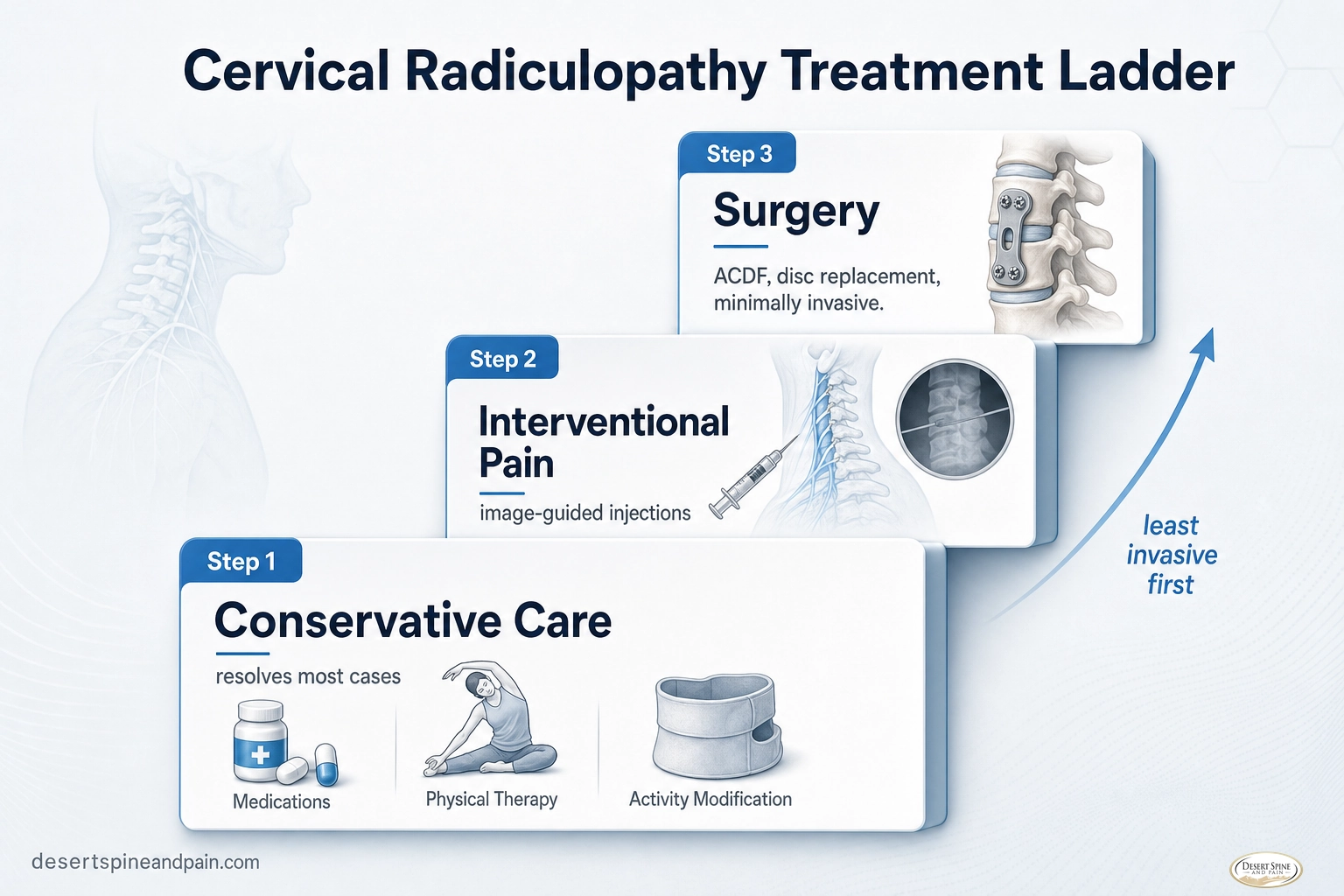
- Step 1, conservative care. Activity changes, anti-inflammatory medication, a short course of a soft cervical collar when appropriate, and guided physical therapy. This is the foundation, and it resolves most cases. Explore non-invasive and conservative treatment options.
- Step 2, interventional pain procedures. If pain persists, an image-guided interventional pain procedure such as an epidural steroid injection can reduce inflammation around the nerve and buy time for natural recovery.
- Step 3, surgery. When conservative and interventional care have not worked, or when there are red flags, surgery relieves the pressure on the nerve. Common operations for cervical radiculopathy include anterior cervical discectomy and fusion (ACDF), cervical disc replacement, and minimally invasive approaches.
Seeing a doctor who offers this full range, from conservative care through complex surgery, means your treatment plan is guided by what you need, not by the only tool a given office happens to have.
Source: Radhakrishnan et al.: Epidemiology of cervical radiculopathy, Brain (1994) | Cleveland Clinic: treatment of cervical radiculopathy
Why One Expert Across the Whole Spine Matters
When nerve compression in the neck does need a surgeon, patients often ask whether to see an orthopedic spine surgeon or a neurosurgeon. For a standard pinched-nerve operation the two overlap heavily, and the more useful question is how focused the surgeon is on the spine and how experienced they are with your specific problem.
At Desert Spine and Pain, that question has a clean answer. The practice is led by Dr. David L. Greenwald, MD, FACS, who is board certified as both a spine surgeon and a neurosurgeon. That dual training spans the entire problem, from the nerve root and the spinal cord to the bones and discs around them, so one expert can evaluate your case and, if you ever need it, perform the surgery. Just as important, the practice leads with the least invasive effective option and reserves surgery for when it is genuinely the right call.
Desert Spine and Pain serves the Greater Phoenix, Arizona area and welcomes out-of-network patients, and it also partners with personal injury attorneys and their clients. If a pinched nerve in your neck is not improving, or you just want a clear read on which path is right, a focused consultation is the fastest way to get answers.
Meet Dr. David L. Greenwald, MD, FACS
Explore surgical options for the neck
Book a consultation or second opinion
Common Questions About Choosing a Doctor
What type of doctor should I see first for cervical radiculopathy?
Do I need a neurologist or a neurosurgeon for a pinched nerve in my neck?
When should I see a spine surgeon for cervical radiculopathy?
Can cervical radiculopathy go away without surgery?
What is the difference between an orthopedic spine surgeon and a neurosurgeon for neck surgery?
Related Spine Terms
- Cervical radiculopathy: a compressed or irritated nerve root in the neck, the pinched nerve this guide is about.
- Myelopathy: pressure on the spinal cord itself, a red-flag condition that calls for prompt surgical evaluation.
- Physiatrist (PM&R): a non-surgical rehabilitation physician who often coordinates conservative spine care.
- Epidural steroid injection: an image-guided injection that reduces inflammation around an irritated nerve root.
- ACDF: anterior cervical discectomy and fusion, a common surgery for a pinched nerve in the neck.
- Cervical corpectomy: removing a full vertebral body when compression sits behind the bone, used in more extensive cases.
- Annular tear: a tear in the outer ring of a disc that can precede the herniation behind many pinched nerves.
Sources
Sources and Methodology
This guide summarizes established clinical references and peer-reviewed data on cervical radiculopathy and the specialists who treat it. Incidence and referral figures are general population data presented for reference, not as individual predictions. It is educational information, not medical advice. Decisions about diagnosis and treatment should be made with a qualified physician after an in-person evaluation.
- American Family Physician (2010): Cervical Radiculopathy, Nonoperative Management of Neck Pain and Radicular Symptoms
- Radhakrishnan et al. (1994): Epidemiology of Cervical Radiculopathy, Brain
- OrthoInfo (American Academy of Orthopaedic Surgeons): Cervical Radiculopathy (Pinched Nerve)
- Cleveland Clinic: Cervical Radiculopathy (Pinched Nerve)
- Cervical Spine Research Society: What Is Radiculopathy?