
SI Joint Fusion Statistics (2026): Success Rates, Pain Relief, and Outcomes
Sacroiliac (SI) joint fusion is a highly effective option for the right patient, with radiographic fusion rates near 96 to 100 percent and pain scores that often fall from about 8.7 to under 1. Its most important statistic, though, is diagnostic: the SI joint drives 14 to 22 percent of chronic low back pain, and confirming it as the true pain source is what makes the surgery succeed.
- Radiographic fusion after minimally invasive SI joint fusion is reported at roughly 96 to 100 percent by 12 to 18 months.
- Average pain scores fell from about 8.7 to 0.9 at one year in a 40-patient study, with high satisfaction and no reoperations.
- Six-month satisfaction was about 77 percent for SI joint fusion versus 27 percent for non-surgical management in a randomized trial.
- A systematic review found SI joint fusion more effective and more cost-effective than conservative care, improving disability by about 21 points.
- Roughly 70 to 90 percent of patients achieve at least 50 percent pain reduction.
- The SI joint drives 14 to 22 percent of chronic low back or buttock pain, rising to 32 to 42 percent after lumbar fusion.
- Complications are low and usually minor, but accurate diagnosis is the strongest predictor of success.
What's in This Guide
1What SI Joint Fusion Treats
The sacroiliac joint connects the base of the spine (sacrum) to the pelvis. When it becomes painful, from degeneration, disruption, or trauma, it can cause low back, buttock, and groin pain that mimics other spine problems. SI joint fusion stabilizes the joint, most often through a minimally invasive approach using small implants placed across it.
The SI joint is one of the most underrecognized sources of low back pain. Because its symptoms overlap so closely with lumbar spine problems, it is easy to miss, which is exactly why some patients continue to hurt even after otherwise successful lumbar surgery. Recognizing the SI joint as the culprit is the first and most important step.
Our Phoenix practice, led by board-certified neurosurgeon and spine surgeon Dr. David L. Greenwald, MD, FACS, carefully evaluates the SI joint as a potential pain source and offers minimally invasive fusion for appropriate patients.
Explore SI joint fusion in PhoenixSource: MIS SI joint fusion vs conservative management meta-analysis, IJSS
2Fusion and Success Rates
For well-selected patients, minimally invasive SI joint fusion delivers both high radiographic fusion and dramatic pain relief. The numbers are among the stronger in spine surgery.
Across studies, radiographic fusion clusters near 96 to 100 percent, and pain relief is substantial, with 70 to 90 percent of patients achieving at least a 50 percent reduction in pain and comparable improvement in disability scores. The 40-patient series showed a nearly 8-point drop on a 10-point pain scale at one year with no reoperations, illustrating how effective the procedure can be when the right joint is treated.
Learn about sacroiliac joint fusionSource: MIS SI joint fusion one-year outcomes (40 patients), PMC | SI joint fusion outcomes (20 patients), PMC
3SI Fusion vs Conservative Care
The strongest evidence for SI joint fusion comes from randomized trials comparing it directly with non-surgical management for patients who had already failed conservative care.
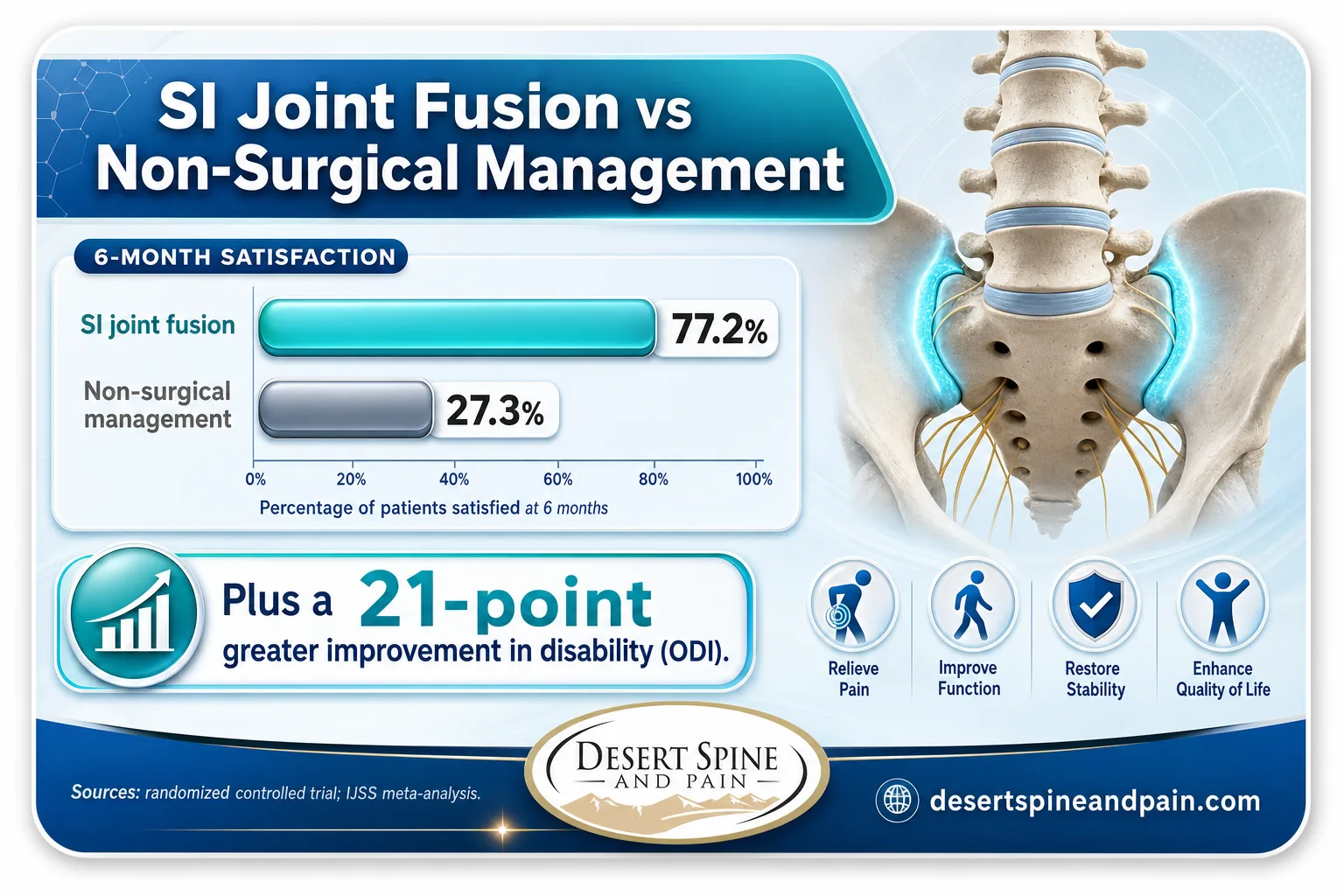
A systematic review and meta-analysis concluded that minimally invasive SI joint fusion is both more effective and more cost-effective than conservative management for reducing pain and disability, with adverse events low and comparable between groups. Importantly, this applies specifically to patients who have already exhausted appropriate conservative care, which remains the right first step for SI joint pain.
See conservative care optionsSource: MIS SI joint fusion vs conservative management meta-analysis, PMC | SIJF vs non-surgical management RCT, IJSS
4Why Diagnosis Drives Success
The single most important factor in SI joint fusion success is not the surgery itself, but confirming that the SI joint is genuinely the source of pain before operating.
Good outcomes depend on a rigorous diagnostic pathway: concordant history and exam, positive provocative maneuvers, imaging, and a confirmatory diagnostic injection showing substantial pain relief. When these line up, fusion succeeds at high rates. When the SI joint is not truly the pain source, no operation will help, which is why careful diagnosis is the foundation of every good result.
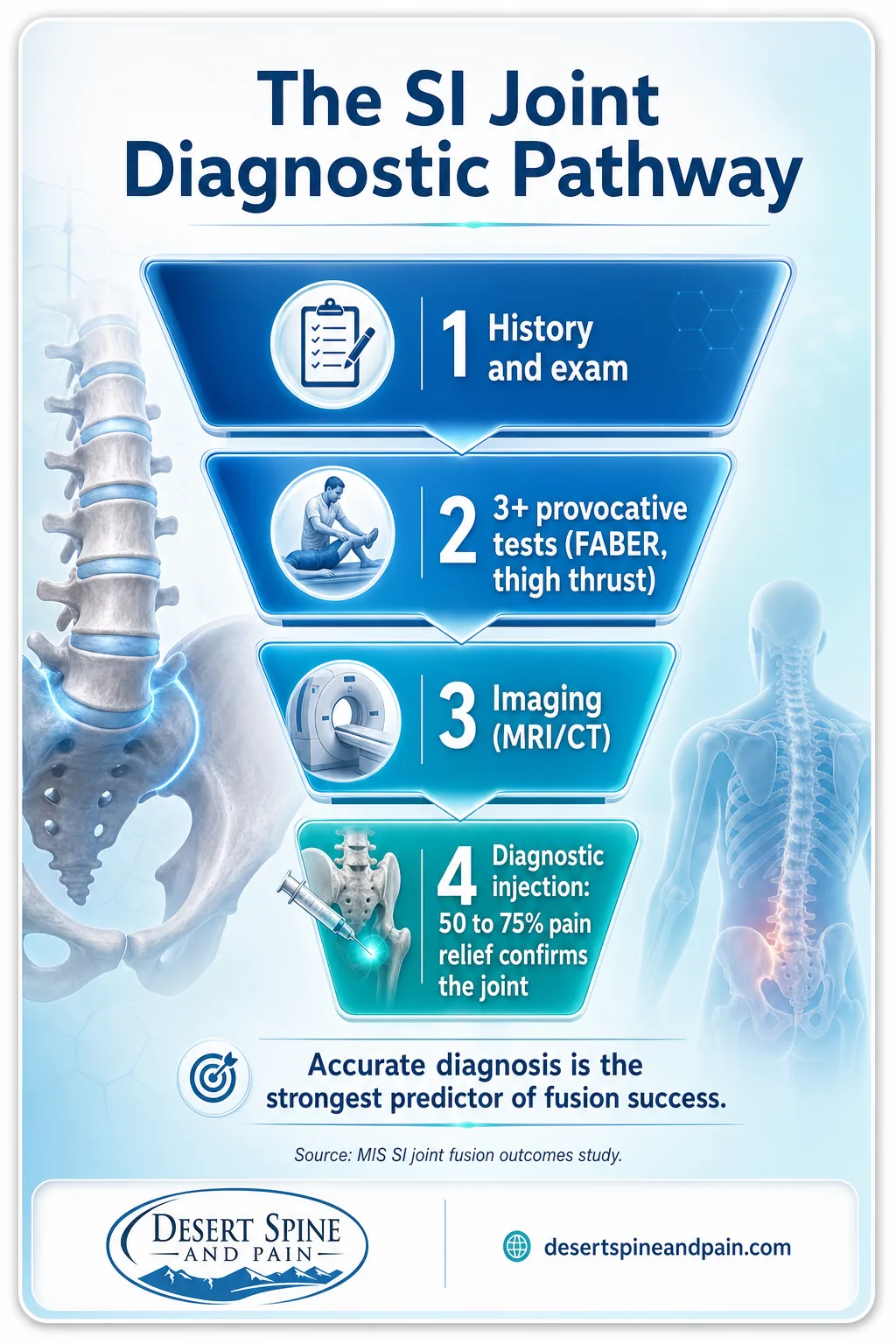
The impressive fusion and satisfaction numbers come from patients whose SI joint was verified as the pain source through provocative testing and a confirmatory diagnostic injection. Operating on an unconfirmed SI joint, or on a patient whose pain actually comes from the lumbar spine or hip, is where poor outcomes happen. The statistics reward diagnostic discipline, not a rush to surgery, which is why conservative care and careful confirmation must come first.
SI joint fusion outcomes reveal a principle that runs through all spine care: the operation is only as good as the diagnosis behind it. Fusion rates of 96 to 100 percent and satisfaction near 77 percent are achievable precisely because the best programs confirm the SI joint as the pain source through provocative testing and diagnostic injection before operating. The technical procedure is reliable, so the deciding variable is diagnostic accuracy, which is where experience and thoroughness matter most. Interpretation original to Desert Spine and Pain.
Source: SI joint diagnosis and fusion outcomes, PMC
5Complications and the PI Connection
Minimally invasive SI joint fusion is a safe procedure, and it holds particular relevance for personal injury cases, since SI joint disruption is frequently caused by trauma.
The safety profile is reassuring: complications are typically minor and self-limiting, serious events are uncommon, and adverse event rates match non-surgical care in the first six months. For personal injury attorneys, the SI joint is an important consideration, since traumatic disruption from accidents is a recognized cause, and confirming it as a pain generator can be central to a client's diagnosis and care.
Desert Spine and Pain works with out-of-network patients of every kind and partners closely with personal injury attorneys, offering 24/7 concierge response and documentation coordination for injured clients, including those with post-traumatic SI joint pain.
Book a consultation: (602) 566-9500Source: Minimally invasive sacroiliac fusion review, PubMed
Summary Table: SI Joint Fusion Statistics 2026
| Statistic | Figure | Source | Year |
|---|---|---|---|
| SI joint involvement in chronic low back/buttock pain | 14 to 22% | IJSS meta-analysis | 2022 |
| SI joint involvement after lumbar fusion | 32 to 42% | IJSS meta-analysis | 2022 |
| Radiographic fusion rate (12-18 mo) | 96 to 100% | SI fusion outcome studies | 2026 |
| Radiographic fusion (20-patient study) | 96.9% | SI fusion outcomes (20 pts) | 2015 |
| Pain score before vs after (40 patients) | 8.7 to 0.9 | MIS SI fusion (40 pts) | 2013 |
| Patients achieving ≥50% pain reduction | 70 to 90% | SI fusion outcome studies | 2026 |
| 6-month satisfaction, SIJF vs NSM | 77% vs 27% | SIJF vs NSM RCT | 2016 |
| ODI improvement, SIJF vs conservative | 21 points greater | IJSS meta-analysis | 2022 |
| Cost-effectiveness vs conservative | Favors SIJF | IJSS meta-analysis | 2022 |
| Trochanteric bursitis (transient) | 5% | MIS SI fusion (40 pts) | 2013 |
| Reoperations at one year | 0 | MIS SI fusion (40 pts) | 2013 |
| Diagnostic injection pain-relief threshold | 50 to 75% | MIS SI fusion outcomes | 2013 |
Frequently Asked Questions
What is the success rate of SI joint fusion?
Is SI joint fusion better than conservative treatment?
How is SI joint pain diagnosed before fusion?
What are the risks of SI joint fusion?
How common is SI joint pain?
Methodology & Sources
How we compiled these statistics
Every figure traces to a Tier 1 primary source: randomized controlled trials, systematic reviews and meta-analyses, and peer-reviewed cohort studies. Fusion, pain, and satisfaction figures reflect differences in implant, technique, follow-up length, and patient selection. Because SI joint fusion outcomes depend so heavily on diagnosis, we emphasize the diagnostic pathway. All statistics describe populations, not any individual patient.
Primary sources referenced:
- Two-year outcomes from a randomized controlled trial of minimally invasive SI joint fusion versus non-surgical management, International Journal of Spine Surgery
- Minimally invasive SI joint fusion versus conservative management: systematic review and meta-analysis, International Journal of Spine Surgery / PMC
- Minimally invasive SI joint fusion: one-year outcomes in 40 patients, PMC
- A retrospective outcomes study of 20 sacroiliac joint fusion patients, PMC
- Minimally invasive sacroiliac fusion: a review, PubMed
This article is educational and is not individual medical advice. For guidance specific to your spine or SI joint condition, consult a qualified spine surgeon. No outcome can be guaranteed.
Journalists and researchers may cite these statistics with attribution to Desert Spine and Pain and a link to this page. Please attribute the underlying figures to their original Tier 1 sources as listed above. For expert commentary on SI joint fusion data from a board-certified neurosurgeon and spine surgeon, contact Desert Spine and Pain at (602) 566-9500.