

Failed Back Surgery Syndrome Statistics (2026): Prevalence, Causes, and Prevention
Failed back surgery syndrome (FBSS), persistent or new pain after spine surgery, affects an estimated 10 to 40 percent of spinal operations. The most important statistic is not how often it happens, but why: a large share of cases trace back to the initial surgical decision, which is exactly why the right diagnosis and the right surgeon matter most before any operation.
- FBSS is generally reported in about 10 to 40 percent of spine surgeries, with a pooled chronic-pain prevalence near 15 percent.
- A database study of 102,047 patients found 5.4 percent diagnosed with FBSS within 6 months and 8.4 percent within 12 months.
- Rates are highest in multi-level surgery (up to 10 percent early), inpatient settings, and ages 70 to 74.
- In a survey of 1,842 patients, FBSS prevalence was about 20.6 percent, with residual low back pain in 94 percent.
- Multiple prior back surgeries raised FBSS odds (OR 1.87), and severe residual pain was strongly associated (OR 15.21).
- Epidural scar tissue (fibrosis) was found in over 60 percent of FBSS patients in one series.
- Spinal cord stimulation can be more effective than repeat surgery for persistent post-surgical pain.
What's in This Guide
1What Failed Back Surgery Syndrome Is
Failed back surgery syndrome is an umbrella term for chronic pain that persists, returns, or newly appears after spine surgery. It is not a single diagnosis. It groups many different problems that share one feature: the surgery did not resolve the pain, or a new pain source emerged. Newer terminology such as persistent postoperative syndrome (PPS) is sometimes used to avoid implying the surgery itself failed.
The most important idea about FBSS is that it is a signal, not a verdict. It tells the care team that the true pain source needs to be found and addressed, which may be scar tissue, a missed diagnosis, a new problem at a nearby level, or a joint that was never the target of the first surgery. Understanding this reframes FBSS from a dead end into a solvable puzzle.
Our Phoenix practice, led by board-certified neurosurgeon and spine surgeon Dr. David L. Greenwald, MD, FACS, evaluates patients with continued pain after prior surgery to identify what is actually driving it.
Explore spinal cord stimulationSource: Failed back surgery syndrome narrative review
2How Common FBSS Is
FBSS is more common than most patients expect, though the exact number depends heavily on how it is defined and measured.
The wide range, from about 5 percent to over 40 percent, reflects how differently FBSS is defined across studies. Formal early-diagnosis rates from insurance databases sit around 5 to 8 percent in the first year, while patient-reported surveys that count residual symptoms and dissatisfaction run higher, around 20 percent. The honest summary is that a meaningful minority of spine surgeries do not fully resolve pain, which is why the decision to operate deserves great care.
Explore spine conditionsSource: FBSS etiology review, PubMed | FBSS incidence by setting and procedure, PubMed
3Leading Causes
Understanding why FBSS happens is where the data becomes genuinely useful, because many causes point back to the initial diagnosis and surgical plan.
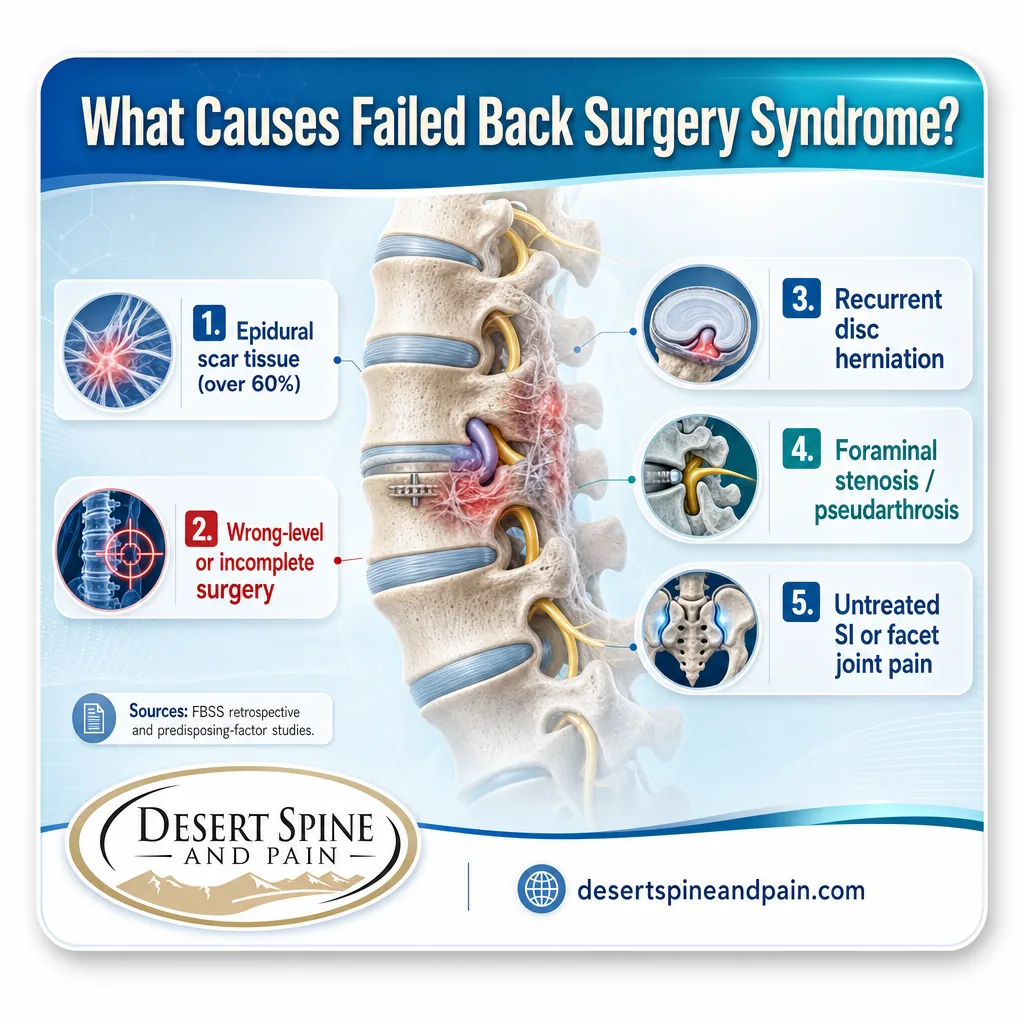
The causes fall into three groups: decisions made before surgery (diagnosing the wrong pain source or selecting the wrong patient), factors during surgery (wrong level, incomplete decompression, technique), and things that happen afterward (scar tissue, new disc herniation, adjacent segment issues). Crucially, the first two groups, which together account for a large share of cases, are influenced directly by the surgeon's judgment and skill. Scar tissue alone appears in a majority of FBSS patients, and some pain sources like the sacroiliac joint are never addressed by the original operation.
Learn about decompression surgerySource: Clinical insights and statistical analysis of FBSS, PMC
4Risk Factors and Reoperation
Certain patients and procedures carry higher FBSS risk, and the reoperation data reveals an important trap: more surgery is not always the answer.
The strongest risk signals are multiple prior surgeries, multi-level procedures, older age (peaking around 70 to 74), and severe pre-existing pain. The reoperation data carries a warning: because each additional surgery can raise the risk of continued pain, repeat operations for FBSS must be chosen carefully. This is why guidelines and studies increasingly favor pinpointing the exact pain source and using targeted, less invasive treatments, including spinal cord stimulation, which can outperform repeat surgery for persistent pain.
See interventional pain optionsSource: Prevalence and burden of FBSS: nationwide survey, PMC
5Why Prevention Starts Before Surgery
The most powerful FBSS statistic is the one that is hardest to measure: how many cases could be prevented by a better decision before the first incision. The causes point clearly to that answer.

The FBSS data delivers a sobering, clarifying message: many failed back surgeries were shaped before the operation began, by the accuracy of the diagnosis and the decision to operate. Wrong-level surgery, operating on patients who were not ideal candidates, and choosing surgery when a targeted or conservative approach would have served better all contribute heavily. This is why the least-invasive-first philosophy and rigorous diagnosis are not slogans, they are the most effective FBSS prevention available. The first surgery is the best chance to get it right, which is why who performs it, and whether it should happen at all, matters more than any statistic here. Interpretation original to Desert Spine and Pain.
When pain persists after spine surgery, the instinct can be to operate again. But the data urges caution: additional surgeries can compound the risk of continued pain, and repeat operations are strongly associated with FBSS. The better path usually begins with careful re-diagnosis to find the exact pain source, followed by targeted, often less invasive treatment. A surgeon willing to say that more surgery is not the answer is often protecting the patient, not withholding care.
Desert Spine and Pain works with out-of-network patients of every kind and partners closely with personal injury attorneys, offering 24/7 concierge response and documentation coordination for injured clients seeking a second opinion after prior spine surgery.
Book a consultation: (602) 566-9500Source: FBSS prevention and management review
Summary Table: FBSS Statistics 2026
| Statistic | Figure | Source | Year |
|---|---|---|---|
| FBSS incidence (general) | 10 to 40% | FBSS etiology review | 2018 |
| Pooled chronic post-surgical pain | ~15% (5 to 27.6%) | FBSS narrative review | 2024 |
| FBSS within 6 months (102,047 patients) | 5.4% | Incidence database study | 2022 |
| FBSS within 12 months | 8.4% | Incidence database study | 2022 |
| Inpatient vs outpatient FBSS | 6.0% vs 4.3% | Incidence database study | 2022 |
| Multi-level decompression (inpatient) | Up to 10% | Incidence database study | 2022 |
| Survey-based FBSS prevalence (1,842) | ~20.6% | Nationwide survey | 2017 |
| Residual low back pain in FBSS | 94.0% | Nationwide survey | 2017 |
| Odds of FBSS, multiple prior surgeries | OR 1.87 | Nationwide survey | 2017 |
| Reoperation at 5 years (11,027 patients) | 14.2% | Nationwide survey (cited) | 2017 |
| Epidural fibrosis in FBSS patients | Over 60% | Predisposing factors study | 2025 |
| Spinal cord stimulation vs reoperation | More effective (persistent pain) | FBSS narrative review | 2024 |
Frequently Asked Questions
How common is failed back surgery syndrome?
What causes failed back surgery syndrome?
What are the risk factors for failed back surgery syndrome?
Can failed back surgery syndrome be treated?
How can failed back surgery syndrome be prevented?
Methodology & Sources
How we compiled these statistics
Every figure traces to a Tier 1 primary source: large insurance-database studies, nationwide patient surveys, and peer-reviewed reviews. FBSS prevalence varies widely because the diagnosis is defined differently across studies, so we present both formal early-diagnosis rates and patient-reported figures. Odds ratios describe adjusted associations, not certainties. All statistics describe populations, not any individual patient.
Primary sources referenced:
- Failed back surgery syndrome: terminology, etiology, prevention, evaluation, and management, a narrative review
- The incidence of failed back surgery syndrome varies between clinical setting and procedure type (102,047 patients), PubMed
- Prevalence, characteristics, and burden of failed back surgery syndrome: nationwide survey (1,842 patients), PMC
- Etiology, evaluation, and treatment of failed back surgery syndrome, PubMed
- Clinical insights and statistical analysis of failed back surgery syndrome: multicentric retrospective review, PMC
This article is educational and is not individual medical advice. For guidance specific to your situation, including continued pain after a prior spine surgery, consult a qualified spine surgeon. No outcome can be guaranteed.
Journalists and researchers may cite these statistics with attribution to Desert Spine and Pain and a link to this page. Please attribute the underlying figures to their original Tier 1 sources as listed above. For expert commentary on failed back surgery syndrome data from a board-certified neurosurgeon and spine surgeon, contact Desert Spine and Pain at (602) 566-9500.