

Stem Cell Therapy for Back Pain Statistics (2026): What the Research Actually Shows
Stem cell therapy for back pain is one of the most talked-about, and most overstated, areas in spine medicine. The honest picture from the 2026 peer-reviewed research is nuanced: several meta-analyses report statistically significant pain and disability improvement for degenerative disc disease, yet the most rigorous recent reviews describe the human evidence as modest, low-to-moderate quality, and lacking proof of actual disc repair. This article summarizes what the published data shows, and what it does not, so patients can separate research from marketing.
Key Takeaways
- The evidence is genuinely mixed. Some meta-analyses show statistically significant pain and disability improvement; recent reviews call the trials low-to-moderate quality.
- A 2021 RCT meta-analysis found MSC therapy significantly reduced VAS pain and Oswestry Disability Index scores in degenerative disc disease.
- A 2025 NASSJ review found 13 low-to-moderate-quality trials with modest improvement and no compelling imaging proof of disc repair.
- One systematic review found no strong evidence to support routine human use, despite promising animal studies.
- Safety is generally favorable short-term: several trials reported no serious related adverse events, though minor events occur and long-term data are limited.
- Most treatments are not FDA-approved and are considered investigational; the FDA has warned about unproven consumer stem cell products.
- Bottom line: promising research, not an established treatment. Any decision belongs with a qualified specialist after accurate diagnosis.
What's in This Guide
01 The State of the Evidence in 2026
Stem cell therapy, most often using mesenchymal stem cells (MSCs) from bone marrow or fat, aims to regenerate damaged spinal tissue rather than mask pain. The concept is compelling. The clinical evidence is a work in progress.
The defining feature of the 2026 evidence is a gap between promise and proof. A PRISMA-compliant systematic review published in the North American Spine Society Journal in December 2025 found that while preclinical (animal) models uniformly demonstrate meaningful disc regeneration, the human clinical evidence is limited: thirteen low-to-moderate-quality trials showed modest, statistically significant improvements in pain and disability, but without compelling imaging proof of actual biological repair. In other words, some patients feel better, but the discs themselves have not been shown to regenerate in humans the way they do in the lab.
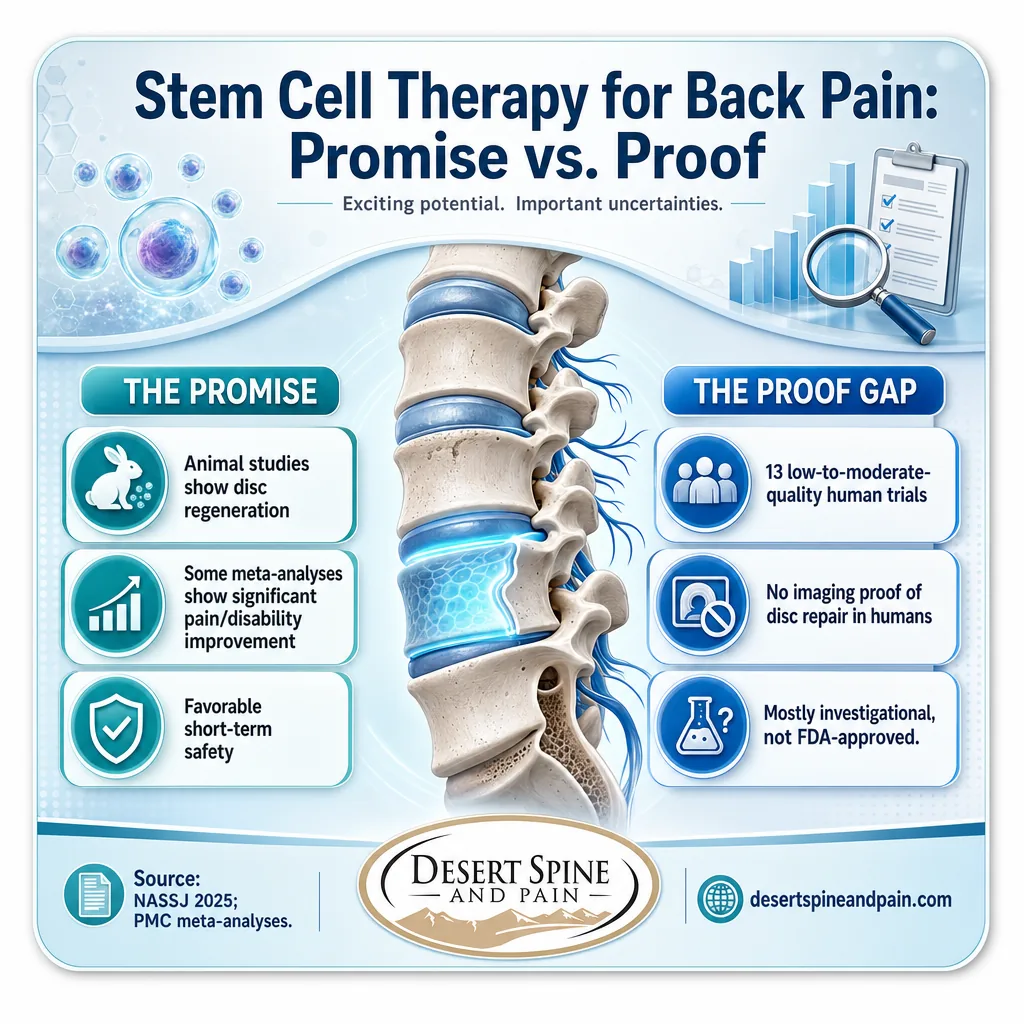
Source: North American Spine Society Journal, systematic review (Dec 2025) | PMC, systematic review of stem cell regenerative therapy for DDD
Learn about degenerative disc disease
02 What the Efficacy Studies Report
On the more encouraging side, several meta-analyses have pooled the available trials and found measurable benefit, which is why the research continues to attract serious attention.
A 2021 meta-analysis of randomized controlled trials found that MSC therapy significantly decreased both VAS pain scores and Oswestry Disability Index (ODI) scores in patients with degenerative disc disease, with higher proportions of patients reaching clinically significant change thresholds compared to controls. A separate meta-analysis reported a pooled reoperation proportion of just 7.4% and no serious related adverse events. In a small 1-year feasibility study of nine patients receiving low-dose adipose-derived MSCs, seven (78%) reported pain reductions at 12 months, five (56%) reported increased work capacity, and MRI showed no further disc degeneration. These are genuinely promising signals, from small studies.
Reported Outcomes in Early MSC Studies (illustrative, small samples)
An important caveat travels with every one of these numbers: the studies are small, heterogeneous, and often carry a high risk of bias. A percentage from a nine-patient study is a research signal, not a reliable success rate. That distinction is the heart of reading this topic honestly.
Source: PMC, MSC for DDD meta-analysis of RCTs (2021) | PMC, low-dose ADMSC 1-year feasibility study
Explore conservative and non-invasive care
03 The Limits: Why Researchers Urge Caution
The same literature that reports benefit is remarkably candid about its own weaknesses. Reading those limitations is essential to an honest understanding.
The cautions are direct. One systematic review evaluating stem cell regenerative therapy for degenerative disc disease concluded plainly that it found no evidence to support its use in humans, despite promising animal data. Meta-analyses reporting benefit also report extreme statistical heterogeneity (I² values as high as 98%), meaning the studies vary so much that pooling them is inherently uncertain. Sample sizes are small, follow-up is often short, standardization of cell type and preparation is poor, and randomized controlled trials are scarce. Researchers consistently call for large, well-designed trials before stem cell therapy can be considered established for back pain.
Separating research from marketing
Some clinics advertise stem cell "success rates" of 70% to 85% for back conditions. Those figures generally come from marketing materials or small case series, not from rigorous controlled trials, and they do not reflect the cautious conclusions of the peer-reviewed systematic reviews summarized here. Be skeptical of any provider who presents stem cell therapy for back pain as a proven, high-success treatment. The published science does not support that framing. This article is educational and is not medical advice.
Source: PMC, MSC for discogenic pain meta-analysis (heterogeneity data) | PMC, systematic evidence analysis (risk of bias)
Meet Dr. Greenwald, spine surgeon and neurosurgeon
04 Safety and Regulatory Status
Safety and regulation are two areas patients frequently overlook, and both matter enormously with an investigational therapy.
On safety, the published record is reasonably reassuring in the short term: multiple trials and meta-analyses report no serious related adverse events, though one analysis found a higher rate of minor treatment-emergent adverse events (such as temporary back pain, joint pain, or muscle spasm) in treated patients. Long-term safety data remain limited. On regulation, most stem cell treatments for back pain are not FDA-approved and are considered investigational; the FDA has issued warnings about unapproved stem cell products marketed directly to consumers. Legitimate use generally occurs within approved clinical trials or defined regulatory pathways, which is a critical safeguard patients should ask about.
Desert Spine and Pain Analysis: The Gap Between Signal and Standard
Combining the evidence, statistically significant pain improvement in some meta-analyses against a leading 2025 review finding only modest, low-to-moderate-quality results with no proof of disc repair, defines exactly where stem cell therapy sits in 2026: a promising research signal that has not yet become a proven standard of care. The responsible reading is neither dismissal nor hype. It is to treat stem cell therapy as an evolving option that requires accurate diagnosis, honest expectations, and, ideally, a regulated setting, rather than a shortcut around better-established treatments.
Formula: Positive-but-small efficacy signals + high bias + no imaging-confirmed repair + investigational status = promising research, not established treatment.
Calculation and interpretation original to Desert Spine and Pain. Source figures: 2021-2025 peer-reviewed meta-analyses and systematic reviews.
Source: PMC, MSC safety data (2021 meta-analysis) | NASSJ, clinical translation review (2025)
Explore evidence-based interventional care
05 How to Think About Stem Cell Therapy for Back Pain
For a patient weighing options, the practical question is not "does stem cell therapy work?" but "where does it belong in my decision-making right now?"
The least-invasive-first philosophy provides a useful framework. For most spine conditions, treatments with stronger evidence, conservative care, targeted interventional procedures, and, when structurally warranted, surgery, are the appropriate first considerations. Stem cell therapy is an area of active investigation that may play a larger role in the future as the evidence matures. Today, the responsible path is to base decisions on an accurate diagnosis and the strength of the evidence, not on marketing claims.
Where Regenerative Research Fits in the Ladder
- Conservative first: non-opioid medication, bracing, and physical therapy by referral.
- Established interventional care: injections, nerve blocks, and radiofrequency ablation with stronger evidence for many conditions.
- Surgery when warranted: minimally invasive through complex spine surgery for structural problems.
- Emerging regenerative options: considered thoughtfully, with honest expectations and attention to evidence and regulation.
Because Dr. Greenwald is both a spine surgeon and a neurosurgeon, Desert Spine and Pain can give patients a straight, evidence-based assessment of where an emerging therapy like this realistically fits, without overpromising and without a referral handoff.
This article summarizes published research for general education and is not medical advice or a recommendation for or against any specific treatment. Whether any therapy is appropriate depends on an individual evaluation by a qualified physician. For structural problems that clearly warrant it, established surgical options carry far stronger evidence than emerging regenerative approaches.
Source: Frontiers in Bioengineering, MSC for discogenic pain review
Learn about minimally invasive spine surgeryAsk about regenerative treatment options
06 All the Numbers in One Table
| Statistic / Finding | Figure | Source | Year |
|---|---|---|---|
| Overall evidence verdict | Mixed / developing | Multiple systematic reviews | 2026 |
| Human trials in 2025 NASSJ review | 13 (low-moderate quality) | NASSJ | 2025 |
| Imaging proof of disc repair (human) | Not demonstrated | NASSJ | 2025 |
| VAS pain reduction, MSC (RCT meta-analysis) | Statistically significant | PMC (2021) | 2026 |
| ODI reduction, MSC | Statistically significant | PMC (2021) | 2026 |
| Pooled VAS mean difference (discogenic) | 41.62 | PMC meta-analysis | 2026 |
| Pooled ODI mean difference | 22.04 | PMC meta-analysis | 2026 |
| Pooled reoperation proportion | 7.4% | PMC meta-analysis | 2026 |
| Statistical heterogeneity (I²) | up to 98% | PMC meta-analysis | 2026 |
| Feasibility study pain reduction (12 mo) | 78% (7 of 9) | PMC feasibility study | 2026 |
| Increased work capacity | 56% (5 of 9) | PMC feasibility study | 2026 |
| Reduced analgesic use | 33% (3 of 9) | PMC feasibility study | 2026 |
| Serious related adverse events | None reported (several trials) | Multiple meta-analyses | 2026 |
| Minor treatment-emergent AEs | Higher in treated group (1 analysis) | PMC (2021) | 2026 |
| Cell/PRP disc studies analyzed | 68 studies, 1,974+ patients | PMC systematic analysis | 2026 |
| FDA approval status | Mostly investigational | FDA guidance | 2026 |
| Systematic review on routine human use | "No evidence to support" | PMC review | 2026 |
07 Frequently Asked Questions
Does stem cell therapy work for back pain?
What does the evidence say about stem cells for degenerative disc disease?
Is stem cell therapy for back pain safe?
Is stem cell therapy for back pain FDA approved?
Should I choose stem cell therapy instead of other back pain treatments?
Methodology & Sources
This article summarizes peer-reviewed research only; it deliberately excludes clinic marketing materials and unverified "success rate" claims. Efficacy and safety figures come from Tier 1 sources: a 2021 meta-analysis of randomized controlled trials of MSC therapy for degenerative disc disease, a meta-analysis of MSC therapy for discogenic pain (VAS/ODI/reoperation data), a 2022 1-year feasibility study of adipose-derived MSCs, and a comprehensive systematic evidence analysis of 68 cell/PRP studies. The critical-appraisal context comes from a 2025 PRISMA systematic review in the North American Spine Society Journal and an earlier systematic review that found no strong evidence for routine human use. Regulatory context reflects FDA guidance on stem cell products.
Reported figures come predominantly from small studies with high statistical heterogeneity and high risk of bias; percentages from small samples are research signals, not reliable success rates. No outcome is guaranteed. This article is educational and is not medical advice or an endorsement of any specific treatment.
Media & press: Journalists and researchers may cite these statistics with attribution to Desert Spine and Pain and a link to this page. The Desert Spine and Pain Analysis box contains original calculation and interpretation.
Talk to a Phoenix Spine and Pain Specialist
Desert Spine and Pain is led by Dr. David L. Greenwald, MD, FACS, a board-certified surgeon who is both a spine surgeon and a neurosurgeon. The practice serves out-of-network patients across Greater Phoenix and partners with personal injury attorneys, offering 24/7 concierge response for their clients. Care follows a least-invasive-first philosophy, from conservative treatment through interventional pain management to complex spine surgery, always grounded in an accurate diagnosis and the strength of the evidence.
Call (602) 566-9500 to book a consultation.