
Spine Surgery Statistics (2026): Volume, Success Rates, Costs, and Complications
Spine surgery in the United States now spans hundreds of thousands of recorded procedures a year, with the American Spine Registry capturing 312,477 lumbar cases alone between 2015 and 2024. Success rates for common procedures run high, from roughly 90 percent for fusion to 85 to 95 percent for disc replacement, yet outcomes hinge on precise diagnosis, careful patient selection, and choosing the least invasive effective option first.
- The American Spine Registry's 2026 report captured 312,477 lumbar spine cases from participating surgeons and institutions covering 2015 to 2024, with TLIF/PLIF the most common procedure group at 32.54 percent.
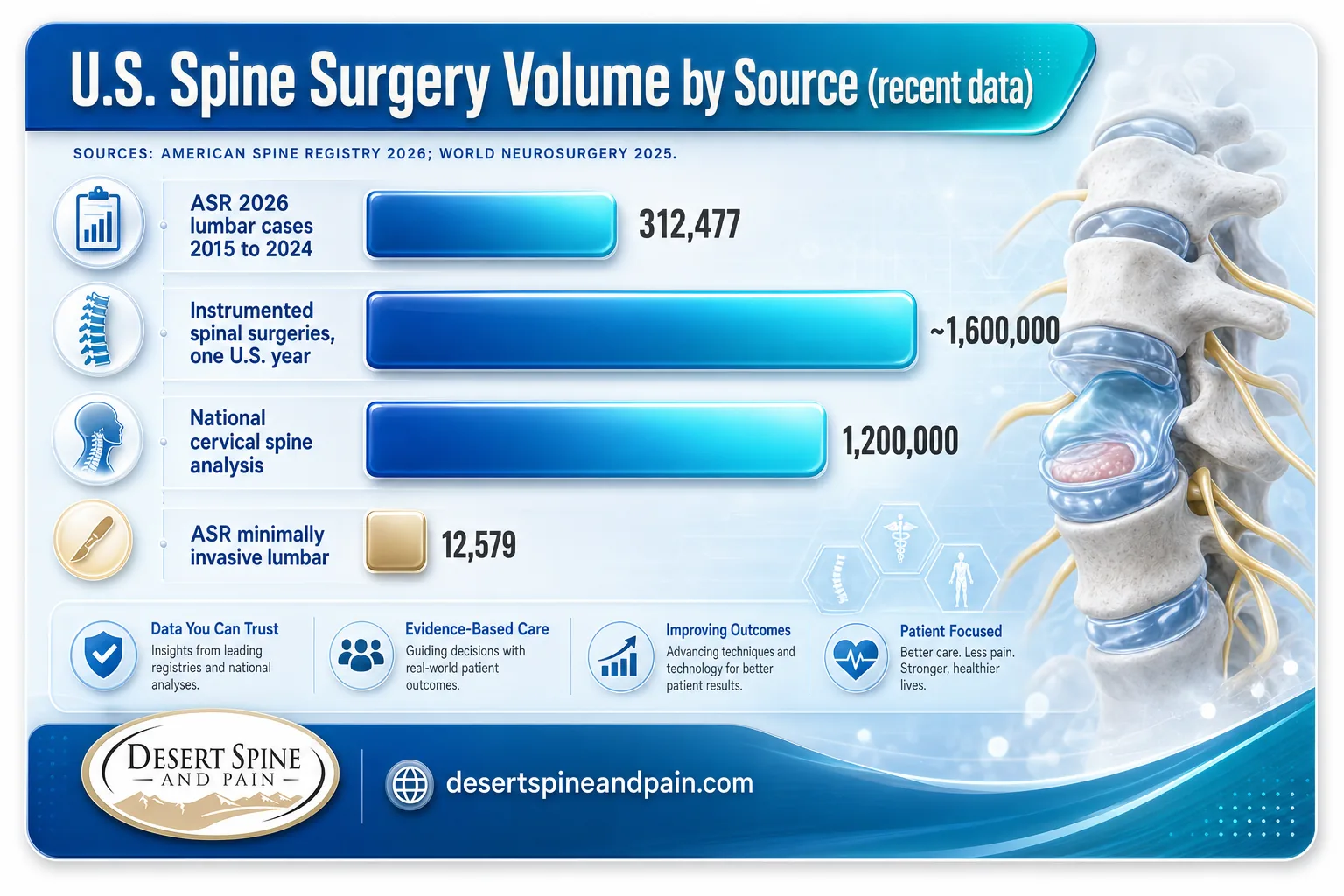
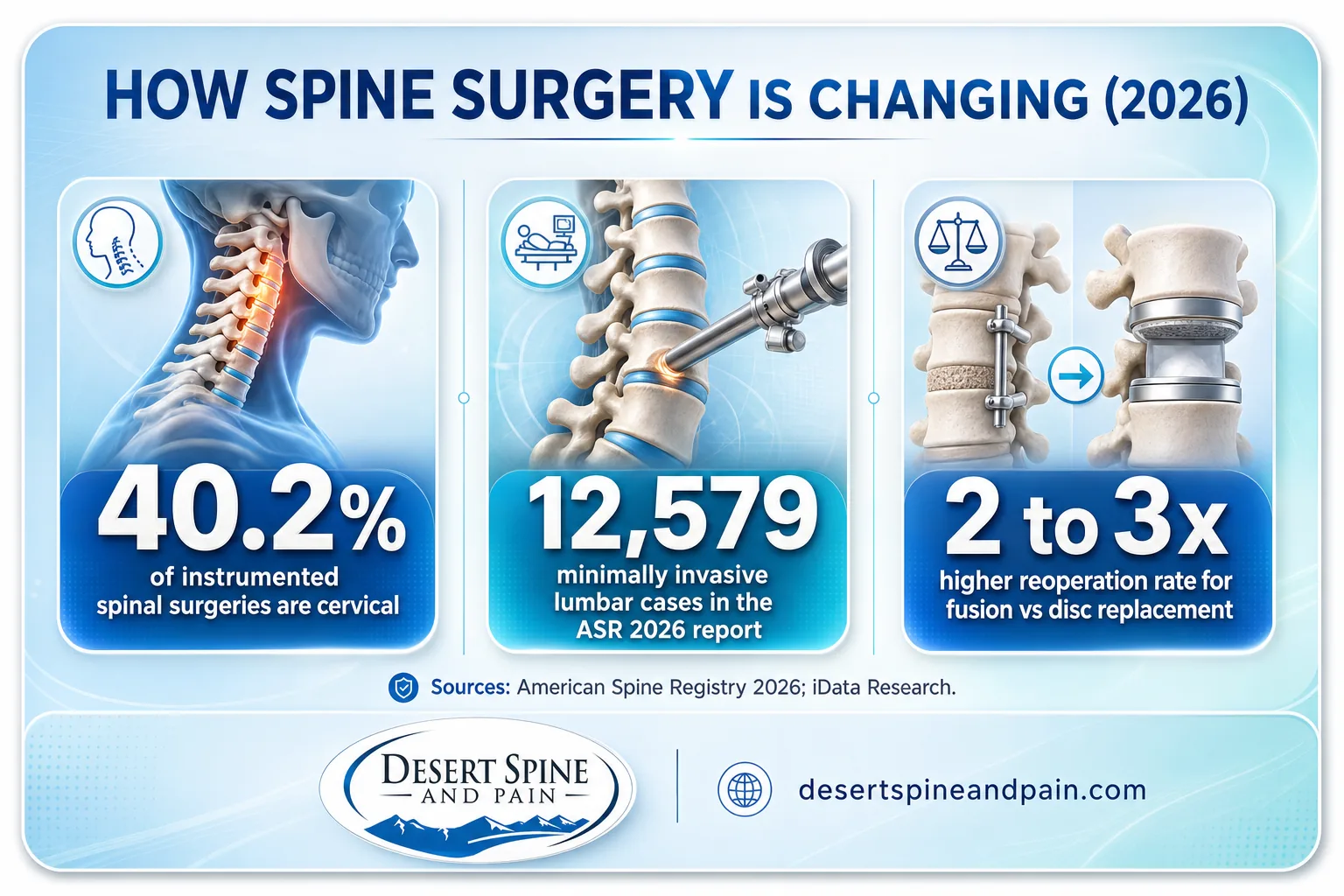
- One national dataset counted roughly 1.6 million instrumented spinal surgeries in a recent single year, with about 40 percent involving the cervical spine.
- Published success rates are procedure-specific: fusion around 90 percent, decompression 71 to 90 percent, disc replacement 85 to 95 percent.
- Mortality for spinal fusion is low at 0.13 to 0.2 percent, but failed back surgery syndrome is reported in 10 to 40 percent of back surgery patients.
- Spinal stenosis was the top lumbar diagnosis at 60 percent of lumbar cases in the ASR 2026 report.
- A rising share of procedures is shifting to outpatient and ambulatory settings, driven by minimally invasive technique and better pain control.
- Surgeon experience and diagnostic accuracy are consistently associated with better outcomes, which is why a top-tier evaluation matters before any operation.
What's in This Guide
- Spine Surgery Volume in the United States
- Most Common Spine Procedures and Diagnoses
- Success Rates by Procedure
- Complications, Reoperation, and Mortality
- Cost and Value of Spine Surgery
- Technology, Minimally Invasive, and Outpatient Trends
- Who Has Spine Surgery: Patient Demographics
- Summary Table: Spine Surgery Statistics 2026
- Frequently Asked Questions
1Spine Surgery Volume in the United States
Spine surgery is one of the highest-volume areas of surgical care in the country, but no single number captures it cleanly. Counts differ depending on whether a database tracks hospital claims, device implantations, or registry submissions, and because one operation can generate several separately coded procedures.
The clearest recent benchmark comes from the American Spine Registry, a joint effort of the American Association of Neurological Surgeons and the American Academy of Orthopaedic Surgeons. Its 2026 annual report, released in February 2026, captured 312,477 lumbar spine cases from participating surgeons and institutions covering 2015 through 2024. That figure reflects only reporting sites, so the true national total is considerably higher.
Adult Spine Surgery Claims, New York Metro Sample (annual)
Volume dipped during the pandemic, then rebounded above pre-pandemic levels. Source: SPARCS database analysis, PMC, 2025.
The broader trend over two decades is one of growth. Rates of spine surgery have more than doubled over the last 20 years, with lumbar fusion increasing by a reported 62 percent alone, driven by an aging population and expanded surgical indications. This makes reliable, data-informed decision making more important than ever for patients weighing whether surgery is truly warranted.
Combining the ASR 2026 lumbar total (312,477 cases over 2015 to 2024) with the roughly 1.6 million instrumented spinal surgeries counted nationally in a single recent year shows how partial any one registry is. Registry data reflects participating sites; national claims data reflects billing. Neither is the whole picture, and both point to the same conclusion: spine surgery is common, but "common" is not the same as "necessary for you." Calculation and interpretation original to Desert Spine and Pain.
Led by board-certified neurosurgeon and spine surgeon Dr. David L. Greenwald, MD, FACS, our Phoenix practice begins every case with the least invasive effective option and reserves surgery for patients who genuinely need it.
Explore spine surgery options in PhoenixSource: Becker's Spine Review (ASR 2026 data) | World Neurosurgery, 2025
2Most Common Spine Procedures and Diagnoses
Knowing which procedures are performed most often helps patients understand where they fit and what questions to ask. The American Spine Registry 2026 report breaks lumbar cases down by procedure and by diagnosis, giving one of the cleanest recent snapshots available.
| Lumbar Procedure or Diagnosis | Share of Lumbar Cases | Source |
|---|---|---|
| TLIF / PLIF (interbody fusion) | 32.54% | ASR 2026 |
| Laminectomy / decompression | 30.98% | ASR 2026 |
| ALIF / LLIF | 16.79% | ASR 2026 |
| Corpectomy | 5.41% | ASR 2026 |
| Lumbar arthroplasty (disc replacement) | 0.30% | ASR 2026 |
| Diagnosis: spinal stenosis | 60% | ASR 2026 |
| Diagnosis: herniated disc / radiculopathy | 33.9% | ASR 2026 |
| Diagnosis: spondylolisthesis | 25.6% | ASR 2026 |
On the cervical side, anterior cervical discectomy and fusion (ACDF) has long been the most common procedure, accounting for 61.6 percent of cervical cases in a national PearlDiver analysis, followed by posterior and lateral fusion at 22.1 percent, posterior cervical fusion at 14.0 percent, and cervical disc arthroplasty at 3.4 percent. That study also found ACDF's dominance is now declining while disc replacement grows, especially among younger patients.
Dr. Greenwald's dual training as both a spine surgeon and a neurosurgeon means he evaluates cervical and lumbar problems across the full range of these procedures rather than defaulting to a single technique. For patients researching a specific operation, our minimally invasive spine surgery options often reduce recovery time compared with traditional open approaches.
Source: American Spine Registry 2026 via Becker's | World Neurosurgery, 2025
3Success Rates by Procedure
"Success" in spine surgery means different things depending on the procedure and the goal, whether that is pain relief, restored function, or spinal stability. Published success ranges are procedure-specific, and the higher end generally reflects appropriately selected patients treated by experienced surgeons.
Reported Success Rate Ranges by Procedure
Ranges reflect appropriately selected patients. Source: peer-reviewed literature compiled by Spine Together, 2026.Not necessarily. Success rates describe averages across patients who were good candidates for a specific procedure. A 90 percent fusion success rate says nothing about whether fusion is the right operation for your particular anatomy, or whether a less invasive option would serve you better. Some studies have found no clear benefit from fusion versus non-operative care for certain degenerative back pain. The number that matters is your individual likelihood of benefit, which only a careful evaluation can estimate.
This is exactly why our practice emphasizes least-invasive-first care and precise diagnosis. A statistic is a starting point for a conversation, not a substitute for one.
Book a consultation with Dr. GreenwaldSource: Spine Together (peer-reviewed compilation) | Lown Institute Hospitals Index
4Complications, Reoperation, and Mortality
Every operation carries risk, and honest data on complications helps patients make informed decisions. Reported complication rates for spine surgery vary widely by procedure, patient health, and how complications are defined, but the ranges below reflect published, peer-reviewed figures.
Failed back surgery syndrome, where pain persists or returns after an operation, is one of the most important figures for patients to understand. The wide 10 to 40 percent range reflects differences in patient selection, surgical technique, and diagnosis accuracy. In other words, a large share of that risk is influenced by decisions made before and during surgery, not by chance alone.
Complication and reoperation rates are not fixed properties of a procedure. They are strongly shaped by patient selection, surgical precision, and whether the right operation was chosen in the first place. A surgeon who correctly identifies which patients should not have surgery lowers the failure rate for everyone. Dr. Greenwald's dual expertise as a spine surgeon and neurosurgeon supports precise diagnosis and careful case selection, the two levers most associated with avoiding failed back surgery syndrome.
Patients who have already had a failed operation elsewhere often seek a second opinion for revision options. Our practice regularly evaluates complex and revision cases and welcomes out-of-network patients from across the country.
Review the conditions we treatSource: Lown Institute Hospitals Index | Revision Lumbar Surgery cohort study, PMC
5Cost and Value of Spine Surgery
Spine care is among the most expensive categories in U.S. healthcare, and cost data increasingly overlaps with questions of value and appropriateness. Low back and neck pain has ranked as the single most expensive health condition in national spending analyses.
These overuse figures matter for value-minded patients and for the personal injury attorneys who coordinate care for injured clients. Unnecessary procedures inflate cost without improving outcomes, and they complicate claims. Choosing a surgeon who declines to operate when surgery is not indicated protects both the patient and the case.
The Lown Institute has repeatedly documented low-value back procedures in Medicare data. This is not an argument against spine surgery, which helps many patients, but against the wrong spine surgery for the wrong patient. The safeguard is a surgeon whose incentive is the correct decision, not just another case on the schedule.
Desert Spine and Pain works with out-of-network patients of every kind and partners closely with personal injury attorneys, offering 24/7 concierge response and coordination of documentation for their clients and their operations.
See non-invasive care options firstSource: Lown Institute Hospitals Index, 2025
6Technology, Minimally Invasive, and Outpatient Trends
The last decade has reshaped how spine surgery is delivered. Minimally invasive techniques, navigation, robotics, and a shift toward outpatient settings are changing both recovery and safety profiles.
Ambulatory surgery centers are increasingly performing procedures that were once inpatient-only, including many ACDF and minimally invasive lumbar cases, with documented short-stay results. Meanwhile 2026 has already seen a series of technology firsts, from navigated endoscopic lumbar fusion to new robotic platforms, signaling how quickly the field is advancing.
Dr. Greenwald offers advanced minimally invasive and motion-preserving techniques where they are appropriate, always matching the technique to the patient rather than the other way around.
Learn about motion-preservation surgerySource: iData Research | Becker's Spine Review, 2026
7Who Has Spine Surgery: Patient Demographics
Understanding who undergoes spine surgery helps patients see where they fit and helps attorneys anticipate the profile of an injured client's care.
The gradual decline in average patient age is notable. It may reflect lifestyle factors, earlier presentation, or shifting surgical indications. For personal injury practices, it signals that spine injuries increasingly affect working-age adults whose recovery and earning capacity are directly at stake.
If spinal cases account for roughly 77 percent of neurosurgical operations, then a surgeon trained in both neurosurgery and spine surgery brings the full depth of nervous-system expertise to problems that orthopedic-only training approaches from a different angle. Dr. Greenwald's dual credential is not a marketing line, it maps directly onto where the surgical volume and the neurological risk actually sit. Interpretation original to Desert Spine and Pain.
Source: SPARCS database analysis, PMC | Nagoya Spine Group registry, PMC
Summary Table: Spine Surgery Statistics 2026
| Statistic | Figure | Source | Year |
|---|---|---|---|
| Lumbar cases in ASR report | 312,477 | American Spine Registry | 2026 |
| Instrumented spinal surgeries, single U.S. year | ~1.6 million | National dataset via literature | 2025 |
| Cervical surgeries in national analysis | 1.2 million | World Neurosurgery | 2025 |
| Most common lumbar procedure (TLIF/PLIF) | 32.54% | American Spine Registry | 2026 |
| Laminectomy / decompression share | 30.98% | American Spine Registry | 2026 |
| Top lumbar diagnosis (spinal stenosis) | 60% | American Spine Registry | 2026 |
| ACDF share of cervical cases | 61.6% | World Neurosurgery | 2025 |
| Spinal fusion success rate | ~90% | Peer-reviewed compilation | 2026 |
| Decompression success rate | 71 to 90% | Peer-reviewed compilation | 2026 |
| Disc replacement success rate | 85 to 95% | Peer-reviewed compilation | 2026 |
| Spinal fusion mortality | 0.13 to 0.2% | Int'l J Spine Surgery et al. | 2018 |
| Failed back surgery syndrome | 10 to 40% | Asian Spine Journal | 2018 |
| Major complication risk | 10 to 24% | BMC Musculoskeletal Disorders | 2023 |
| Unnecessary vertebroplasties (3 yrs, Medicare) | 100,000+ | Lown Institute | 2025 |
| MIS lumbar procedures in ASR report | 12,579 | American Spine Registry | 2026 |
| Fusion vs disc replacement reoperation ratio | 2 to 3x | iData Research | 2025 |
| Average patient age (metro sample) | 54.1 years | SPARCS analysis, PMC | 2025 |
| Spinal share of neurosurgical operations | 77% | Peer-reviewed literature | 2013 |
Frequently Asked Questions
How many spine surgeries are performed in the United States each year?
What is the success rate of spine surgery?
What is the most common spine surgery?
How risky is spine surgery?
Is spine surgery moving to outpatient settings?
Methodology & Sources
How we compiled these statistics
Every figure in this article traces to a Tier 1 primary source: government data, national registries, peer-reviewed journals, or established research databases. Where a single operation can be coded as multiple procedures, we note that national counts differ by method. Success and complication ranges reflect published peer-reviewed literature and describe appropriately selected patients; individual results vary.
Primary sources referenced:
- American Spine Registry (AANS/AAOS) 2026 Annual Report, reported via Becker's Spine Review and Healio
- World Neurosurgery, national cervical spine trends (PearlDiver database), 2025
- Lown Institute Hospitals Index, Unnecessary Back Surgery reports, 2024 and 2025
- iData Research, U.S. spinal implant and fusion market data
- SPARCS database analysis of adult spine surgery trends, PMC, 2025
- Nagoya Spine Group registry, spine surgery epidemiology, PMC
- Peer-reviewed success-rate literature compiled with citations by Spine Together, 2026
This article is educational and is not individual medical advice. Statistics describe populations, not any single patient. For guidance specific to your spine condition, consult a qualified spine surgeon.
Journalists and researchers may cite these statistics with attribution to Desert Spine and Pain and a link to this page. Please attribute the underlying figures to their original Tier 1 sources as listed above. For expert commentary on spine surgery data from a board-certified neurosurgeon and spine surgeon, contact Desert Spine and Pain at (602) 566-9500.