

Spine Impairment Ratings Explained: How They're Determined and Why They Matter
A spine impairment rating is a percentage a physician assigns to measure the permanent loss of function in your neck or back once an injury has healed as much as it is going to. Expressed as a whole person impairment (WPI) figure, it is calculated using a national medical rulebook, the AMA Guides to the Evaluation of Permanent Impairment, and it often becomes the single number that decides how much a workers' compensation or personal injury case is worth.
- A spine impairment rating is a medical percentage, not a legal verdict. It measures permanent physical loss, not whether you can work.
- Most ratings are built from the AMA Guides to the Evaluation of Permanent Impairment, the standard reference published by the American Medical Association.
- A valid rating can only be assigned after you reach maximum medical improvement (MMI), the point where your spine is as recovered as it is going to get.
- Impairment is not disability. You can have a low rating and still be unable to do your old job, and a 0% rating does not always mean you are pain free.
- The number drives real money. It sets workers' compensation permanent-disability benefits and heavily influences personal injury settlement value.
- Different systems use different rulebooks. The VA and Social Security do not use the AMA Guides at all, so the same spine can carry very different ratings in different programs.
What's in This Guide
- What Is a Spine Impairment Rating?
- Impairment Is Not Disability
- The AMA Guides: The Rulebook Behind the Number
- How a Spine Impairment Rating Is Determined
- How the Spine Is Rated by Region
- Who Assigns the Rating, and Why the Examiner Matters
- Why Your Spine Impairment Rating Matters
- Impairment Across Workers' Comp, the VA, and Social Security
- What This Means for Your Spine and Your Case
- Frequently Asked Questions
- Methodology and Sources
What Is a Spine Impairment Rating?
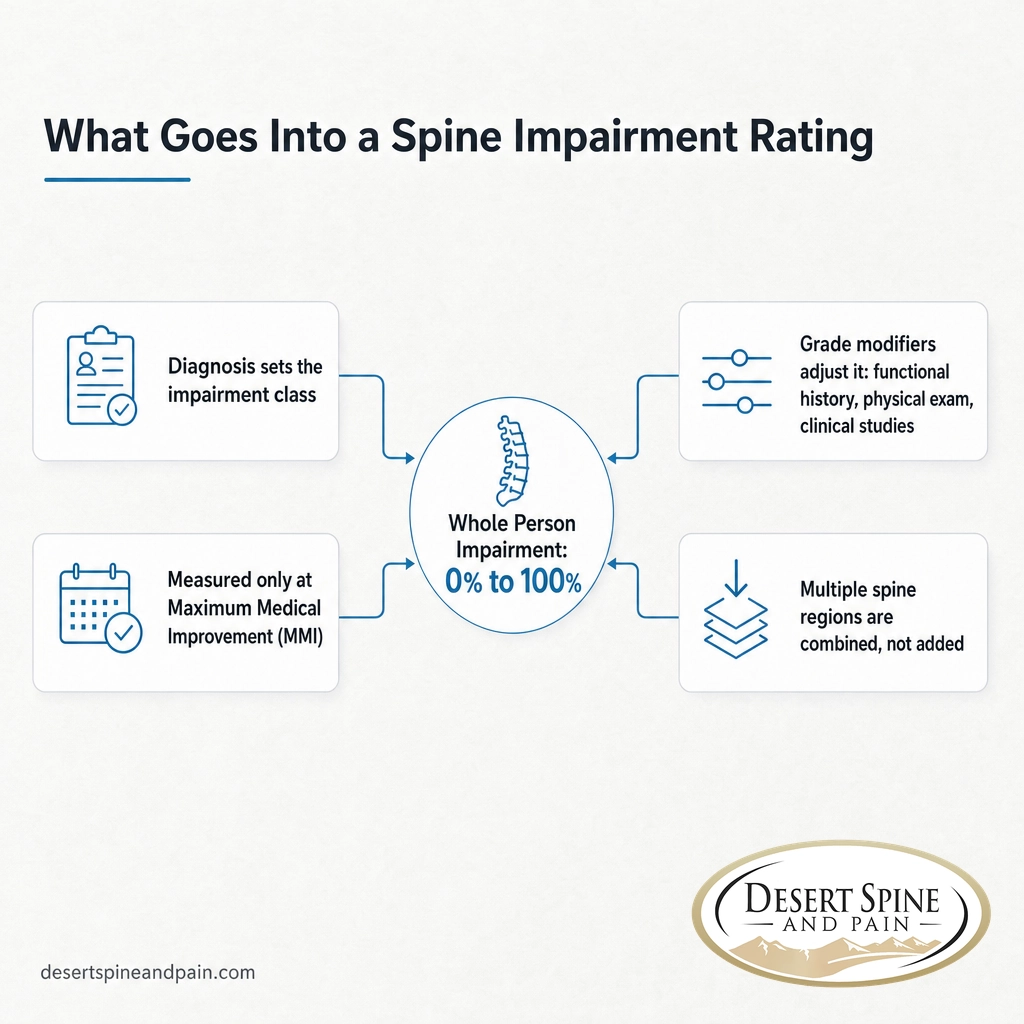
A spine impairment rating puts a number on something that is otherwise hard to quantify: the permanent damage left in your neck or back after an injury or a degenerative condition. A physician examines you, reviews your imaging and records, and assigns a percentage that reflects how much structure and function you have permanently lost.
That percentage is usually reported as a whole person impairment, or WPI. The idea is to express the loss as a share of your entire body's function, so that a spine injury can be compared on the same scale as any other permanent injury. The scale runs from 0% to 100%.
Most spine impairment ratings land in the lower part of that scale. A rating is not a measure of your pain, your frustration, or your fear about the future. It is a structured, repeatable estimate of permanent loss, designed so that two different qualified examiners, applying the same rulebook to the same spine, should arrive at a similar figure. The rating exists because insurers, courts, and benefit systems need a consistent way to translate a neck or back injury into a value they can act on.
Because the stakes are high, the rating is treated as medical evidence. It is documented, defended, and sometimes challenged. Understanding where the number comes from is the first step to knowing whether the one you received is fair.
Source: American Medical Association, AMA Guides to the Evaluation of Permanent Impairment
Impairment Is Not Disability
This is the single most misunderstood part of the whole subject, and getting it wrong costs people money and peace of mind. Impairment and disability are two different things.
Impairment is a medical measurement: a significant loss or derangement of a body structure or function. Your spine impairment rating measures that loss. Disability is the real-world consequence of that loss, the activity limitations and participation restrictions it creates, especially your ability to work and earn a living.
Myth: a spine impairment rating tells you whether you are disabled. It does not. The AMA Guides are explicit that an impairment percentage should not be used as a direct estimate of disability. A warehouse worker and an office worker can carry the exact same 10% spine impairment rating, yet one may be unable to return to work while the other is fully employed. A rating of 0% does not always mean you are free of symptoms, and a modest rating can still coincide with a serious loss of earning capacity. Impairment is the medical starting point; disability is a separate judgment made by a court or a benefit program.
Why does this matter in practice? Because insurers sometimes present a low impairment rating as if it settles the question of what you can do. It does not. The impairment rating is one input. Whether you are disabled, and to what degree, depends on your job, your training, your age, and the rules of the specific system evaluating your claim. The same distinction explains why people are surprised to learn that back pain and long-term disability do not track neatly with any single rating number.
Source: Social Security Administration, Disability Evaluation Under Social Security
The AMA Guides: The Rulebook Behind the Number
Almost every serious spine impairment rating in the United States is built from one reference: the AMA Guides to the Evaluation of Permanent Impairment, published by the American Medical Association. First issued decades ago and revised several times, the Guides give physicians a standardized method so that ratings are consistent rather than a matter of personal opinion.
There is a catch that trips up patients and even some attorneys: which edition applies depends on where your case is and what kind of claim it is. The editions use meaningfully different methods, and the same spine can produce a different percentage under different editions.
| Edition | Published | What changed for the spine |
|---|---|---|
| Fourth Edition | 1993 | An older framework still mandated in a small number of state systems. |
| Fifth Edition | 2000 | Rated the spine two ways: the Diagnosis-Related Estimate (DRE) method and the Range of Motion (ROM) method. Still required in several states, including California. |
| Sixth Edition | 2008 (2024 update) | Moved to a diagnosis-based system: the diagnosis sets an impairment class, which is then adjusted by grade modifiers. The standalone spine ROM method was essentially retired. |
The practical takeaway is simple. If someone quotes you a spine impairment percentage, the first question is which edition of the AMA Guides it came from, because the answer changes what the number means and whether it was calculated under the rules your claim actually requires. Jurisdictions differ widely: the majority of state workers' compensation systems adopt some edition of the AMA Guides, while a number of states use their own impairment schedules instead and a few use fixed "scheduled loss" systems that do not rely on the Guides at all.
Source: American Medical Association, AMA Guides | U.S. Department of Labor, Federal Employees' Compensation Act program
How a Spine Impairment Rating Is Determined
A spine impairment rating is not a guess and it is not a single measurement. It is the end of a structured process. Here is how a careful physician gets to the number, step by step.
Step 1: You reach maximum medical improvement (MMI)
Nothing can be rated until your spine has stabilized. Maximum medical improvement is the point at which your condition is as recovered as it is reasonably going to get, and further treatment is not expected to produce significant improvement. Only the permanent impairment that remains at MMI can be rated. Importantly, reaching MMI does not mean your care is over. Many patients continue treatment, including injections, therapy, or medication, long after MMI is declared; MMI simply marks when the permanent loss can be measured.
Step 2: The physician gathers the evidence
The examiner reviews your full history: how the injury happened, the course of treatment, operative reports if you had surgery, and your imaging (MRI, CT, X-ray). A physical examination follows, documenting neurological findings, strength, sensation, reflexes, and motion. For the spine, objective findings carry far more weight than symptoms alone.
Step 3: The diagnosis sets the class
Under the current Sixth Edition approach, the diagnosis is the anchor. The physician places your spine condition into a diagnostic category, such as a disc or motion-segment problem, spinal stenosis, a fracture, or non-specific chronic pain, and that category defines an impairment class. Each class carries a range of possible WPI percentages.
Step 4: Grade modifiers fine-tune the number
Within the class, the rating is adjusted up or down using grade modifiers. These capture your functional history (how the condition affects your daily activities), your physical examination findings, and your clinical study results such as imaging. The modifiers move you to a specific grade inside the class rather than letting the examiner pick a figure freely.
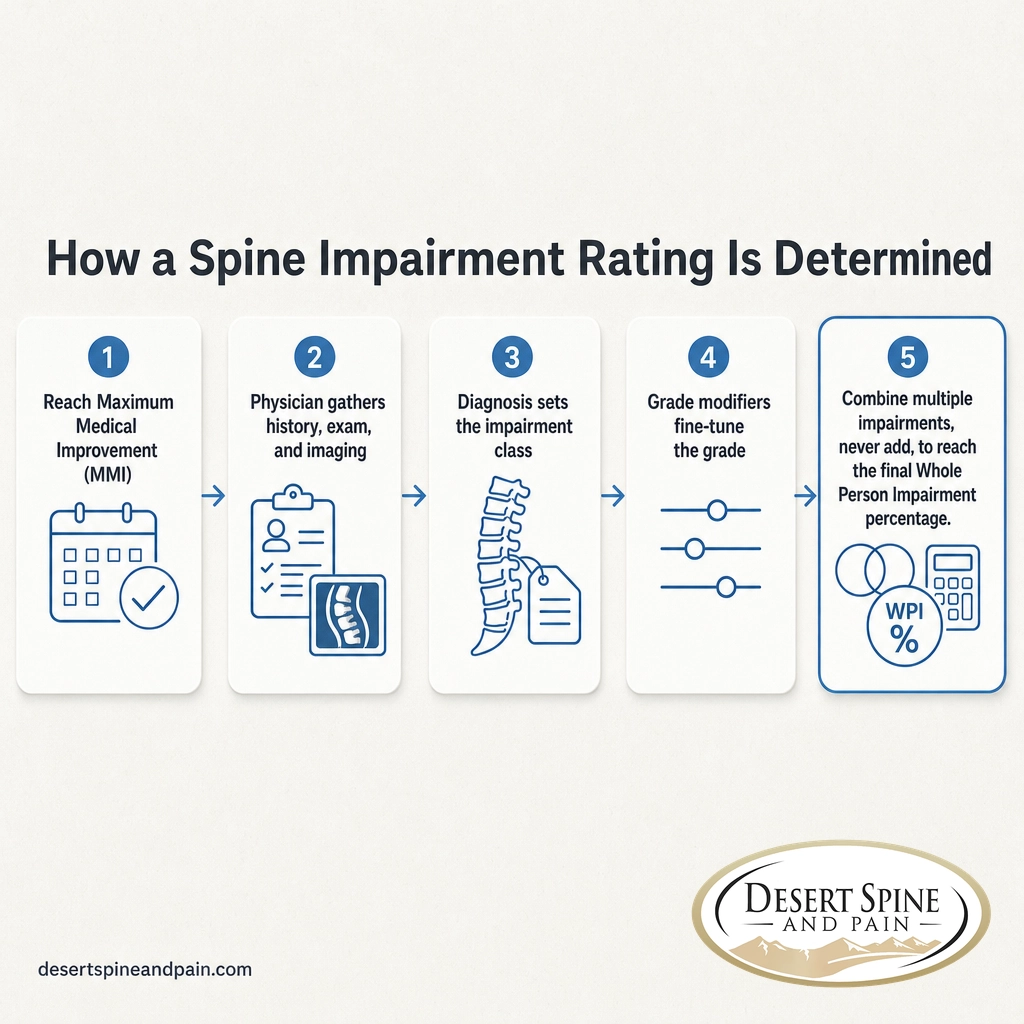
Step 5: Multiple impairments are combined, not added
If you have more than one ratable impairment, for example a cervical injury and a lumbar injury, the physician does not simply add the percentages together. The AMA Guides use a combining method so that total impairment can never exceed 100% of the whole person. This is a common point of error: a report that adds impairments instead of combining them can overstate the true figure, which is one reason ratings get challenged.
The honest caveat. The exact percentage your spine earns depends entirely on your specific diagnosis, examination, and imaging applied to the correct edition of the Guides. Any source that promises a flat "a herniated disc equals X percent" is oversimplifying. The number is the output of this process, not a lookup from a chart, and that is exactly why the quality and thoroughness of the examining physician matters so much.
Source: U.S. Department of Labor, Office of Workers' Compensation Programs, impairment rating procedures
How the Spine Is Rated by Region
The spine is rated by region, because the function and the consequences of injury differ along its length. A rating report will specify which region is involved, and a single person can carry a rating in more than one.
Cervical spine (neck)
The cervical spine is the seven vertebrae of the neck. Injuries here can affect the arms and hands through the nerves that exit at each level, which is why cervical ratings often consider upper-extremity symptoms alongside neck findings. Conditions range from whiplash and disc herniation to stenosis and the aftermath of fusion surgery.
Thoracic spine (mid-back)
The thoracic spine is the stiffer middle section, anchored by the rib cage. It is injured less often than the neck or low back, but compression fractures and direct trauma are rated here.
Lumbar spine (low back)
The lumbar spine bears the most load and is the most frequently injured region. Herniated discs, degenerative changes, stenosis, and the nerve pain of sciatica or radiculopathy commonly generate lumbar ratings. Because low-back injuries are so common in car accidents and at work, lumbar ratings are the ones most often disputed in workers' compensation back injury claims.
Each region is evaluated on its own diagnosis and findings, then combined if more than one applies. The anatomy matters because the same event, say a rear-end collision, can injure the neck and the low back differently, and each deserves its own careful evaluation. If you want to understand which symptoms map to which part of the spine, our guide to how specific vertebrae affect specific nerves lays it out.
Source: American Medical Association, AMA Guides, spine chapter
Who Assigns the Rating, and Why the Examiner Matters
A spine impairment rating is only as good as the physician who performs it. The rating must be done by a qualified doctor, often a spine surgeon, a physiatrist (a physical medicine and rehabilitation specialist), or another physician trained in the specific edition of the AMA Guides that applies. Training matters, because misapplying the method, for example adding impairments instead of combining them or using the wrong edition, produces a defensible-looking report that is simply wrong.
There are two common contexts in which the rating is assigned:
The treating physician. The doctor who has managed your spine care knows your history, your imaging, and your response to treatment. That continuity often makes for a thorough, well-supported rating.
The independent medical examination (IME). Insurers and attorneys frequently request an IME, a one-time evaluation by a physician who has not treated you, specifically to assign or review a rating. An IME is where ratings are often contested, and where a surgeon's credibility and command of the Guides carry real weight. The role of medical experts in these disputes is covered in our breakdown of how medical expert testimony shapes injury cases.
When a rating seems too low, or when an insurer's IME conflicts with your treating doctor, a second, independent evaluation from a board-certified spine specialist is a well-established and reasonable response. The examiner's expertise is not a formality. It is often the difference between a rating that holds up and one that falls apart under scrutiny.
Source: American Medical Association, AMA Guides

Why Your Spine Impairment Rating Matters
For most people, the rating is not an academic exercise. It is attached to money and to the resolution of a difficult chapter of their life. Here is where the number does its work.
It sets workers' compensation benefits
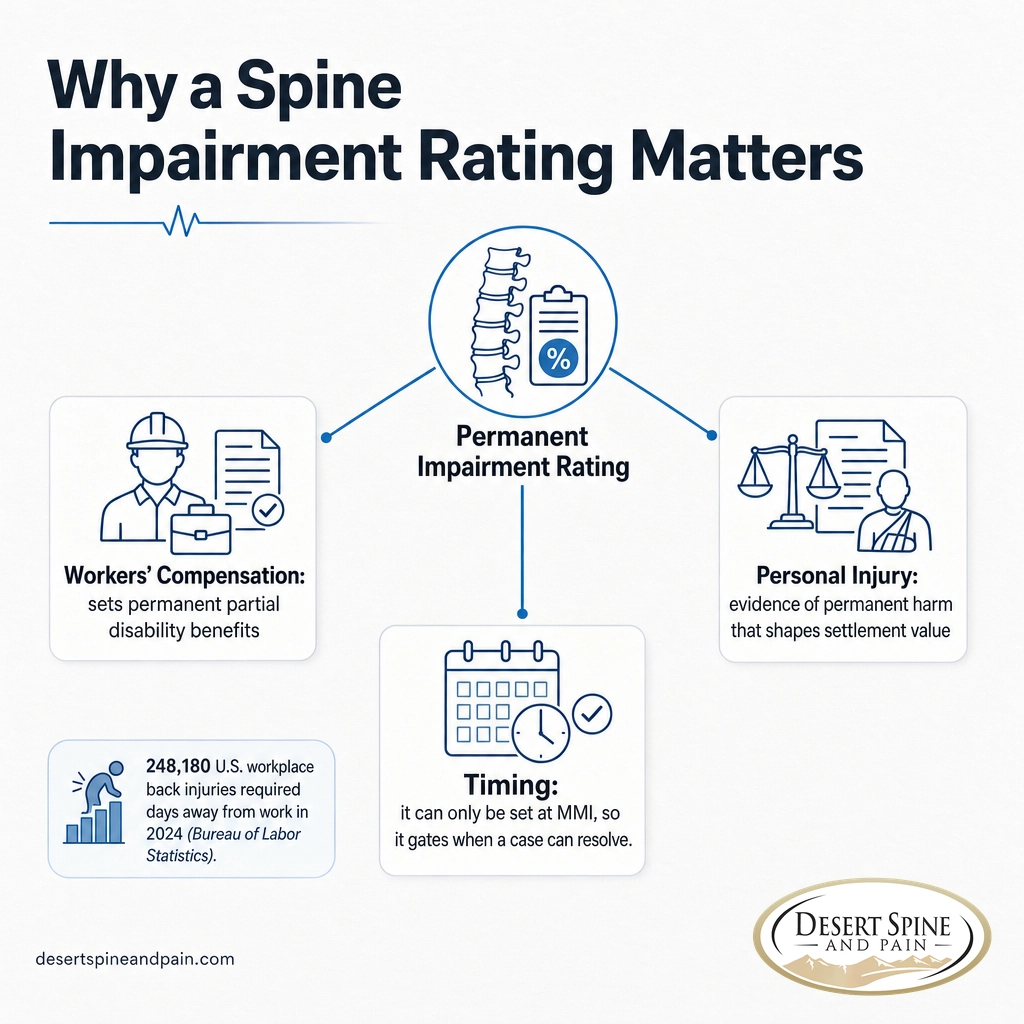
In workers' compensation, a permanent spine impairment rating is frequently plugged into a state formula that calculates permanent partial disability benefits. The rating, often combined with your wages and other factors, translates directly into a dollar figure or a number of benefit weeks. A difference of a few percentage points can mean a substantial difference in what you receive. Spine injuries are a large share of the workplace claims that run through this process.
It shapes personal injury settlements
In a personal injury claim after a car accident, slip and fall, or other incident, a spine impairment rating is powerful evidence of permanent harm. It helps establish that the injury is not temporary, which supports damages for future medical care, lost earning capacity, and pain and suffering. A higher, well-documented rating generally strengthens a claim, which is precisely why defense insurers scrutinize ratings and commission their own IMEs. The rating is one of the clearest signals of how a case may resolve, and it factors into the realities of average back injury settlement values and lost wages from a spinal injury.
It influences timelines and strategy
Because a rating can only be assigned at MMI, it also governs timing. Cases often cannot resolve until the rating is in hand, which is one reason spine claims take as long as they do. If you are tracking the clock on your own matter, our overview of how long personal injury cases take explains where the rating fits in the sequence.
Source: U.S. Bureau of Labor Statistics, Injuries, Illnesses, and Fatalities program
Impairment Across Workers' Comp, the VA, and Social Security
One of the most confusing realities is that the same injured spine can carry different ratings in different programs, because not every system uses the AMA Guides. Confusing an AMA Guides impairment rating with a VA rating or a Social Security decision is a frequent and costly mistake.
| System | What it measures | Rulebook used | How it is expressed |
|---|---|---|---|
| State workers' comp | Permanent impairment, then permanent partial disability | AMA Guides in most states (edition varies); some use their own schedule | WPI percentage feeding a benefit formula |
| Federal workers' comp (FECA) | Permanent impairment of covered federal employees | AMA Guides, Sixth Edition | WPI percentage |
| Personal injury (civil) | Permanent harm as evidence of damages | AMA Guides commonly used as medical evidence | WPI percentage supporting a settlement or verdict |
| Veterans Affairs (VA) | Service-connected disability | Its own VA Schedule for Rating Disabilities (38 CFR Part 4), not the AMA Guides | 0% to 100% in 10% steps |
| Social Security (SSDI) | Ability to work, not degree of impairment | Its own five-step process and medical listings, not the AMA Guides | A yes-or-no disability finding, no percentage |
The lesson: a 20% spine impairment rating under the AMA Guides in a workers' compensation case tells you nothing about what the VA would assign or whether Social Security would find you disabled. The VA uses its own schedule, and Social Security asks a different question entirely, namely whether you can work at all. If your situation touches more than one system, each rating must be understood on its own terms.
Source: VA Schedule for Rating Disabilities, 38 CFR Part 4 (eCFR) | Social Security Administration, Disability Evaluation
What This Means for Your Spine and Your Case
If you are facing a spine impairment rating, whether as an injured patient or as a personal injury attorney guiding a client, a few principles follow directly from how the number is built.
First, the rating is only as strong as the examination and documentation behind it. A thorough evaluation at true MMI, using the correct edition of the Guides and the right diagnosis-based method, is what makes a rating hold up. Second, a low or rushed rating is not the final word. A second opinion from an independent, board-certified spine specialist is a reasonable and common response. Third, the physician's expertise is not a detail. The credibility of the doctor applying the Guides often decides whether a rating survives an IME or a deposition.
Where Desert Spine and Pain fits in. Dr. David L. Greenwald, MD, FACS is board certified as both a spine surgeon and a neurosurgeon, and practices in Phoenix, Arizona, where the Industrial Commission of Arizona uses impairment ratings to determine permanent partial disability benefits. The practice provides least-invasive-first spine care from conservative treatment through complex surgery, with the thorough, well-organized documentation that a sound impairment evaluation depends on. For personal injury attorneys, that means a responsive, expert spine partner for clients whose cases turn on an accurate rating.
If your spine care includes the prospect of surgery, understanding the full range of options helps you weigh any rating in context.
Explore Spine Surgery OptionsAnd if your decision turns on the surgeon, Dr. Greenwald's dual spine and brain surgery credentials are the reason patients travel to Phoenix for this level of care.
Meet Dr. Greenwald, Spine Surgeon and NeurosurgeonFrequently Asked Questions
What is a spine impairment rating?
Is an impairment rating the same as a disability rating?
When is a spine impairment rating assigned?
Can I challenge a spine impairment rating I think is too low?
Why does my spine impairment rating matter so much?
Methodology and Sources
This article explains how spine impairment ratings are defined, determined, and used, drawn from the governing medical and governmental sources rather than secondary summaries. The definition of impairment, the whole person impairment scale, the distinction between impairment and disability, the maximum medical improvement requirement, and the diagnosis-based method of the current edition reflect the American Medical Association's AMA Guides to the Evaluation of Permanent Impairment and official descriptions of its editions.
The treatment of impairment ratings across systems reflects the U.S. Department of Labor's workers' compensation programs (including the Federal Employees' Compensation Act), the VA Schedule for Rating Disabilities at 38 CFR Part 4, and the Social Security Administration's disability evaluation process. Workplace back-injury figures are from the U.S. Bureau of Labor Statistics Survey of Occupational Injuries and Illnesses.
This content is general educational information. It is not legal advice or individualized medical advice, and it is not a solicitation of expert-witness engagement. Specific impairment percentages depend entirely on an individual's diagnosis, examination, imaging, and the edition of the Guides that a given jurisdiction requires. The exact edition and rules that apply to any claim vary by state and program and change over time; confirm current requirements with a qualified attorney and physician.
Primary sources:
- American Medical Association, AMA Guides to the Evaluation of Permanent Impairment (editions and spine chapter).
- U.S. Department of Labor, Office of Workers' Compensation Programs and the Federal Employees' Compensation Act.
- U.S. Department of Veterans Affairs, Schedule for Rating Disabilities, 38 CFR Part 4.
- Social Security Administration, Disability Evaluation Under Social Security.
- U.S. Bureau of Labor Statistics, Survey of Occupational Injuries and Illnesses, 2024.
For journalists and researchers: the explanations in this article may be cited with attribution to Desert Spine and Pain and the underlying primary sources named above.