

Spinal Surgery Complications Statistics (2026): Rates, Risks, and What Lowers Them
Most spinal surgeries have relatively low complication rates, commonly 1 to 8.6 percent, but the odds are not fixed. One of the clearest findings in the research is that surgeon experience changes the numbers: surgeons below volume benchmarks had up to 63 percent higher complication rates. Who performs the surgery is itself a risk factor.
- Overall complication rates for spinal fusion and laminectomy run about 1 to 8.6 percent, with fusion mortality of 0.13 to 0.2 percent.
- Accidental dural tears occur in 3 to 5 percent of primary lumbar surgeries, rising to 7 to 17 percent in revision cases.
- Surgeons below volume benchmarks had a 63 percent higher complication risk for decompression, 56 percent for discectomy, and 47 percent for posterolateral fusion.
- Infection was the most common complication at 30 and 90 days in the American Spine Registry 2026 report; lumbar fusion reoperation was 13.9 percent.
- A dural tear is associated with roughly 2.7 times the odds of surgical site infection and 3.3 times the odds of neurological deficit.
- Higher surgeon volume is consistently linked to lower morbidity, mortality, length of stay, readmissions, and reoperations across systematic reviews.
- Minimally invasive approaches tend toward lower complication rates, but technique-specific risks remain, so experience matters.
What's in This Guide
1Overall Complication and Mortality Rates
Every operation carries risk, and spine surgery is no exception. The good news is that for most common procedures, serious complications are relatively uncommon, though the range is wide because it depends heavily on the procedure and the patient.
Complication rates climb with the complexity of the operation. Minimally invasive procedures generally sit at the lower end, while multilevel fusions, deformity corrections, and revision surgeries carry higher risk. The pattern is consistent: the harder the operation, the more the surgeon's skill and judgment influence the outcome.
Our Phoenix practice, led by board-certified neurosurgeon and spine surgeon Dr. David L. Greenwald, MD, FACS, emphasizes the least invasive effective approach precisely because it tends to carry lower complication risk for suitable patients.
Explore spine surgery options in PhoenixSource: Lown Institute Hospitals Index | American Spine Registry 2026 via Becker's
2The Most Common Complications
Complications after spine surgery fall into a few recognizable categories. Knowing them helps patients ask the right questions and understand what their surgical team is working to prevent.
| Complication Category | Examples | Notes |
|---|---|---|
| Infection | Surgical site infection, deep infection | Most common in ASR 2026 |
| Dural tear | Incidental durotomy, CSF leak | 3 to 5% primary; higher in revision |
| Neural injury | Nerve root injury, deficit, paralysis | Often transient; can be permanent |
| Hardware issues | Screw malposition, cage/graft dislocation | May require revision |
| Bleeding | Massive hemorrhage, hematoma | Higher in open and complex cases |
| Medical events | Blood clots, pneumonia, cardiac | Rise with age and comorbidity |
The variation in reported rates, for example neural injury ranging from 0 to 14.3 percent across thoracic minimally invasive studies, reflects differences in procedure, difficulty, and surgeon experience. That variation is not noise. It is a signal that outcomes depend on who is operating and on which patient.
Learn about minimally invasive optionsSource: e-Neurospine PRISMA complications review, 2024 | Thoracic MISS systematic review, PMC
3Dural Tears and Their Ripple Effects
A dural tear, an unintended opening in the membrane surrounding the spinal cord and nerves, is one of the most studied spine surgery complications because it can trigger a cascade of other problems.
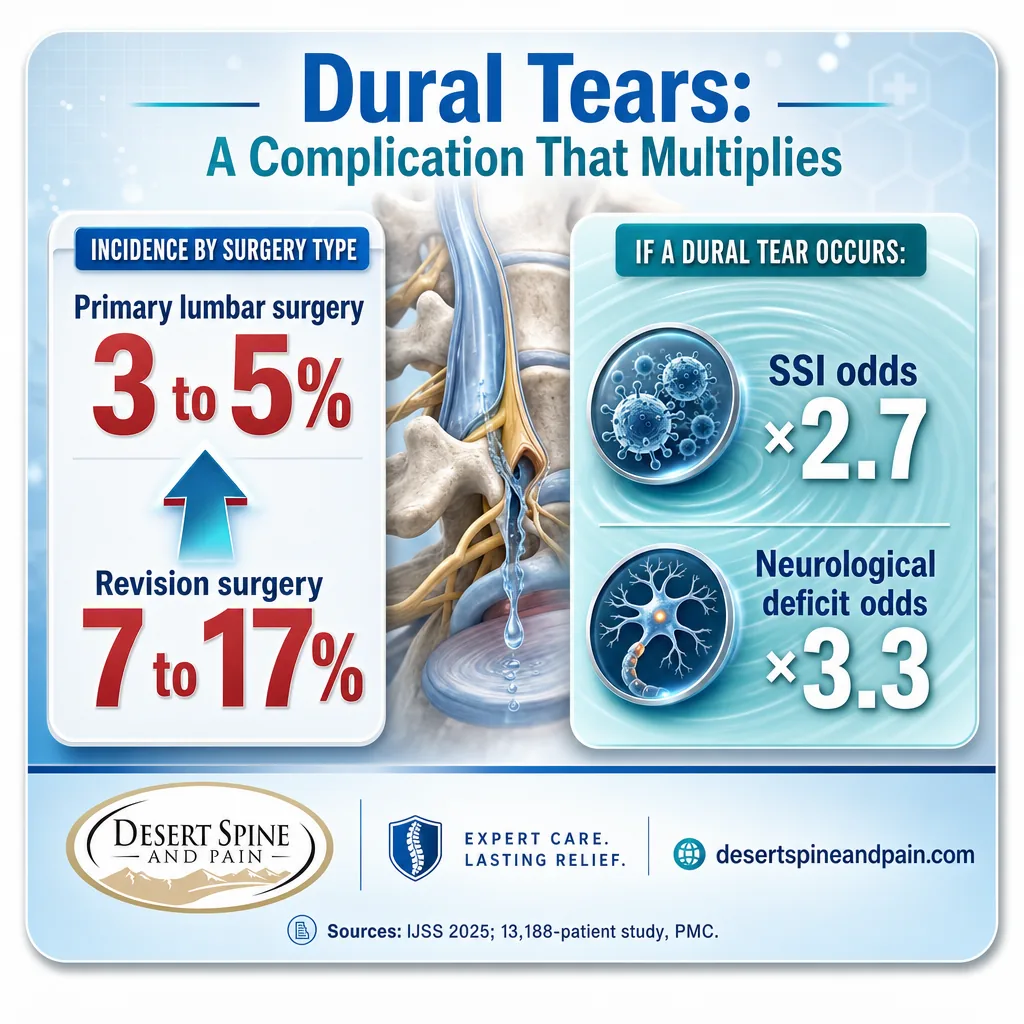
A large multicenter study of 13,188 lumbar surgery patients found that when a dural tear occurred, the odds of surgical site infection rose about 2.7-fold and postoperative neurological deficit about 3.3-fold, even after adjusting for other factors. The jump in dural tear rates from primary to revision surgery, roughly 3 to 5 percent up to 7 to 17 percent, also underscores why avoiding an unnecessary first operation protects against harder, riskier future ones.
Scar tissue and altered anatomy from a prior operation make the dura harder to protect, which is why dural tear rates can triple or more in revision cases. This is one of several reasons the first surgery is so important: a failed or unnecessary first operation does not just fail to help, it makes any future surgery more dangerous. Precise diagnosis and an experienced surgeon at the outset lower this compounding risk.
Source: Durotomy and infection meta-analysis, IJSS 2025 | Dural tear complication study (13,188 patients), PMC
4How Surgeon Volume Changes the Odds
This is the section every patient should read carefully. A large body of research shows that the surgeon's experience, measured by how many procedures they perform, is one of the strongest modifiable factors in complication risk.
Increased Complication Risk for Surgeons Below Volume Benchmarks
Excess complication risk when surgeons fell below volume benchmarks. Source: Florida Statewide Inpatient Dataset, The Spine Journal.The Florida statewide analysis is striking in its specificity: falling below a volume benchmark was associated with a 63 percent higher complication risk for decompression, 56 percent for discectomy, and 47 percent for posterolateral fusion. A dose-response meta-analysis reached the same conclusion by a different route, finding that morbidity and mortality decline steadily as surgeon volume increases, a pattern the authors summarized as practice makes perfect.
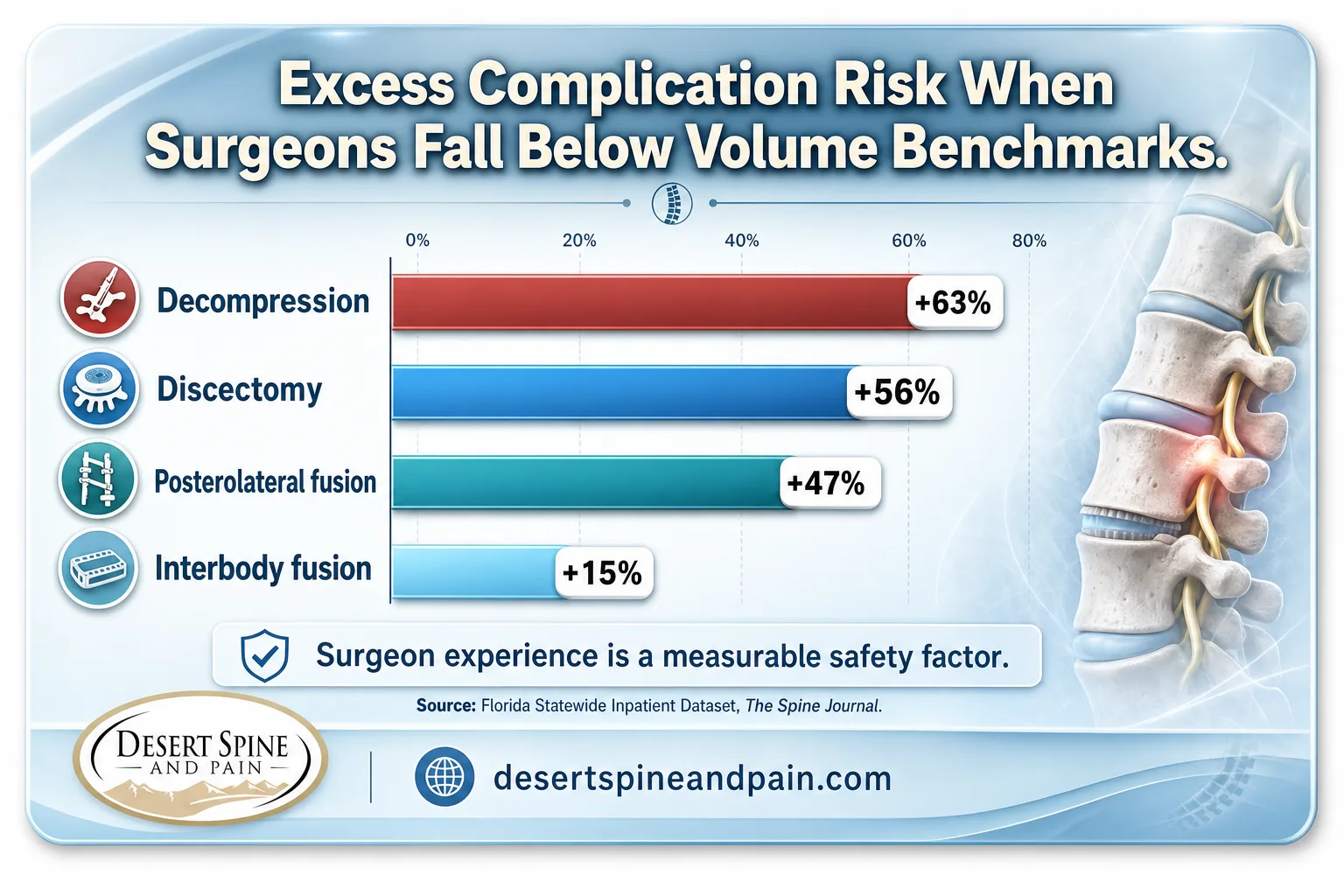
When falling below a volume benchmark raises decompression complication risk by 63 percent, surgeon experience stops being a soft preference and becomes a quantifiable safety variable, on par with a patient's own health factors. Dr. Greenwald's dual training as a spine surgeon and neurosurgeon, combined with extensive surgical experience, directly addresses the single most modifiable risk factor the literature identifies. Interpretation original to Desert Spine and Pain.
Source: Volume-outcome benchmarks, The Spine Journal | Surgeon volume systematic review, European Spine Journal
5What Lowers Complication Risk
The encouraging message from the complications literature is that much of the risk is modifiable. Several factors, most identifiable before surgery, meaningfully shift the odds.
| Factor | Effect on Complication Risk | Source |
|---|---|---|
| Higher surgeon volume | Lower (up to 63% difference) | Spine Journal / ESJ |
| Minimally invasive approach | Lower for suitable cases | e-Neurospine review |
| Avoiding unnecessary revision | Lower dural tear / infection | IJSS meta-analysis |
| Accurate diagnosis / selection | Lower failed surgery risk | FBSS literature |
| Optimizing health (smoking, diabetes) | Lower infection / healing risk | Fusion outcome literature |
| Multidisciplinary surgical team | Lower perioperative risk | Spine team volume study |
The common thread is preparation and expertise. A correct diagnosis, an experienced high-volume surgeon, a suitable minimally invasive approach, and attention to modifiable health factors together account for much of the difference between a smooth recovery and a complication. None of these is left to chance in a well-run practice.
Desert Spine and Pain works with out-of-network patients of every kind and partners closely with personal injury attorneys, offering 24/7 concierge response and documentation coordination for injured clients whose outcomes depend on careful, complication-conscious surgical care.
See conservative care options firstSource: Surgeon volume dose-response meta-analysis, PMC
Summary Table: Complications Statistics 2026
| Statistic | Figure | Source | Year |
|---|---|---|---|
| Overall complication rate | 1 to 8.6% | Johns Hopkins / Global Spine J | 2024 |
| Spinal fusion mortality | 0.13 to 0.2% | Int'l J Spine Surgery | 2018 |
| Lumbar fusion reoperation rate | 13.9% | American Spine Registry | 2026 |
| Lumbar fusion revision rate | 7.6% | American Spine Registry | 2026 |
| Dural tear, primary lumbar | 3 to 5% | IJSS | 2025 |
| Dural tear, revision lumbar | 7 to 17% | IJSS | 2025 |
| Dural tear, endoscopic MISS (large series) | 1.07% | AME Surgical Journal | 2025 |
| Dural tear in 13,188-patient study | 3.4% | PMC multicenter study | 2019 |
| SSI odds with dural tear | OR 2.68 | PMC multicenter study | 2019 |
| Neurological deficit odds with dural tear | OR 3.27 | PMC multicenter study | 2019 |
| Neural injury, thoracic MISS | 0 to 14.3% | Thoracic MISS review | 2025 |
| Excess complication risk, decompression (low volume) | +63% | Spine Journal (Florida data) | 2018 |
| Excess complication risk, discectomy (low volume) | +56% | Spine Journal (Florida data) | 2018 |
| Excess complication risk, posterolateral fusion (low volume) | +47% | Spine Journal (Florida data) | 2018 |
| Excess complication risk, interbody fusion (low volume) | +15% | Spine Journal (Florida data) | 2018 |
Frequently Asked Questions
What is the overall complication rate for spinal surgery?
How common are dural tears in spine surgery?
Does surgeon experience affect spine surgery complication rates?
What are the most common complications after spine surgery?
How can I lower my risk of spine surgery complications?
Methodology & Sources
How we compiled these statistics
Every figure traces to a Tier 1 primary source: national registries, government-linked databases, and peer-reviewed journals including systematic reviews and meta-analyses. Complication rates vary by procedure, patient health, and definition, so we present ranges and attribute each figure. Odds ratios describe associations after statistical adjustment and are not the same as absolute risk. All statistics describe populations, not any individual patient.
Primary sources referenced:
- American Spine Registry (AANS/AAOS) 2026 Annual Report, via Becker's Spine Review
- Lown Institute Hospitals Index, Unnecessary Back Surgery (complication and mortality ranges)
- Dural tear and perioperative complications multicenter study (13,188 patients), PMC
- Incidental durotomy and infection systematic review and meta-analysis, International Journal of Spine Surgery, 2025
- Complications in minimally invasive spine surgery, e-Neurospine PRISMA review, 2024
- Complications in thoracic minimally invasive spine surgery systematic review, PMC, 2025
- Volume-outcome benchmarks for lumbar spine procedures, The Spine Journal (Florida Statewide Inpatient Dataset)
- Surgeon volume and outcomes systematic review, European Spine Journal, and dose-response meta-analysis, PMC
This article is educational and is not individual medical advice. For guidance specific to your spine condition, consult a qualified spine surgeon. No outcome can be guaranteed.
Journalists and researchers may cite these statistics with attribution to Desert Spine and Pain and a link to this page. Please attribute the underlying figures to their original Tier 1 sources as listed above. For expert commentary on spine surgery complications from a board-certified neurosurgeon and spine surgeon, contact Desert Spine and Pain at (602) 566-9500.