
Spinal Implant Statistics (2026): Fusion Rates, Screw Loosening, and Cage Materials
Spinal implants, the cages, screws, and rods that stabilize a fusion, achieve high success, with fusion rates commonly above 90 percent. But the statistics reveal a crucial truth: implant material and design matter less than the patient's bone quality, which is the single biggest factor in whether screws hold and cages stay put.
- Modern interbody cages achieve fusion rates commonly between 85 and over 95 percent.
- Cage subsidence occurs in about 15 to 34 percent of lumbar interbody fusions, screw loosening in about 7 to 25 percent, many mild.
- In the lumbar spine, titanium cages had significantly lower subsidence and revision than PEEK; in the cervical spine there was no difference.
- Low bone density (L1 Hounsfield unit under 117) raised the risk of loosening or subsidence about four-fold.
- 3D-printed titanium cages achieved fusion rates around 89 to 91 percent with low collapse rates.
- Implant osteolysis is uncommon, about 5.9 percent for titanium versus 7.7 percent for non-titanium in pooled data.
- Bone quality, not brand, is the decisive factor, making preoperative assessment essential.
What's in This Guide
1What Spinal Implants Are
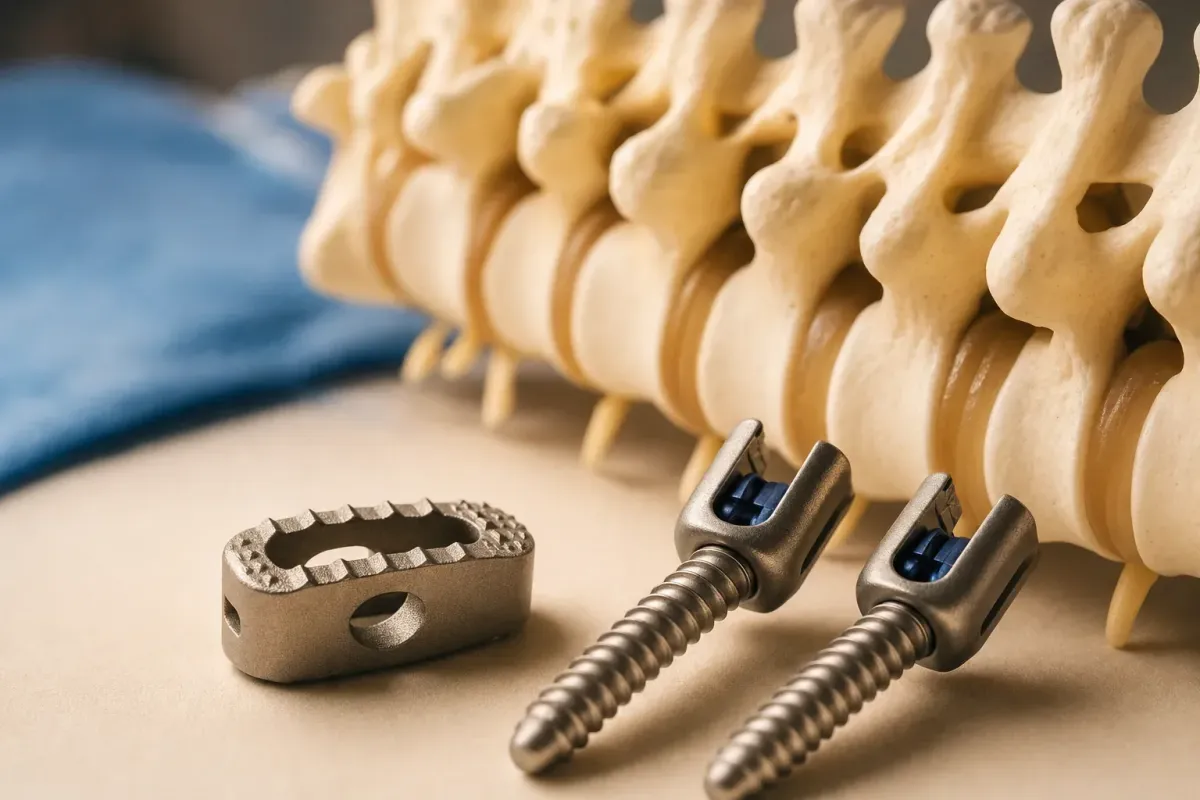
Spinal implants are the hardware that stabilizes the spine during a fusion. The main components are interbody cages (spacers placed between vertebrae to restore height and hold bone graft), pedicle screws and rods (which lock the segment in place), and plates. Their job is to hold everything steady while a solid bony fusion forms.
Implants do not create the fusion themselves; the body does that by growing new bone. The implants only provide a stable scaffold during the months it takes for that bone to solidify. Understanding this explains why the two things that most determine success are the stability of the fixation and the patient's ability to grow bone, which comes down to bone quality.
Our Phoenix practice, led by board-certified neurosurgeon and spine surgeon Dr. David L. Greenwald, MD, FACS, selects implants and technique to match each patient's anatomy and bone health.
Explore spinal fusion in PhoenixSource: 3D-printed interbody cage cohort study, PMC
2Fusion Rates and Implant Success
The primary measure of a spinal implant's success is whether it achieves a solid fusion. Modern cages perform well across materials and designs.
Across studies, modern interbody cages achieve fusion in the high-80s to mid-90s percent range, with collapse and displacement uncommon. Newer 3D-printed porous titanium cages are designed to encourage bone growth directly into the implant surface, and they have shown excellent one-year fusion rates. The differences between good implants are real but modest, which is why other factors carry so much weight.
Learn about lumbar fusionSource: 3D-printed titanium cages for lumbar fusion, PMC
3Screw Loosening and Cage Subsidence
The two most common implant complications are screw loosening and cage subsidence (the cage sinking into the vertebra). Their reported rates are higher than many patients expect, though most cases are mild.
Implant Complication Rates in Lumbar Interbody Fusion
Reported ranges across TLIF studies; many cases are mild and asymptomatic. Source: MI-TLIF Hounsfield unit study.
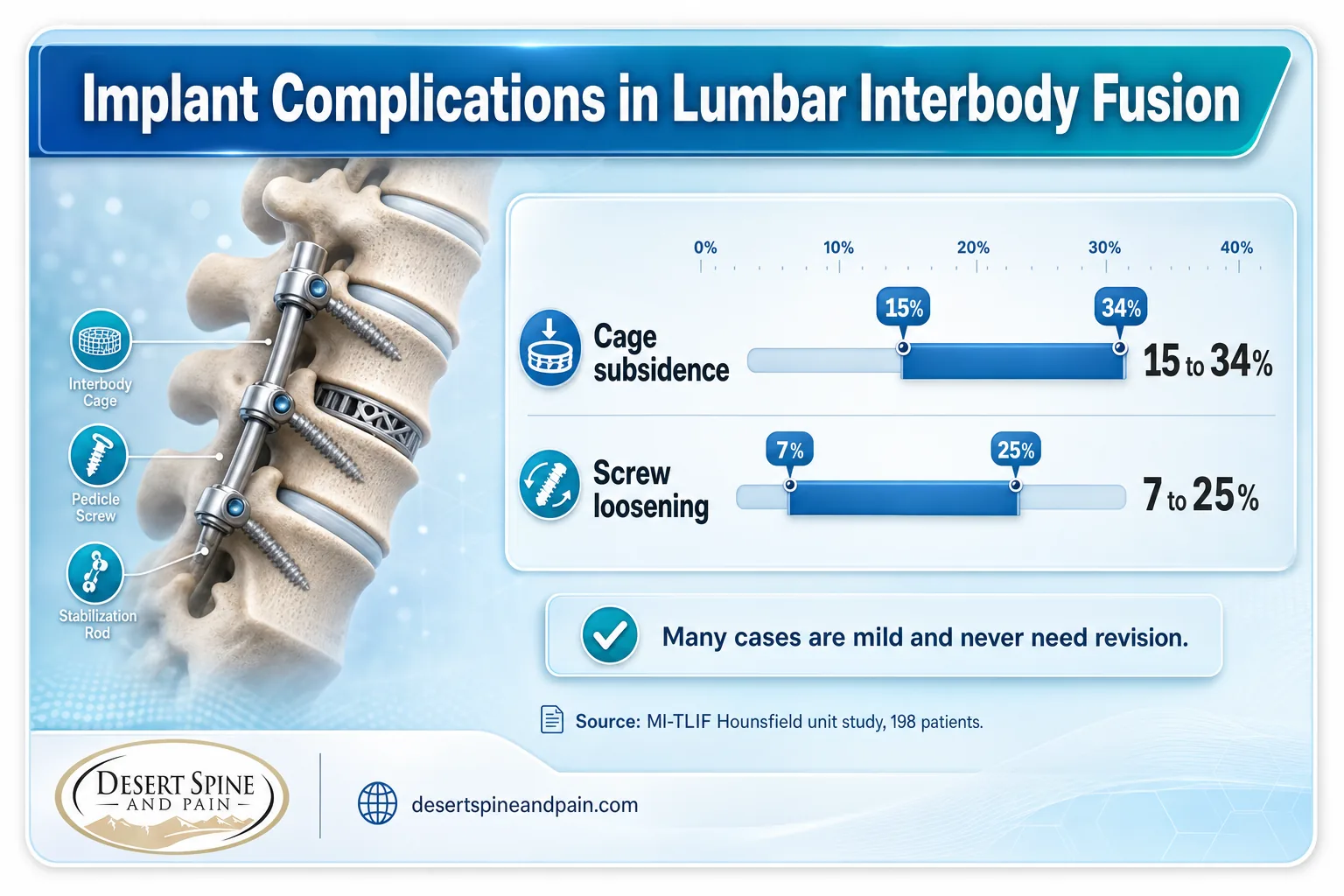
These numbers sound high, but context matters: a large share of loosening and subsidence is detected only on imaging and never causes symptoms or needs revision. When these complications do cause problems, they can lead to non-union, recurrent back or leg pain, and reoperation. The key question is not whether some settling occurs, but whether it is enough to threaten the fusion, and that is heavily influenced by bone quality.
Meet Dr. GreenwaldSource: CT Hounsfield unit predicts screw loosening and cage subsidence, PMC
4Titanium vs PEEK Cages
The choice between titanium and PEEK (a strong polymer) cage materials is one of the longest-running debates in spine surgery, and a recent meta-analysis brought useful clarity.
The evidence gives a nuanced answer: in the lumbar spine, titanium cages tend to have lower subsidence and revision, while in the cervical spine the two materials perform comparably. PEEK offers radiolucency (it does not obscure imaging), while titanium offers strength and bone integration but can create imaging artifacts. Neither is universally best, which is why material choice is matched to the level, the patient, and the goal.
Compare implant-based optionsSource: Titanium versus PEEK cages meta-analysis, ScienceDirect
5Why Bone Quality Decides Everything
The most important spinal implant statistic is not about any implant at all. It is about the bone the implant anchors into. Poor bone quality is the dominant driver of implant failure.
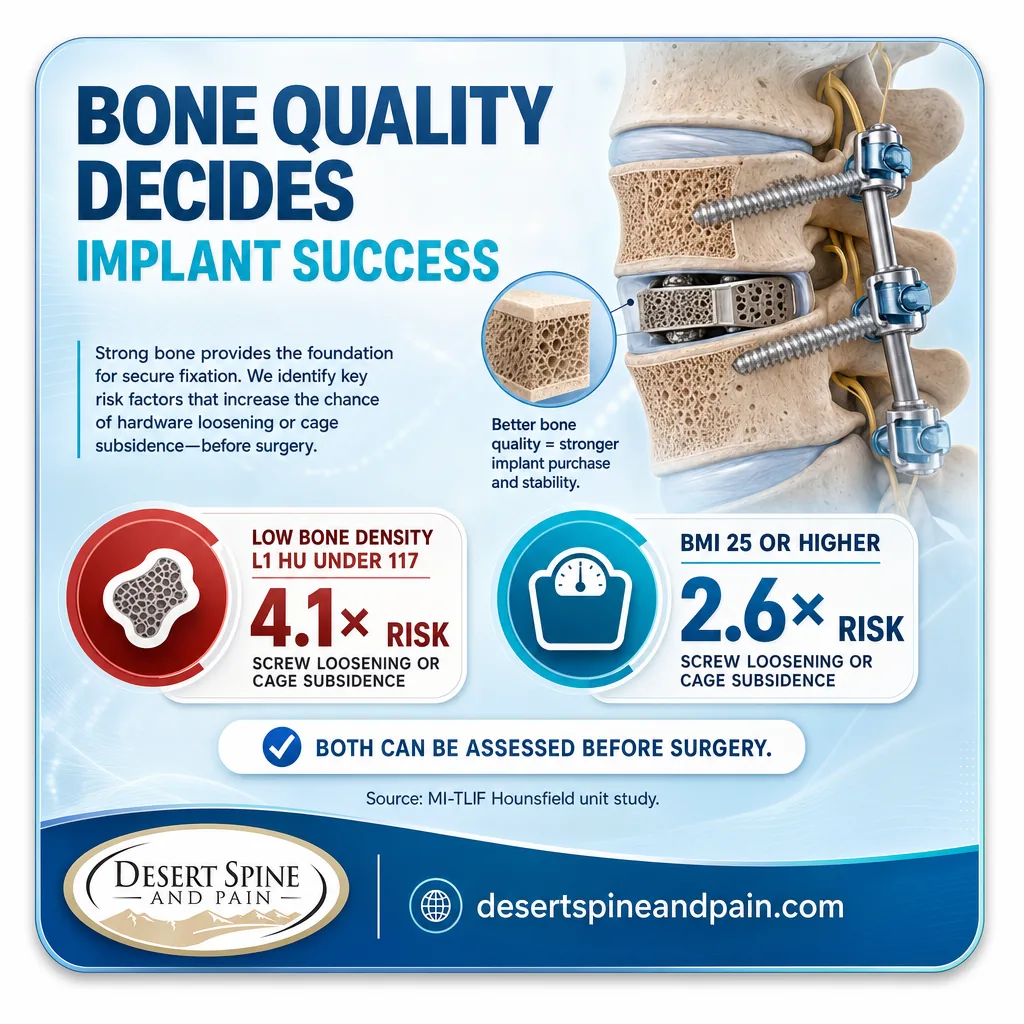
The spinal implant data delivers a counterintuitive lesson: the choice of cage or screw brand matters far less than the quality of the bone it anchors into. A low CT bone density raises implant failure risk about four-fold, dwarfing the differences between titanium and PEEK. That is why a careful surgeon assesses bone quality before operating, using tools like CT Hounsfield units, and optimizes it when possible. Choosing the right implant is important, but ensuring the bone can hold it is what truly protects the fusion. Interpretation original to Desert Spine and Pain.
Much of implant failure is predictable and, in part, preventable. Low bone density and higher body mass index sharply raise the risk of screw loosening and cage subsidence, and both can be identified before surgery. A surgeon who checks bone quality, plans fixation accordingly, and addresses osteoporosis where possible protects the fusion far more than any single implant choice can. This preoperative diligence is a hallmark of careful, experienced spine care.
Desert Spine and Pain works with out-of-network patients of every kind and partners closely with personal injury attorneys, offering 24/7 concierge response and documentation coordination for injured clients considering fusion surgery.
Book a consultation: (602) 566-9500Source: Bone density and implant failure risk factors, PMC
Summary Table: Spinal Implant Statistics 2026
| Statistic | Figure | Source | Year |
|---|---|---|---|
| PEEK cage fusion rate (ALIF/LLIF) | 85 to 96.6% | 3D-printed titanium cage study | 2025 |
| 3D titanium vs PEEK fusion (posterior) | 89 to 91% | 3D-printed cage cohort | 2024 |
| Cage collapse (PEEK vs 3D titanium) | 4.5 to 6.5% | 3D-printed cage cohort | 2024 |
| Cage subsidence range (lumbar IF) | 15 to 34% | MI-TLIF Hounsfield study | 2023 |
| Screw loosening range (lumbar IF) | 7 to 25% | MI-TLIF Hounsfield study | 2023 |
| Cage subsidence (198-patient study) | 16.2% | MI-TLIF Hounsfield study | 2023 |
| Screw loosening (198-patient study) | 24.7% | MI-TLIF Hounsfield study | 2023 |
| Lumbar subsidence/revision, Ti vs PEEK | Lower with titanium | Ti vs PEEK meta-analysis | 2024 |
| Cervical Ti vs PEEK difference | None significant | Ti vs PEEK meta-analysis | 2024 |
| Osteolysis, titanium vs non-titanium | 5.9% vs 7.7% | FDA material performance study | 2023 |
| Loosening/subsidence risk, low bone density | 4.1x higher | MI-TLIF Hounsfield study | 2023 |
| Loosening/subsidence risk, BMI ≥ 25 | 2.6x higher | MI-TLIF Hounsfield study | 2023 |
Frequently Asked Questions
How often do spinal implants fail?
Are titanium or PEEK spinal cages better?
What causes spinal implants to loosen?
How long do spinal implants last?
Do spinal implants set off metal detectors?
Methodology & Sources
How we compiled these statistics
Every figure traces to a Tier 1 primary source: meta-analyses, national and cohort studies, and an FDA material performance review. Fusion, subsidence, and loosening figures reflect differences in region, cage material, technique, and crucially patient bone quality. Many radiographic complications are mild and do not require revision. All statistics describe populations, not any individual patient.
Primary sources referenced:
- Titanium versus polyetheretherketone cages in interbody fusions: meta-analysis of clinical and radiographic outcomes, ScienceDirect
- CT Hounsfield unit as a predictor of screw loosening and cage subsidence in MI-TLIF (198 patients), PMC
- 3D-printed titanium cages for anterior and lateral lumbar interbody fusion, PMC
- Postoperative clinical effects of 3D-printed interbody fusion cages in posterior lumbar fusion, PMC
- Medical device material performance study: titanium safety profile, U.S. Food and Drug Administration
This article is educational and is not individual medical advice. For guidance specific to your spine condition and implant options, consult a qualified spine surgeon. No outcome can be guaranteed.
Journalists and researchers may cite these statistics with attribution to Desert Spine and Pain and a link to this page. Please attribute the underlying figures to their original Tier 1 sources as listed above. For expert commentary on spinal implant data from a board-certified neurosurgeon and spine surgeon, contact Desert Spine and Pain at (602) 566-9500.