
Spinal Fusion Success Rate Statistics (2026): Fusion Rates by Technique and Outcome
Spinal fusion succeeds at joining bone in the great majority of cases: modern techniques commonly exceed 90 percent radiographic fusion, rising to 94 percent or more with anterior plating or bone morphogenetic protein. But a solid fusion and a satisfied patient are separate outcomes, and the gap between them is where surgical judgment earns its value.
- In a direct comparison, 1-year fusion rates were 90 percent for OLIF, 85 percent for TLIF, and 80 percent for PLIF; contemporary TLIF commonly exceeds 90 percent.
- Stand-alone anterior fusion (ALIF) averaged 88.2 percent across 55 studies and 5,517 patients, rising to 94.2 percent with an anterior fixation plate.
- Fusion rate reached about 94.4 percent when recombinant bone morphogenetic protein (rhBMP-2) was used.
- Large reviews find broadly equivalent pain and function outcomes across ALIF, PLIF, and TLIF, so technique is matched to anatomy rather than chosen to chase a number.
- Pooled clinical spinal fusion success is around 90 percent with a 71.1 percent satisfaction rate and a 3.9 percent reoperation rate.
- Surgeon technical skill and experience are identified as critical determinants of fusion success in the systematic-review literature.
- A solid radiographic fusion does not guarantee pain relief, which is why diagnosis and patient selection matter as much as the operation.
What's in This Guide
1The Two Numbers Behind "Fusion Success"
When a spine surgeon quotes a fusion "success rate," they could mean one of two very different things. Radiographic fusion is whether the vertebrae actually knit into solid bone, confirmed on imaging. Clinical success is whether the patient's pain and function improved. Both are legitimate measures, and confusing them is the most common source of misleading statistics.
A recent CT-mapped study of TLIF for degenerative spondylolisthesis found high facet and interbody fusion rates yet only limited correlation between how much fused and how much disability improved. In plain terms, the bones fusing is important, but it does not by itself explain who feels better.
Our Phoenix practice, led by board-certified neurosurgeon and spine surgeon Dr. David L. Greenwald, MD, FACS, plans fusions around both goals: a durable construct and a patient who was the right candidate in the first place.
Explore spinal fusion options in PhoenixSource: CT-mapped TLIF fusion study, PMC
2Fusion Rates by Technique
Different fusion approaches reach the spine from different directions, and their radiographic fusion rates vary somewhat. A comparative study of the main lumbar interbody techniques gives a clean head-to-head at one year.
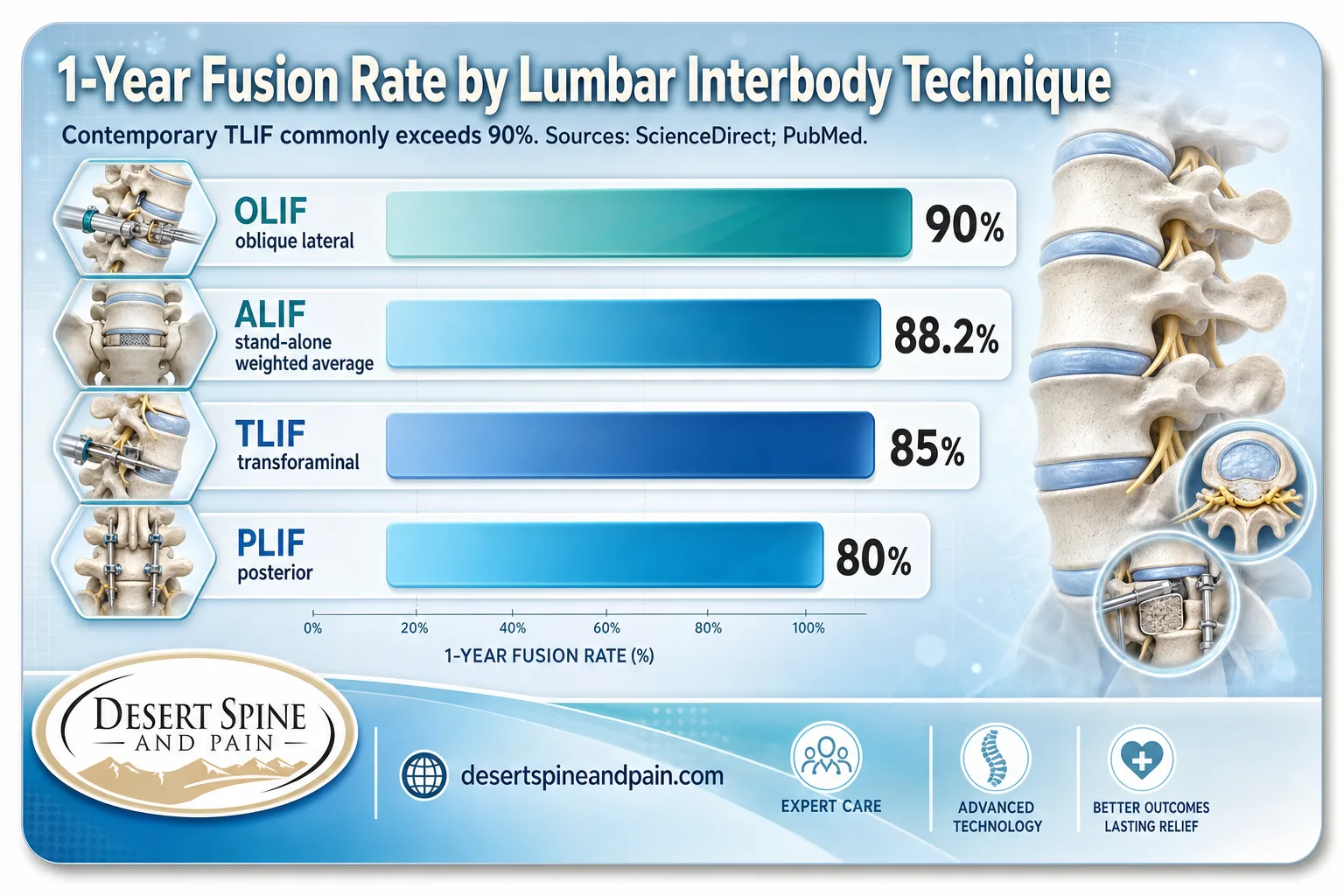
Two things stand out. First, the ranges are wide, that ALIF range of 16.6 to 100 percent shows how much study design and patient factors affect the number. Second, most rigorous reviews conclude the techniques deliver broadly equivalent pain and function outcomes, so the "best" technique is the one that fits a given patient's anatomy and pathology. Dr. Greenwald performs the full range, including minimally invasive interbody fusion techniques such as XLIF, TLIF, and ILIF.
Source: Fusion rate factors systematic review, ScienceDirect 2025 | Stand-alone ALIF fusion rate review, PubMed
3Graft, Implant, and Instrumentation Effects
Beyond the surgical approach, what goes into the fusion, the graft material, biologics, cage, and hardware, measurably shifts the fusion rate. This is one of the clearest examples of how surgical choices, not luck, determine outcomes.
Cage material also matters. Network meta-analyses have compared PEEK, titanium, and 3D-printed implants on fusion rate, and the field continues to refine which combinations work best for which patients. The practical takeaway is that fusion success is engineered, through approach, biologics, and instrumentation, not merely hoped for.
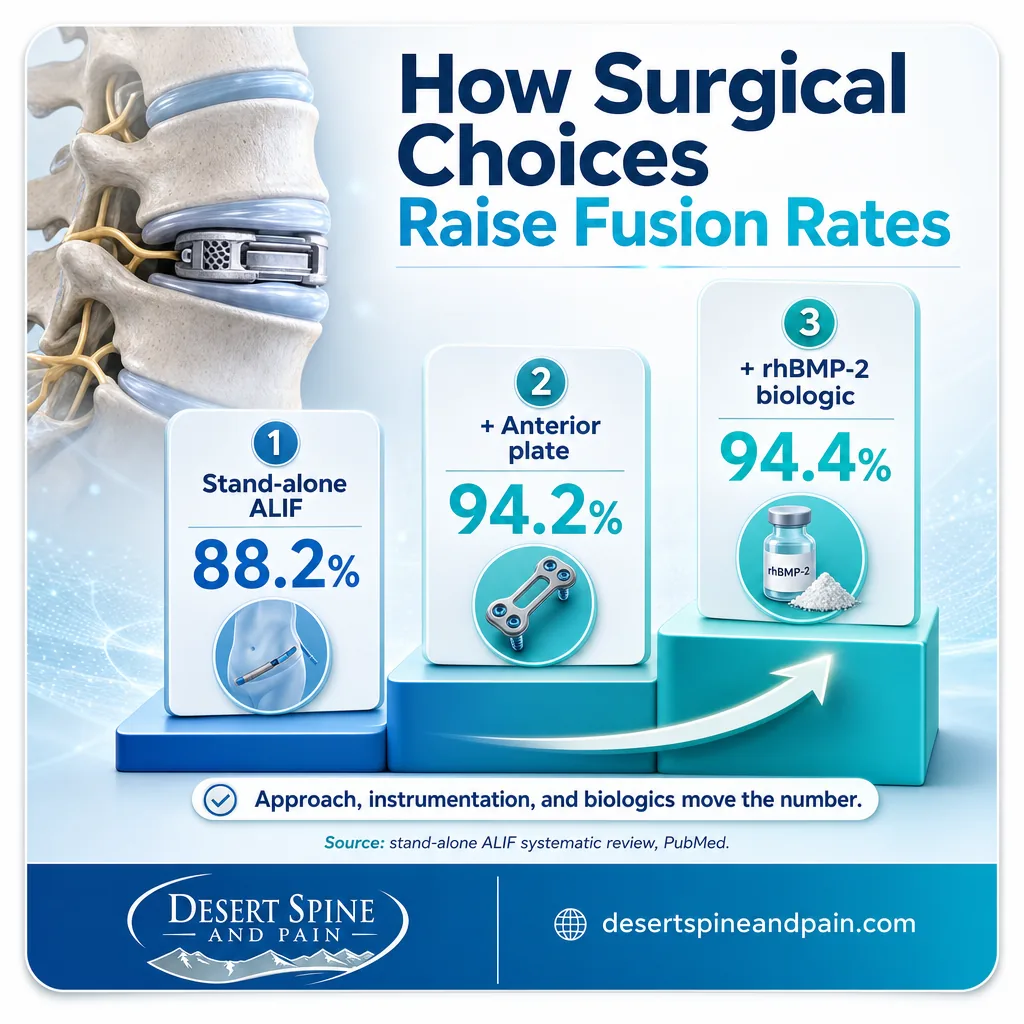
Layering the technique data (OLIF 90 percent, TLIF 85 percent, PLIF 80 percent) with the implant data (anterior plate 94.2 percent, rhBMP-2 94.4 percent) shows that surgical decisions can move the fusion rate by 10 to 15 percentage points for otherwise similar patients. That spread is not random, it reflects approach, biologics, instrumentation, and surgeon skill. It is the strongest argument for choosing an experienced surgeon who tailors the construct to the case. Calculation and interpretation original to Desert Spine and Pain.
Source: Stand-alone ALIF fusion rate review, PubMed | TLIF cage material meta-analysis, PMC
4Clinical Success and Satisfaction
A high fusion rate is only worth pursuing if patients actually feel and function better. Here the pooled data is strong, with the important caveat that clinical success is defined differently across studies.
The enormous 16 to 95 percent satisfaction range from a 2025 systematic review is not a sign that fusion is unreliable. It reflects that some studies measure imaging, others symptom relief, and others patient-reported satisfaction. When you compare like with like, modern fusion delivers strong and consistent results for well-selected patients. Comparative national database work also examined reoperation at 90 days, 1 year, and 2 years across anterior and posterior approaches, reinforcing that outcomes are broadly comparable when patients are matched.
Not necessarily. Imaging can confirm a perfect fusion while a patient still hurts, especially if the original pain generator was misidentified or if pain has multiple sources. This is precisely why diagnosis comes before technique. A flawless fusion at the wrong level solves nothing. Getting the diagnosis right is the single most important predictor of a good clinical result.
Source: Journal of Neurosurgery: Spine, 2025 | Anterior vs posterior fusion database analysis, PMC
5What Raises and Lowers Fusion Success
The research identifies consistent factors that push fusion success up or down. Encouragingly, many are visible before surgery and can be addressed.
| Factor | Effect on Fusion Success | Source |
|---|---|---|
| Surgeon skill and experience | Critical determinant (higher) | Fusion rate systematic review |
| Anterior approach / interbody cage | Higher | Cervical claims study |
| Anterior plate fixation (ALIF) | 94.2% vs 88.2% | ALIF review |
| rhBMP-2 biologic | ~94.4% | ALIF review |
| Smoking | Lower (trend) | ALIF review |
| Workers' compensation status | Lower (trend) | ALIF review |
| Occipitocervical involvement | Higher pseudarthrosis | Pediatric cervical study |
| Lack of instrumentation | Higher pseudarthrosis | Pediatric cervical study |
The single most striking entry is the first one. A fusion-rate systematic review states plainly that a surgeon's technical skill and experience directly influence implant positioning and stability, which are critical determinants of fusion success, and that inadequate proficiency is associated with reduced fusion rates. For patients, that is a clear signal to prioritize surgical expertise.
This is where Dr. Greenwald's dual training as a spine surgeon and neurosurgeon, combined with a least-invasive-first philosophy, directly serves the outcome. Desert Spine and Pain also partners with personal injury attorneys, providing 24/7 concierge response and documentation support for injured clients whose recovery depends on getting the fusion right the first time.
See conservative care options firstSource: Fusion rate factors systematic review, ScienceDirect 2025 | Cervical fusion pseudarthrosis study, PubMed
Summary Table: Fusion Success Statistics 2026
| Statistic | Figure | Source | Year |
|---|---|---|---|
| OLIF 1-year fusion rate | 90% | Comparative study via ScienceDirect | 2025 |
| TLIF 1-year fusion rate | 85% | Comparative study via ScienceDirect | 2025 |
| PLIF 1-year fusion rate | 80% | Comparative study via ScienceDirect | 2025 |
| Contemporary TLIF fusion rate | >90% | PMC TLIF cohorts | 2025 |
| Stand-alone ALIF fusion (weighted avg) | 88.2% | PubMed ALIF review | 2019 |
| ALIF with anterior plate | 94.2% | PubMed ALIF review | 2019 |
| Fusion with rhBMP-2 | 94.4% | PubMed ALIF review | 2019 |
| Zero-profile interbody implants (ALIF) | 89.2% | PubMed ALIF review | 2019 |
| PLIF interbody fusion (single-segment) | 98.65% | PMC PLIF vs M-TLIF | 2024 |
| Modified TLIF interbody fusion | 97.30% | PMC PLIF vs M-TLIF | 2024 |
| OLIF single-position fusion rate | 96.8% | PMC O-arm navigated study | 2021 |
| Pooled clinical fusion success | ~90% | Peer-reviewed compilation | 2026 |
| Pooled fusion satisfaction | 71.1% | Peer-reviewed compilation | 2026 |
| Fusion reoperation rate | 3.9% | Peer-reviewed compilation | 2026 |
| Fusion satisfaction range (definition-driven) | 16 to 95% | JNS Spine systematic review | 2025 |
| Fusion mortality | 0.105 to 0.321% | Peer-reviewed compilation | 2026 |
Frequently Asked Questions
What is the success rate of spinal fusion?
Which spinal fusion technique has the highest fusion rate?
Does bone graft type affect fusion success?
What factors lower spinal fusion success?
Does a solid fusion guarantee pain relief?
Methodology & Sources
How we compiled these statistics
Every figure traces to a Tier 1 primary source: peer-reviewed systematic reviews, meta-analyses, national database analyses, and registries. Radiographic fusion rates and clinical outcomes are reported separately because they measure different things. Ranges reflect differences in study design, patient factors, and success definitions rather than a difference in the value of fusion for well-selected patients. All figures describe populations, not any individual.
Primary sources referenced:
- Analysis of Factors Influencing the Fusion Rate in Lumbar Interbody Fusion, systematic review, ScienceDirect, 2025
- The rate of fusion for stand-alone anterior lumbar interbody fusion, systematic review, PubMed
- PLIF vs modified TLIF single-segment comparison, PMC, 2024
- CT-mapped fusion patterns after 360-degree TLIF, PMC
- Anterior vs posterior lumbar interbody fusion national database analysis (PearlDiver), PMC
- TLIF cage material network meta-analysis, PMC
- Journal of Neurosurgery: Spine systematic review on defining fusion success, 2025
- Cervical fusion pseudarthrosis studies, PubMed and ScienceDirect
- Peer-reviewed success-rate literature compiled with citations by Spine Together, 2026
This article is educational and is not individual medical advice. For guidance specific to your spine condition, consult a qualified spine surgeon. No outcome can be guaranteed.
Journalists and researchers may cite these statistics with attribution to Desert Spine and Pain and a link to this page. Please attribute the underlying figures to their original Tier 1 sources as listed above. For expert commentary on spinal fusion outcomes from a board-certified neurosurgeon and spine surgeon, contact Desert Spine and Pain at (602) 566-9500.