
Spinal Fusion Statistics (2026): Volume, Fusion Rates, Costs, and Outcomes
Spinal fusion is one of the most common major spine operations in the United States, with roughly 1.36 million performed in 2021 by one analysis and rising. Radiographic fusion rates now exceed 90 percent with modern technique, yet outcomes still depend on precise patient selection, since fused bone and a satisfied patient are not always the same result.
- One analysis of procedure codes estimated roughly 1.36 million spinal fusions in the U.S. in 2021, with volume rising; the American Spine Registry's 2026 report captured 312,477 lumbar cases over 2015 to 2024.
- Interbody fusion (TLIF/PLIF) was the most common lumbar procedure group at 32.54 percent in the ASR 2026 report.
- Pseudarthrosis (failed fusion) after cervical fusion was 2.0 percent at 1 year and 3.3 percent at 2 years in a 45,584-patient national claims analysis.
- Pooled spinal fusion success is around 90 percent with a 71.1 percent satisfaction rate and a 3.9 percent reoperation rate.
- Adjacent segment disease prevalence ranges from about 5.2 to 16.5 percent at 5 years and 10.6 to 36.1 percent at 10 years.
- 2023 inpatient fusion costs ranged from about $33,610 for a 1-level fusion to $55,034 for a multilevel anterior-posterior fusion.
- Anterior approaches, interbody cages, and instrumentation are associated with lower pseudarthrosis risk, underscoring the value of surgical technique and judgment.
What's in This Guide
1How Many Spinal Fusions Are Performed
Spinal fusion joins two or more vertebrae so they heal into a single solid unit, and it is among the highest-volume major spine procedures in the country. As with all spine surgery, the exact annual count depends on how procedures are tallied, because a single fusion can generate several separately coded steps.
Fusion volume has grown substantially over the past two decades alongside an aging population and broader surgical indications. That growth makes careful case selection more important, not less, because higher volume raises the stakes of operating on patients who might do just as well without surgery.
Our Phoenix practice, led by board-certified neurosurgeon and spine surgeon Dr. David L. Greenwald, MD, FACS, reserves fusion for cases of genuine instability, deformity, or decompression that requires stabilization, and always weighs less invasive options first.
Explore spinal fusion options in PhoenixSource: iData Research | American Spine Registry 2026 via Becker's
2Types of Spinal Fusion and Their Share
"Spinal fusion" covers a family of techniques that differ by where the spine is accessed and how the vertebrae are joined. The American Spine Registry 2026 report gives a clean breakdown of the lumbar procedure mix.
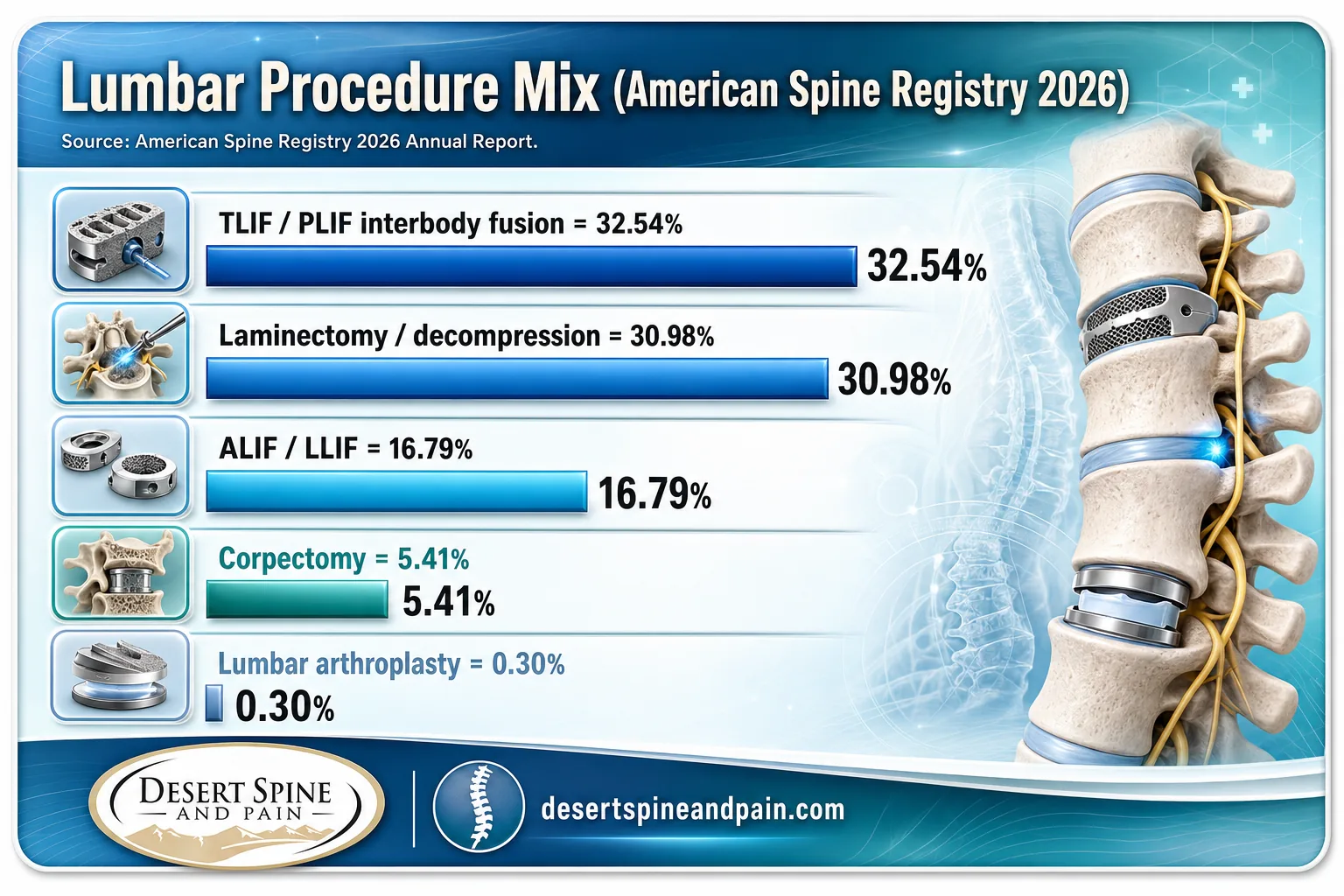
Dr. Greenwald performs the full range of these approaches, including minimally invasive interbody techniques such as XLIF, TLIF, and ILIF. Choosing among them is a technical decision matched to the patient's anatomy and diagnosis, which is where a surgeon trained in both spine surgery and neurosurgery adds real value. Patients can learn more about our minimally invasive fusion techniques.
Source: American Spine Registry 2026 via Becker's | World Neurosurgery, 2025
3Fusion Rates and Pseudarthrosis
The most fundamental question about a fusion is whether the bones actually fuse. When they do not, the result is pseudarthrosis, a failed union that can cause ongoing pain and sometimes requires revision surgery.
The national claims data offers an important nuance: modern surgical choices meaningfully lower the risk. The study found that an anterior cervical approach, use of an interbody cage, and multilevel anterior instrumentation were each associated with a decreased risk of pseudarthrosis, while factors like substance use history and prior spinal pain raised it.
The data says otherwise. Failed fusion rates vary enormously, from near 0 percent to over 60 percent in the broader literature, depending on approach, number of levels, graft choice, instrumentation, and patient factors. Many of those variables are decisions made by the surgeon. Technique and case selection are not incidental to fusion success, they are central to it, which is why who performs the operation matters.
Source: Cervical pseudarthrosis national claims study, ScienceDirect
4Success, Satisfaction, and Reoperation
Beyond whether the bone fuses, patients care whether they feel better. Here the picture is strong but not uniform, and the gap between clinical improvement and satisfaction is one of the most studied topics in spine surgery.
A 2025 systematic review reported that fusion satisfaction has been documented anywhere from 16 to 95 percent across studies, with an average successful outcome near 68 percent, largely because studies define success differently. The lesson for patients is to ask which definition a quoted success rate uses, radiographic fusion, symptom relief, or satisfaction, since they are not interchangeable.
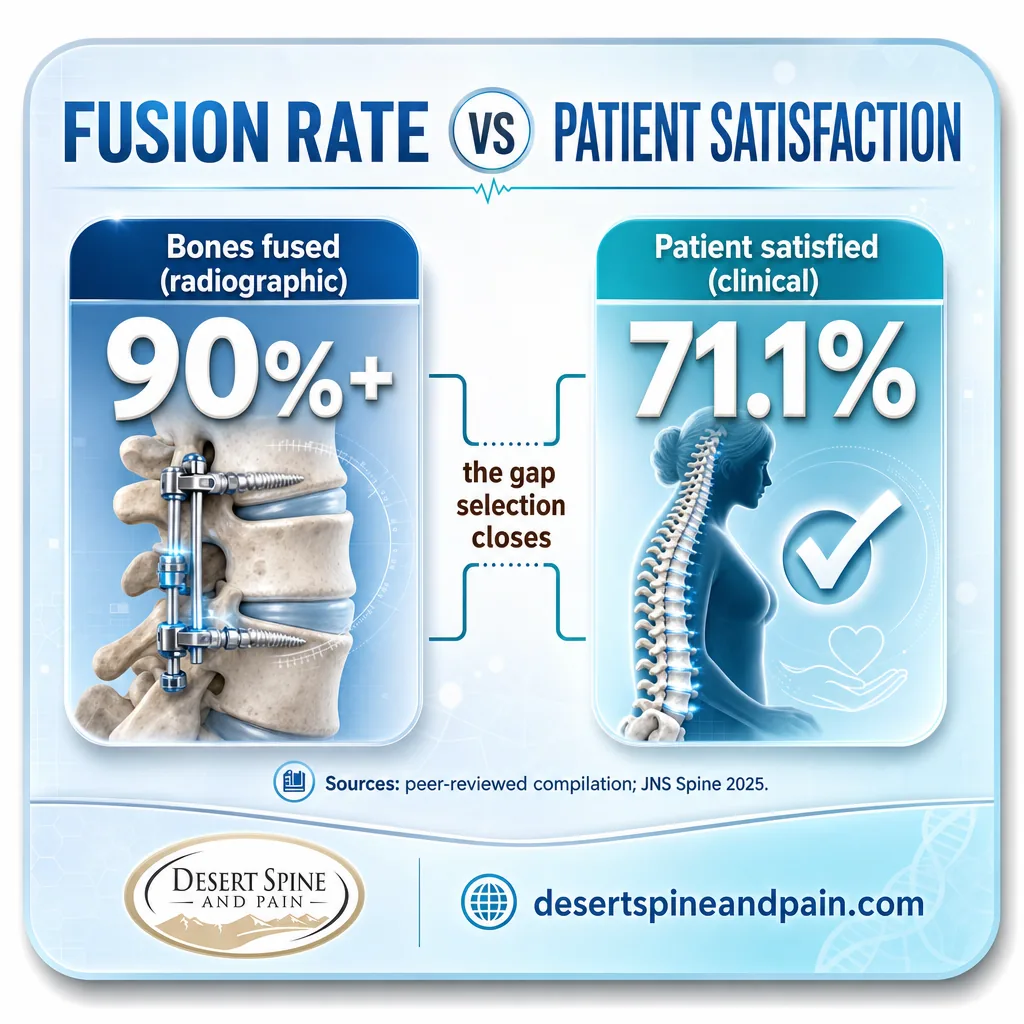
Combining the radiographic fusion rate (often above 90 percent with modern instrumentation) with the pooled clinical satisfaction rate (71.1 percent) reveals a roughly 20-point gap between "the bones fused" and "the patient is satisfied." This gap is the single most important thing a fusion candidate should understand: a technically perfect fusion can still leave a poorly selected patient dissatisfied. Selection and diagnosis close that gap. Calculation and interpretation original to Desert Spine and Pain.
Source: Spine Together (peer-reviewed compilation) | Journal of Neurosurgery: Spine, 2025
5Adjacent Segment Disease
Because fusion eliminates motion at the treated level, the segments above and below can absorb extra stress over time. When that leads to symptomatic degeneration, it is called adjacent segment disease, and it is one of the more important long-term considerations in fusion planning.
Two practical points emerge from the research. First, adjacent segment disease is partly driven by the natural progression of degeneration and partly by the biomechanics of fusion, so risk is not fully avoidable. Second, technique matters: studies link fusion method and sagittal alignment to adjacent segment disease risk, and motion-preserving alternatives may reduce it in appropriate candidates.
This is one reason our practice evaluates motion-preservation options such as disc replacement where they fit, rather than defaulting every case to fusion.
Source: Adjacent segment degeneration meta-analysis, PMC | MIS-TLIF adjacent segment study, PMC
6The Cost of Spinal Fusion
Fusion is a significant investment of both healthcare resources and patient recovery time. National cost data helps patients and, in personal injury cases, attorneys understand the financial scale of these procedures.
| Lumbar Fusion Type (2023 inpatient) | Mean Adjusted Cost | Source |
|---|---|---|
| 1-level single-column fusion | $33,610 | NIS via PMC |
| 1-level anterior-posterior fusion | $36,071 | NIS via PMC |
| Multilevel single-column fusion | $48,931 | NIS via PMC |
| Multilevel anterior-posterior fusion | $55,034 | NIS via PMC |
| Cervical ASD revision (average direct) | $27,702 | PMC economic study |
These are facility cost estimates from national inpatient data, not charges, negotiated insurance rates, or patient out-of-pocket amounts, which vary widely. For personal injury attorneys coordinating care for injured clients, these figures illustrate why accurate documentation and a surgeon who operates only when indicated protect both the patient and the case.
Desert Spine and Pain works with out-of-network patients of every kind and partners closely with personal injury attorneys, offering 24/7 concierge response and coordination of documentation for their clients and their operations.
See conservative care options firstSource: Cost and Utilization Trends of Lumbar Fusion, PMC | Economic impact of cervical ASD revision, PMC
Summary Table: Spinal Fusion Statistics 2026
| Statistic | Figure | Source | Year |
|---|---|---|---|
| Spinal fusions performed (U.S.) | ~1.36 million | iData Research | 2021 |
| Lumbar cases in ASR report | 312,477 | American Spine Registry | 2026 |
| Annual cervical fusions | 125,000+ | National claims via ScienceDirect | 2022 |
| Most common lumbar procedure (TLIF/PLIF) | 32.54% | American Spine Registry | 2026 |
| ALIF/LLIF share of lumbar cases | 16.79% | American Spine Registry | 2026 |
| ACDF share of cervical cases | 61.6% | World Neurosurgery | 2025 |
| Cervical pseudarthrosis, 1 year | 2.0% | ScienceDirect claims study | 2022 |
| Cervical pseudarthrosis, 2 years | 3.3% | ScienceDirect claims study | 2022 |
| Subsequent surgery after pseudarthrosis | 11.7 to 13.8% | ScienceDirect claims study | 2022 |
| Spinal fusion success (pooled) | ~90% | Peer-reviewed compilation | 2026 |
| Spinal fusion satisfaction (pooled) | 71.1% | Peer-reviewed compilation | 2026 |
| Spinal fusion reoperation rate | 3.9% | Peer-reviewed compilation | 2026 |
| Fusion satisfaction range (definition-driven) | 16 to 95% | JNS Spine systematic review | 2025 |
| Adjacent segment disease, 5 years | 5.2 to 16.5% | Global meta-analysis, PMC | 2017 |
| Adjacent segment disease, 10 years | 10.6 to 36.1% | Global meta-analysis, PMC | 2017 |
| ASD requiring surgery after MIS-TLIF | 4.7% | PMC MIS-TLIF cohort | 2022 |
| 1-level lumbar fusion cost | $33,610 | NIS via PMC | 2023 |
| Multilevel AP fusion cost | $55,034 | NIS via PMC | 2023 |
Frequently Asked Questions
How many spinal fusions are performed each year in the United States?
What is the fusion success rate for spinal fusion surgery?
What is pseudarthrosis and how common is it after spinal fusion?
How much does spinal fusion cost?
What is adjacent segment disease after fusion?
Methodology & Sources
How we compiled these statistics
Every figure traces to a Tier 1 primary source: national registries, government-linked databases, and peer-reviewed journals. Volume counts differ by method because a single fusion can be coded as multiple procedures. Cost figures are facility cost estimates from national inpatient data and are not charges, insurance rates, or out-of-pocket amounts. Success, pseudarthrosis, and adjacent segment disease rates reflect appropriately selected populations and describe averages, not any individual patient.
Primary sources referenced:
- American Spine Registry (AANS/AAOS) 2026 Annual Report, via Becker's Spine Review
- iData Research, U.S. spinal fusion procedure volume analysis
- World Neurosurgery, national cervical spine trends (PearlDiver), 2025
- Cervical pseudarthrosis national claims database study (45,584 patients), ScienceDirect, 2022
- Cost and Utilization Trends of Lumbar Fusion (NIS/NASS), PMC
- Economic Impact of Revision Operations for Cervical Adjacent Segment Disease, PMC
- Global and MIS-TLIF adjacent segment disease studies, PMC
- Journal of Neurosurgery: Spine systematic review on defining fusion success, 2025
- Peer-reviewed success-rate literature compiled with citations by Spine Together, 2026
This article is educational and is not individual medical advice. For guidance specific to your spine condition, consult a qualified spine surgeon. No outcome can be guaranteed.
Journalists and researchers may cite these statistics with attribution to Desert Spine and Pain and a link to this page. Please attribute the underlying figures to their original Tier 1 sources as listed above. For expert commentary on spinal fusion data from a board-certified neurosurgeon and spine surgeon, contact Desert Spine and Pain at (602) 566-9500.