

Spinal Fusion Settlement Value Statistics (2026): Payouts, Levels, and Value Drivers
Spinal fusion is the single most powerful factor in a spine injury settlement, and the reason is straightforward: it is a permanent, life-altering procedure that objectively proves severity. Personal injury fusion settlements commonly run from about $250,000 to $750,000 and can exceed $1 million in catastrophic cases, while workers' compensation fusions typically settle lower. The variables that move the number most are the number of levels fused, documented complications, and available coverage.
- Personal injury spinal fusion settlements commonly range from about $250,000 to $750,000, reaching $1 million and up in catastrophic cases.
- Workers' compensation fusion settlements typically run lower, roughly $50,000 to $300,000, and up to $750,000 in some reports.
- Each additional vertebral level fused adds roughly $50,000 to $100,000 in value.
- Single-level fusions average around $110,000 in workers' comp; multi-level with disability often exceeds $275,000.
- Fusion is a level-3 treatment that validates the injury and reduces disputes over pain and suffering.
- About 15 to 20% of fusions require revision within 10 years, a major future-cost driver.
- Fusion typically produces a 10 to 30% whole-person impairment rating under AMA Guidelines.
What's in This Guide
- Personal Injury vs. Workers' Comp: Two Different Ranges
- Single vs. Multi-Level: The Per-Level Value
- Cervical vs. Lumbar Fusion
- Why Fusion Multiplies Settlement Value
- Complications and Future-Cost Drivers
- The Arizona and Phoenix Picture
- Every Statistic in One Table
- Frequently Asked Questions
- Methodology and Sources
1Personal Injury vs. Workers' Comp: Two Different Ranges
The first thing to understand about fusion settlements is that "spinal fusion settlement" describes two very different legal tracks with different value ranges. Confusing them is the most common way people misjudge a claim.
The difference is structural. Personal injury claims allow recovery of non-economic damages such as pain and suffering, which can dwarf the medical bills. Workers' compensation systems generally limit recovery to economic components (medical care, wage loss, and a scheduled impairment award), which caps values well below what a comparable PI case can reach. In New York-area PI data, fusion settlements are reported from about $250,000 on the low end to over $5 million on the high end.
Myth: "There's one average spinal fusion settlement." A workers' comp fusion and a personal injury fusion for the same surgery can land in completely different places, because the two systems compensate different things. Any single "average" that blends them is misleading. Match the number to the claim type, then to the specific facts.
Source: ConsumerShield multi-firm fusion data | FairSettlement.org
Because most of our patients arrive through personal injury attorneys, the documentation that supports a PI-track valuation is central to what our practice provides.
Learn About Spinal Fusion Surgery2Single vs. Multi-Level: The Per-Level Value
Within either track, the number of vertebral levels fused is one of the clearest predictors of value. More levels means more surgery, more permanent restriction, and a larger future-care projection.
Fusion Settlement by Number of Levels (Workers' Comp Reference Ranges)
Illustrative workers' comp reference ranges built from a single-level baseline plus reported $50K-$100K per added level; personal injury values run substantially higher.
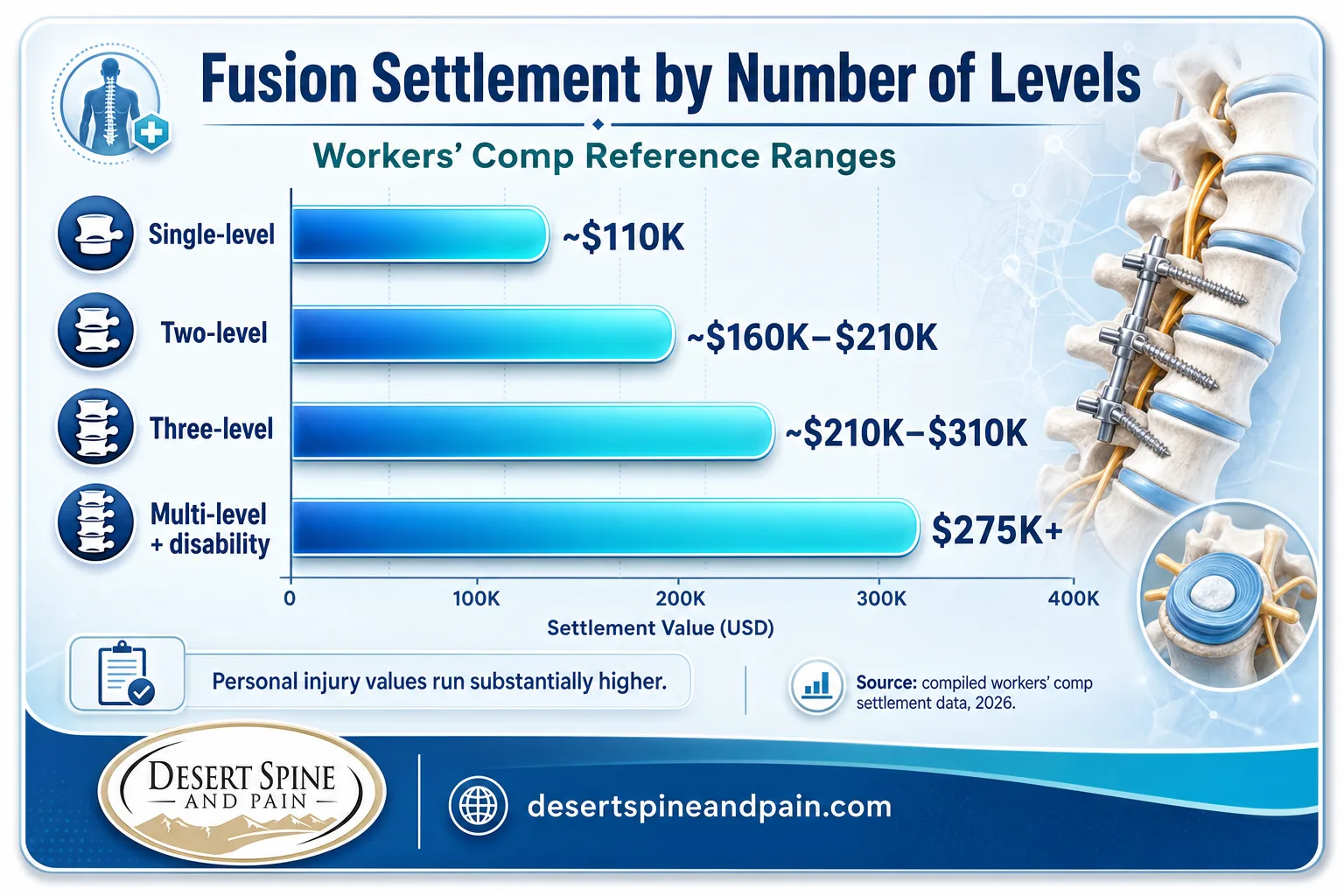
Desert Spine and Pain Analysis: the per-level ladder. Starting from a reported single-level workers' comp baseline near $110,000 and applying the reported $50,000 to $100,000 per added level, a two-level fusion projects to roughly $160,000 to $210,000 and a three-level to roughly $210,000 to $310,000, converging with the reported $275,000-plus figure for multi-level cases with disability. In the personal injury track, where pain and suffering is recoverable, the same level progression produces substantially higher numbers. Calculation and interpretation original to Desert Spine and Pain, based on published per-level settlement data.
Source: Phillips Law Offices per-level data | Scher & Bassett multi-level fusion data
Where fusion is warranted, our practice favors the least invasive effective approach and the fewest levels necessary, then documents the operative detail these valuations depend on.
Learn About Minimally Invasive Spine Surgery3Cervical vs. Lumbar Fusion
Where the fusion occurs shapes both the clinical picture and the claim. The two most common patterns are cervical fusion in the neck and lumbar fusion in the lower back.
Cervical fusion cases frequently involve radiating arm pain, numbness, and weakness from nerve root involvement, which strengthens the objective record. Lumbar fusion cases often follow a long conservative-care history, injections and physical therapy through a referral, and failed non-surgical management, which is itself documentation that the surgery was necessary. Multi-level constructs like C4-C5-C6 or L4-L5-S1 push values higher regardless of region.
Source: Miller & Zois cervical and lumbar fusion analysis
Distinguishing which levels and which nerve roots are involved, and correlating them to symptoms, is core diagnostic work for a spine and neurosurgery practice.
Explore Spine Conditions We Treat4Why Fusion Multiplies Settlement Value
Across every data source, fusion is described as a step-change in value. The mechanism is both evidentiary and economic.
It validates the injury
Adjusters and juries treat treatment intensity as a proxy for severity. A claim that stops at conservative care is easy to discredit. A claim that required fusion, the top rung of the treatment ladder, is far harder to dispute, so the pain-and-suffering component holds up.
It adds large documented costs
Fusion surgery itself commonly costs tens of thousands of dollars, and that is only the beginning. Hospitalization, rehabilitation, hardware, imaging follow-ups, and pain management all add to the economic total.
It establishes permanent impairment
Fusion permanently changes how the spine moves, typically producing a 10 to 30% whole-person impairment rating under AMA Guidelines. That permanence supports future-care and lost-earning-capacity claims for the rest of the person's life.
Source: Scher & Bassett impairment and MMI data
Fusion is a last resort in our least-invasive-first philosophy, reserved for when conservative care and interventional options have not resolved the problem, and every case is documented to that standard.
Explore Interventional Pain Treatments5Complications and Future-Cost Drivers
The largest fusion settlements are usually driven not by the surgery itself but by what happens after it. Documented complications and future-care needs are where the real value sits.
The recurring high-value complications include failed back surgery syndrome (chronic pain despite a technically successful fusion), adjacent segment disease (degeneration above or below the fusion that can require further surgery), hardware problems such as screw breakage or migration, and persistent radiculopathy. Each adds documented future cost, and a life-care plan projecting those costs is frequently the single most valuable line item in a serious fusion claim.
Caution: settling before maximum medical improvement. Because a meaningful share of fusions develop complications or require revision, settling before reaching maximum medical improvement risks locking in a number before adjacent segment disease, hardware issues, or failed back surgery syndrome have declared themselves. A complete medical record before final valuation protects the claimant. This article is general information, not legal or medical advice for a specific case.
Source: Sharpe Law Firm failed-back-syndrome data | Phillips Law Offices revision-rate data
For personal injury attorneys, our practice provides the operative reports, imaging, and complication documentation a defensible fusion valuation depends on, backed by a surgeon who is both a spine surgeon and a neurosurgeon.
Meet Dr. Greenwald6The Arizona and Phoenix Picture
Fusion cases across the Greater Phoenix metro follow the same national value drivers. As a comparative-fault state, Arizona reduces recoverable amounts by a claimant's share of fault, and defense apportionment arguments (attributing part of the disability to pre-existing degeneration) are common, which makes clear causation documentation especially valuable.
For patients and attorneys in the Valley, the lesson from the data holds: the fusion settlement follows the operative record and the future-care projection. A practice that establishes causation, performs the least invasive effective fusion, and documents levels, hardware, and prognosis thoroughly gives the claim its evidentiary backbone.
Related reading in this series: For the injuries that most often lead to fusion, see our herniated disc settlement data and back injury settlement statistics. For the most severe cases, see our spinal cord injury settlement statistics, and for the overall picture, our personal injury settlement statistics.
Source: Lein Law Offices valuation-factors overview
Book a Consultation7Every Statistic in One Table
| Statistic | Figure | Source | Year |
|---|---|---|---|
| Personal injury fusion settlement range | $250K-$750K | Compiled PI settlement data | 2026 |
| PI catastrophic / clear-liability cases | $1M+ | Compiled verdict data | 2026 |
| PI high-end range (NY-area data) | $250K to $5M+ | Compiled PI settlement data | 2026 |
| Workers' comp fusion range | $50K-$300K | Compiled WC settlement data | 2026 |
| Workers' comp broad range (some reports) | $50K-$750K | ConsumerShield (8-firm comparison) | 2026 |
| Single-level fusion (WC average) | ~$110,000 | Compiled WC settlement data | 2026 |
| Value added per additional level | $50K-$100K | Compiled WC settlement data | 2026 |
| Multi-level + disability (WC) | $275K+ | Compiled WC settlement data | 2026 |
| Whole-person impairment after fusion | 10-30% | AMA Guides via WC analyses | 2026 |
| Fusions requiring revision within 10 yrs | 15-20% | Compiled clinical/legal sources | 2026 |
| Fusion surgery cost (procedure) | $16K-$30K+ | Compiled WC settlement data | 2026 |
| Time to MMI after fusion | 6-12 months | Compiled WC settlement data | 2026 |
| PI moderate-complication range | $75K-$200K | Compiled PI settlement data | 2026 |
| Cases settling before trial | ~95% | BJS via FairSettlement.org | 2026 |
| Median auto PI settlement (all injuries) | ~$31,000 | IRC | 2023 |
8Frequently Asked Questions
What is the average spinal fusion settlement in 2026?
How much does each additional fusion level add to a settlement?
Why does spinal fusion increase a settlement so much?
Does a cervical fusion settle for more than a lumbar fusion?
What complications raise a spinal fusion settlement?
9Methodology and Sources
How we compiled this data
Settlement ranges in this article are drawn from compiled personal injury and workers' compensation settlement data reported by multiple independent legal sources for 2026, including a multi-firm comparison published by ConsumerShield, and cross-checked for consistency. Impairment-rating figures reference the AMA Guides as applied in workers' compensation valuation. Broader personal injury context is drawn from FairSettlement.org, which cites the Insurance Research Council and the Bureau of Justice Statistics.
Settlement figures are descriptive summaries of reported national outcomes and are not predictions of any individual result. Personal injury and workers' compensation values differ because the two systems compensate different categories of damages. Figures vary by jurisdiction, number of levels, complications, liability, and available coverage. The per-level chart uses illustrative reference ranges built from a reported single-level baseline plus reported per-level increments.
Primary and compiled sources:
- ConsumerShield multi-firm spinal fusion settlement comparison (May 2026).
- Compiled personal injury and workers' compensation fusion settlement data, 2025-2026.
- AMA Guides to the Evaluation of Permanent Impairment (as applied in workers' comp).
- Insurance Research Council (IRC) and Bureau of Justice Statistics (BJS), via FairSettlement.org.
This content is provided for general educational purposes and does not constitute legal advice or individualized medical advice. Settlement outcomes depend on the specific facts of each case. Consult a qualified attorney and physician regarding any specific situation.
For journalists and researchers: The statistics in this article may be cited with attribution to Desert Spine and Pain and the underlying primary sources named above. The Desert Spine and Pain Analysis box reflects an original interpretation of published per-level settlement data and may be cited with attribution to Desert Spine and Pain.
Facing possible spinal fusion after an accident in Phoenix? Dr. David L. Greenwald, MD, FACS is both a board-certified spine surgeon and a neurosurgeon, offering least-invasive-first care from conservative treatment through complex fusion surgery. Call (602) 566-9500 or book a consultation online.