

Spinal Fusion Revision and Reoperation Rate Statistics (2026): ASD, Pseudarthrosis, and Risk Factors
Most spinal fusions last a lifetime, but a meaningful minority need revision, about 7.5 percent within 10 years in one study. The leading reason is adjacent segment disease, wear on the levels next to the fusion, and because revision surgery does worse than the first operation, these statistics point to one conclusion: getting the first fusion right matters most.
- One prospective study reported about a 7.5 percent chance of revision surgery within 10 years of fusion.
- Adjacent segment disease (ASD) is the leading cause of reoperation after fusion.
- Symptomatic ASD drives a reoperation rate around 6.57 percent after cervical fusion, peaking in younger patients.
- Pseudarthrosis (failed fusion) is reported across a wide range, roughly 5 to 35 percent, and at least about 15 percent in primary lumbar fusion.
- Diabetes was linked to a 44 percent higher revision rate for ASD after lumbar fusion.
- Multi-level fusion and pre-existing adjacent degeneration raise revision risk substantially.
- Revision lumbar fusions have higher reoperation rates and worse outcomes than primary fusions.
What's in This Guide
1What Revision and Reoperation Mean
A reoperation is any additional surgery after the first (index) procedure. A revision specifically redoes or extends a prior fusion. After spinal fusion, reoperation usually happens for one of three reasons: adjacent segment disease (degeneration next to the fusion), pseudarthrosis (the fusion failing to solidify), or hardware problems. Understanding which is which is the first step to understanding the numbers.
It helps to keep perspective: the large majority of spinal fusions succeed and never require another operation. The statistics that follow describe a minority of cases, but they are important because they reveal what drives reoperation and, crucially, how much of it can be reduced by good decisions before and during the first surgery.
Our Phoenix practice, led by board-certified neurosurgeon and spine surgeon Dr. David L. Greenwald, MD, FACS, plans each fusion with an eye on the long term, not only the immediate problem.
Explore spinal fusion in PhoenixSource: 12-year revision risk after lumbar fusion, PMC
2How Often Fusion Needs Revision
The headline reoperation numbers are lower than many patients fear, but they rise steadily the longer patients are followed.
These figures need context. The roughly 7.5 percent 10-year revision rate means more than 9 in 10 patients did not need revision over a decade. Pseudarthrosis has a wide reported range because it is defined and detected differently across studies, and not every failed fusion causes symptoms or requires surgery. The single most useful takeaway is that reoperation is uncommon in the short term and accumulates slowly, mostly from adjacent segment disease.
Learn about lumbar fusionSource: Cervical adjacent segment disease reoperation study, PMC
3Adjacent Segment Disease: The Main Driver
Adjacent segment disease is the single most important concept in fusion reoperation. It is the wear that develops at the mobile levels next to a rigid fusion, and it is the leading reason patients come back for more surgery.
Cervical ASD Reoperation Rate by Age Group
Younger patients face higher ASD reoperation due to longer remaining lifespan. Source: cervical ASD reoperation study.
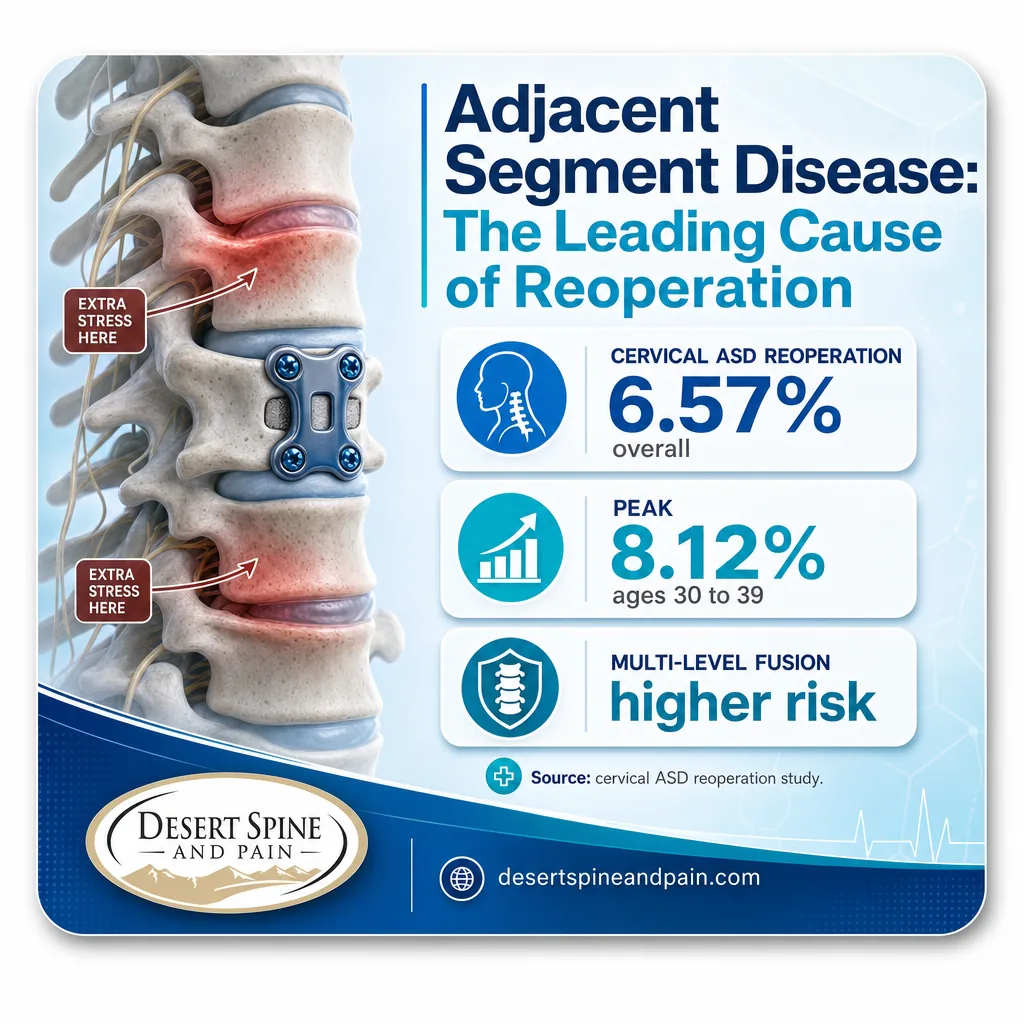
ASD arises from two forces: the natural aging of the spine, which would occur anyway, and the extra mechanical stress that a rigid fusion places on its neighbors. Because part of it is biomechanical, surgical choices matter, fusing fewer levels when possible, respecting healthy segments, and considering motion-preserving options in appropriate patients can all reduce the burden on adjacent levels. Interestingly, younger patients show higher cervical ASD reoperation rates, because they live and stay active longer after surgery.
Explore motion-preserving optionsSource: Risk factors and treatment strategies for ASD, PMC
4Risk Factors You Can Influence
Some revision risk factors cannot be changed, but several important ones can be identified and addressed before surgery, which is where careful preoperative planning pays off.
The pattern is encouraging: many drivers of revision are modifiable. Diabetes control, smoking cessation, bone-density optimization, and thoughtful surgical planning that fuses only what needs fusing all reduce long-term risk. Pre-existing degeneration at adjacent levels can be assessed on imaging before surgery, helping the surgeon plan the fusion and counsel the patient. This preoperative diligence is a direct callback to why the surgeon's judgment shapes outcomes years down the road.
Explore spine conditionsSource: Preexisting degeneration and 12-year revision risk, PMC
5Why the First Fusion Matters Most
The most consequential revision statistic is about revision itself: redoing a fusion is harder and tends to work less well than getting it right the first time.
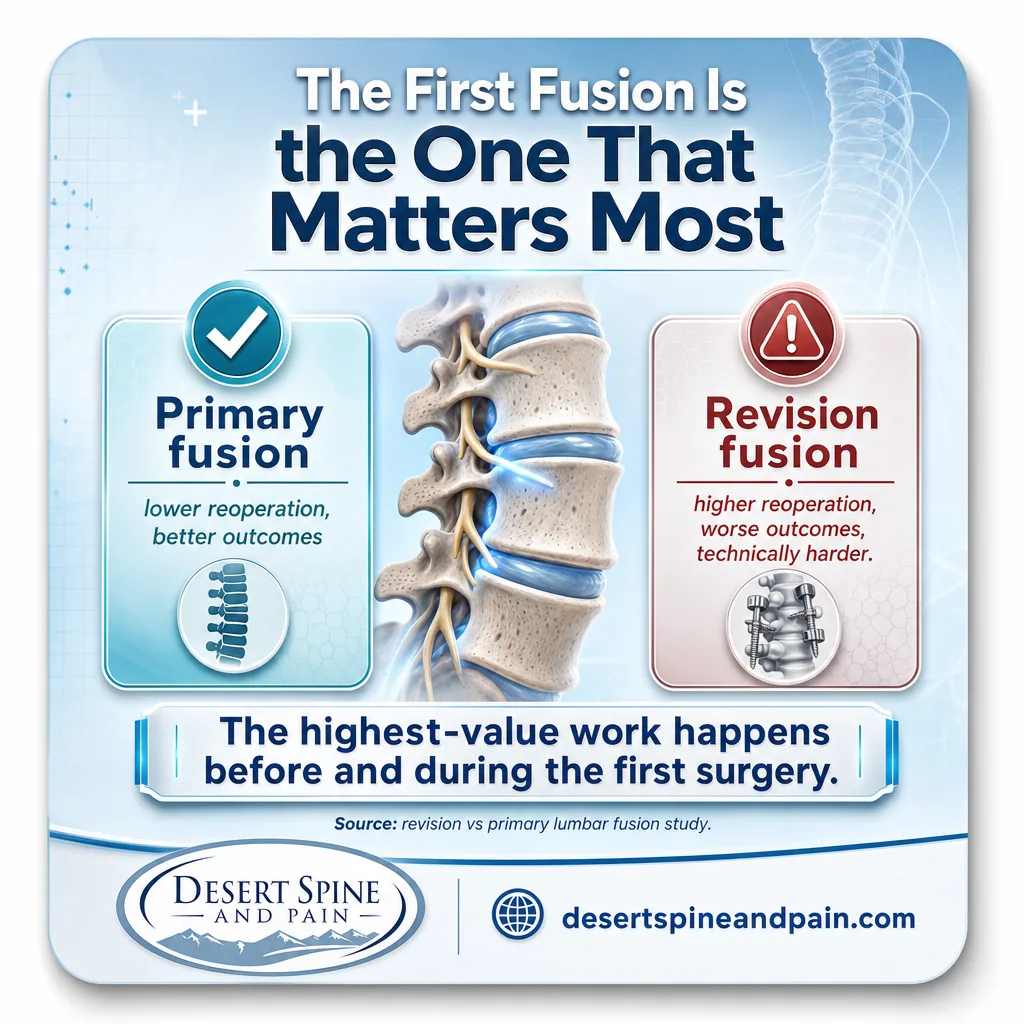
Read together, the fusion revision numbers tell a single story. Most reoperation comes from adjacent segment disease, which is partly preventable through conservative level selection and motion-preserving choices. Many risk factors, diabetes, smoking, and bone quality, are modifiable before surgery. And revision itself does worse than primary fusion. Each of these points to the same conclusion: the highest-value work happens before and during the first operation, in the diagnosis, the patient optimization, and the decision about how much to fuse. That is where an experienced surgeon changes the long-term trajectory, long before any question of revision arises. Interpretation original to Desert Spine and Pain.
A revision rate is not a reason to avoid a needed fusion. For the right patient, fusion is highly effective and most never need another operation. These statistics are not an argument against surgery, they are an argument for careful surgery: accurate diagnosis, conservative level selection, patient optimization, and choosing the least invasive effective option. The goal is not to fear revision, but to make it as unlikely as possible by getting the first decision right.
Desert Spine and Pain works with out-of-network patients of every kind and partners closely with personal injury attorneys, offering 24/7 concierge response and documentation coordination for injured clients evaluating fusion or a second opinion.
Book a consultation: (602) 566-9500Source: Revision vs primary lumbar fusion outcomes, ScienceDirect
Summary Table: Fusion Revision Statistics 2026
| Statistic | Figure | Source | Year |
|---|---|---|---|
| Revision surgery within 10 years | ~7.5% | 10-year prospective follow-up | 2020 |
| Cervical ASD reoperation (overall) | 6.57% | Cervical ASD study | 2024 |
| Cervical ASD reoperation (peak, age 30-39) | 8.12% | Cervical ASD study | 2024 |
| Pseudarthrosis range (lumbar fusion) | 5 to 35% | Pseudarthrosis literature | 2024 |
| Pseudarthrosis, primary lumbar fusion | At least ~15% | Nuclear imaging study (cited) | 2024 |
| Diabetes and ASD revision | +44% higher | ASD risk factors review | 2025 |
| Osteoporotic vs non-osteoporotic reoperation | 7.4% vs 13.1% | ASD risk factors review | 2025 |
| Multi-level fusion and ASD | Consistent higher risk | Cervical ASD study | 2024 |
| Pre-existing adjacent degeneration | Predicts revision | 12-year revision study | 2024 |
| Revision vs primary reoperation | Higher for revision | Revision vs primary study | 2022 |
| Revision vs primary outcomes | Worse for revision | Revision vs primary study | 2022 |
| Patients not needing revision at 10 years | Over 90% | 10-year prospective follow-up | 2020 |
Frequently Asked Questions
How often does spinal fusion need revision surgery?
What is adjacent segment disease?
What is the reoperation rate after spinal fusion?
What are the risk factors for spinal fusion revision?
Is revision fusion surgery as successful as the first?
Methodology & Sources
How we compiled these statistics
Every figure traces to a Tier 1 primary source: prospective and retrospective cohort studies, insurance-database analyses, and peer-reviewed reviews. Revision and reoperation rates depend heavily on follow-up length, levels fused, and how outcomes like pseudarthrosis are defined, so ranges are wide. Odds and rate comparisons describe adjusted associations. All statistics describe populations, not any individual patient.
Primary sources referenced:
- Exploring the incidence and risk factors of reoperation for symptomatic adjacent segment disease following cervical decompression and fusion, PMC
- Risk factors and treatment strategies for adjacent segment disease following spinal fusion, a review, PMC
- Nonlinear effect of preexisting adjacent disc degeneration on cumulative 12-year revision risk following lumbar fusions, PMC
- Revision lumbar fusions have higher rates of reoperation and worse clinical outcomes compared to primary lumbar fusions, ScienceDirect
- Rates of adjacent segment disease in PEEK versus titanium rods after posterior lumbar fusion, a systematic review, Cureus
This article is educational and is not individual medical advice. For guidance specific to your spine, including whether fusion or a revision is right for you, consult a qualified spine surgeon. No outcome can be guaranteed.
Journalists and researchers may cite these statistics with attribution to Desert Spine and Pain and a link to this page. Please attribute the underlying figures to their original Tier 1 sources as listed above. For expert commentary on spinal fusion revision data from a board-certified neurosurgeon and spine surgeon, contact Desert Spine and Pain at (602) 566-9500.