Spinal Cord Stimulator Statistics (2026): Success Rates, Trials, and Outcomes Data
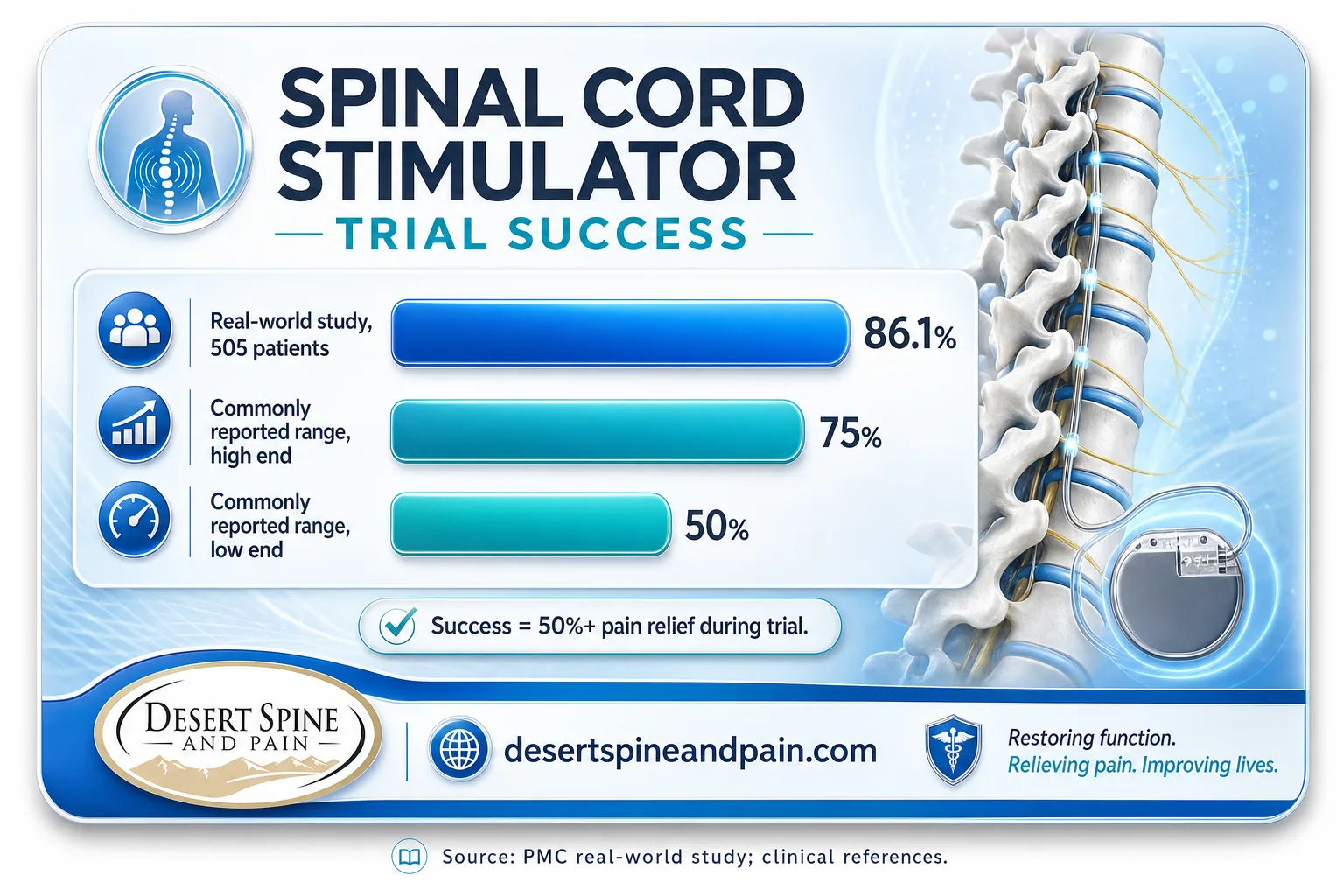
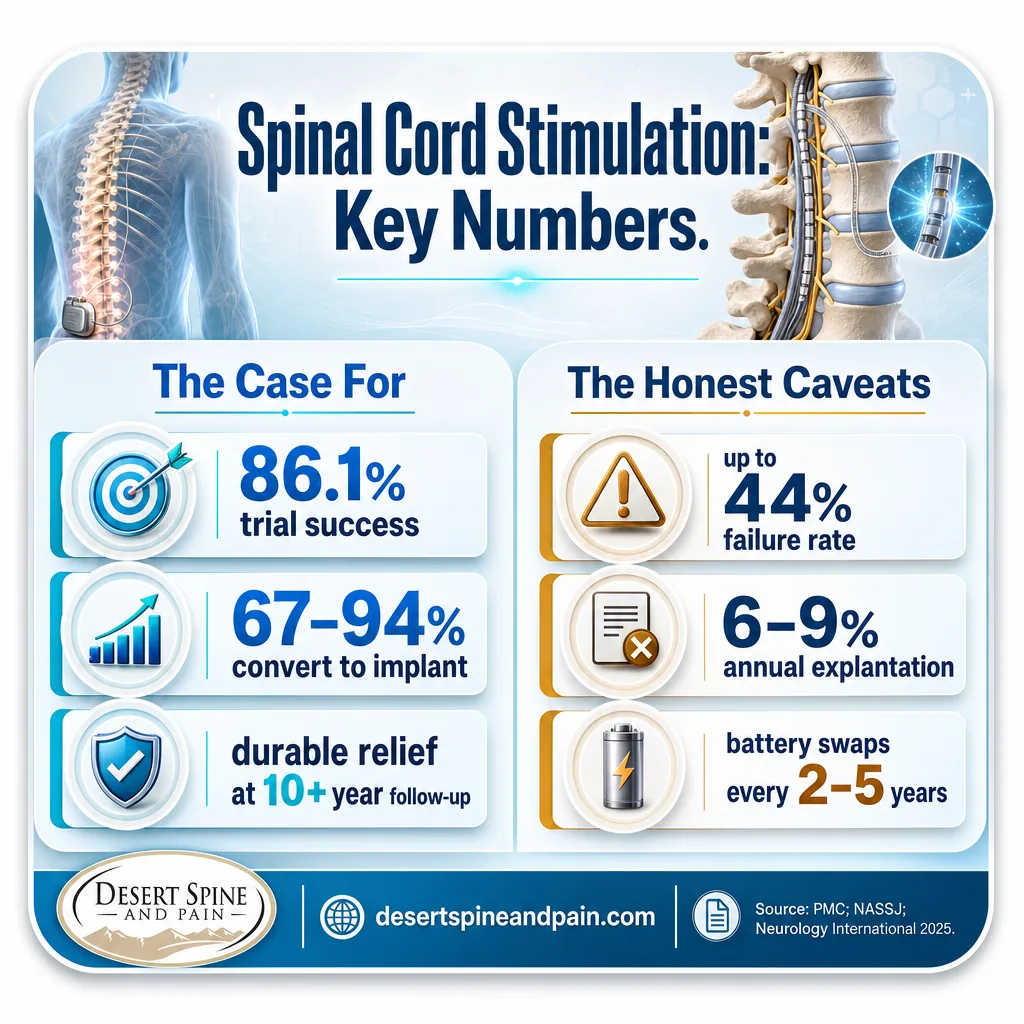
Spinal cord stimulator trials succeed for a large share of carefully selected patients, with reported trial success rates ranging from 50% to 75% and reaching 86.1% in one real-world study of 505 patients. But the therapy is not universal: failure rates of up to 44% and annual explantation rates of 6% to 9% make patient selection critical. Here is what the 2026 data says about how well spinal cord stimulation works, why trials matter, and who benefits most.
Key Takeaways
- Trial success rates run 50% to 75%, with one real-world study of 505 patients reporting 86.1% trial success (50%+ pain relief).
- Trial-to-implant conversion ranges from 67% to 94%, so the trial period screens candidates effectively.
- Failed back surgery syndrome (FBSS), the leading indication, occurs in 10% to 40% of patients after lumbar surgery.
- Failure happens too: a 2025 cohort reported failure rates up to 44% and annual explantation of 6% to 9%.
- Long-term relief is achievable: a 20-year single-center audit confirmed durable pain relief for radicular FBSS pain.
- Works across ages: studies show significant pain improvement in both under-75 and 75-plus patients with no difference in complications.
- Selection is everything: the trial, waveform, pain location, and surgical history all influence the odds of success.
What's in This Guide
01 Trial Success and Response Rates
A spinal cord stimulator (SCS) delivers mild electrical pulses to the spinal cord to interrupt pain signals before they reach the brain. Unlike most procedures, it comes with a built-in test drive: a temporary trial before any permanent implant.
The headline numbers are encouraging but wide. Clinical sources commonly report SCS trial success between 50% and 75%, depending on the pain syndrome and patient factors. A real-world study of 505 patients who underwent SCS trials between 2022 and 2024 found that 86.1% achieved trial success, defined as at least 50% pain relief at the time of lead removal. That spread reflects a central truth about SCS: outcomes depend heavily on which patients are selected and how success is measured.
The trial period is what makes these numbers actionable. Because patients only proceed to a permanent implant if the trial delivers meaningful relief, the therapy has a natural filter that most interventions lack.
Source: SCS review citing PMC real-world data | SCS trial success (clinical reference)
See how spinal cord stimulation works
02 Trial-to-Implant Conversion
How many patients who trial an SCS go on to a permanent device is one of the most telling metrics, because it captures real-world decision-making, not just study endpoints.
Conversion rates vary by setting. A utilization study published in the North American Spine Society Journal found 67% of SCS patients progressed from trial to permanent implant, while a 20-year single-center audit reported a 93.6% trial-to-implant ratio, 191 of 204 trialed patients went on to implantation. The gap between these figures reflects differences in patient selection and program design. Research has identified a "fantastic four" of predictors, age, stimulator waveform, pain localization, and history of spine surgery, that influence the odds of a successful trial.
Desert Spine and Pain Analysis: What the Trial Filter Actually Buys
Combining two Tier 1 findings, an 86.1% trial success rate against a 67% to 94% trial-to-implant conversion range, shows the trial is doing real work. A meaningful share of patients who might otherwise receive a permanent device learn during the trial that it will not help them enough, sparing them an implant unlikely to succeed. That is the opposite of a hard sell: it is a built-in off-ramp grounded in the patient's own response.
Formula: Trial success (86.1%) vs. permanent conversion (67-94%) = the trial's screening value, filtering candidates before an irreversible commitment.
Calculation and interpretation original to Desert Spine and Pain. Source figures: PMC real-world 505-patient study and NASSJ / 20-year audit conversion data.
Source: North American Spine Society Journal, 2025 | 20-year SCS audit (ScienceDirect)
Explore the full range of interventional pain care
03 Who Spinal Cord Stimulation Helps
SCS is not a general-purpose back-pain treatment. Its strongest evidence is concentrated in specific, well-defined conditions.
The leading indication is failed back surgery syndrome (FBSS), persistent or recurrent low back and leg pain after lumbar surgery, which affects an estimated 10% to 40% of patients who undergo lumbar procedures. SCS is also established for complex regional pain syndrome, chronic radicular leg pain, and diabetic peripheral neuropathy. A retrospective study found that SCS significantly improved back pain, leg pain, and overall pain at one year in both patients under 75 and those 75 and older, with no significant difference in complications between age groups, useful reassurance given the older skew of the Greater Phoenix patient population.
Myth: "A spinal cord stimulator means my surgery failed and nothing else can help."
Failed back surgery syndrome is a recognized outcome that occurs in a meaningful share of spine surgeries, and it does not mean options have run out. SCS exists specifically for this scenario and can deliver durable relief for radicular pain when other treatments have not. Importantly, it is reversible: the device can be removed if it does not help. Outcomes vary by individual, and whether SCS fits depends on a specialist evaluation, not a general rule.
Source: PMC, SCS efficacy for FBSS in elderly patients | SCS review citing JAMA Network Open 2024
Learn about complex and revision spine surgery
04 Failure, Explantation, and Realistic Expectations
An honest statistics article has to include the downside, and SCS has a real one. Balanced expectations are part of good care.
A 2025 retrospective cohort study from Saint Louis University, published in Neurology International, identified failure rates of up to 44% and annual explantation rates of 6% to 9%. Failure can result from loss of efficacy over time, lead migration, or infection, and non-rechargeable systems require periodic battery-replacement surgery every two to five years. Rare but serious adverse events, including infection requiring device removal, have been reported. The researchers framed these figures as a clear reason to identify high-risk patients before implantation rather than after.
The 2024 JAMA Network Open network meta-analysis reinforced the nuance: SCS showed advantages over conventional medical management for certain populations, but with significant variability in outcomes and a strong emphasis on careful patient selection. This is precisely why the trial period, and the expertise of the physician choosing candidates, matters so much.
Source: SCS review citing Neurology International 2025 & JAMA Network Open 2024 | North American Spine Society Journal, 2025
Meet Dr. Greenwald, spine surgeon and neurosurgeon
05 Where SCS Fits in Spine Care
Spinal cord stimulation sits near the top of the interventional ladder, considered after other options, but before or instead of further open surgery for the right patient.
Because SCS is most often used for failed back surgery syndrome, it typically enters the conversation after conservative care, interventional procedures, and, where relevant, prior surgery. The dual expertise of a physician who is both a spine surgeon and a neurosurgeon is especially relevant here: the same specialist who can evaluate whether revision surgery is warranted can also determine whether neuromodulation is the better path, without a referral handoff.
Where Spinal Cord Stimulation Sits in the Ladder
- Conservative first: non-opioid medication, bracing, physical therapy by referral.
- Interventional: injections, nerve blocks, and radiofrequency ablation, matched to diagnosis.
- Neuromodulation and surgery: spinal cord stimulation for FBSS and refractory pain; minimally invasive through complex or revision spine surgery when structure demands it.
Because Dr. Greenwald is both a spine surgeon and a neurosurgeon, Desert Spine and Pain can evaluate the full range, from the least invasive option to complex revision surgery, and match the therapy to the patient rather than the other way around.
This is general information, not individual medical advice. Whether spinal cord stimulation is appropriate depends on a full evaluation and a successful trial.
Source: 20-year SCS audit for FBSS (ScienceDirect) | PMC, SCS efficacy for FBSS
Review conservative, non-invasive care
06 All the Numbers in One Table
| Statistic | Figure | Source | Year |
|---|---|---|---|
| Real-world trial success (505 patients) | 86.1% | PMC real-world study | 2026 |
| Commonly reported trial success range | 50-75% | Clinical reference | 2026 |
| Trial success threshold | 50%+ relief | Multiple studies | 2026 |
| Trial-to-implant conversion (utilization) | 67% | NASSJ | 2025 |
| Trial-to-implant ratio (20-yr audit) | 93.6% | ScienceDirect | 2026 |
| Patients implanted in 20-yr audit | 191 of 204 | ScienceDirect | 2026 |
| Mean follow-up, 20-yr audit | 10.6 years | ScienceDirect | 2026 |
| FBSS incidence after lumbar surgery | 10-40% | PMC | 2026 |
| Pain improvement at 1 yr (FBSS) | P<0.001 | PMC retrospective study | 2026 |
| Reported failure rate | up to 44% | Neurology International | 2025 |
| Annual explantation rate | 6-9% | Neurology International | 2025 |
| Battery replacement interval (non-rechargeable) | 2-5 years | Clinical reference | 2026 |
| Major indications | FBSS, CRPS, DPN | JAMA Network Open | 2024 |
| SCS trials in real-world study window | 505 (2022-2024) | PMC real-world study | 2026 |
| Predictors of trial success | 4 factors | Pain Physician | 2026 |
| Age groups with significant benefit | <75 and 75+ | PMC retrospective study | 2026 |
07 Frequently Asked Questions
What is the success rate of a spinal cord stimulator?
Why is there a trial before a spinal cord stimulator is implanted?
How often do spinal cord stimulators fail?
Who is a good candidate for a spinal cord stimulator?
Is a spinal cord stimulator a last resort?
Methodology & Sources
Figures draw on peer-reviewed journals, clinical trial data, and clinical references. Trial success and real-world outcomes come from a PMC-indexed real-world study of 505 patients (2022-2024) and clinical references synthesizing that data. Trial-to-implant conversion comes from the North American Spine Society Journal (2025) and a 20-year single-center audit published via ScienceDirect. FBSS incidence and age-group efficacy come from PMC-indexed retrospective studies. Failure and explantation rates come from a 2025 retrospective cohort study in Neurology International (Saint Louis University). Comparative efficacy context comes from a 2024 JAMA Network Open network meta-analysis and the Cochrane Database of Systematic Reviews.
Success is generally defined as at least 50% pain relief. SCS outcomes vary substantially by diagnosis, device waveform, and patient selection; ranges are presented rather than single figures where the literature diverges. Failure and explantation figures are included deliberately to present a balanced picture.
Media & press: Journalists and researchers may cite these statistics with attribution to Desert Spine and Pain and a link to this page. The Desert Spine and Pain Analysis box contains original calculation and interpretation.
Talk to a Phoenix Spine and Pain Specialist
Desert Spine and Pain is led by Dr. David L. Greenwald, MD, FACS, a board-certified surgeon who is both a spine surgeon and a neurosurgeon. The practice serves out-of-network patients across Greater Phoenix and partners with personal injury attorneys, offering 24/7 concierge response for their clients. Care follows a least-invasive-first philosophy, from conservative treatment through interventional pain management to complex spine surgery.
Call (602) 566-9500 to book a consultation.