
Robotic Spine Surgery Statistics (2026): Screw Accuracy, Safety, and Outcomes
Robotic spine surgery uses computer-guided precision to place pedicle screws far more accurately than the human hand alone, over 90 percent accuracy versus freehand misplacement rates that historically reach 30 to 55 percent. The technology improves accuracy, blood loss, and radiation exposure, but the data is clear on one point: the robot is a tool the surgeon directs, not a substitute for surgical skill.
- Robot-assisted pedicle screw placement achieves accurate positioning in over 90 percent of screws.
- Robotic placement has about 2.7 times higher odds of acceptable accuracy than freehand, with class I (convincing) evidence.
- Freehand screw misplacement historically ranges from about 30 percent (lumbar) to 55 percent (thoracic).
- A meta-analysis found robotic techniques had a lower complication rate (about 4.83 percent) than freehand.
- Robotics reduced intraoperative blood loss and hospital stay and improved pain and disability scores modestly in pooled data.
- There was no significant difference in overall surgical time versus freehand in meta-analysis.
- Whether robotics improves long-term clinical outcomes is still debated, keeping surgeon judgment central.
What's in This Guide
1What Robotic Spine Surgery Is
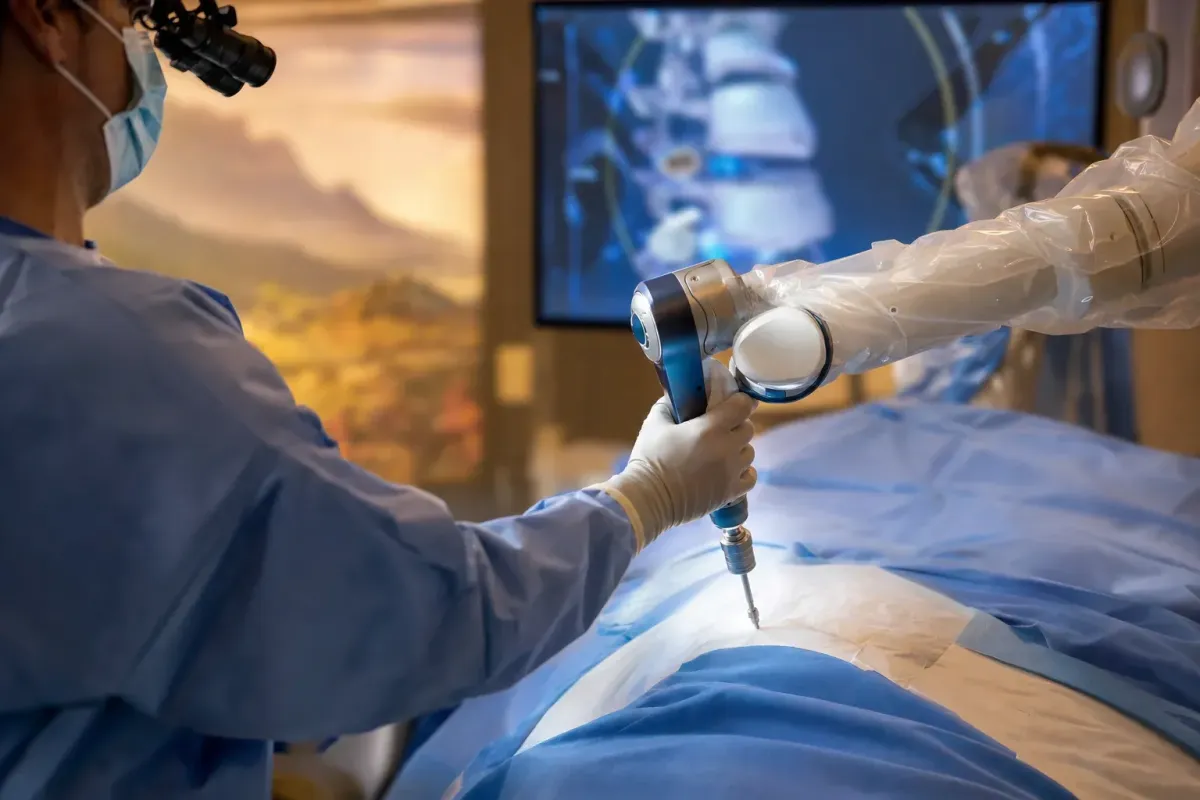
Robotic spine surgery uses a computer-guided robotic arm, combined with 3D navigation and preoperative planning, to place pedicle screws with high precision during spinal fusion. The surgeon plans each screw's trajectory on imaging, and the robot helps guide the instruments along that exact path. It assists, it does not operate on its own.
The reason accuracy matters so much is safety: a misplaced pedicle screw can injure nearby nerves or blood vessels. Because the pedicles are small and surrounded by critical structures, even millimeters count. Robotics addresses exactly this challenge, helping the surgeon translate a precise plan into precise execution.
Our Phoenix practice, led by board-certified neurosurgeon and spine surgeon Dr. David L. Greenwald, MD, FACS, uses advanced technology in service of the least invasive, most precise care for each patient.
Explore spinal fusion in PhoenixSource: Robotic pedicle screw placement review, Frontiers in Surgery
2Screw Placement Accuracy
Accuracy is where robotic spine surgery shines, and the evidence here is among the strongest in spine technology, graded as convincing in an umbrella review of meta-analyses.
Odds of Acceptable Pedicle Screw Placement: Robotic vs Alternatives
Higher odds of acceptable placement, class I (convincing) evidence. Source: 2025 umbrella review and meta-meta-analysis.The 2025 umbrella review, which pools multiple meta-analyses and grades the evidence, found convincing (class I) support for robotics improving both acceptable and perfect screw placement over freehand and over computer-assisted navigation. Accuracy is measured on the Gertzbein-Robbins scale, where grade A means the screw is entirely within the pedicle. This is the clearest, best-established benefit of robotic spine surgery.
Learn about lumbar fusionSource: Robot-assisted screw placement umbrella review, PMC 2025 | Robot vs freehand umbrella review, PMC
3Complications, Blood Loss, and Radiation
Beyond accuracy, robotics offers measurable safety advantages in complications, bleeding, and radiation exposure, benefits that grow with the complexity of the surgery.
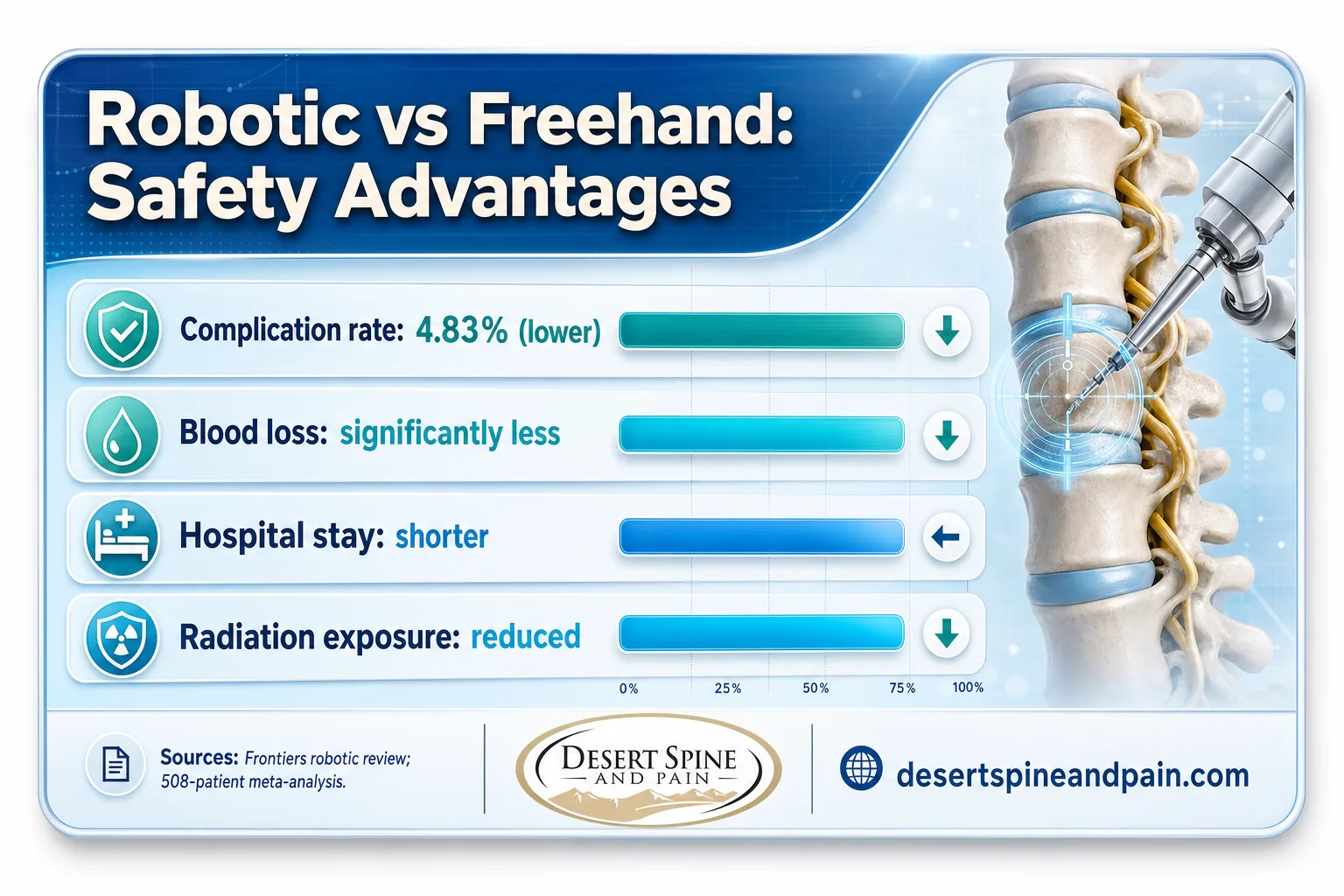
A meta-analysis found robot-assisted techniques carried a significantly lower complication rate than freehand (about 4.83 percent), along with less blood loss and shorter hospital stays. Reduced radiation is a meaningful and underappreciated benefit, protecting both the patient and the surgical team over a career of procedures. These safety gains are especially valuable in longer, multilevel, or deformity surgeries where many screws are placed.
Meet Dr. GreenwaldSource: Robot vs freehand short-term clinical outcomes meta-analysis, PMC
4Clinical Outcomes: The Honest Picture
Here is where honesty matters. Robotics clearly improves accuracy and safety, but whether it produces better long-term pain and function is genuinely debated in the literature.
A meta-analysis of eight studies and 508 patients found robotics scored modestly better on pain and disability, with less blood loss and shorter stays, and no significant time penalty. Yet the authors and others note that whether these differences are clinically meaningful over the long term is still unsettled. The most accurate summary: robotics reliably improves the technical quality of screw placement, and the clinical payoff is real but modest and still being defined.
Robotic spine surgery clearly places screws more accurately, and that is genuinely valuable for safety. But more accurate screws do not automatically mean dramatically better pain relief, because the outcome also depends on correct diagnosis, appropriate procedure choice, and whether surgery was the right answer at all. Robotics is a powerful precision tool in the hands of a skilled surgeon, not a guarantee of a better result on its own. The judgment behind the technology still matters most.
Source: Robot vs freehand clinical outcomes meta-analysis (508 patients), PMC
5Why the Surgeon Still Matters Most
The most important thing to understand about robotic spine surgery is that the robot does not perform the operation. It executes a plan the surgeon designs, and the quality of that plan and judgment determines the outcome.
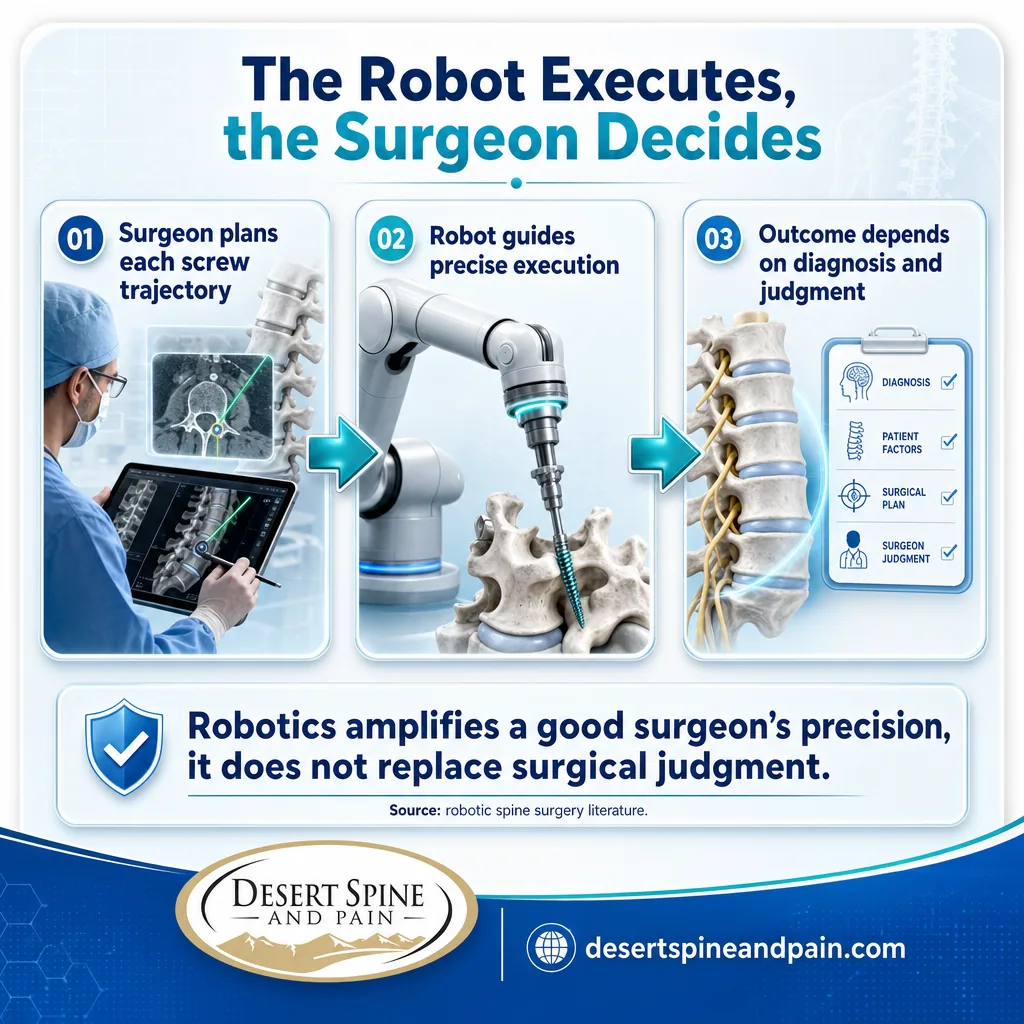
Robotic spine surgery data tells a balanced story: the technology genuinely improves screw accuracy, lowers complications, and reduces radiation, while its effect on long-term pain and function is real but modest. The reason is simple, a perfectly placed screw only helps if the right operation was chosen for the right patient in the first place. Robotics amplifies a good surgeon's precision; it cannot substitute for the diagnosis and judgment that decide whether and how to operate. The technology serves the surgeon's expertise, not the reverse. Interpretation original to Desert Spine and Pain.
Desert Spine and Pain works with out-of-network patients of every kind and partners closely with personal injury attorneys, offering 24/7 concierge response and documentation coordination for injured clients evaluating advanced surgical options.
Book a consultation: (602) 566-9500Source: Robotic vs freehand in adult spinal deformity, PMC
Summary Table: Robotic Spine Surgery Statistics 2026
| Statistic | Figure | Source | Year |
|---|---|---|---|
| Robotic screw placement accuracy | Over 90% | Frontiers robotic review | 2025 |
| Acceptable placement odds, robotic vs freehand | 2.74x (eOR) | Umbrella review (2025) | 2025 |
| Acceptable placement odds, robotic vs navigation | 2.36x (eOR) | Umbrella review (2025) | 2025 |
| Freehand misplacement (lumbar to thoracic) | 30 to 55% | Frontiers robotic review | 2025 |
| Robotic complication rate | ~4.83% | Frontiers robotic review | 2025 |
| Pain (VAS) and disability (ODI) | Modestly better | Clinical outcomes meta (508) | 2023 |
| Intraoperative blood loss | Lower with robotics | Clinical outcomes meta (508) | 2023 |
| Length of hospital stay | Shorter with robotics | Clinical outcomes meta (508) | 2023 |
| Overall surgical time | No significant difference | Clinical outcomes meta (508) | 2023 |
| Radiation exposure | Reduced | Robotic safety literature | 2025 |
| Evidence grade (accuracy) | Class I (convincing) | Umbrella review (2025) | 2025 |
| Long-term clinical benefit | Real but debated | Clinical outcomes meta (508) | 2023 |
Frequently Asked Questions
How accurate is robotic spine surgery?
Is robotic spine surgery better than traditional surgery?
Does robotic spine surgery reduce complications?
Does robotic spine surgery take longer?
What is the Gertzbein-Robbins scale?
Methodology & Sources
How we compiled these statistics
Every figure traces to a Tier 1 primary source: umbrella reviews of meta-analyses, systematic reviews, comparative cohort studies, and randomized trial protocols. Accuracy is reported on the Gertzbein-Robbins scale, and evidence is graded where available. We distinguish clearly between well-established benefits (accuracy, safety) and debated ones (long-term clinical outcomes). All statistics describe populations, not any individual patient.
Primary sources referenced:
- Robot-assisted pedicle screw placement: updated systematic umbrella review and meta-meta-analysis versus freehand and navigation, PMC, 2025
- Robot-assisted versus freehand technique: umbrella review with Gertzbein-Robbins grading, PMC
- Comparison of short-term clinical outcomes between robot-assisted and freehand pedicle screw placement: meta-analysis (508 patients), PMC
- Robotic pedicle screw placement for minimally invasive thoracolumbar spine surgery, Frontiers in Surgery
- Robotic-assisted versus freehand techniques in adult spinal deformity surgery, PMC
This article is educational and is not individual medical advice. For guidance specific to your spine condition, consult a qualified spine surgeon. No outcome can be guaranteed.
Journalists and researchers may cite these statistics with attribution to Desert Spine and Pain and a link to this page. Please attribute the underlying figures to their original Tier 1 sources as listed above. For expert commentary on robotic spine surgery data from a board-certified neurosurgeon and spine surgeon, contact Desert Spine and Pain at (602) 566-9500.