
PRP Therapy Statistics (2026): Success Rates, Evidence, and Outcomes Data
Platelet-rich plasma (PRP) therapy achieves clinically meaningful improvement in roughly 50% to 70% of appropriately selected patients, with the strongest evidence in knee osteoarthritis and certain tendon conditions. For spine and back pain, the evidence is promising and growing but still developing. Here is what the 2026 data says about how well PRP works, which conditions have the best evidence, and how safe it is, presented honestly, including where the science is still catching up.
Key Takeaways
- PRP helps 50% to 70% of appropriately selected patients achieve clinically meaningful improvement.
- Knee osteoarthritis has the strongest evidence: responder rates of ~69% to 73% through 12 months, superior to hyaluronic acid and corticosteroids medium-to-long term.
- Platelet concentration matters: results are best when concentration exceeds 1 million per microliter.
- Spine evidence is emerging: graded Level II overall for low back pain, Level III (fair) for lumbar disc injection.
- Benefit can last: peaks around 3 to 6 months for knee OA and sustains to 12 months; some spine studies report up to 2 years.
- Strong safety profile: uses the patient's own blood; adverse events across studies are minor and self-limiting.
- Evidence varies by preparation: heterogeneity in PRP formulation is the biggest caveat in the research.
What's in This Guide
01 Overall Success Rates
PRP therapy concentrates the healing growth factors from a patient's own blood and injects them into an injured or arthritic area to stimulate repair. Its success depends heavily on what is being treated and how patients are selected.
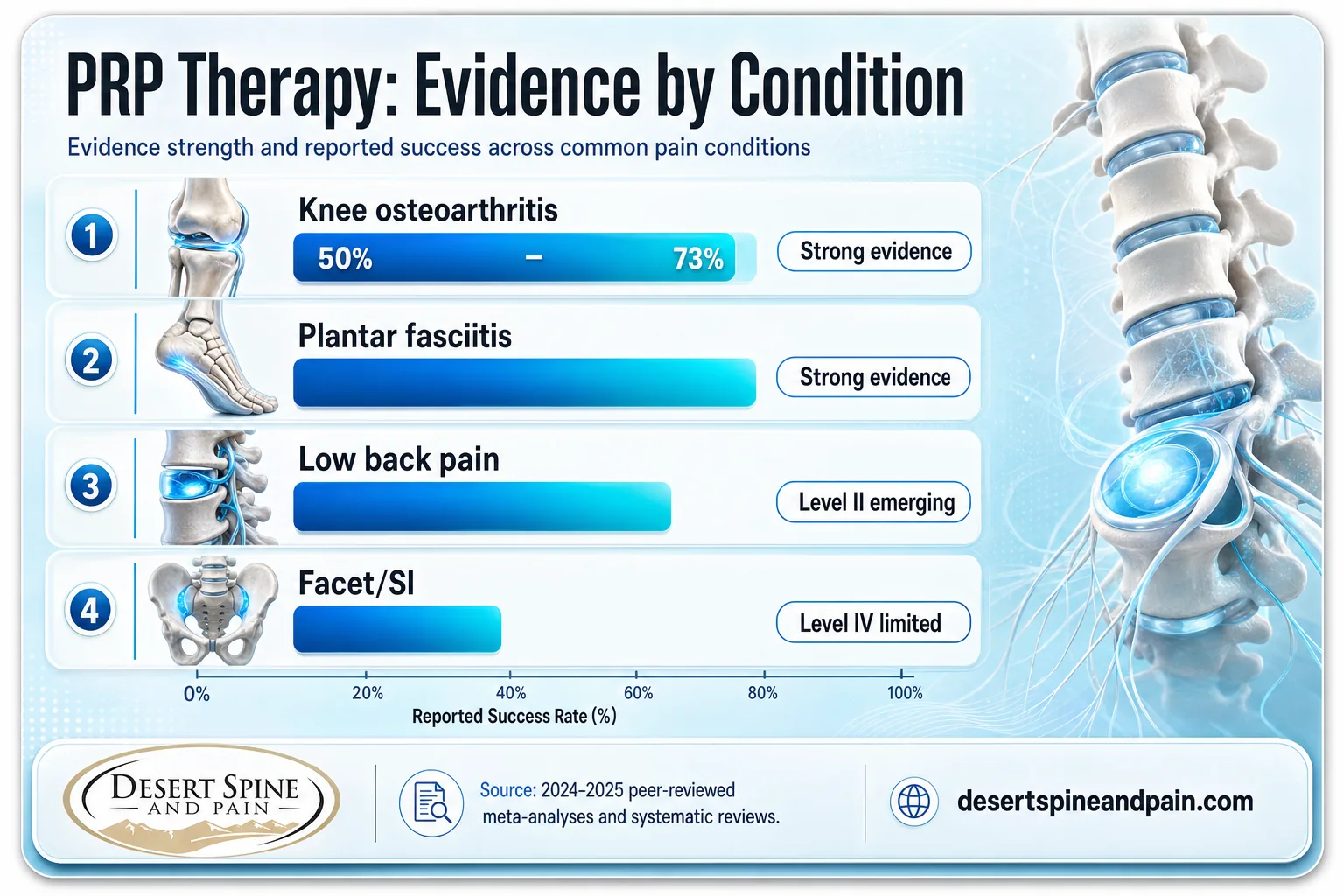
Across conditions, PRP achieves clinically meaningful improvement in roughly 50% to 70% of appropriately selected patients, with the highest success in knee osteoarthritis and plantar fasciitis. Recent 2024-2025 meta-analyses show PRP reaching the minimal clinically important difference (MCID) at all timepoints through 12 months, but importantly, only when platelet concentration exceeds 1 million per microliter. Lower-concentration formulations often fail to provide lasting relief, which is one reason outcomes vary so much between providers and studies.
Source: PMC, PRP for knee OA narrative review (2025) | PMC, high-dose PRP responder rates
See how PRP therapy works
02 The Strongest Evidence: Knee Osteoarthritis
If any application of PRP has earned solid evidence, it is knee osteoarthritis, where multiple recent meta-analyses point in the same direction.
A retrospective study of 212 patients treated with high-dose, neutrophil-depleted PRP reported responder rates of 68.9%, 72.7%, and 70.6% at 3, 6, and 12 months, with benefit lasting up to a year. A meta-analysis of 42 studies covering 3,696 patients found PRP produced significantly greater pain relief than hyaluronic acid and corticosteroid injections, with the most significant improvement at six months. PRP works best for mild-to-moderate disease (Kellgren-Lawrence grades 1 to 3), and leukocyte-poor formulations tend to outperform others. The knee OA evidence has reached the point where the AAOS gives PRP a moderate recommendation supported by Level I meta-analyses.
High-Dose PRP Responder Rates for Knee Osteoarthritis
Source: PMC, high-dose neutrophil-depleted PRP for KOA | PMC, comparative meta-analysis (42 studies)
Explore regenerative and conservative options
03 PRP for Spine and Back Pain
For back and spine conditions, the honest answer is that the evidence is promising and growing, but not yet as mature as the knee data. Transparency here matters.
A PRISMA systematic review graded the overall evidence for PRP in low back pain as Level II, concluding it is generally an effective and safe treatment for degenerative low back pain, while noting that large multicenter randomized trials are still needed. A separate evidence review graded lumbar disc (intradiscal) PRP injection as Level III (fair) and facet, intra-articular, and sacroiliac applications as Level IV (limited). A comprehensive systematic analysis of cell and PRP therapies for disc-degeneration pain found that injections could produce clinically significant improvement in pain and disability for up to two years, comparable to outcomes seen after spinal fusion, though it emphasized that most studies carried a high risk of bias.
Setting honest expectations for spine PRP
PRP for spine and disc pain shows real promise, and its safety profile is reassuring, but the evidence base is still maturing. Study designs vary widely, high-quality randomized trials remain limited, and PRP preparation is not standardized across providers. That does not mean PRP does not help; it means results cannot be guaranteed and PRP is best considered as one option within a broader, individualized plan. This is general information, not medical advice, and candidacy should be determined through a personal evaluation.
Source: PRISMA systematic review, PRP for low back pain (Level II) | NCBI Bookshelf, PRP for lower back pain evidence grades
See the spine conditions we evaluate
04 What Determines Whether PRP Works
The wide range in reported PRP outcomes is not random. Research has identified specific factors that separate strong results from disappointing ones.
Four factors dominate. First, platelet concentration: formulations exceeding 1 million per microliter consistently outperform lower-concentration preparations. Second, disease severity: mild-to-moderate disease (Kellgren-Lawrence grades 1 to 3) responds far better than advanced degeneration. Third, formulation and technique: leukocyte-poor PRP is often favored for joints, and preparation methods vary widely between providers. Fourth, patient selection and the willingness to pair PRP with appropriate rehabilitation. This variability is precisely why the same therapy can show a 50% success rate in one setting and 70% in another.
Desert Spine and Pain Analysis: Why "PRP Success Rate" Is the Wrong Question
Combining the evidence, MCID reached at all timepoints only above 1 million platelets per microliter, versus lower-concentration formulations that fail to sustain relief, shows that PRP outcomes are driven as much by preparation and selection as by the therapy itself. Asking "what is PRP's success rate?" is less useful than asking "is this the right patient, the right concentration, and the right condition?" The answer to the second question is what actually predicts the first.
Formula: Outcome = right condition (KL 1-3) + right concentration (>1M/µL) + right formulation + right selection, not the therapy label alone.
Calculation and interpretation original to Desert Spine and Pain. Source figures: PRP concentration and selection data from 2024-2025 meta-analyses.
Source: PMC, PRP preparation protocols and evidence | PMC, PRP knee OA meta-analysis
Meet Dr. Greenwald, spine surgeon and neurosurgeon
05 Safety and Where PRP Fits
One area where the PRP evidence is consistent and reassuring is safety, which supports its role as a low-risk option to consider before more invasive steps.
Because PRP is autologous, derived from the patient's own blood, it carries minimal risk of rejection or allergic reaction. Across both joint and spine studies, reported adverse events are minor and self-limiting, most commonly temporary soreness at the injection site. Multiple systematic reviews describe a well-established safety profile with a low frequency of adverse events. That favorable safety picture is a genuine part of PRP's appeal as an early, minimally invasive option.
Where PRP Fits in the Least-Invasive-First Ladder
- Conservative first: non-opioid medication, bracing, and physical therapy by referral.
- Regenerative and interventional options: PRP and related injections for appropriate candidates, especially mild-to-moderate degenerative conditions, alongside targeted injections and nerve blocks.
- Surgery only when warranted: minimally invasive through complex spine surgery for structural problems that require it.
Because Dr. Greenwald is both a spine surgeon and a neurosurgeon, Desert Spine and Pain can offer a clear-eyed assessment of whether PRP is a reasonable option for a given case, or whether the condition calls for a different approach, without overselling a therapy whose evidence is still developing.
This article is for general education and is not medical advice. PRP is not appropriate for every condition or patient, and outcomes cannot be guaranteed; a personal evaluation is the right way to determine whether it fits. When PRP is not the right tool, targeted interventional options may reach the source of pain more reliably.
Source: PMC, systematic evidence analysis of cell/PRP for disc pain | PMC, intradiscal PRP safety profile
Explore targeted interventional pain careLearn about PRP injections for pain
06 All the Numbers in One Table
| Statistic | Figure | Source | Year |
|---|---|---|---|
| Overall meaningful-improvement rate | 50-70% | 2024-2025 meta-analyses | 2026 |
| Knee OA responder rate, 3 mo | 68.9% | PMC (212-patient study) | 2026 |
| Knee OA responder rate, 6 mo | 72.7% | PMC (212-patient study) | 2026 |
| Knee OA responder rate, 12 mo | 70.6% | PMC (212-patient study) | 2026 |
| Meta-analysis patients (PRP vs HA) | 3,696 | PMC (42-study meta-analysis) | 2026 |
| WOMAC pain reduction (pooled) | -8.5 points | PMC meta-analysis | 2026 |
| Platelet concentration threshold | >1M/µL | 2024-2025 meta-analyses | 2026 |
| Best-responding OA grades | KL 1-3 | PMC narrative review | 2026 |
| Low back pain evidence grade | Level II | PRISMA systematic review | 2026 |
| Lumbar disc injection evidence | Level III (fair) | NCBI evidence review | 2026 |
| Facet/SI injection evidence | Level IV (limited) | NCBI evidence review | 2026 |
| Spine improvement duration (some studies) | Up to 2 years | PMC systematic analysis | 2026 |
| Disc-pain studies analyzed | 68 studies, 1,974+ patients | PMC systematic analysis | 2026 |
| Plantar fasciitis effect size (vs placebo) | SMD 3.42 | Meta-analysis (cited) | 2026 |
| Adverse event profile | Minor, self-limiting | Multiple systematic reviews | 2026 |
| AAOS recommendation (knee OA) | Moderate | AAOS / Level I meta-analyses | 2026 |
07 Frequently Asked Questions
What is the success rate of PRP therapy?
Does PRP work for back pain?
How long does PRP therapy take to work and how long does it last?
Is PRP therapy safe?
What affects whether PRP therapy works?
Methodology & Sources
All figures trace to Tier 1 peer-reviewed sources published primarily in 2024-2025. Knee osteoarthritis outcomes come from a 212-patient retrospective study of high-dose PRP, a 42-study meta-analysis (3,696 patients), and a 2025 comprehensive narrative review synthesizing 40 high-quality studies. Spine and back pain evidence comes from a PRISMA systematic review (graded Level II), an NCBI Bookshelf evidence review (Level III for lumbar disc, Level IV for facet/SI), and a systematic evidence analysis of 68 cell/PRP studies for disc-degeneration pain. Safety data are drawn from multiple systematic reviews.
PRP outcomes vary substantially by platelet concentration, formulation, disease severity, and patient selection, and much of the spine literature carries a high risk of bias with limited large randomized trials. Success rates are therefore presented as ranges with evidence grades, and results cannot be guaranteed for any individual. This article is for general education and is not medical advice.
Media & press: Journalists and researchers may cite these statistics with attribution to Desert Spine and Pain and a link to this page. The Desert Spine and Pain Analysis box contains original calculation and interpretation.
Talk to a Phoenix Spine and Pain Specialist
Desert Spine and Pain is led by Dr. David L. Greenwald, MD, FACS, a board-certified surgeon who is both a spine surgeon and a neurosurgeon. The practice serves out-of-network patients across Greater Phoenix and partners with personal injury attorneys, offering 24/7 concierge response for their clients. Care follows a least-invasive-first philosophy, from conservative treatment through interventional pain management to complex spine surgery.
Call (602) 566-9500 to book a consultation.