

Personal Injury Lawsuit Statistics (2026): Trial Rates, Dismissals, and Duration
Filing a personal injury lawsuit is not the same as winning one. About 450,000 are filed in U.S. state courts each year, but roughly 40% are dismissed before trial, mostly for lack of evidence, and only a small fraction ever reach a verdict. The lawsuit stage is a filter, and the single factor that determines which cases survive it is the strength of the underlying evidence, especially the medical proof of causation and damages.
- About 450,000 personal injury lawsuits were filed in U.S. state courts in a recent year.
- Motor vehicle accidents make up about 35% of lawsuits filed; slip and fall about 15%.
- Roughly 40% of lawsuits are dismissed before trial, primarily for lack of evidence.
- Only about 4 to 15% reach a verdict; roughly 55% settle out of court.
- Trial plaintiffs win about 50 to 60% overall, varying widely by case type.
- The average lawsuit takes about 28 months from filing to verdict.
- Litigating a case averages about $75,000 versus about $45,000 to settle out of court.
What's in This Guide
1How Many Lawsuits Are Filed
A lawsuit is what happens when a claim cannot be resolved through negotiation and moves into formal litigation. Only a portion of injury claims ever reach this stage.
Motor vehicle accidents dominate lawsuit filings just as they dominate claims, and because spine and back injuries are among the most common serious crash injuries, they feature heavily in litigated cases. Federal filings can swing dramatically year to year due to mass tort litigation, but the state court volume that captures most ordinary personal injury cases is comparatively stable.
Source: WiFiTalents personal injury lawsuit statistics
Cases that reach litigation are typically the more serious ones, where accurate spine documentation carries the most weight. That is where our practice contributes.
Explore Spine Conditions We Treat2The Dismissal Filter: Why Evidence Decides
The most consequential lawsuit statistic is the dismissal rate. A large share of filed lawsuits never reach a jury because they cannot clear the evidentiary bar.
The phrase "lack of evidence" is worth dwelling on. In a spine-injury lawsuit, the evidence that matters most is medical: an objective diagnosis, imaging that correlates with the reported symptoms, and a clear causal link between the accident and the injury. When that chain is missing or weak, the case is vulnerable to dismissal or to a defense argument that the injury predated the accident or was exaggerated. Establishing causation is often described as the pivotal battle in a personal injury lawsuit, and it is frequently lost without strong medical support.
Myth: "Filing a lawsuit means the case will be heard by a jury." It usually will not. With roughly 40% of lawsuits dismissed before trial and most of the rest settling, only a small fraction reach a verdict. The cases that survive are the ones built on solid, objective evidence. This article is general information, not legal or medical advice for a specific case.
Source: WiFiTalents dismissal and settlement data
For personal injury attorneys, our practice supplies exactly this kind of objective spine documentation and causal analysis, with 24/7 concierge response to support litigation timelines.
Meet Dr. Greenwald3Trial Rates and Plaintiff Win Rates
Trials are rare, and their outcomes vary enormously by case type. Understanding both facts is essential to reading personal injury lawsuit data correctly.
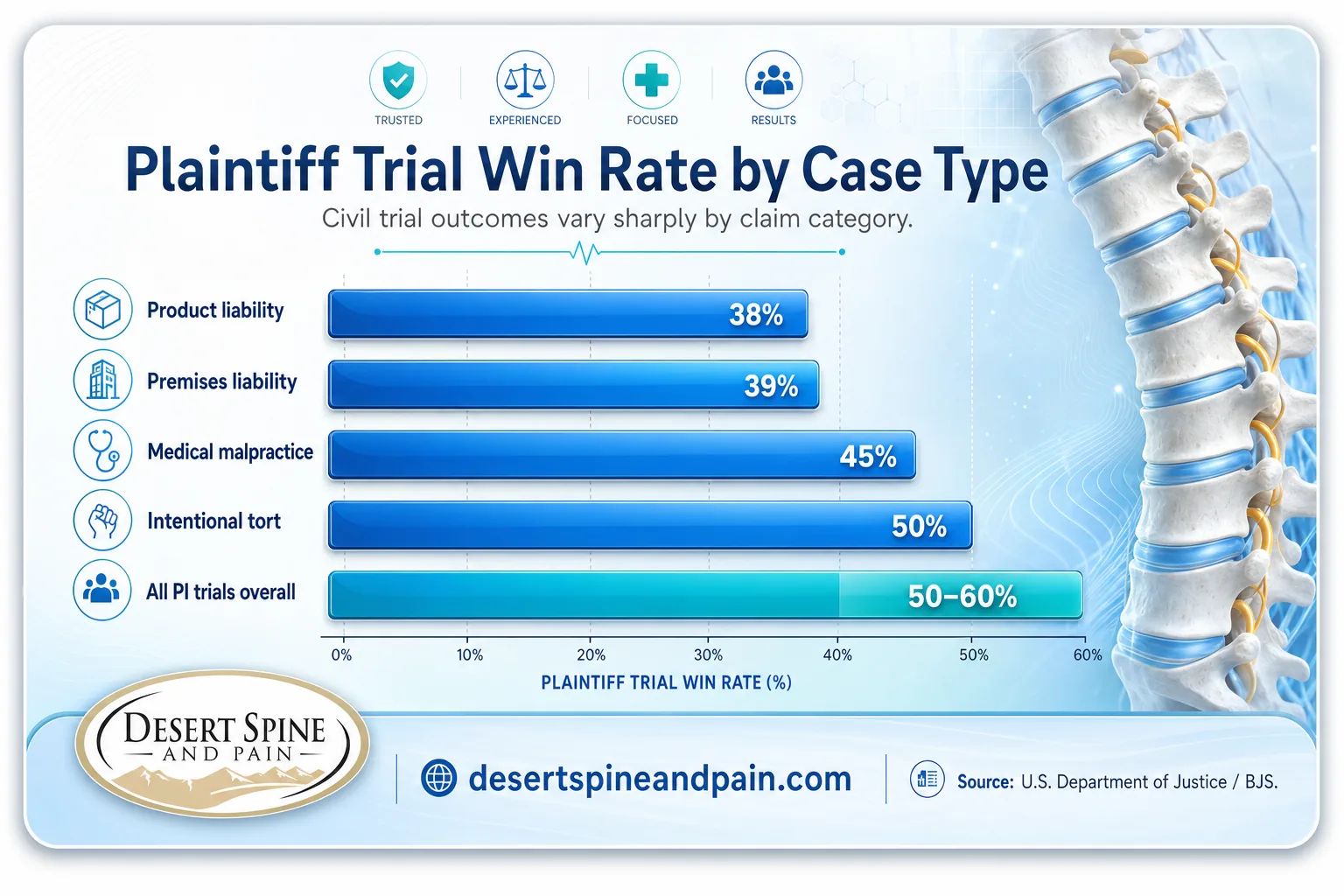
There is an apparent paradox in the data: some sources report that over 90% of tried cases end in a plaintiff win, while others report 50 to 60%. The difference is which cases are counted. The higher figure reflects a heavily filtered set of very strong cases that reach a jury; the lower figures reflect broader samples across all tried cases. Both point to the same lesson: only well-supported cases should reach trial, and evidence quality is what makes a case strong enough to try.
Source: DOJ / BJS trial success rates by type | Compiled win-rate data
See All Treatment Options4How Long Lawsuits Take
Litigation adds time. Once a lawsuit is filed, resolution is measured in years for many case types, and trial extends it further.
Bureau of Justice Statistics data shows meaningful variation by type: motor vehicle cases average about 20 months, premises liability about 24 months, intentional torts about 25 months, and medical malpractice about 31 months. Witness availability is a leading cause of trial delays, contributing to roughly 30% of them, which underscores how much the practical logistics of evidence and testimony shape the timeline.
Source: BJS tort case duration data
We cover case duration in depth, including what lengthens and shortens the timeline, in a dedicated companion guide.
See Case Duration Statistics5The Cost of Litigation
Litigation is expensive for both sides, which is a major reason most cases settle rather than proceed to trial.
The economics explain the system's behavior. Because a trial costs far more than a settlement and carries uncertain outcomes, both sides are pushed toward resolution, and leverage comes from the strength of the evidence each side can bring. A well-documented spine injury increases a plaintiff's leverage precisely because it raises the defense's risk of losing at trial.
Desert Spine and Pain Analysis: how evidence quality shifts settlement leverage. With litigation running roughly $75,000 versus $45,000 to settle, and about 40% of lawsuits dismissed for lack of evidence, the value of strong medical documentation is not only that it wins trials, it is that it changes the settlement math before trial. A defense facing objective, well-correlated spine imaging and a clear causal opinion faces higher trial risk and settles closer to full value. Weak evidence invites both dismissal and lowball offers. Interpretation original to Desert Spine and Pain, based on published litigation-cost and dismissal data.
Source: WiFiTalents litigation-cost data
See Our Spine Surgery Options6Where Medical Evidence Fits
Every statistic in this guide points back to one factor: evidence. The 40% dismissal rate, the win-rate variation by case type, and the settlement-versus-trial economics all turn on whether a case can prove causation and damages.
For spine injuries, proving causation means connecting a specific diagnosis to a specific event and ruling out alternative explanations, work that requires precise imaging interpretation and clinical correlation. The role of the treating physician, and where warranted the medical expert, is central to whether a lawsuit survives the dismissal filter and reaches fair value. We explore that role in depth in our companion guide on medical expert testimony.
Related in this series: For how medical experts and depositions shape outcomes, see our medical expert witness and deposition statistics. For the claim stage that precedes litigation, see our personal injury claim statistics, and for the settle-versus-trial decision, our settlement vs. trial statistics.
For patients and attorneys across Phoenix, Scottsdale, Tempe, Mesa, and the wider metro, the lesson is consistent. As a comparative-fault state, Arizona also reduces recovery by a claimant's share of fault, making clear, objective documentation especially valuable in litigation.
Source: WiFiTalents litigation analysis
Because Dr. Greenwald is both a spine surgeon and a neurosurgeon, our practice can document the full spine-injury picture and articulate causation to the standard litigation demands.
Book a Consultation7Every Statistic in One Table
| Statistic | Figure | Source | Year |
|---|---|---|---|
| PI lawsuits filed in state courts | ~450,000 | State court data | 2022 |
| Motor vehicle share of lawsuits | ~35% | WiFiTalents | 2026 |
| Slip and fall share of lawsuits | ~15% | WiFiTalents | 2026 |
| Lawsuits dismissed before trial | ~40% | WiFiTalents | 2026 |
| Cases settling out of court | ~55% | WiFiTalents | 2026 |
| Cases reaching a verdict | ~4-15% | DOJ / Law Dictionary | 2026 |
| Plaintiff win rate at trial (overall) | 50-60% | DOJ | 2026 |
| Medical malpractice trial win rate | ~45% | WiFiTalents / BJS | 2026 |
| Premises liability trial win rate | ~39% | BJS | 2026 |
| Product liability trial win rate | ~38% | BJS | 2026 |
| Intentional tort trial win rate | ~50% | BJS | 2026 |
| Filing-to-verdict duration | ~28 months | WiFiTalents | 2026 |
| Tort case duration (overall) | 23 months | BJS | 2026 |
| Motor vehicle case duration | ~20 months | BJS | 2026 |
| Medical malpractice case duration | ~31 months | BJS | 2026 |
| Cost to litigate a case | ~$75,000 | WiFiTalents | 2026 |
| Cost to settle out of court | ~$45,000 | WiFiTalents | 2026 |
| Trial delays from witness availability | ~30% | WiFiTalents | 2026 |
8Frequently Asked Questions
How many personal injury lawsuits are filed each year?
What percentage of personal injury lawsuits are dismissed?
What percentage of personal injury lawsuits go to trial?
What are the odds of winning a personal injury trial?
How long does a personal injury lawsuit take?
9Methodology and Sources
How we compiled this data
Lawsuit filing volume, dismissal rates, settlement-versus-trial shares, litigation costs, and filing-to-verdict duration are drawn from the WiFiTalents (worldmetrics) personal injury lawsuits data brief, which aggregates peer-reviewed studies, official statistics, and industry databases with disclosed methodology. Case-duration and trial-success-rate figures by type are from the Bureau of Justice Statistics and U.S. Department of Justice civil justice data. Trial rate ranges reflect differing methodologies across the DOJ, The Law Dictionary, and NOLO.
These figures are descriptive summaries of reported national data and are not predictions of any individual lawsuit's outcome. Trial rates and win rates vary substantially by source, case type, and jurisdiction, and are reported here as ranges where sources differ. Figures reflect the source years indicated.
Primary and compiled sources:
- Bureau of Justice Statistics (BJS), Civil Trial Cases and Verdicts / tort case duration data.
- U.S. Department of Justice civil justice statistics.
- WiFiTalents / worldmetrics Personal Injury Lawsuits Statistics data brief, 2026.
- The Law Dictionary and NOLO trial-rate data, via compiled industry sources.
This content is provided for general educational purposes and does not constitute legal advice or individualized medical advice. Lawsuit outcomes depend on the specific facts of each case. Consult a qualified attorney and physician regarding any specific situation.
For journalists and researchers: The statistics in this article may be cited with attribution to Desert Spine and Pain and the underlying primary sources named above. The Desert Spine and Pain Analysis box reflects an original interpretation of published litigation-cost and dismissal data and may be cited with attribution to Desert Spine and Pain.
Building a spine-injury case in Phoenix? Dr. David L. Greenwald, MD, FACS is both a board-certified spine surgeon and a neurosurgeon, offering least-invasive-first care from conservative treatment through complex surgery, with documentation and causal analysis to the standard litigation requires. Call (602) 566-9500 or book a consultation online.