

Outpatient Spine Surgery Statistics (2026): Safety, Readmission, and Patient Selection
Outpatient spine surgery, going home the same day, has become common because for the right patient it is as safe as an inpatient stay. A systematic review of 56 studies found most reported no difference in complications or readmissions, while patient selection remains the decisive factor separating a smooth same-day recovery from a case that belongs in the hospital.
- A systematic review of 56 studies found most reported no difference in complications, readmissions, or reoperations between outpatient and inpatient spine surgery.
- Some studies showed lower morbidity and reoperation rates for ambulatory surgery center procedures such as ACDF.
- Overall unplanned 30-day readmission for spine surgery runs about 7 percent, with cervical (1.8 percent) lower than thoracolumbar (5.5 percent).
- Outpatient lumbar fusion showed no difference in adverse events or readmissions versus inpatient in propensity-matched data, with fewer blood transfusions.
- Recommended inpatient criteria include age over 65, BMI over 30, ASA class 3 to 4, dialysis, operative time over 120 minutes, or recent sepsis.
- Some higher-risk outpatient cases, such as certain ACDFs, showed greater complication risk, underscoring the importance of selection.
- Wound-related issues are the most common reason for readmission after spine surgery.
What's in This Guide
1What Outpatient Spine Surgery Means
Outpatient or ambulatory spine surgery means the patient goes home the same day rather than staying overnight in a hospital. It can be performed in a hospital operating room with same-day discharge or in a dedicated ambulatory surgery center (ASC), and it has grown rapidly alongside minimally invasive techniques.
An important note on terminology: outpatient can mean true same-day discharge or up to 23-hour observation, which varies by state and facility and can make direct comparisons tricky. What matters for patients is that the procedure is designed for a quick, at-home recovery, made possible by modern minimally invasive approaches.
Our Phoenix practice, led by board-certified neurosurgeon and spine surgeon Dr. David L. Greenwald, MD, FACS, is a consultation and pain-management practice, not a surgery center. When surgery is indicated, Dr. Greenwald performs it at affiliated surgical facilities, selecting an outpatient or inpatient setting based on the patient and procedure.
Explore minimally invasive spine surgerySource: Ambulatory spine surgery review, PMC
2Safety vs Inpatient Surgery
The central question about outpatient spine surgery is whether it is as safe as staying in the hospital. For appropriately selected patients, the evidence says yes.
Multiple national database studies point the same way: for elective, well-selected cases, outpatient minimally invasive fusion, ACDF, and decompression show complication and readmission rates comparable to, and sometimes better than, inpatient surgery. One analysis of outpatient lumbar fusion even found significantly fewer blood transfusions, which can lower both complications and cost. The safety is real, but it is conditional on selecting the right patient.
Learn about ACDF surgerySource: Same-day orthopedic surgery outcomes review, PMC | Current trends in ambulatory spine surgery, PMC
3Readmission and Complications
Readmission is one of the clearest safety measures, and for spine surgery overall it is reassuringly low, with clear differences by region of the spine.
Unplanned 30-Day Readmission After Spine Surgery
Community-hospital readmission rates by region. Source: 1,077-patient readmission study.
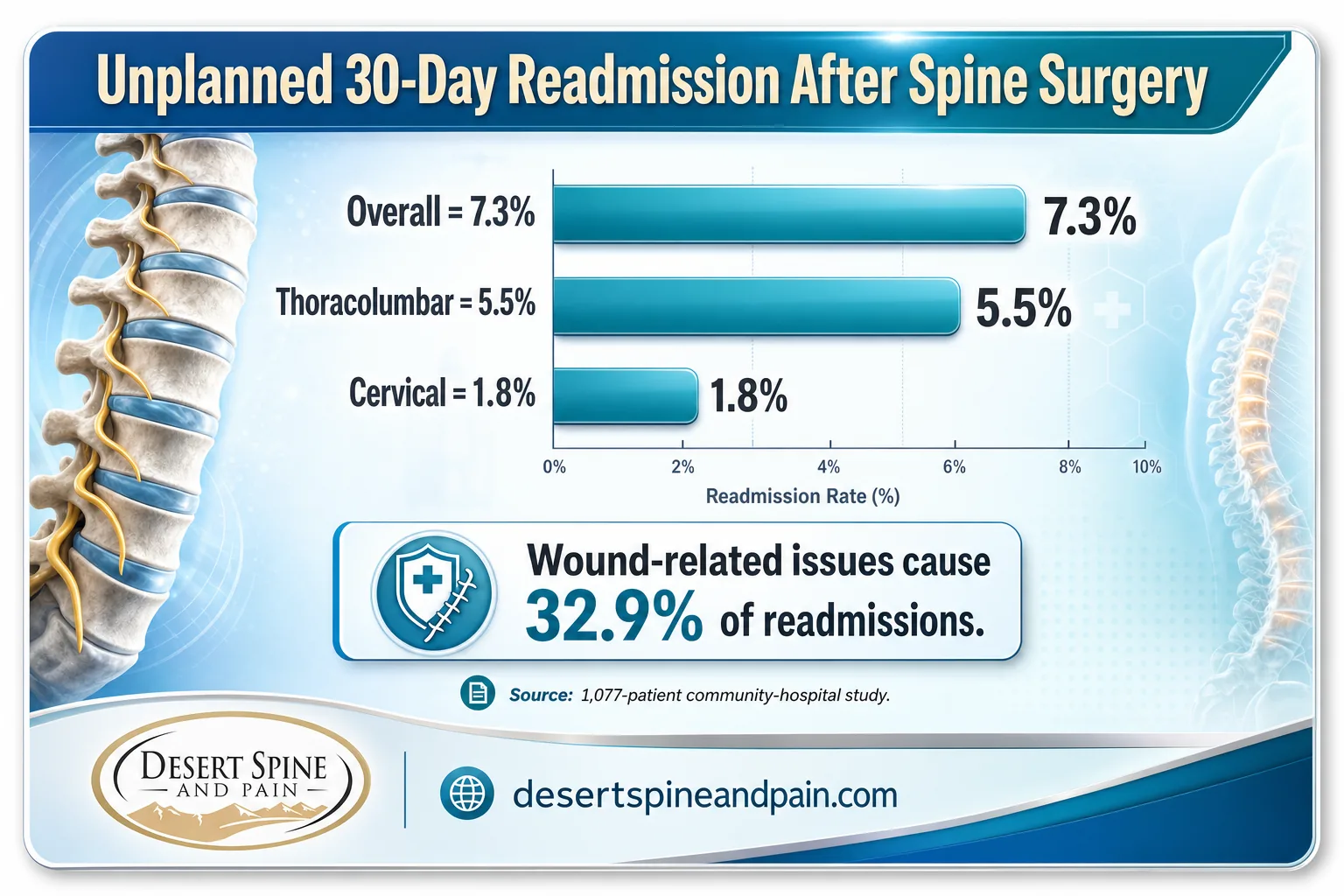
The pattern is instructive: cervical procedures readmit far less often than thoracolumbar ones, and wound-related issues top the list of reasons. Because the average readmission occurs over 11 days after surgery, good outpatient programs pair careful selection with clear discharge instructions and follow-up, so problems are caught early even after the patient has gone home.
Meet Dr. GreenwaldSource: Unplanned 30-day readmission after spine surgery, PubMed
4Patient Selection Criteria
The single most important factor in outpatient spine surgery safety is choosing the right patient. The literature is specific about who should stay in the hospital instead.
These criteria exist because the safety data has a flip side: when the wrong patient is chosen, outpatient surgery can carry higher risk. One national database study found outpatient ACDF was associated with greater perioperative surgical complications in its population, a reminder that same-day discharge is not automatically appropriate. The evidence supports outpatient surgery for healthier patients and less complex procedures, and a hospital stay for those who need closer monitoring.

Headlines that say outpatient spine surgery is just as safe are true, but incomplete. That safety applies to carefully selected patients undergoing appropriate procedures. In higher-risk patients, or for more complex operations, some studies show greater complication risk with same-day discharge. The statistics reward disciplined selection, matching patient, procedure, and setting, rather than defaulting to outpatient because it is convenient or lower cost.
Source: Safety considerations in ambulatory spine surgery, PMC
5Which Procedures and Why It's Growing
Not every spine operation is suited to same-day discharge, but the list of outpatient-appropriate procedures has grown steadily as techniques have improved.
The procedures most suited to outpatient care share a theme: they use minimally invasive or endoscopic approaches that limit tissue trauma, reduce blood loss, and speed recovery. As these techniques have matured, more operations have safely moved to the same-day setting. The driving forces, better technique, high patient satisfaction with home recovery, and cost pressure, all point the same direction, tempered always by patient selection.
The outpatient spine data tells a consistent story: same-day surgery is as safe as inpatient care for the right patient and procedure, and riskier for the wrong ones. The value is not in sending everyone home the same day, but in accurately matching each patient to the safest setting. That judgment, weighing age, health, procedure complexity, and support at home, is a clinical decision that rewards experience, not a box to check for convenience. Interpretation original to Desert Spine and Pain.
Desert Spine and Pain works with out-of-network patients of every kind and partners closely with personal injury attorneys, offering 24/7 concierge response and documentation coordination for injured clients evaluating their surgical options.
See all surgical optionsSource: Current trends in ambulatory spine surgery, PMC
Summary Table: Outpatient Spine Surgery Statistics 2026
| Statistic | Figure | Source | Year |
|---|---|---|---|
| Systematic review studies (ambulatory spine) | 56 | Same-day orthopedic review | 2021 |
| Outpatient vs inpatient complications | Mostly no difference | Same-day orthopedic review | 2021 |
| Overall unplanned 30-day readmission | 7.3% | Community-hospital study (1,077) | 2020 |
| Cervical readmission rate | 1.8% | Community-hospital study | 2020 |
| Thoracolumbar readmission rate | 5.5% | Community-hospital study | 2020 |
| Wound-related share of readmissions | 32.9% | Community-hospital study | 2020 |
| Mean time to readmission | 11.4 days | Community-hospital study | 2020 |
| Outpatient lumbar fusion adverse events | No difference | ACS-NSQIP (Bovonratwet) | 2019 |
| ASC ACDF morbidity/reoperation | Decreased | ACS-NSQIP (McGirt) | 2015 |
| Inpatient criteria: age | Over 65 | Ambulatory spine review | 2019 |
| Inpatient criteria: operative time | Over 120 min | Ambulatory spine review | 2019 |
| Outpatient ACDF complication signal | Higher in one database | Ambulatory safety review | 2023 |
Frequently Asked Questions
Is outpatient spine surgery safe?
What is the readmission rate after outpatient spine surgery?
Which spine surgeries can be done outpatient?
Who is a good candidate for outpatient spine surgery?
Why has outpatient spine surgery increased?
Methodology & Sources
How we compiled these statistics
Every figure traces to a Tier 1 primary source: systematic reviews, national surgical database analyses (ACS-NSQIP), and peer-reviewed cohort studies. Safety and readmission figures reflect differences in procedure, patient selection, and how outpatient status is defined, since same-day discharge and 23-hour observation are not always distinguished. All statistics describe populations, not any individual patient.
Primary sources referenced:
- Ambulatory spine surgery, PMC (review of settings, selection criteria, and cost drivers)
- Current trends in ambulatory spine surgery: a systematic review, PMC
- Outcomes of same-day orthopedic surgery: spine patient recovery, PMC (review of 56 articles)
- Unplanned 30-day readmission rates after spine surgery in a community-based hospital, PubMed
- Safety considerations with current ambulatory trends, PMC
This article is educational and is not individual medical advice. For guidance specific to your spine condition and whether outpatient surgery is right for you, consult a qualified spine surgeon. No outcome can be guaranteed.
Journalists and researchers may cite these statistics with attribution to Desert Spine and Pain and a link to this page. Please attribute the underlying figures to their original Tier 1 sources as listed above. For expert commentary on outpatient spine surgery data from a board-certified neurosurgeon and spine surgeon, contact Desert Spine and Pain at (602) 566-9500.