
Microdiscectomy Success Rate: What the Research Shows
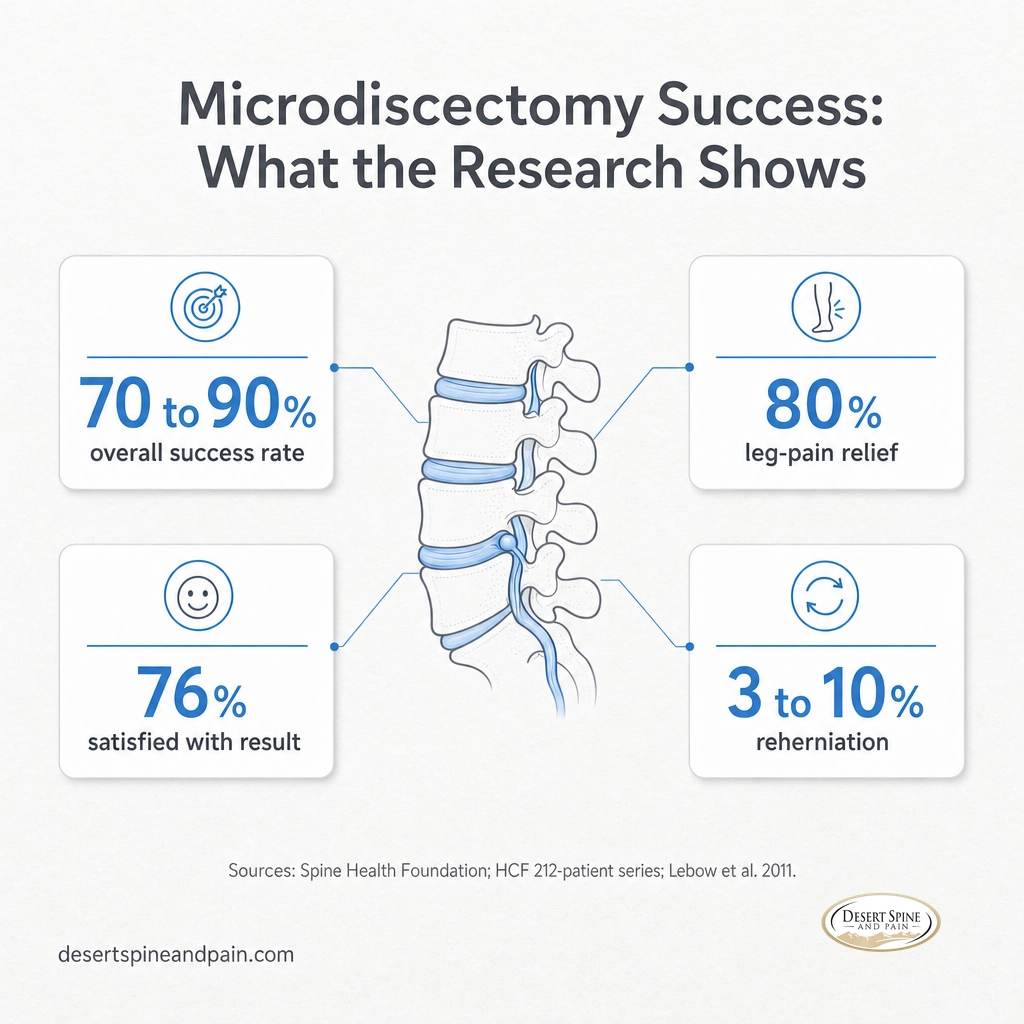
Research puts the success rate of microdiscectomy at roughly 70 to 90 percent, and the single most important detail behind that range is what kind of pain you have: the surgery relieves leg pain (sciatica) far more reliably than it relieves back pain. When the herniated disc clearly explains the leg symptoms, outcomes are strong and relief is often fast. When it does not, the numbers fall. This guide walks through what the peer-reviewed data and clinical series actually show, from leg-pain relief and recurrence to complications, recovery, and the factors that move your odds.
- Reported microdiscectomy success rates run about 70 to 90 percent, concentrated in leg-pain relief rather than back pain.
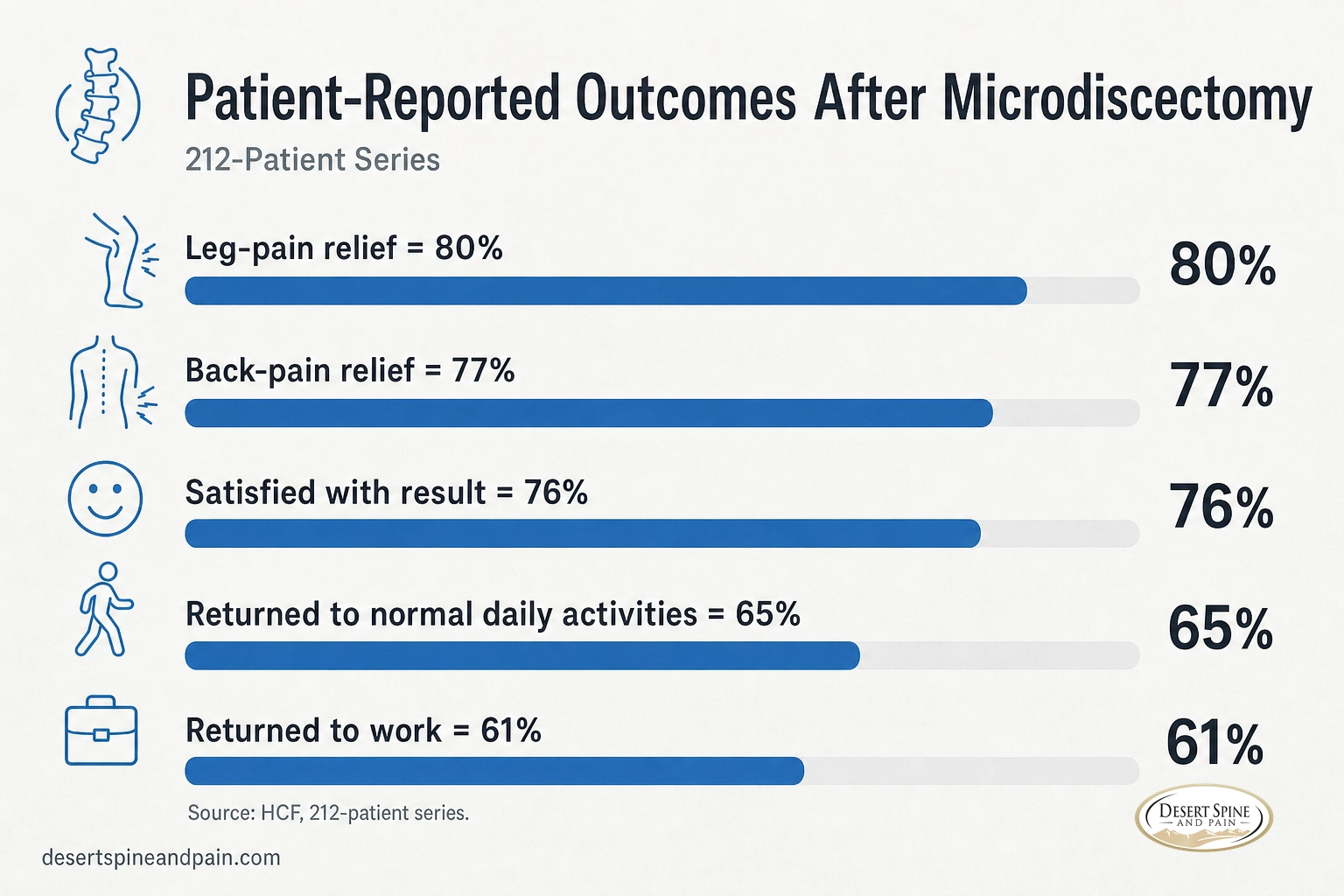
- In a 212-patient series, 80 percent had leg-pain relief, 77 percent back-pain relief, and 76 percent were satisfied with the result.
- 65 percent returned to normal daily activities and 61 percent of those who worked returned to work.
- Reherniation at the same disc is about 3 to 10 percent; only around 10 percent of recurrences lead to a second operation.
- Roughly 7 to 10 percent of patients get no improvement or feel worse, more often after long-standing symptoms.
- Serious complications are uncommon: cauda equina syndrome is reported in under 1 percent of cases.
- Timing and patient selection matter: outcomes are best when surgery is not delayed past about 6 to 12 months of matching symptoms.

What's in This Guide
- How Successful Is Microdiscectomy? The Headline Numbers
- Why Leg Pain Responds Better Than Back Pain
- Surgery vs. Waiting: What the Comparisons Show
- How Long Results Last: Recurrence and Reherniation
- Risks and Complications: How Often Things Go Wrong
- What Actually Drives a Good Outcome
- The Recovery Timeline
- Summary Table: Microdiscectomy Outcomes
- Frequently Asked Questions
1How Successful Is Microdiscectomy? The Headline Numbers
Microdiscectomy removes the small fragment of a herniated lumbar disc that is pressing on a nerve root, relieving the sciatica it causes. It is one of the most common spine operations, and across the published literature its success rate clusters in a wide but consistent band.
The reason the range is so wide is that "success" is defined differently across studies, and outcomes depend heavily on who is being operated on. A patient with classic leg pain, a matching disc on MRI, and a few months of failed conservative care sits near the top of that band. A patient with mostly back pain, a borderline image, or symptoms that have dragged on for years sits lower. The headline percentage is real, but it is an average across very different situations.
Our Phoenix practice, led by dual board-certified spine surgeon and neurosurgeon Dr. David L. Greenwald, performs microdiscectomy and evaluates whether a patient actually fits the profile that the success data describes.
See how microdiscectomy is performed in PhoenixSource: Deciding on disc surgery, Spine Health Foundation
2Why Leg Pain Responds Better Than Back Pain
The most useful thing the research reveals is not a single number, it is a pattern: microdiscectomy is a leg-pain operation. It decompresses a pinched nerve, so the symptom it fixes best is the one caused by that pinched nerve, radiating leg pain. Pure axial back pain responds far less predictably.
This is why a careful surgeon spends so much time matching the picture on the MRI to the pattern of your pain before recommending surgery. A disc herniation that lines up with a specific nerve and a specific leg-pain pattern is a strong candidate for a good microdiscectomy result. Back pain without clear nerve compression is a different problem, and a microdiscectomy is not the reliable answer for it.
Not usually. The data is clear that this operation treats leg pain (sciatica) better than it treats back pain, because it works by taking pressure off a nerve. If your dominant complaint is central low-back pain rather than radiating leg pain, microdiscectomy is less likely to deliver the result you are hoping for, and a thorough evaluation should establish that before any surgery is scheduled.
Source: Results vs risks of microdiscectomy, HCF | Microdiscectomy overview, Spine-health.com
3Surgery vs. Waiting: What the Comparisons Show
Many disc herniations improve on their own, which raises a fair question: does surgery actually beat patience? The comparative research gives a nuanced answer. Surgery tends to produce faster and greater relief, and that advantage holds for a couple of years, but timing shapes how big the gap is.
The practical takeaway is that surgery is rarely an emergency, but it is also not something to postpone indefinitely once a clear, disabling disc herniation has failed conservative care. Most patients try non-surgical treatment, physical therapy referrals, anti-inflammatory measures, and targeted injections such as epidural steroid injections, for several weeks to a few months first. If that fails and the leg pain is still clearly tied to the disc, the research supports moving forward rather than waiting years, because very long-standing symptoms carry lower success rates.
Review non-surgical treatment options firstSource: Microdiscectomy outcomes, Spine-health.com | Deciding on disc surgery, Spine Health Foundation
4How Long Results Last: Recurrence and Reherniation
When patients ask how many years a microdiscectomy "lasts," they are usually asking about reherniation, a new disc fragment escaping at the same level. This is the main reason a good result can later fade, and the published rates are reassuringly modest.
Not all sources agree on the exact figure. Some clinical series report reherniation as high as roughly a quarter of patients within the first year, especially when the original fragment was large or the disc space was already badly degenerated. The honest summary is that reherniation is a real but uncommon risk, and even when it happens, most patients do not end up needing repeat surgery. A recurrence is a manageable complication, not a failed operation.
Reading the recurrence data alongside the success data, a pattern emerges: the same factors that predict a strong initial result, a contained herniation, a healthy remaining disc, and a well-selected patient, also predict a durable one. The peer-reviewed 3 to 10 percent recurrence rate and the higher first-year figures from some series are not contradictory; they describe different patient populations. This is why the preoperative evaluation, not just the operation itself, shapes how long relief lasts. Interpretation original to Desert Spine and Pain.
Source: Microdiscectomy recurrence data, Spine-health.com | Recurrent herniation estimates, Spine Health Foundation
5Risks and Complications: How Often Things Go Wrong
An honest success rate has to include its mirror image: the share of patients who do not benefit, and the complications that can occur. Both are well documented, and both are relatively low for an operation performed this often.
Beyond these, the recognized risks include infection, bleeding, nerve-root irritation, and the small chance of persistent or recurrent leg pain. The most important predictor of a poor result is not a rare surgical accident, it is operating on the wrong problem or the wrong patient. That is why the 7 to 10 percent "no better or worse" figure tends to concentrate in patients whose pain was never a clean match for the disc on imaging, or whose symptoms had become chronic.
Understand the conditions microdiscectomy treatsSource: Microdiscectomy risks, HCF | Microdiscectomy complications, Hospital for Special Surgery
6What Actually Drives a Good Outcome
Across every source, the same three levers decide where a patient lands in the 70 to 90 percent range. None of them is luck, and all of them are decided before the operation begins.
- Patient selection. Leg pain that clearly matches a disc on MRI is the single strongest predictor of success. The clearer the match, the better the result.
- Timing. Relief is best when surgery is not delayed past roughly 6 to 12 months of persistent, matching symptoms. Beyond a year, success rates measurably decline.
- Surgeon experience and technique. Microdiscectomy is a precision operation around a nerve root. Judgment about who to operate on, and careful technique when operating, directly shape both the success rate and the complication rate.
This is the part of the data that patients control least directly but benefit from most. A thorough evaluation that confirms the diagnosis, respects the timing window, and is carried out by an experienced spine surgeon is what turns a population average into your individual result.

At Desert Spine and Pain, every candidate is evaluated against exactly these factors before microdiscectomy is recommended, and Dr. Greenwald's dual training as both a spine surgeon and a neurosurgeon brings a nerve-focused perspective to that decision.
Meet Dr. Greenwald, dual board-certified spine surgeon and neurosurgeonSource: Timing and patient-selection factors, Spine Health Foundation
7The Recovery Timeline
Recovery is quicker than most patients expect, which is part of why microdiscectomy is considered minimally invasive. The leg pain often eases right away, while the nerve itself heals more gradually.
One important nuance: pain relief and neurological recovery are not the same clock. Radiating leg pain frequently improves almost immediately, but numbness, tingling, or weakness can take weeks or even months to resolve because the compressed nerve needs time to recover. That slower timeline is normal and is not a sign the surgery failed. Following the activity and therapy plan closely is one of the few recovery variables fully in the patient's hands.
Ask about recovery and candidacy: (602) 566-9500Source: Microdiscectomy recovery, Hospital for Special Surgery
Summary Table: Microdiscectomy Outcomes
| Outcome | Figure | Population / Note | Source |
|---|---|---|---|
| Overall reported success rate | 70 to 90% | Mostly leg-pain relief; varies with timing/selection | Spine Health Foundation |
| Success rate commonly quoted to patients | 80 to 85% | Clear symptom-to-disc match | Spine Health Foundation |
| Leg-pain relief | 80% | 212-patient series | HCF |
| Back-pain relief | 77% | 212-patient series | HCF |
| Satisfied with result | 76% | 212-patient series | HCF |
| Returned to normal daily activities | 65% | 212-patient series | HCF |
| Returned to work | 61% | Of those working beforehand | HCF |
| No improvement or worse | 7 to 10% | Higher with long-standing symptoms | HCF |
| Reherniation at same level | 3 to 10% | Peer-reviewed; some series report higher first-year rates | Spine-health.com (Lebow 2011) |
| Recurrence leading to second surgery | ~10% | Of symptomatic recurrences | Spine-health.com |
| Cauda equina syndrome | Under 1% | Most serious nerve complication | HSS |
| Surgical advantage over non-operative care | Up to 2 years | Greater improvement with surgery | Spine-health.com (Abraham 2016) |
Frequently Asked Questions
What is the success rate of microdiscectomy?
How many years does a microdiscectomy last?
Will I ever be normal after a microdiscectomy?
What are the downsides of microdiscectomy?
Is microdiscectomy surgery worth it?
Methodology & Sources
How we compiled these figures
This article synthesizes published, publicly available data on microdiscectomy outcomes rather than first-party data from our practice. Figures are drawn from peer-reviewed clinical literature, surgeon-authored clinical references, and institutional patient resources, and each statistic is attributed to the source that reports it. Where sources disagree, such as reherniation rates, we present the range and note which figures come from peer-reviewed series versus clinical estimates. "Success" is defined differently across studies (leg-pain relief, patient satisfaction, return to work), so we report the specific measure alongside each number. All figures describe populations and averages, not any individual patient's expected result.
Primary sources referenced:
- Spine Health Foundation, "Deciding on Disc Surgery" (Neville Alleyne, MD): success-rate range, timing effects, recurrence estimates, procedure volume
- Spine-health.com (Veritas Health), microdiscectomy overview: reherniation (Lebow et al., 2011), surgery vs. non-operative outcomes (Abraham et al., 2016), symptom-improvement timeline (Dydyk et al., StatPearls)
- HCF patient resource, "Results vs risks of microdiscectomy": 212-patient outcome series (leg pain, back pain, satisfaction, activity, work, no-improvement rate)
- Hospital for Special Surgery, microdiscectomy patient library: complication rates, recovery timeline, operative duration
This article is educational and is not individual medical advice. Outcomes vary by patient, and no surgical result can be guaranteed. For guidance specific to your spine condition, consult a qualified spine surgeon.
Journalists and researchers may cite this summary with attribution to Desert Spine and Pain and a link to this page, and should attribute the underlying figures to their original sources as listed above. For expert commentary on microdiscectomy outcomes from a dual board-certified spine surgeon and neurosurgeon, contact Desert Spine and Pain at (602) 566-9500.