
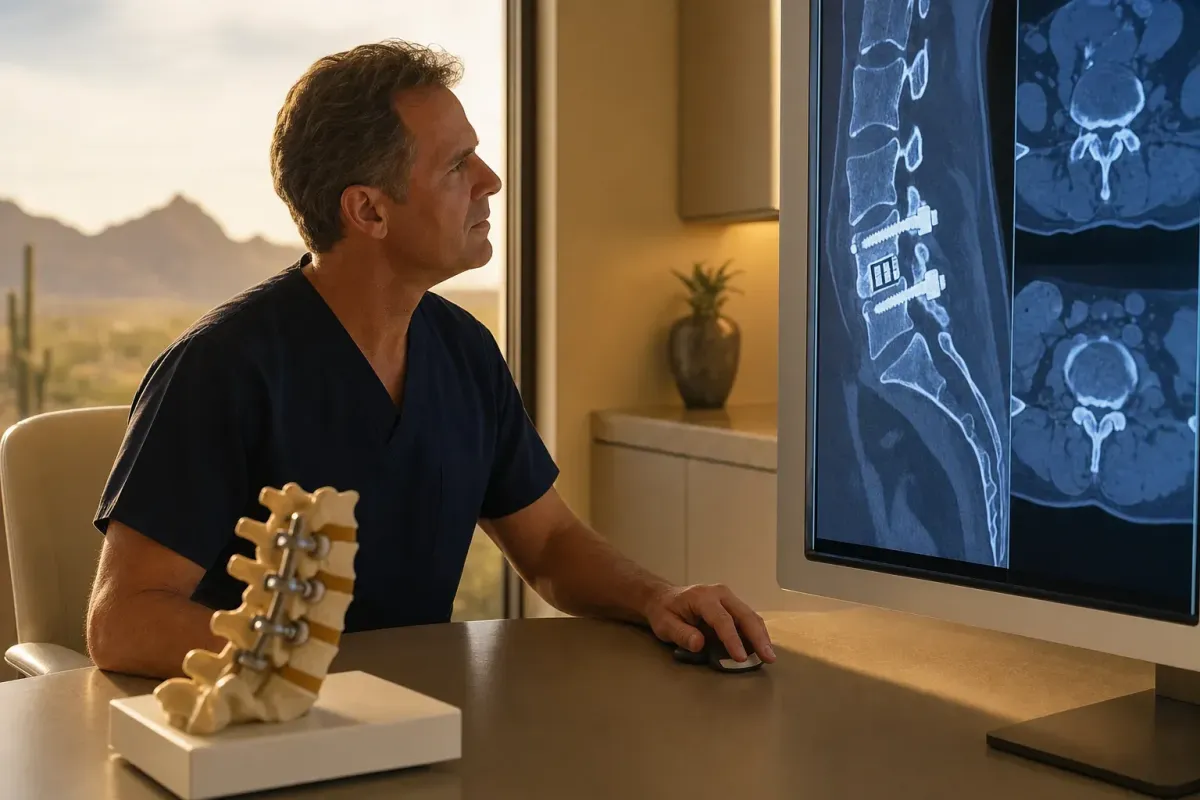
Lumbar Fusion Statistics (2026): Success, Reoperation, and the Fusion Debate
Lumbar fusion succeeds in roughly 90 percent of well-selected patients and is essential for instability and deformity. But one of the most important findings in modern spine research is that for many stenosis patients, decompression alone works just as well as adding a fusion, making patient selection the decisive factor in a good outcome.
- Lumbar fusion succeeds in about 90 percent of appropriately selected patients, with a satisfaction rate near 71 percent.
- Reported success ranges from about 65 to over 90 percent, driven largely by how success is defined and by patient factors.
- A national meta-analysis of 39 studies found reoperation of about 10 percent for fusion and 9 percent for decompression with fusion.
- In a 5-year randomized trial, reoperation was 22 percent (decompression alone) versus 24 percent (decompression plus fusion), with decompression alone trending better clinically.
- Randomized trials found adding fusion did not improve satisfaction or disability for many stenosis patients, but increased operative time, blood loss, and hospital stay.
- Despite that evidence, fusion use for stenosis with spondylolisthesis rose from 67 percent to 90 percent between 2016 and 2019.
- Fusion remains vital for instability and deformity, so the key is matching the operation to the diagnosis.
What's in This Guide
1What Lumbar Fusion Treats
Lumbar fusion permanently joins two or more vertebrae to eliminate motion at a painful or unstable segment. It is a cornerstone operation for instability, spondylolisthesis (slipped vertebra), deformity such as scoliosis, and some degenerative disc conditions.
Fusion is genuinely valuable when the spine is unstable or deformed, since stabilizing the segment is exactly what those conditions require. The debate, explored below, is not about whether fusion works, but about when it is truly needed versus when a less invasive decompression would serve the patient just as well.
Our Phoenix practice, led by board-certified neurosurgeon and spine surgeon Dr. David L. Greenwald, MD, FACS, reserves fusion for patients who clearly benefit from it and favors the least invasive effective option otherwise.
Explore lumbar fusion in PhoenixSource: Lumbar fusion success and sequelae narrative review, AOAO
2Success and Satisfaction Rates
For the right patient, lumbar fusion is a highly effective operation. Its success and satisfaction figures are strong, though the range is wide because so much depends on the diagnosis and how success is measured.
The honest picture is a wide but generally favorable range. A frequently cited figure puts fusion success near 90 percent with about 71 percent satisfaction, while long-term prospective data shows combined satisfaction in the mid-80s. Reported success for a single level such as L4-L5 spans 65 to over 90 percent depending on age, health, and technique. The variation is real and mostly explained by patient selection and definitions.
Learn about spinal fusion optionsSource: Peer-reviewed compilation, Spine Together
3Reoperation and Complications
Reoperation rates after lumbar fusion are moderate and comparable to other lumbar procedures, though they rise with follow-up time and vary by diagnosis.
A national meta-analysis of 39 cohort studies found reoperation rates that were similar across decompression (11 percent), fusion (10 percent), and decompression with fusion (9 percent), concluding that reoperation after lumbar degenerative surgery is generally low. Complications such as greater blood loss and longer hospital stay are, however, consistently higher for fusion than decompression alone, which matters when weighing the two.
Meet Dr. GreenwaldSource: Reoperation rates national cohort meta-analysis, ScienceDirect
4Fusion vs Decompression Alone
This is the most important lumbar fusion topic of the past decade. Multiple high-quality randomized trials have asked whether adding a fusion to a decompression actually helps patients with stenosis, and the answer is often no.
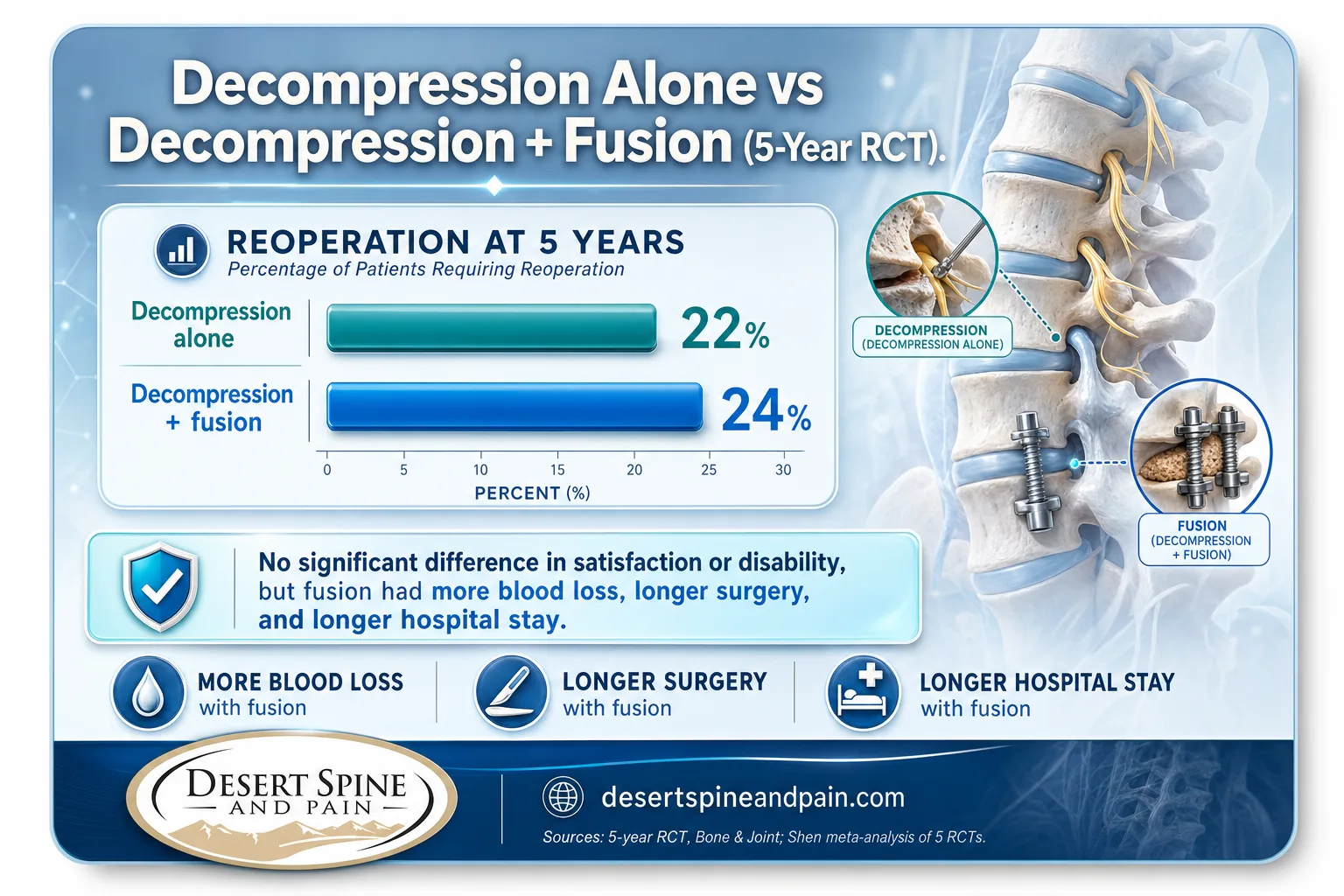
In a 5-year randomized clinical trial for lumbar stenosis, patients treated with decompression alone actually trended toward better clinical outcomes than the fusion group, and reoperation rates were similar (22 versus 24 percent). A meta-analysis of five randomized trials found no significant difference in satisfaction or disability, but significantly more operative time, blood loss, and hospital stay with fusion. The landmark 2016 SLIP and SPORT-related trials reached compatible conclusions for degenerative spondylolisthesis.
Here is one of the most striking statistics in spine surgery. After two major 2016 trials suggested fusion was not superior to decompression alone for many stenosis patients with spondylolisthesis, the use of decompression-with-fusion actually rose from 67.4 percent to 90.4 percent between 2016 and 2019, a 113 percent increase, while decompression alone fell. Evidence and practice diverged. This is precisely why a surgeon's commitment to evidence-based, least-invasive-first decision-making matters so much for patients.
Source: Decompression alone vs with fusion, 5-year RCT, Bone & Joint | Practice patterns after major trials, JAMA Network Open
5Why Selection Matters
The lumbar fusion data does not say fusion is bad. It says fusion is powerful when needed and unnecessary when it is not, and telling the difference is the surgeon's job.
The nuance is important: in some conditions, such as certain upper lumbar disc herniations, fusion produced clearly better satisfaction (93.8 versus 66.7 percent). In others, such as typical stenosis with stable anatomy, it added risk without benefit. A skilled surgeon reads that distinction from each patient's imaging and symptoms, which is where dual spine-and-neurosurgery training and experience translate directly into better outcomes.

The fusion literature delivers a unified message: fusion is excellent for instability and deformity and often unnecessary for stable stenosis, yet its use has risen even where trials found no added benefit. That gap between evidence and practice is exactly where careful, honest surgical judgment protects patients, choosing decompression alone when it suffices and fusion only when the anatomy truly calls for it. The goal is the right operation, not the bigger one. Interpretation original to Desert Spine and Pain.
Desert Spine and Pain works with out-of-network patients of every kind and partners closely with personal injury attorneys, offering 24/7 concierge response and documentation coordination for injured clients weighing their surgical options.
See conservative care options firstSource: Upper lumbar HIVD decompression vs fusion study, PMC
Summary Table: Lumbar Fusion Statistics 2026
| Statistic | Figure | Source | Year |
|---|---|---|---|
| Lumbar fusion success rate | ~90% | Peer-reviewed compilation | 2026 |
| Fusion patient satisfaction | 71.1% | Peer-reviewed compilation | 2026 |
| Combined satisfaction (7.4-yr study) | 86.3% | Long-term prospective study | 2026 |
| L4-L5 fusion success range | 65 to 90%+ | Seminars in Plastic Surgery | 2021 |
| Reoperation, fusion (39-study meta) | 10% | National cohort meta-analysis | 2019 |
| Reoperation, decompression + fusion | 9% | National cohort meta-analysis | 2019 |
| Reoperation, fusion (pooled) | 3.9% | Peer-reviewed compilation | 2026 |
| Reoperation at 8-10 yr (stenosis, SPORT) | 11 to 18% | SPORT trial | 2015 |
| Fusion mortality | 0.11 to 0.32% | Peer-reviewed compilation | 2026 |
| 5-yr reoperation, decompression alone | 22% | 5-year RCT (Bone & Joint) | 2024 |
| 5-yr reoperation, decompression + fusion | 24% | 5-year RCT (Bone & Joint) | 2024 |
| Satisfaction/disability, fusion vs decompression | No significant difference | Shen meta-analysis (5 RCTs) | 2025 |
| Fusion use for stenosis+spondylolisthesis, 2016 | 67.4% | JAMA Network Open | 2016 |
| Fusion use for stenosis+spondylolisthesis, 2019 | 90.4% | JAMA Network Open | 2019 |
| Fusion satisfactory, upper lumbar HIVD | 93.8% vs 66.7% | Upper lumbar HIVD study | 2019 |
Frequently Asked Questions
What is the success rate of lumbar fusion?
What is the reoperation rate after lumbar fusion?
Is lumbar fusion better than decompression alone?
How long does lumbar fusion take to heal?
Why has lumbar fusion increased so much?
Methodology & Sources
How we compiled these statistics
Every figure traces to a Tier 1 primary source: randomized controlled trials, national population-based cohorts, systematic reviews, and meta-analyses. Success and reoperation ranges reflect differences in diagnosis, number of levels, follow-up length, and how success is defined. The fusion-versus-decompression comparison is drawn from randomized trials and large database studies. All statistics describe populations, not any individual patient.
Primary sources referenced:
- Decompression alone or decompression with fusion for lumbar spinal stenosis: five-year clinical results from a randomized clinical trial, Bone & Joint Journal
- Patterns in decompression and fusion procedures for lumbar stenosis after major clinical trial results, 2016 to 2019, JAMA Network Open
- Reoperation rates after posterior lumbar spinal fusion by preoperative diagnosis: national population-based cohort (39 studies)
- Lumbar fusion success and sequelae: a narrative review, AOAO (Shen et al. meta-analysis of 5 RCTs)
- Peer-reviewed success and satisfaction compilation, Spine Together
- Surgical outcomes for upper lumbar disc herniation: decompression alone versus fusion, PMC
This article is educational and is not individual medical advice. For guidance specific to your spine condition, consult a qualified spine surgeon. No outcome can be guaranteed.
Journalists and researchers may cite these statistics with attribution to Desert Spine and Pain and a link to this page. Please attribute the underlying figures to their original Tier 1 sources as listed above. For expert commentary on lumbar fusion data from a board-certified neurosurgeon and spine surgeon, contact Desert Spine and Pain at (602) 566-9500.