
Herniated Disc From Car Accident Statistics (2026): Diagnosis, Data, and Recovery
A herniated disc is one of the more serious injuries a crash can produce, and one of the most contested. Research reports lumbar disc herniation in up to 35 percent of people with moderate to severe spinal trauma from a collision, yet the injury is frequently disputed as pre-existing. This report covers the data on how crashes cause herniations, how imaging distinguishes new from old, and what recovery involves.
- Lumbar herniation appears in up to 35 percent of moderate-to-severe crash spinal trauma, per Spine Journal research.
- Only 5 to 20 per 1,000 adults are diagnosed with a herniated disc yearly, so a new post-crash herniation is clinically meaningful.
- MRI is the gold standard; X-rays do not show disc herniation, which is why early imaging can miss it.
- Specific MRI findings, high-intensity zones, new extrusion, annular tears, and Modic changes, point toward acute rather than pre-existing injury.
- Symptoms are often delayed by days, weeks, or months, appearing as pain radiates from the neck or lower back into the limbs.
- Treatment costs run roughly $20,000 to over $100,000, and most cases improve without surgery.
What's in This Report
1 How Often Crashes Cause Herniated Discs
A herniated disc happens when the soft inner core of an intervertebral disc pushes through its tougher outer ring, often pressing on a nearby nerve. Crashes are a recognized cause, though the frequency depends heavily on the severity of the collision.
Research published in The Spine Journal found lumbar disc herniation in up to 35 percent of individuals who experienced moderate to severe spinal trauma from a motor vehicle accident. That figure applies to serious trauma, not every fender bender, which is an important distinction. For context, in the general adult population only about 5 to 20 people per 1,000 are diagnosed with a herniated disc in a given year, so a new, symptomatic herniation appearing after a crash is a clinically significant event, not a routine finding.
This is the deep-dive companion to our broader report on car accident back injury data, which places disc herniation within the full spectrum of crash back injuries.

Source: Spine Journal data via clinical summary | Back injury epidemiology summary
2 How a Crash Herniates a Disc
The mechanism depends on the direction of impact, and the pattern is well described in the clinical literature. Discs fail when force exceeds what the annulus can contain, and different crashes load the spine in different ways.
At the lumbar level, herniation is generally driven by linear forces, the front-to-back loading of a head-on or rear-end impact. At the cervical level, herniation more often results from torsional or tangential forces, the rotational loading of a sideswipe or T-bone. Restraint systems, though unquestionably lifesaving, play a role in the injury pattern: the lap belt concentrates force at the lumbar spine and the shoulder belt at the cervical spine. When the force is sufficient, the disc can bulge, herniate, or in severe cases rupture, with the displaced material pressing on the spinal cord or nerve roots.
- Head-on and rear-end (linear forces): tend to produce lumbar herniation.
- Sideswipe and T-bone (torsional forces): tend to produce cervical herniation.
- Lap belt loading: concentrates force at the lumbar level.
- Shoulder belt loading: concentrates force at the cervical level.
A collision can cause an acute herniation outright, or it can convert a previously silent, degenerated disc into a painful, symptomatic one. Both are real, and both can be attributable to the crash. Discs also tend to fail partly from accumulated wear, so the picture is rarely as simple as "the crash created a brand-new disc from scratch." What matters clinically is whether the crash caused the symptoms, and that is a question imaging and an expert exam can answer.

Source: Traumatic disc herniation mechanism, clinical review
3 Telling New From Old: What the MRI Shows
This is the heart of the matter, both clinically and for anyone pursuing a claim. Because spinal degeneration is common, the question is rarely "is there a herniation" but "is this herniation new and crash-related, or old and pre-existing." Modern imaging can help answer it.
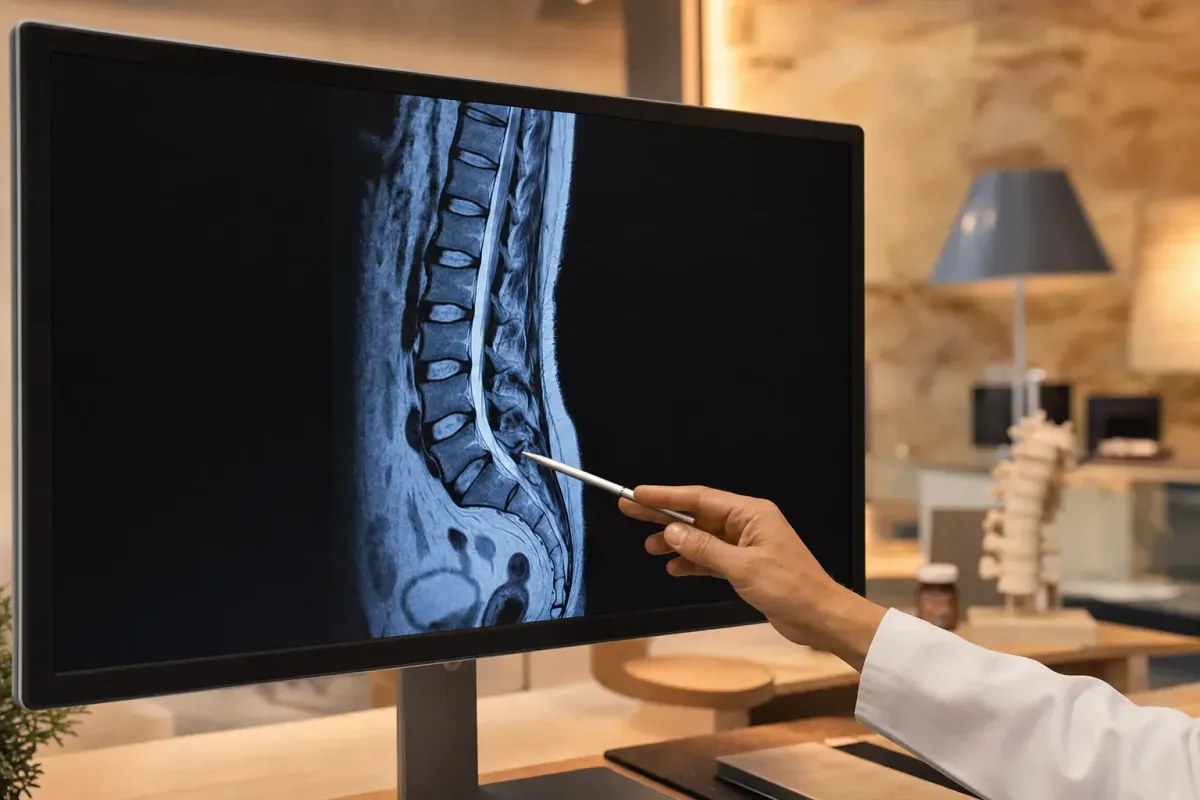
MRI is the gold standard for detecting disc herniation; plain X-rays cannot show it, which is one reason herniations are missed in early emergency evaluations. Beyond simply confirming a herniation, an MRI carries specific markers that point toward an acute, recent injury rather than long-standing wear.
- High-intensity zones (HIZ): bright signals in the annulus associated with recent annular tears.
- New or dramatic disc extrusion: disc material displaced beyond its normal boundary.
- Annular tears: disruptions in the outer disc ring.
- Modic changes: end-plate and bone-marrow changes that can signify recent injury.
- Absence of chronic degenerative markers: where surrounding structures look otherwise healthy.
No single finding is definitive on its own. The value comes from a spine specialist reading these features together, alongside the timeline of symptoms and the mechanism of injury. That integrated judgment, image plus history plus exam, is what distinguishes a credible acute diagnosis from guesswork, and it is exactly the kind of assessment a board-certified spine surgeon and neurosurgeon performs routinely.

Learn how we diagnose and treat herniated discs
Source: Clinical MRI findings in post-accident disc injury
4 Symptoms and Why They're Often Delayed
One of the most misunderstood features of a crash herniation is timing. The assumption that a serious injury announces itself immediately is often wrong, and that misunderstanding causes people to delay care.
Symptoms may be immediate, but they can also emerge days, weeks, or even months after the crash. A herniation that is just beginning at the time of the accident may not be visible on early imaging, and an initial emergency evaluation may record only "back pain." As inflammation develops or the disc continues to displace, what felt like ordinary post-crash soreness can progress into the classic pattern of a herniated disc.
That pattern depends on location. Cervical herniations tend to produce sharp, localized neck pain that can radiate into the arms, while lumbar herniations produce lower back pain that radiates into the buttocks, thighs, and legs, the syndrome commonly known as sciatica. Nerve compression can also cause numbness, tingling, and weakness. One symptom is an emergency: loss of bladder or bowel control, which requires immediate evaluation.
Source: Delayed-onset herniation clinical description | NIH StatPearls, Motor Vehicle Collisions
5 Treatment, Cost, and Recovery
The encouraging reality is that most herniated discs improve, and many never require surgery. Treatment follows a least-invasive-first ladder, escalating only when the response calls for it.
Conservative care comes first: targeted rehabilitation, anti-inflammatory medication, activity modification, and time. When pain persists, interventional options such as epidural steroid injections delivered at the affected disc level can reduce inflammation and nerve irritation. Surgery, typically a discectomy or microdiscectomy to remove the herniated portion, is reserved for cases with persistent nerve compression, significant or progressive weakness, or pain that does not respond to less invasive measures.
Cost tracks severity. Estimates for treating a herniated disc range from about $20,000 to more than $100,000 when diagnostics, conservative care, injections, and possible surgery are included. Cases involving permanent impairment or surgery can carry substantially higher lifetime costs, and research has documented that some post-traumatic herniations lead to chronic disability and long-term pain even when surgery is performed.
- Conservative: targeted rehabilitation, medication, activity modification, time.
- Interventional: epidural steroid injections at the affected level.
- Surgical: discectomy or microdiscectomy when nerve compression or weakness persists.
Explore our conservative and non-invasive options
Source: Herniated disc treatment cost and outcome data
6 What This Means for a Claim
For the personal injury attorneys whose clients make up much of any spine practice's caseload, the herniated disc is among the most valuable and most contested injuries. The data explains why, and where expert care makes the difference.
The central battleground is causation. Insurers and their reviewing physicians routinely argue that a herniation seen on MRI is old degeneration, not a crash injury, in order to dispute liability for medical bills, lost wages, and compensation. As the diagnostic section above shows, this argument is often answerable: acute markers on imaging, a clear symptom timeline, and an expert clinical assessment can establish that a crash caused the symptomatic injury, even when some background degeneration exists. A degenerated disc that was silent before the crash and painful after it is still a crash-related harm.
This is where the caliber of the treating physician matters. Desert Spine and Pain is led by Dr. David L. Greenwald, a board-certified surgeon who is both a spine surgeon and a neurosurgeon. His assessment of imaging and mechanism carries the clinical weight that these cases turn on. The practice offers personal injury attorneys 24/7 concierge coordination, fast response, and the thorough documentation their clients' claims depend on, all while pursuing the least invasive effective treatment first for the patient's own recovery.
Connect our team with your attorney or book a consultation
Source: Pre-existing condition defense in disc claims
7 Summary Data Table
| Statistic | Figure | Source | Year |
|---|---|---|---|
| Lumbar herniation in moderate-severe crash trauma | up to 35% | The Spine Journal | Cited |
| Herniated discs diagnosed per 1,000 adults/year | 5-20 | Published clinical data | Cited |
| Most common age range for symptomatic herniation | 30-50 | Back injury epidemiology | 2025 |
| Herniated discs that are lumbar (ages 25-55) | ~95% | Back injury epidemiology | 2025 |
| Male vs female likelihood | ~2 to 1 | Back injury epidemiology | 2025 |
| Gold-standard imaging | MRI | Clinical consensus | 2026 |
| Acute-injury MRI markers | HIZ, extrusion, annular tear, Modic | Clinical imaging data | 2026 |
| Typical treatment cost range | $20,000-$100,000+ | Clinical cost summary | 2025 |
| Lumbar mechanism | Linear forces (head-on/rear-end) | Clinical review | Cited |
| Cervical mechanism | Torsional forces (sideswipe/T-bone) | Clinical review | Cited |
| Symptom onset | Immediate to weeks/months | Clinical description | 2025 |
| Post-traumatic chronic disability risk | Documented even post-surgery | BMC Musculoskeletal Disorders | 2021 |
| First-line treatment | Conservative (non-surgical) | Clinical consensus | 2026 |
| Surgical option | Discectomy / microdiscectomy | Clinical consensus | 2026 |
| X-ray ability to show herniation | No (MRI required) | Clinical consensus | 2026 |
Frequently Asked Questions
How common is a herniated disc after a car accident?
How do doctors tell if a herniated disc is from the accident or pre-existing?
Why didn't my herniated disc show up right after the crash?
How much does treating a herniated disc cost?
Can a herniated disc from a crash heal without surgery?
All figures trace to primary and peer-reviewed sources. Herniation frequency in crash trauma is drawn from research published in The Spine Journal; general-population diagnosis rates, age, sex, and lumbar-share data from peer-reviewed back injury epidemiology; treatment cost and chronic-disability data from clinical summaries and a 2021 study in BMC Musculoskeletal Disorders. MRI diagnostic markers of acute injury reflect clinical imaging consensus. Where popular sources overstate how often crashes cause isolated traumatic herniation, this report favors the more precise clinical picture: crashes cause both acute herniations and the symptomatic aggravation of pre-existing degeneration, and imaging plus expert assessment distinguishes the two.