
Epidural Steroid Injection Statistics (2026): Success Rates, Volume, and Safety Data
Epidural steroid injections are one of the most common procedures in spine care, with an estimated 9 million performed each year in the United States. Reported success rates range from 18% to 90% depending on the diagnosis and technique, and serious complications are rare when the injection is done with image guidance. Here is what the 2026 data says about how well epidural steroid injections work, how often they are used, and how safe they are.
Key Takeaways
- About 9 million epidural steroid injections are performed annually in the U.S., among the most common interventional spine procedures.
- Success rates range from 18% to 90%, driven by diagnosis, injection approach, and how "success" is measured.
- Transforaminal injections lead for radicular pain: one study reported 84% success versus 48% for a saline control.
- Relief can last months to years: studies show benefit at 3, 6, and 12 months, and up to 2 years when injections are spaced out.
- Herniated-disc patients respond best, with success rates of 47% to 60% over 12 months versus lower rates for stenosis.
- Serious complications are rare: a large database found stroke risk of 0.46% and spinal cord injury risk of 0.08% for cervical transforaminal injections.
- Medicare utilization is falling, with epidural procedure rates down about 13% from 2019 to 2024 despite rising pain prevalence.
What's in This Guide
01 How Common Epidural Steroid Injections Are
Epidural steroid injections (ESIs) deliver anti-inflammatory medication into the epidural space around irritated spinal nerves. They are a mainstay of interventional pain care, and the sheer volume reflects that.
The roughly 9 million figure, cited in FDA Safe Use Initiative work and peer-reviewed safety reviews, underscores how routine these injections have become for lumbar and cervical radiculopathy. Yet utilization in the traditional Medicare population has fallen. CMS data analyzed in Pain Physician show epidural procedure rates down about 13% from 2019 to 2024, with treatment episodes down 22.6%, attributed to pandemic disruption, coverage policy changes, and economic factors rather than reduced patient need.
For a Phoenix practice serving many out-of-network and personal-injury patients, the takeaway is practical: these are well-established procedures with a long track record, and access to a physician who performs them with proper image guidance matters more than the raw utilization trend.
Source: Safety of ESIs (PMC, FDA Safe Use data) | Pain Physician, 2025 (CMS data)
See how epidural steroid injections work
02 Success Rates by Diagnosis and Approach
There is no single "success rate" for epidural steroid injections, because outcomes depend heavily on what is being treated and how the injection is delivered.
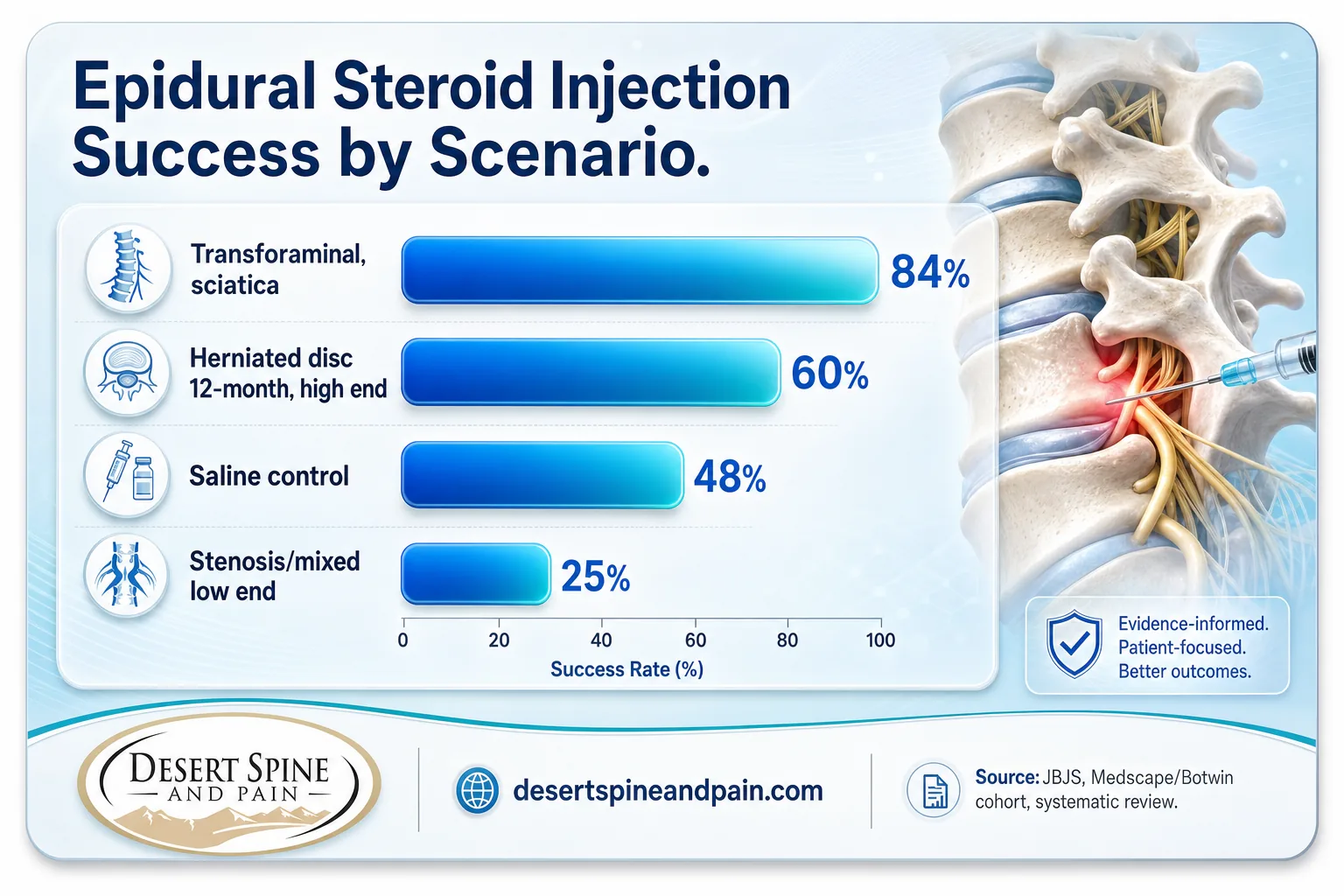
The wide 18% to 90% range reported in the literature reflects differences in diagnosis, technique, and outcome definitions. When studies isolate the right candidates, the picture sharpens. For radicular pain from a herniated disc, transforaminal injections consistently outperform other approaches: one controlled comparison found an 84% success rate for transforaminal injection versus 48% for saline. In a systematic review, herniated-disc (HNP) patients had the greatest rate of clinically meaningful improvement and 12-month success rates of 47% to 60%, higher than patients with spinal stenosis or degenerative disc disease.
Epidural Steroid Injection Success by Scenario
This variability is exactly why diagnosis-first care matters. An injection is not a generic fix; it is a targeted tool that works best when matched to the specific pain generator. Choosing the right approach, interlaminar, transforaminal, or caudal, and confirming the right level is what separates a helpful procedure from a wasted one.
Source: Medscape / Botwin cohort data | ScienceDirect systematic review, 2022
Learn about sciatica and radicular pain
03 How Long Relief Lasts
Duration of relief is one of the most common patient questions, and the honest answer is that it varies, but the data offers useful benchmarks.
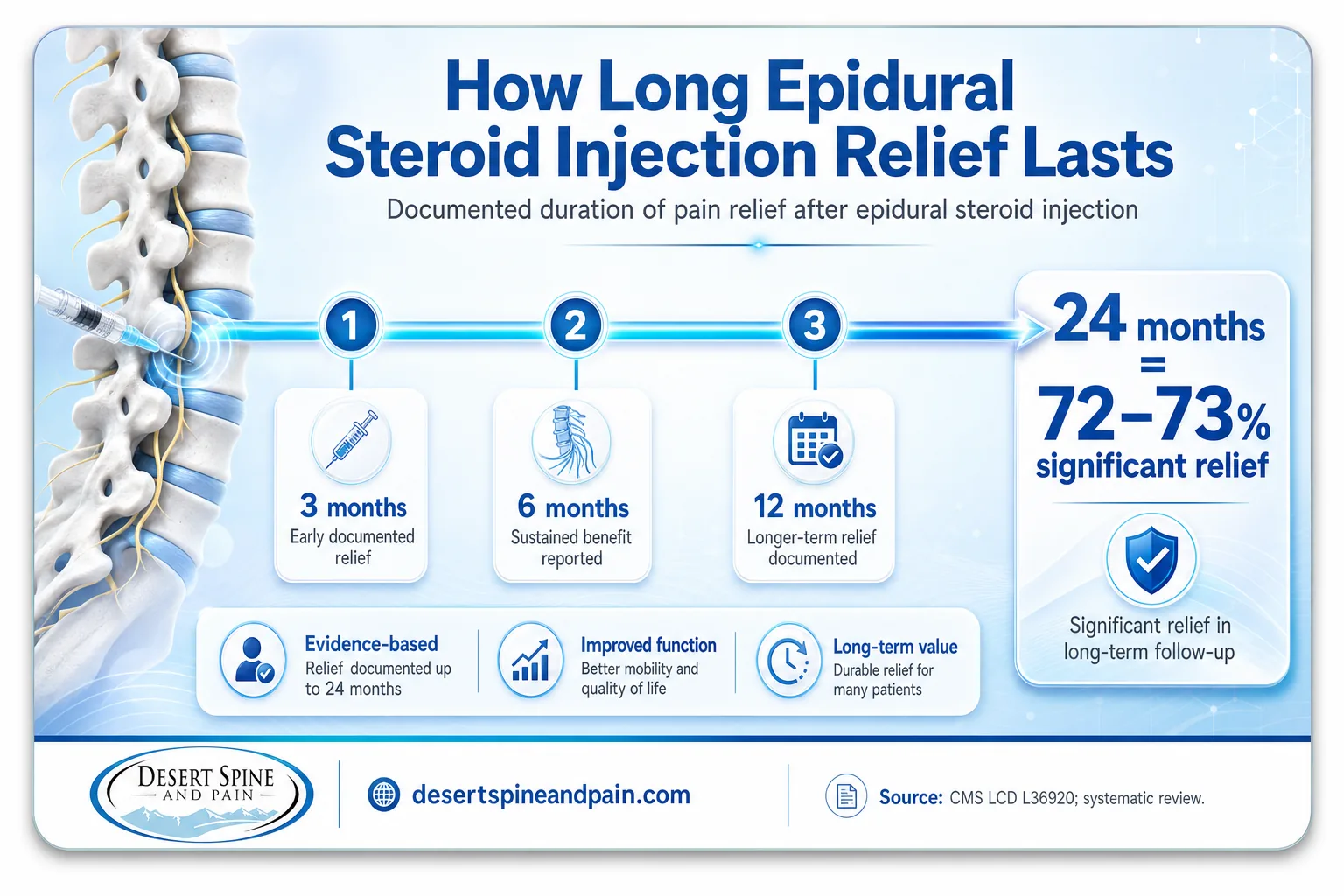
A CMS coverage review summarizing long-term trials found that 72% to 73% of patients receiving epidural injections with local anesthetic, with or without corticosteroid, reported significant pain relief at 24 months. Other studies document relief at the three, six, and twelve-month marks, with caudal ESIs using an in-dwelling catheter showing moderate-quality evidence of effectiveness for disc herniation with radicular pain across all three windows. Some patients maintain relief for up to two years when injections are appropriately spaced.
Myth: "If one injection doesn't cure it, injections don't work for me."
Epidural steroid injections are rarely framed as a one-and-done cure. They are designed to reduce inflammation and pain enough to support rehabilitation, function, and, in many cases, avoidance of surgery. Response often improves with a properly spaced series, and a partial response can still provide valuable diagnostic information about where the pain originates. Outcomes are not guaranteed, and the right plan depends on an individual evaluation.
Source: CMS LCD L36920, Epidural Steroid Injections
Explore the full range of interventional pain care
04 Safety and Complication Rates
Given how many injections are performed, safety is a fair question. The data consistently shows that serious complications are rare when procedures follow modern image-guided standards.
A large national database study of cervical transforaminal ESIs, among the most technically demanding, found major complications were uncommon: stroke risk of 0.46% and spinal cord injury risk of 0.08%. A prospective study of 10,261 fluoroscopically guided epidural procedures reported no major complications, with minor events including a 0.5% dural puncture rate and a 0.05% post-puncture headache rate. The FDA has cataloged rare serious neurological events, most tied to particulate steroids and cervical transforaminal technique, which is why current guidance calls for image guidance, contrast confirmation, and non-particulate steroids for cervical injections.
Desert Spine and Pain Analysis: Volume vs. Serious-Event Rate
Combining two Tier 1 figures, roughly 9 million ESIs performed annually against a spinal cord injury rate near 0.08% for the highest-risk cervical transforaminal approach, illustrates why technique and image guidance dominate the safety conversation. The overwhelming majority of injections proceed without major complication, and the rare serious events cluster in specific techniques that established safety protocols are designed to mitigate.
Formula: ~9M annual procedures, with major-complication rates reported below 0.5% even for the highest-risk cervical transforaminal subset.
Calculation and interpretation original to Desert Spine and Pain. Source figures: PMC ESI safety review (~9M/year) and large-database CTFESI complication rates.
The practical implication: who performs the injection, and how, matters as much as the procedure itself. A surgeon who is both a spine specialist and a neurosurgeon brings a deep understanding of the relevant anatomy to procedures where needle placement precision is everything.
Source: Complication rates after CTFESI (PMC, 2025) | CMS LCD L39054
Meet Dr. Greenwald, spine surgeon and neurosurgeon
05 Where Injections Fit in Spine Care
Epidural steroid injections sit in the middle of the least-invasive-first ladder, above conservative care and below surgery, and often serve as both treatment and diagnostic tool.
Coverage guidance generally positions ESIs after a period of conservative management. For lumbar disc herniation, CMS review notes that the condition can be effectively treated short-term by either transforaminal injection or surgery, but that long-term recurrence rates are high regardless of the treatment chosen. That reality reinforces a diagnosis-driven approach: an injection may resolve the immediate problem, delay or avoid surgery, or clarify whether a structural issue ultimately needs surgical attention.
The Injection-to-Surgery Decision
Because Dr. Greenwald is both a spine surgeon and a neurosurgeon, Desert Spine and Pain can carry a patient across the full ladder without a handoff:
- Conservative first: non-opioid medication, bracing, and physical therapy by referral.
- Interventional next: epidural steroid injections and related procedures, chosen by diagnosis.
- Surgery only when warranted: minimally invasive through complex spine surgery, when structure demands it.
The advantage of a dual-trained surgeon is knowing early when an injection is likely to hold and when a case genuinely needs surgical planning.
Source: CMS LCD L36920 | ScienceDirect systematic review, 2022
Review conservative, non-invasive care
06 All the Numbers in One Table
| Statistic | Figure | Source | Year |
|---|---|---|---|
| ESIs performed annually in U.S. | ~9 million | PMC / FDA Safe Use Initiative | 2026 |
| Reported success-rate range | 18-90% | JBJS / PMC review | 2026 |
| Transforaminal success (sciatica) | 84% | Medscape / Botwin cohort | 2026 |
| Saline control comparison | 48% | Medscape / Botwin cohort | 2026 |
| Herniated-disc 12-month success | 47-60% | ScienceDirect systematic review | 2022 |
| Stenosis/mixed low-end success | 25% | ScienceDirect systematic review | 2022 |
| Significant relief at 24 months | 72-73% | CMS LCD L36920 | 2026 |
| Caudal ESI benefit window | 3, 6, 12 mo | ScienceDirect systematic review | 2022 |
| Patients needing added injections | ~15% | ScienceDirect systematic review | 2022 |
| Stroke risk, cervical TFESI | 0.46% | PMC national database | 2025 |
| Spinal cord injury risk, cervical TFESI | 0.08% | PMC national database | 2025 |
| Dural puncture rate | 0.5% | CMS LCD (10,261-procedure study) | 2026 |
| Post-puncture headache rate | 0.05% | CMS LCD | 2026 |
| Intravascular penetration rate | 4.3% | CMS LCD | 2026 |
| Medicare epidural procedure decline | -13% | Pain Physician (CMS) | 2019-2024 |
| Medicare epidural episode decline | -22.6% | Pain Physician (CMS) | 2019-2024 |
| Historical Medicare procedure rate (65+) | 26.5/1,000 | APSF / Medicare claims | 2026 |
| FDA-cataloged neurological AEs (1997-2014) | 131 cases | FDA FAERS | 2026 |
07 Frequently Asked Questions
How many epidural steroid injections are performed each year?
What is the success rate of an epidural steroid injection?
How long does relief from an epidural steroid injection last?
Are epidural steroid injections safe?
Is an epidural steroid injection a substitute for surgery?
Methodology & Sources
All figures trace to Tier 1 primary sources: U.S. government coverage data, FDA safety records, and peer-reviewed journals. Annual procedure volume (~9 million) comes from a peer-reviewed ESI safety review citing FDA Safe Use Initiative data. Success-rate ranges and approach comparisons come from the Journal of Bone and Joint Surgery, Medscape clinical references citing the Botwin cohort, and a 2022 systematic review published via ScienceDirect. Long-term relief and complication figures come from CMS Local Coverage Determinations (L36920, L39054, L39015) and a 2025 national-database study of cervical transforaminal complications. Utilization trends come from CMS Medicare data analyzed by Manchikanti et al. in Pain Physician (2024, 2025).
Success rates vary substantially by diagnosis, injection approach, and outcome definition; ranges are presented rather than single figures where the literature is mixed. Prevalence and volume figures reflect the most recent published estimates available in 2026.
Media & press: Journalists and researchers may cite these statistics with attribution to Desert Spine and Pain and a link to this page. The Desert Spine and Pain Analysis box contains original calculation and interpretation.
Talk to a Phoenix Spine and Pain Specialist
Desert Spine and Pain is led by Dr. David L. Greenwald, MD, FACS, a board-certified surgeon who is both a spine surgeon and a neurosurgeon. The practice serves out-of-network patients across Greater Phoenix and partners with personal injury attorneys, offering 24/7 concierge response for their clients. Care follows a least-invasive-first philosophy, from conservative treatment through interventional pain management to complex spine surgery.
Call (602) 566-9500 to book a consultation.