
Endoscopic Spine Surgery Statistics (2026): Success Rates, Complications, and vs Microdiscectomy
Endoscopic spine surgery treats disc herniations and stenosis through an incision smaller than a fingertip, with success and satisfaction rates matching traditional microsurgery, one 1,000-case series reported 92 percent satisfaction and a 4 percent complication rate. Its defining lesson is that outcomes depend heavily on the surgeon's experience, since the technique has a genuine learning curve.
- In a study of 1,000 transforaminal endoscopy cases, disability (ODI) improved from about 56 to 18 percent, with 92 percent satisfaction.
- The overall complication rate was about 4 percent, with no major complications, in that series.
- Randomized trials found no significant difference in pain, disability, recurrence, or reoperation versus microdiscectomy.
- One randomized trial showed endoscopic patients had less leg pain at two years than open microdiscectomy patients.
- A 2025 meta-analysis pooled 87 studies and 3,238 patients comparing endoscopic with open and minimally invasive microdiscectomy.
- Complications tend to cluster early in a surgeon's experience, underscoring the learning curve.
- The transforaminal approach is used in about 50 percent of studies, the interlaminar in about 30 percent.
What's in This Guide
1What Endoscopic Spine Surgery Is
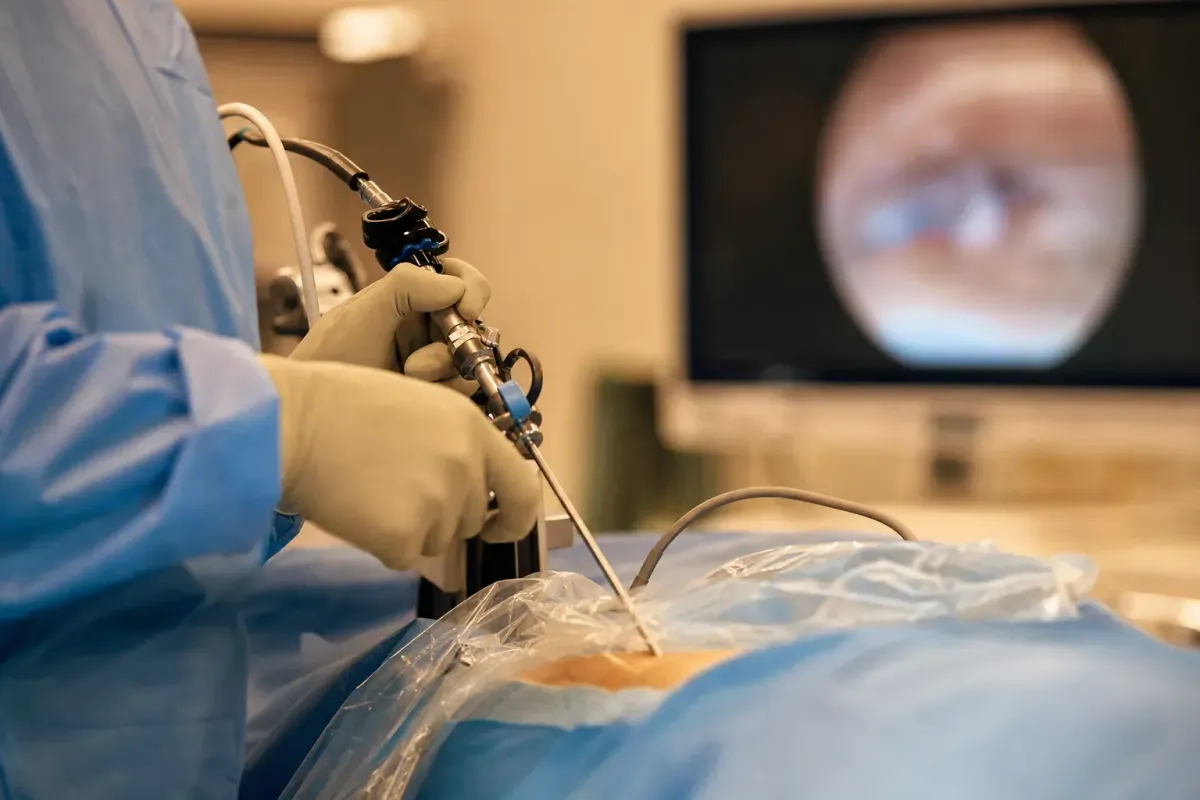
Endoscopic spine surgery uses a tiny camera and specialized instruments passed through an incision often smaller than a centimeter to treat disc herniations, stenosis, and other conditions. It is the least invasive of the surgical decompression techniques, typically done under local or conscious sedation, and usually as an outpatient procedure.
Endoscopic spine surgery has matured rapidly, moving from a niche technique to one supported by randomized trials and large series. Because it disrupts so little tissue, it offers fast recovery and low complication rates, but as the data will show, realizing those benefits depends heavily on the surgeon's specialized skill.
Our Phoenix practice, led by board-certified neurosurgeon and spine surgeon Dr. David L. Greenwald, MD, FACS, offers minimally invasive and endoscopic techniques when they are the right fit for a patient's condition.
Explore minimally invasive spine surgerySource: Endoscopic spine surgery scoping review, PMC
2Success and Satisfaction Rates
For appropriately selected patients, endoscopic spine surgery delivers strong, well-documented outcomes, with high satisfaction and substantial improvements in pain and function.
The 1,000-case series is a strong data point: disability more than halved, over 9 in 10 patients were satisfied, and complications were minimal. Across the literature, most patients achieve good or excellent modified MacNab outcomes. One important exception stands out, calcified disc herniations respond less well to endoscopic techniques, which is exactly the kind of nuance that guides patient selection.
Learn about microdiscectomySource: Effectiveness and safety of transforaminal endoscopy (1,000 cases), PMC
3Endoscopic Surgery vs Microdiscectomy
The most common comparison is between endoscopic discectomy and microdiscectomy, the established minimally invasive standard. Randomized evidence shows they are closely matched.
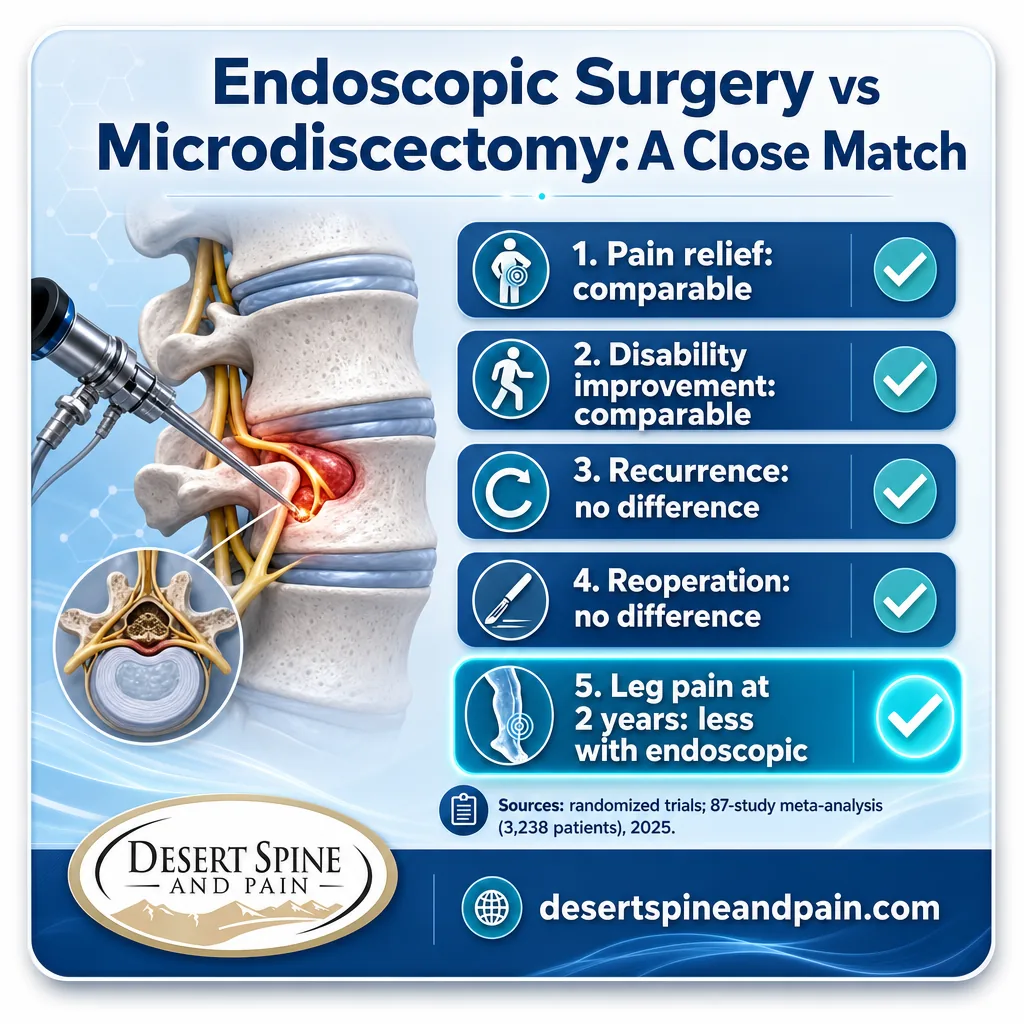
The evidence is consistent: endoscopic discectomy matches microdiscectomy on the outcomes that matter most, pain relief, disability improvement, recurrence, and reoperation, while some studies show advantages such as less residual leg pain and fewer analgesia and rehabilitation needs. The endoscopic approach is not automatically superior, but it is a genuinely comparable option with a smaller footprint for the right patient and an experienced surgeon.
Meet Dr. GreenwaldSource: PELD vs microdiscectomy randomized trial, PMC | Endoscopic microdiscectomy meta-analysis, PMC 2025
4Transforaminal vs Interlaminar
Endoscopic surgery uses two main routes to reach the disc, and understanding them helps explain how the technique is tailored to each patient's anatomy.
Both approaches produce significant, comparable improvements in pain and disability with no difference in long-term outcomes, so the choice is driven by anatomy rather than one being better. The transforaminal route uses the natural nerve exit opening and is most versatile, while the interlaminar route is often chosen at L5-S1, where the pelvis can block transforaminal access. Matching the approach to the level is part of the surgeon's craft.
Learn about discectomy optionsSource: Interlaminar vs transforaminal endoscopic discectomy, PMC
5The Learning Curve and Complications
The single most important theme in endoscopic spine surgery data is the learning curve. This technique rewards experience more than almost any other, which makes surgeon selection critical.
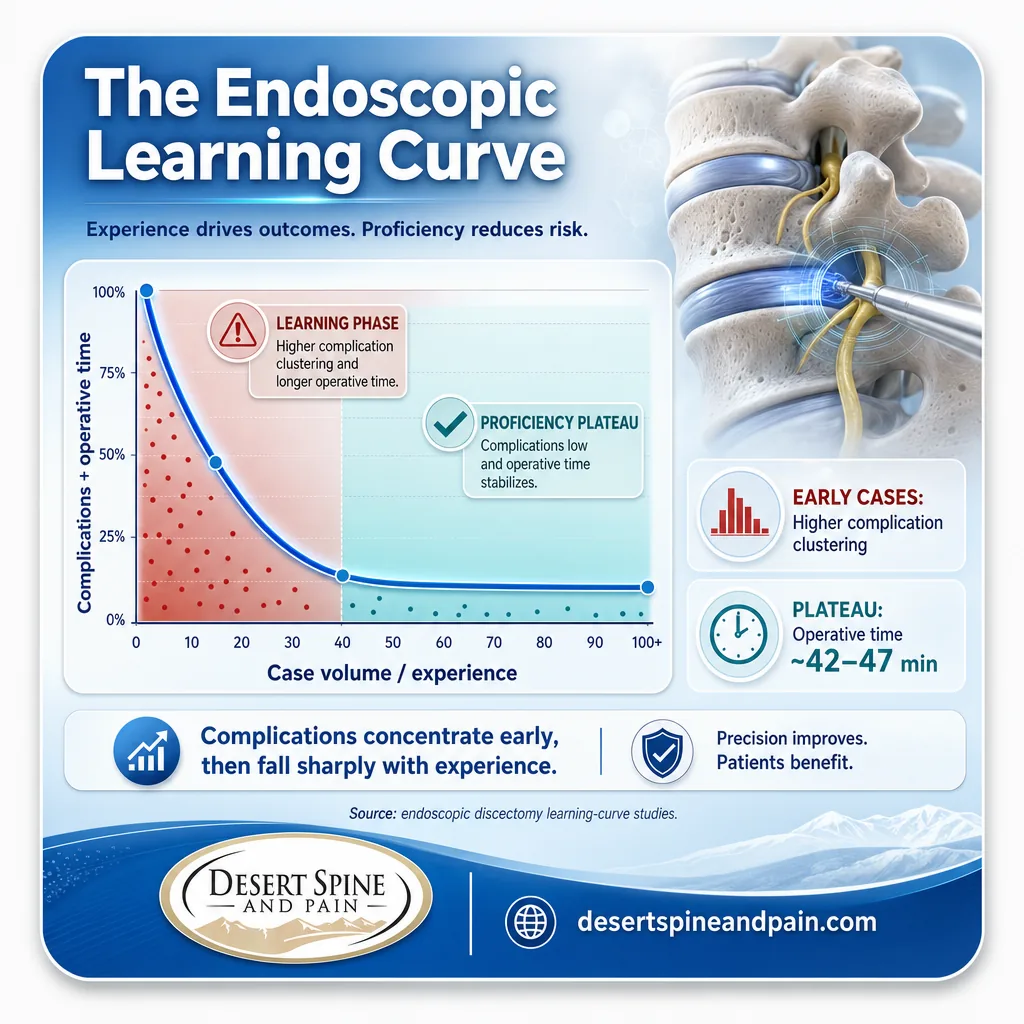
Endoscopic spine surgery data carries a clear message: the technology is excellent, but its results live or die on the surgeon's skill. Complications cluster early in a surgeon's experience and largely vanish with proficiency, and operative times fall as expertise grows. That is why the meaningful question is not just whether a procedure is endoscopic, but who is holding the scope. For patients, choosing a surgeon with deep minimally invasive and endoscopic experience is the single best predictor of a smooth result. Interpretation original to Desert Spine and Pain.
The same endoscopic procedure can produce very different results depending on the surgeon's experience. Studies repeatedly show complications concentrated in a surgeon's early cases, then falling sharply with proficiency. This is not a reason to avoid endoscopic surgery, it is a reason to choose an experienced surgeon for it. When the technique is matched to the right patient by skilled hands, the outcomes are excellent and the footprint is minimal.
Desert Spine and Pain works with out-of-network patients of every kind and partners closely with personal injury attorneys, offering 24/7 concierge response and documentation coordination for injured clients evaluating minimally invasive options.
Book a consultation: (602) 566-9500Source: Endoscopic discectomy learning curve and complications, PMC
Summary Table: Endoscopic Spine Surgery Statistics 2026
| Statistic | Figure | Source | Year |
|---|---|---|---|
| ODI before vs after (1,000 cases) | 56% to 18% | Transforaminal endoscopy (1,000) | 2025 |
| Patient satisfaction (1,000 cases) | 92% | Transforaminal endoscopy (1,000) | 2025 |
| Overall complication rate (1,000 cases) | 4% | Transforaminal endoscopy (1,000) | 2025 |
| Endoscopic vs microdiscectomy (pain/disability) | No significant difference | PELD vs micro RCT | 2020 |
| Leg pain at 2 years (endoscopic vs open) | Less with endoscopic | Gibson RCT | 2017 |
| Meta-analysis studies / patients | 87 / 3,238 | Endoscopic microdiscectomy meta-analysis | 2025 |
| Transforaminal approach share | 50.4% | Scoping review | 2025 |
| Interlaminar approach share | 30.0% | Scoping review | 2025 |
| Operative time after learning curve | 42 to 47 min | IELD vs TELD study | 2024 |
| ODI improvement (Australian series) | ~22 points | Endoscopic vs micro study | 2022 |
| Complication timing | Early / learning curve | IELD vs TELD study | 2024 |
| Thoracic endoscopic discectomy cost | Lower vs microdiscectomy | TETD cost-effectiveness study | 2025 |
Frequently Asked Questions
What is the success rate of endoscopic spine surgery?
Is endoscopic spine surgery better than microdiscectomy?
What are the complications of endoscopic spine surgery?
How steep is the learning curve for endoscopic spine surgery?
What is the difference between transforaminal and interlaminar endoscopy?
Methodology & Sources
How we compiled these statistics
Every figure traces to a Tier 1 primary source: randomized controlled trials, systematic reviews and meta-analyses, and large single-technique cohort studies. Success, complication, and operative-time figures reflect differences in approach, level, disc type, and crucially surgeon experience. Because endoscopic outcomes depend so strongly on the learning curve, we emphasize that factor. All statistics describe populations, not any individual patient.
Primary sources referenced:
- Effectiveness and safety of transforaminal spinal endoscopy: analysis of 1,000 clinical cases, PMC
- Percutaneous endoscopic lumbar discectomy versus microdiscectomy: randomized clinical trial, PMC
- Systematic review and meta-analysis of endoscopic lumbar microdiscectomy versus open and MIS microdiscectomy (87 studies), PMC, 2025
- Interlaminar versus transforaminal full-endoscopic lumbar discectomy for L4-L5 disc herniation, PMC
- Endoscopic spine surgery: a scoping review of the literature, PMC
This article is educational and is not individual medical advice. For guidance specific to your spine condition, consult a qualified spine surgeon. No outcome can be guaranteed.
Journalists and researchers may cite these statistics with attribution to Desert Spine and Pain and a link to this page. Please attribute the underlying figures to their original Tier 1 sources as listed above. For expert commentary on endoscopic spine surgery data from a board-certified neurosurgeon and spine surgeon, contact Desert Spine and Pain at (602) 566-9500.