
Cervical Spine Surgery Complications Statistics (2026): ACDF, C5 Palsy, and Approach Risk
Cervical spine surgery is highly effective, but its complications are distinct from lumbar surgery. A 2025 meta-analysis found an overall ACDF morbidity rate around 16 percent, with most events minor and temporary. The most important finding for patients is that complication risk shifts dramatically with the surgical approach, making the surgeon's judgment central to safety.
- A 2025 meta-analysis found an overall ACDF morbidity rate of about 16 percent, with most complications minor and self-limiting.
- The most common ACDF complications by frequency were excessive neck swelling (11.3%), pseudarthrosis (10.0%), dysphagia (9.5%), cage/graft subsidence (9.4%), and worsening myelopathy (7.7%).
- C5 palsy overall prevalence is about 5 to 6 percent, but ranges from roughly 1.1 percent after ACDF to 14 percent after corpectomy.
- Surgical approach changes the odds sharply: 4.3 percent C5 palsy for anterior versus 10.9 percent for posterior approaches.
- Dysphagia after anterior cervical surgery runs about 1.7 to 9.5 percent and is usually temporary.
- Switching from wide corpectomy to a combined ACDF-plus-corpectomy strategy reduced C5 palsy, showing technique directly affects risk.
- Because approach and level count drive risk, an experienced surgeon's choices are one of the strongest safety factors.
What's in This Guide
1Overall Cervical Surgery Complication Rates
Anterior cervical discectomy and fusion (ACDF) is one of the most common and successful spine procedures, relieving neck and arm pain from nerve compression. Like any surgery it carries risk, but the majority of complications are minor and resolve on their own.
The gap between the 16 percent overall morbidity figure and the 3 percent pooled rate of significant complications tells the real story: most cervical surgery complications are minor, such as temporary swelling or mild swallowing difficulty, while serious complications are relatively uncommon. Understanding that distinction helps patients weigh the procedure realistically.
Our Phoenix practice, led by board-certified neurosurgeon and spine surgeon Dr. David L. Greenwald, MD, FACS, brings dual expertise in both spine surgery and neurosurgery to cervical cases, where the proximity of the spinal cord and nerve roots makes precision especially important.
Explore cervical spine surgery optionsSource: ACDF complications meta-analysis, NASSJ 2025 | Anterior cervical complications review, JSS
2The Most Common ACDF Complications
The 2025 meta-analysis provides one of the clearest rankings of ACDF complications by frequency, drawn from decades of published studies. Most are manageable and temporary.
Most Common ACDF Complications by Incidence
Most common ACDF complications by pooled incidence. Source: NASSJ meta-analysis, 2025.
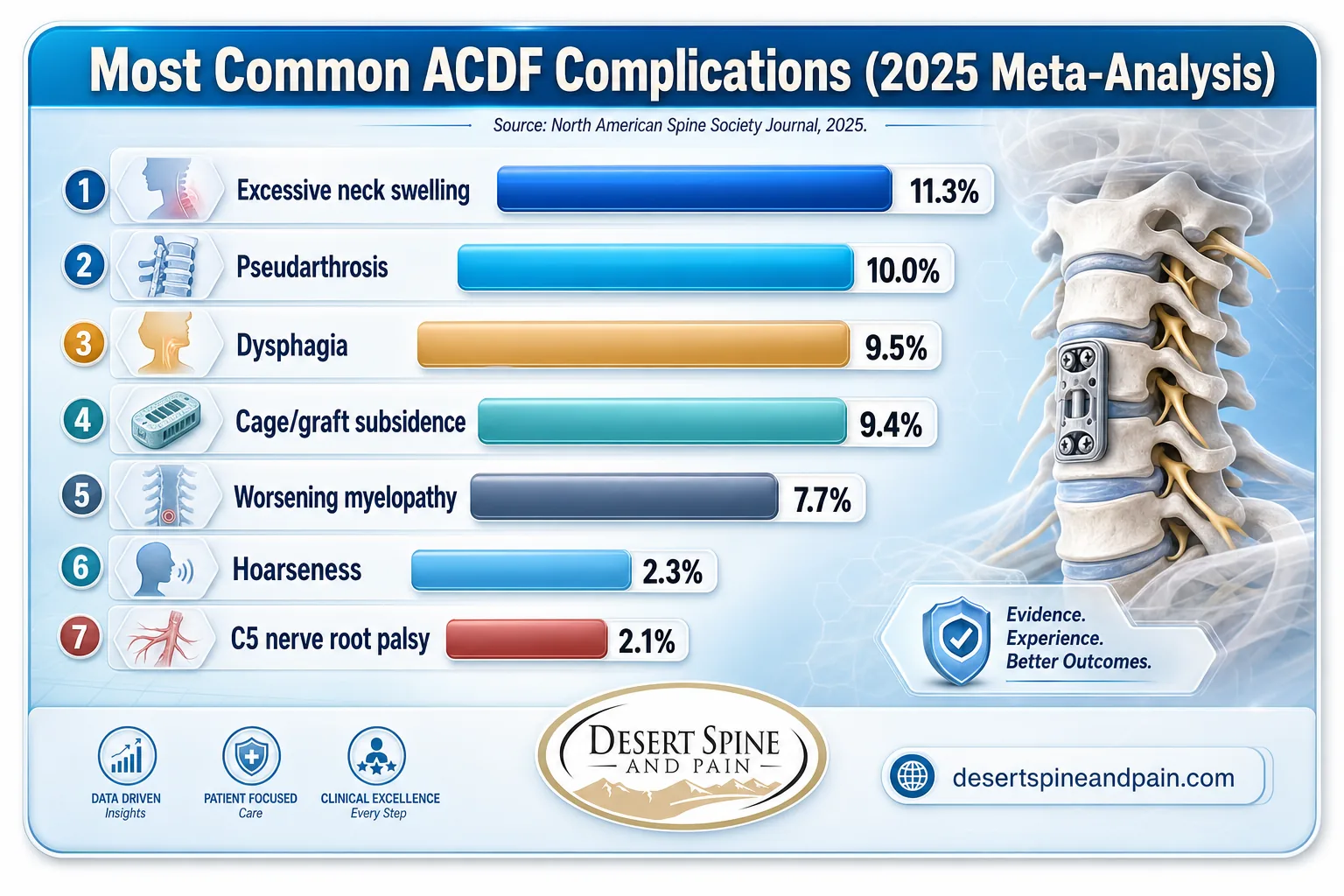
Several of these complications relate directly to the number of levels operated on and the specific technique used. Pseudarthrosis, or failed fusion, for example, is influenced by graft choice and instrumentation, the same factors that raise or lower fusion rates in the lumbar spine. This is another area where surgical decisions, not chance, shape the outcome.
Learn about cervical fusionSource: ACDF complications meta-analysis, NASSJ 2025
3Dysphagia and Voice Complications
Because anterior cervical surgery approaches the spine through the front of the neck, near the esophagus and the nerves that control the voice, swallowing and voice complications are characteristic of this route.
The reassuring news is that most of these complications are transient. Dysphagia typically improves over days to weeks, and hoarseness usually resolves as nerve irritation settles. Serious or permanent voice and swallowing problems are uncommon. Careful surgical technique, including gentle retraction and attention to operative time, is associated with lower rates.
For the large majority of patients, they are not. Post-surgical dysphagia is usually temporary, driven by swelling and retraction during surgery, and it resolves as the neck heals. While a small minority experience longer-lasting symptoms, framing every case as permanent misrepresents the data. Understanding the true, mostly temporary nature of these complications helps patients make a calmer, better-informed decision.
Source: ACDF complication rates review, SNI | Anterior cervical complications review, JSS
4C5 Palsy and the Approach Effect
C5 palsy, weakness of the shoulder and upper arm muscles after cervical surgery, is one of the most approach-dependent complications in all of spine surgery. The data here is the strongest illustration of how a surgeon's choices shape risk.
C5 Palsy Rate by Cervical Procedure and Approach
C5 palsy risk rises sharply with more extensive posterior procedures. Source: cervical decompression study, PMC.A study of 1,708 consecutive cervical decompression patients found the overall C5 palsy rate was 4.8 percent, but only 1.13 percent for ACDF versus 14 percent for corpectomy, and 4.3 percent for anterior versus 10.9 percent for posterior approaches. Crucially, the authors found that switching from a wide two-level corpectomy to a combined ACDF-plus-corpectomy construct significantly lowered the palsy rate. In other words, the surgeon's strategic choice measurably changed the complication risk.
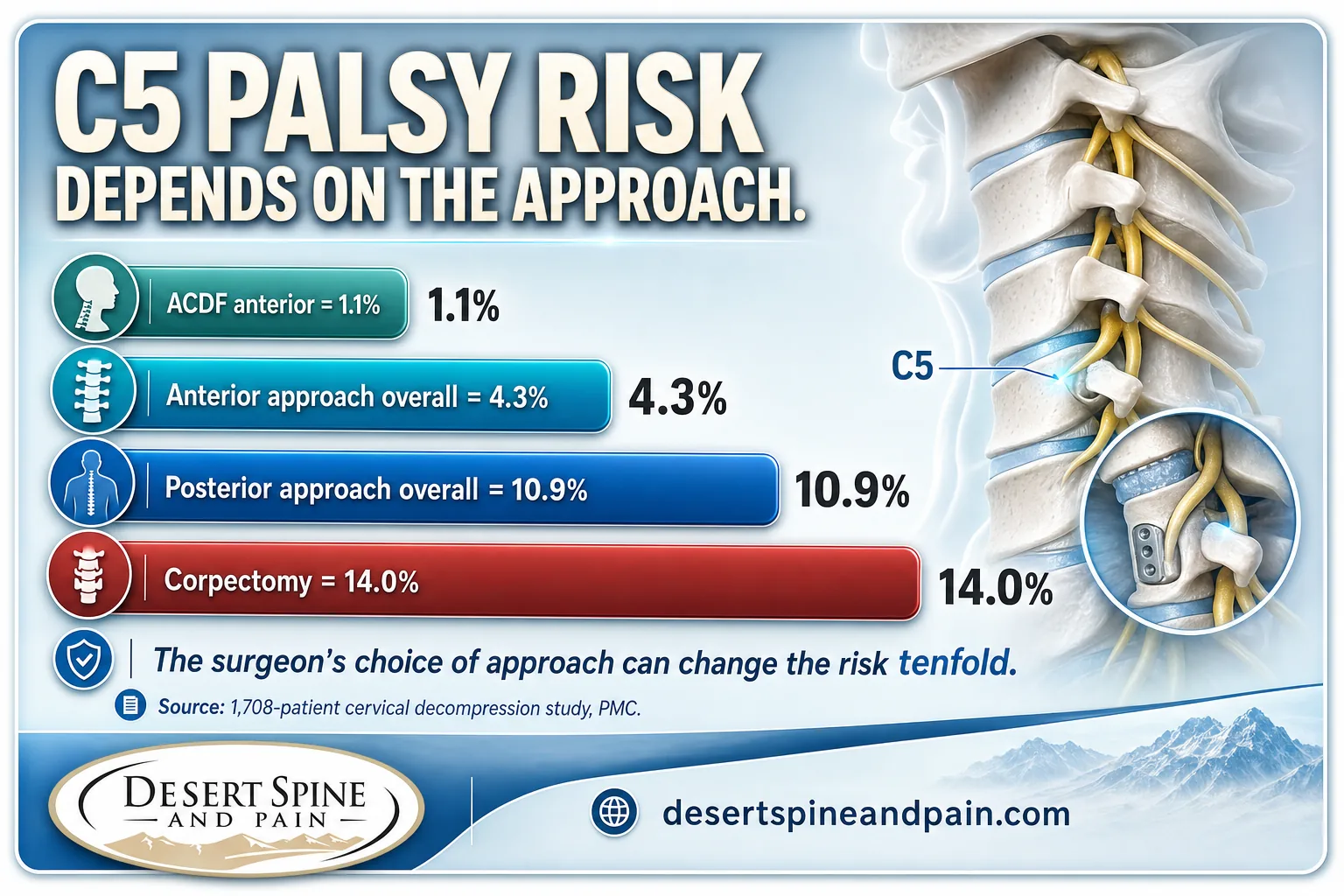
When C5 palsy risk ranges from about 1.1 percent for ACDF to 14 percent for corpectomy, and 4.3 percent anterior versus 10.9 percent posterior, the choice of surgical approach is itself a major determinant of complication risk, sometimes a tenfold difference. Selecting the least extensive effective approach for a given pathology is exactly the kind of judgment that experience and dual spine-and-neurosurgery training provide. Interpretation original to Desert Spine and Pain.
Source: C5 palsy surgical strategy study, PMC | C5 palsy literature review, PMC
5How Technique Lowers Cervical Risk
The cervical complications literature is unusually clear that surgical technique and strategy, not just patient factors, drive the numbers. Several evidence-based choices reduce risk.
| Surgical Choice | Effect on Complication Risk | Source |
|---|---|---|
| Anterior vs posterior approach | Lower C5 palsy (4.3% vs 10.9%) | Cervical decompression study |
| ACDF vs corpectomy | Lower C5 palsy (1.1% vs 14%) | Cervical decompression study |
| Combined ACDF + corpectomy | Lower palsy than wide corpectomy | Cervical decompression study |
| Limiting number of levels | Lower overall morbidity | ACDF meta-analysis |
| Gentle retraction / shorter operative time | Lower dysphagia / hoarseness | Anterior cervical reviews |
| Experienced high-volume surgeon | Lower complications overall | Surgeon volume literature |
The through-line is judgment. Choosing the least extensive effective approach, limiting levels where possible, and applying meticulous technique all lower complication rates. These are not automatic, they depend on the surgeon's experience and decision-making, which is why cervical surgery in particular rewards expertise.
Desert Spine and Pain works with out-of-network patients of every kind and partners closely with personal injury attorneys, offering 24/7 concierge response and documentation coordination for injured clients, including those with cervical injuries from accidents.
See minimally invasive optionsSource: C5 palsy surgical strategy study, PMC | ACDF complications meta-analysis, NASSJ 2025
Summary Table: Cervical Complications 2026
| Statistic | Figure | Source | Year |
|---|---|---|---|
| Overall ACDF morbidity (meta-analysis) | 16% | NASSJ | 2025 |
| ACDF morbidity range (studies) | 13 to 19% | Surgical Neurology Int'l | 2019 |
| Significant anterior complications (pooled) | 3.0% | Journal of Spine Surgery | 2020 |
| Excessive neck swelling | 11.3% | NASSJ | 2025 |
| Pseudarthrosis | 10.0% | NASSJ | 2025 |
| Dysphagia | 9.5% | NASSJ | 2025 |
| Cage/graft subsidence | 9.4% | NASSJ | 2025 |
| Worsening myelopathy | 7.7% | NASSJ | 2025 |
| Hoarseness | 2.3% | NASSJ | 2025 |
| C5 nerve root palsy (ACDF) | 2.1% | NASSJ | 2025 |
| C5 palsy overall prevalence | 5 to 6% | Cervical decompression study | 2017 |
| C5 palsy, ACDF vs corpectomy | 1.1% vs 14% | Cervical decompression study | 2017 |
| C5 palsy, anterior vs posterior | 4.3% vs 10.9% | Cervical decompression study | 2017 |
| C5 palsy broad range | 4 to 30% | C5 palsy literature review | 2024 |
| Horner syndrome (pooled) | 0.4 to 1.0% | Journal of Spine Surgery | 2020 |
Frequently Asked Questions
What is the complication rate for cervical spine surgery?
How common is difficulty swallowing after cervical spine surgery?
What is C5 palsy and how often does it happen?
Is anterior or posterior cervical surgery safer?
How can cervical spine surgery complications be minimized?
Methodology & Sources
How we compiled these statistics
Every figure traces to a Tier 1 primary source: peer-reviewed systematic reviews and meta-analyses. Complication rates vary by procedure, number of levels, approach, and definition, so we present ranges and attribute each figure. Most cervical surgery complications reported here are minor and temporary; serious complications are uncommon. All statistics describe populations, not any individual patient.
Primary sources referenced:
- Postoperative complications of ACDF: comprehensive systematic review and meta-analysis, North American Spine Society Journal, 2025
- Complications of anterior cervical spine surgery: systematic review, Journal of Spine Surgery
- A review of complication rates for ACDF, Surgical Neurology International
- Impact of surgical strategy on C5 nerve root palsy (1,708 patients), PMC
- C5 nerve palsy after posterior instrumentation and decompression review, PMC
- Incidence of C5 palsy and recovery rate systematic review and meta-analysis, PubMed, 2025
This article is educational and is not individual medical advice. For guidance specific to your cervical spine condition, consult a qualified spine surgeon. No outcome can be guaranteed.
Journalists and researchers may cite these statistics with attribution to Desert Spine and Pain and a link to this page. Please attribute the underlying figures to their original Tier 1 sources as listed above. For expert commentary on cervical spine surgery complications from a board-certified neurosurgeon and spine surgeon, contact Desert Spine and Pain at (602) 566-9500.