
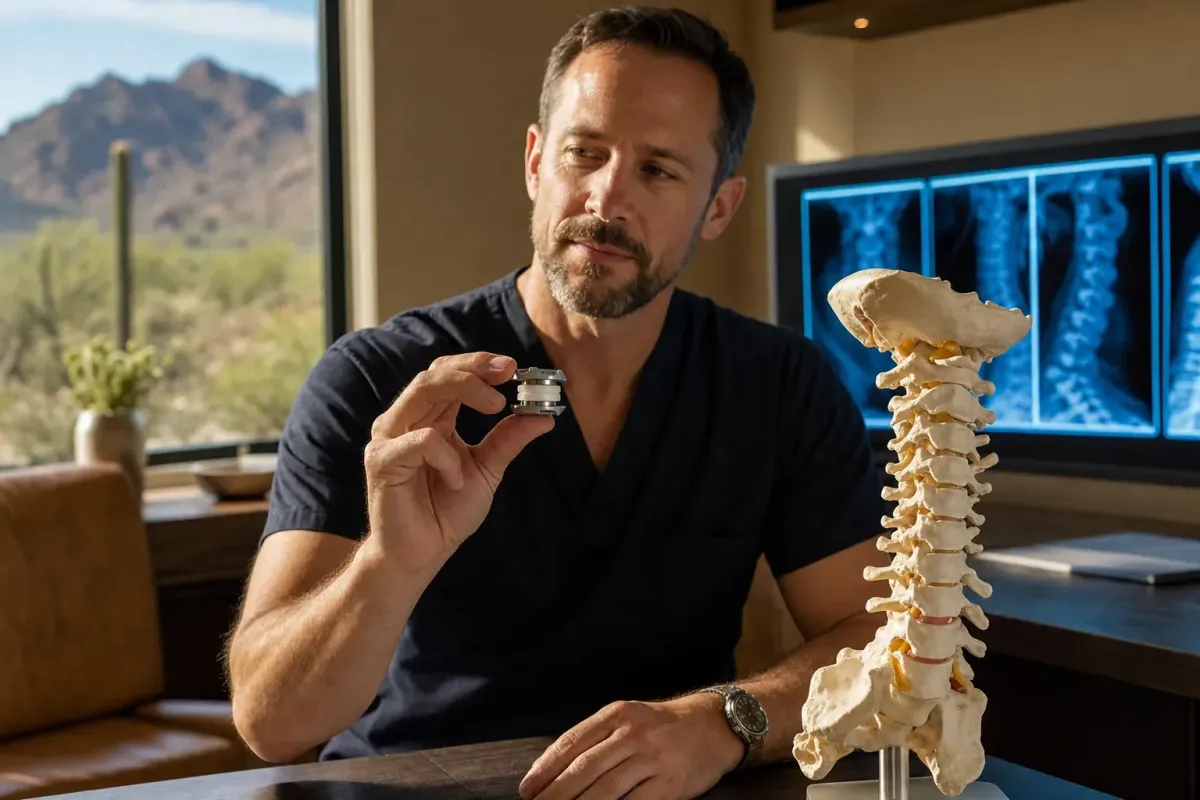
Cervical Disc Replacement Statistics (2026): Success Rates vs ACDF
Cervical disc replacement has some of the strongest long-term data in spine surgery. A 10-year randomized trial found 81 percent success versus 66 percent for ACDF fusion, and a 2025 meta-analysis of 17 trials confirmed higher neurological success, better motion, and significantly fewer reoperations and adjacent-segment problems. For the right single-level candidate, motion preservation increasingly looks like the better long-term bet.
- A 10-year randomized trial found overall success of 81 percent for disc replacement versus 66 percent for ACDF.
- A separate 10-year, three-center study found a composite success score of 62.4 percent versus 22.2 percent for ACDF, with nearly 99 percent very satisfied.
- A 2025 meta-analysis of 17 randomized trials found disc replacement had higher neurological success, greater range of motion, and lower disability and pain scores.
- Reoperation and adjacent-segment degeneration were significantly reduced with disc replacement versus ACDF.
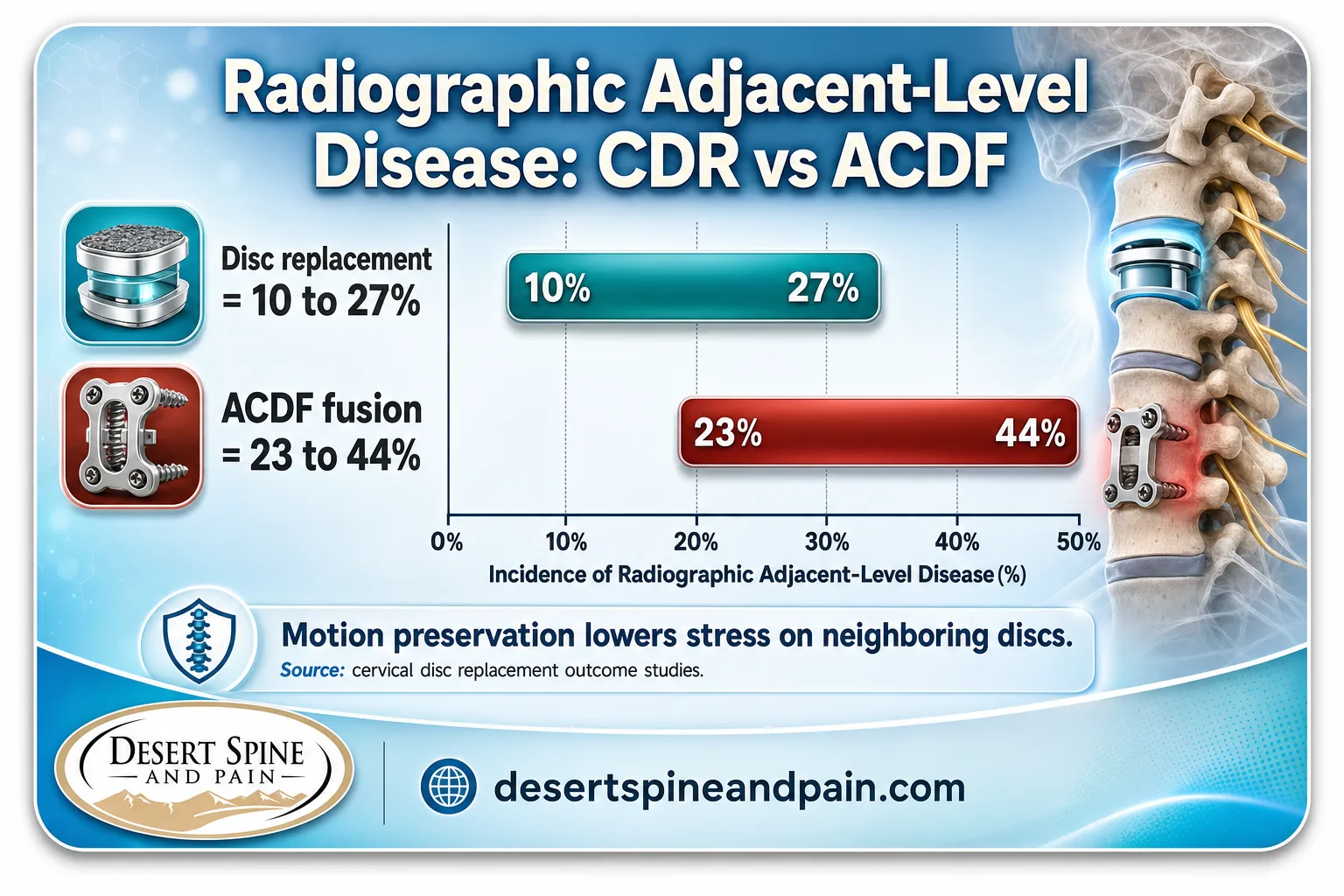
- Radiographic adjacent-level disease ran about 10 to 27 percent with disc replacement versus 23 to 44 percent with ACDF.
- Single-level ACDF adjacent-level reoperation was 10.8 percent at 7 years (about 1.5 percent per year), with disc replacement lower.
- Nine devices are FDA-approved for single-level replacement, three also for two-level, reflecting a mature technology.
What's in This Guide
1What Cervical Disc Replacement Is
Cervical disc replacement (CDR), also called cervical disc arthroplasty (CDA), removes a damaged disc in the neck and replaces it with a mechanical implant that preserves movement. It was developed as a motion-preserving alternative to ACDF, the long-standing fusion standard.
Cervical disc replacement is among the most rigorously studied procedures in all of spine surgery, thanks to a large body of FDA investigational device exemption trials that followed patients for years. That evidence base is what makes its statistics unusually reliable compared with many other operations.
Our Phoenix practice, led by board-certified neurosurgeon and spine surgeon Dr. David L. Greenwald, MD, FACS, offers cervical disc replacement and ACDF, choosing motion preservation when a patient is a strong candidate for it.
Explore cervical disc replacement in PhoenixSource: Cervical disc replacement FDA IDE real-world review, PMC 2026
2Success Rates vs ACDF
The headline cervical disc replacement statistics come from long-term randomized trials comparing it directly with ACDF fusion, and they increasingly favor motion preservation for suitable patients.
Cervical Disc Replacement vs ACDF: 10-Year Overall Success
10-year overall success in a prospective randomized study (128 CDR, 104 ACDF). Source: 10-year cervical RCT.Two independent 10-year studies point the same direction: cervical disc replacement met strict composite success criteria more often than fusion and produced very high satisfaction. The composite score gap in the three-center study (62.4 versus 22.2 percent) looks dramatic because the composite standard is demanding, requiring improvement across disability, neurology, motion, safety, and no reoperation all at once.
Compare with ACDF fusionSource: 10-year cervical RCT outcomes summary | FDA IDE real-world review, PMC 2026
3What the 2025 Meta-Analysis Found
The strongest single piece of evidence is a 2025 systematic review and meta-analysis that pooled 17 randomized controlled trials of single-level cervical disc disease, with searches through February 2025.
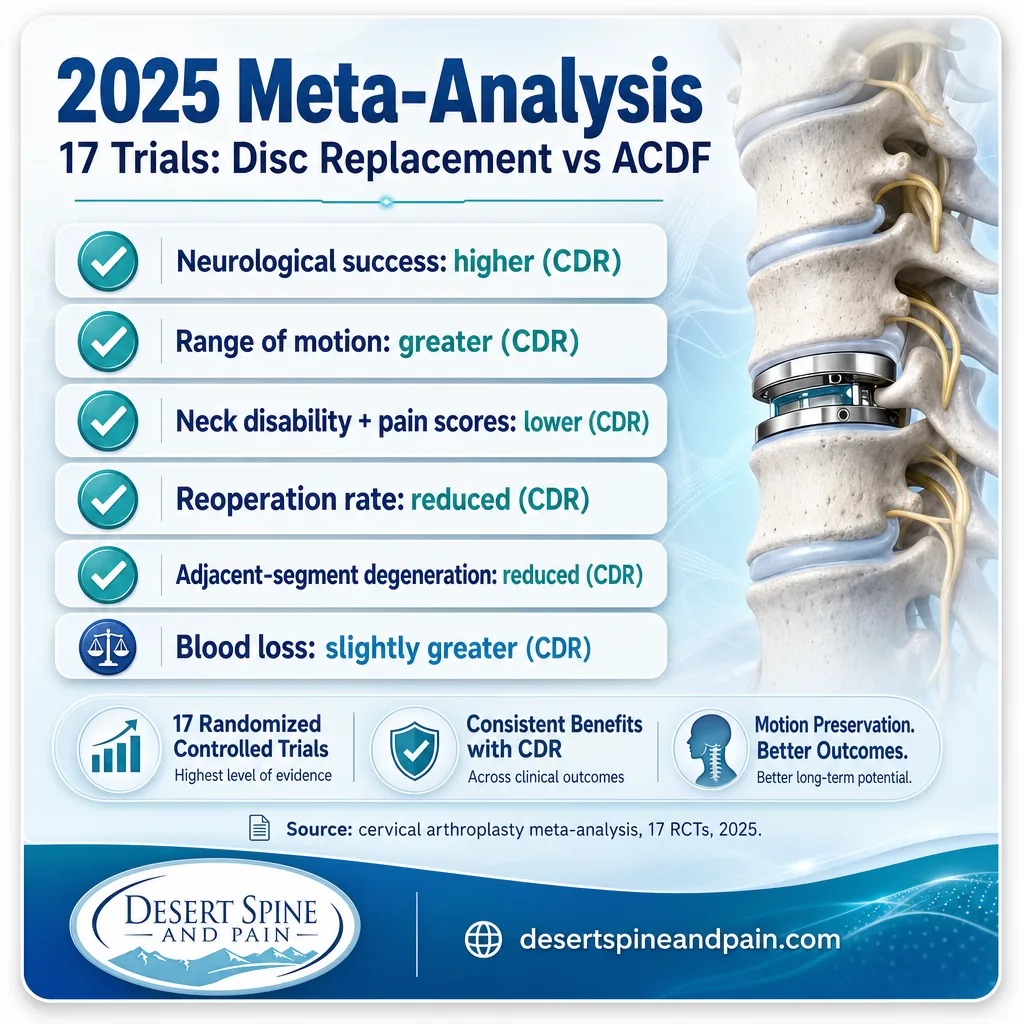
The 2025 analysis concluded that for single-segment cervical disc disease, disc replacement offers a favorable safety profile with lower reoperation rates and superior efficacy over ACDF, along with reduced adjacent-segment degeneration. The main trade-off it identified was slightly greater blood loss, with no significant difference in surgical duration or overall adverse events. That is a strong, current, high-quality body of evidence.
The most compelling cervical disc replacement data applies to single-level disease. While two-level replacement is FDA-approved and increasingly used, and results remain encouraging, the deepest long-term evidence base is strongest for one-level procedures. Multilevel and complex cases still require careful, individualized judgment. This is why candidacy assessment by an experienced surgeon, not a blanket rule, determines whether disc replacement is right for a given patient.
Source: Cervical arthroplasty vs ACDF meta-analysis, JOSR 2025 | Meta-analysis summary, Becker's Spine Review
4Adjacent-Segment Disease
The core rationale for cervical disc replacement is protecting neighboring discs from the stress that fusion transfers to them. The adjacent-segment data supports this, though the size of the benefit varies by how it is measured.
An important honesty check: not every study finds a dramatic difference. A 10-year retrospective study reported similar radiographic adjacent-segment degeneration between ACDF (35.2 percent) and disc replacement (33.3 percent). The reoperation and pooled meta-analysis data more consistently favor disc replacement, and the benefit tends to grow with time, which is why the 7-year and 10-year survivorship curves diverge in its favor.
The adjacent-segment data shows why cervical disc replacement's advantage is best understood as a long-term one. Differences that are small at 2 years become significant by about 4 years and continue to widen through 7 and 10 years. For a younger patient with decades of spine life ahead, that compounding protection against future adjacent-level surgery is exactly the kind of long-horizon benefit that makes candidacy and selection so worthwhile. Interpretation original to Desert Spine and Pain.
Source: Adjacent-level surgery meta-analysis, Journal of Spine Surgery | 10-year ACDF vs TDR adjacent-segment study, PMC
5Long-Term Durability and Candidacy
Cervical disc replacement's durability is unusually well documented, and the practical question for most patients is whether they qualify to benefit from it.
Candidacy is specific: single-level or select two-level disease, preserved alignment and facet joints, adequate bone quality, and no significant instability or severe arthritis. Younger, active patients often benefit most because they have the most years for adjacent-segment protection to matter. Recognizing who fits this profile, and who is better served by ACDF, is the decision that turns strong trial statistics into a strong individual outcome.
Desert Spine and Pain works with out-of-network patients of every kind and partners closely with personal injury attorneys, offering 24/7 concierge response and documentation coordination for injured clients with cervical conditions.
See all motion-preservation optionsSource: 7-year cost-effectiveness of cervical disc replacement, PMC
Summary Table: CDR Statistics 2026
| Statistic | Figure | Source | Year |
|---|---|---|---|
| 10-year overall success, CDR vs ACDF | 81% vs 66% | 10-year RCT (128/104) | 2019 |
| 10-year composite success, CDR vs ACDF | 62.4% vs 22.2% | 10-year three-center study | 2024 |
| Very satisfied at 10 years, CDR vs ACDF | ~99% vs 88.9% | 10-year three-center study | 2024 |
| RCTs in 2025 meta-analysis | 17 | Cervical arthroplasty meta-analysis | 2025 |
| Neurological success, ROM, NDI, VAS | Favor CDR | 2025 meta-analysis | 2025 |
| Reoperation and ASD rates | Reduced with CDR | 2025 meta-analysis | 2025 |
| Radiographic adjacent-level disease, CDR | 10 to 27% | CDR outcome studies | 2019 |
| Radiographic adjacent-level disease, ACDF | 23 to 44% | CDR outcome studies | 2019 |
| Adjacent-level reoperation, single-level ACDF (7 yr) | 10.8% | Adjacent-level meta-analysis | 2020 |
| Annualized adjacent-level reoperation, ACDF | ~1.5%/yr | Adjacent-level meta-analysis | 2020 |
| ASD at 10 years, ACDF vs TDR (one study) | 35.2% vs 33.3% | 10-year retrospective study | 2017 |
| FDA-approved single-level devices | 9 | FDA IDE real-world review | 2026 |
| FDA-approved two-level devices | 3 | FDA IDE real-world review | 2026 |
| Cost-effectiveness at 7 years | Favors CDR | 7-year cost-effectiveness study | 2018 |
Frequently Asked Questions
What is the success rate of cervical disc replacement?
Is cervical disc replacement better than ACDF?
Does cervical disc replacement reduce adjacent-segment disease?
How long do cervical disc replacements last?
Who is a candidate for cervical disc replacement?
Methodology & Sources
How we compiled these statistics
Every figure traces to a Tier 1 primary source: randomized controlled trials, systematic reviews, meta-analyses, and FDA investigational device exemption studies. Success is often defined by a strict composite standard, which is why composite scores can appear lower than single-outcome success rates. Adjacent-segment and reoperation figures vary by measurement method and follow-up length. All statistics describe populations, not any individual patient.
Primary sources referenced:
- Cervical disc arthroplasty versus ACDF for single-segment disease: systematic review and meta-analysis of 17 randomized trials (4+ year follow-up), Journal of Orthopaedic Surgery and Research, 2025
- Cervical disc arthroplasty versus ACDF: meta-analysis of adjacent-level surgery to 7-year follow-up, Journal of Spine Surgery
- 10-year prospective randomized studies of cervical disc replacement versus ACDF
- Long-term outcomes of CDR and ACDF: FDA IDE trials with real-world comparison, PMC, 2026
- 7-year cost-effectiveness of single-level cervical disc replacement versus ACDF, PMC
- 10-year ACDF versus TDR adjacent-segment degeneration study, PMC
This article is educational and is not individual medical advice. For guidance specific to your cervical spine condition, consult a qualified spine surgeon. No outcome can be guaranteed.
Journalists and researchers may cite these statistics with attribution to Desert Spine and Pain and a link to this page. Please attribute the underlying figures to their original Tier 1 sources as listed above. For expert commentary on cervical disc replacement data from a board-certified neurosurgeon and spine surgeon, contact Desert Spine and Pain at (602) 566-9500.