
Car Accident Spinal Injury Statistics (2026): Causes, Levels, and Outcomes
Motor vehicle crashes are the single leading cause of traumatic spinal cord injury in the United States, responsible for roughly 38 to 40 percent of cases according to the National Spinal Cord Injury Statistical Center. Behind that headline sits a far larger group of spine injuries, from fractures to disc injuries, that crashes produce every day. This report explains the data on how, where, and how often crashes injure the spine.
- Crashes cause about 38 to 40 percent of traumatic spinal cord injuries, the leading single cause, per NSCISC.
- The U.S. sees roughly 17,000 to 18,000 new spinal cord injuries a year, with just under 7,000 from motor vehicle crashes.
- The cervical spine (neck) is injured most often, involved in just over half of crash spinal cord injuries in clinical studies.
- Vehicle occupants sustain cervical (C3 to C7) injuries; pedestrians more often sustain thoracolumbar (T11 to L2) injuries.
- Spinal cord injuries are the rare, severe end of the spectrum; fractures, disc injuries, and whiplash are far more common.
- Roughly 85 percent of spinal cord injuries occur at the moment of impact, which is why rapid evaluation matters.
What's in This Report
1 Crashes as the Leading Cause of Spinal Cord Injury
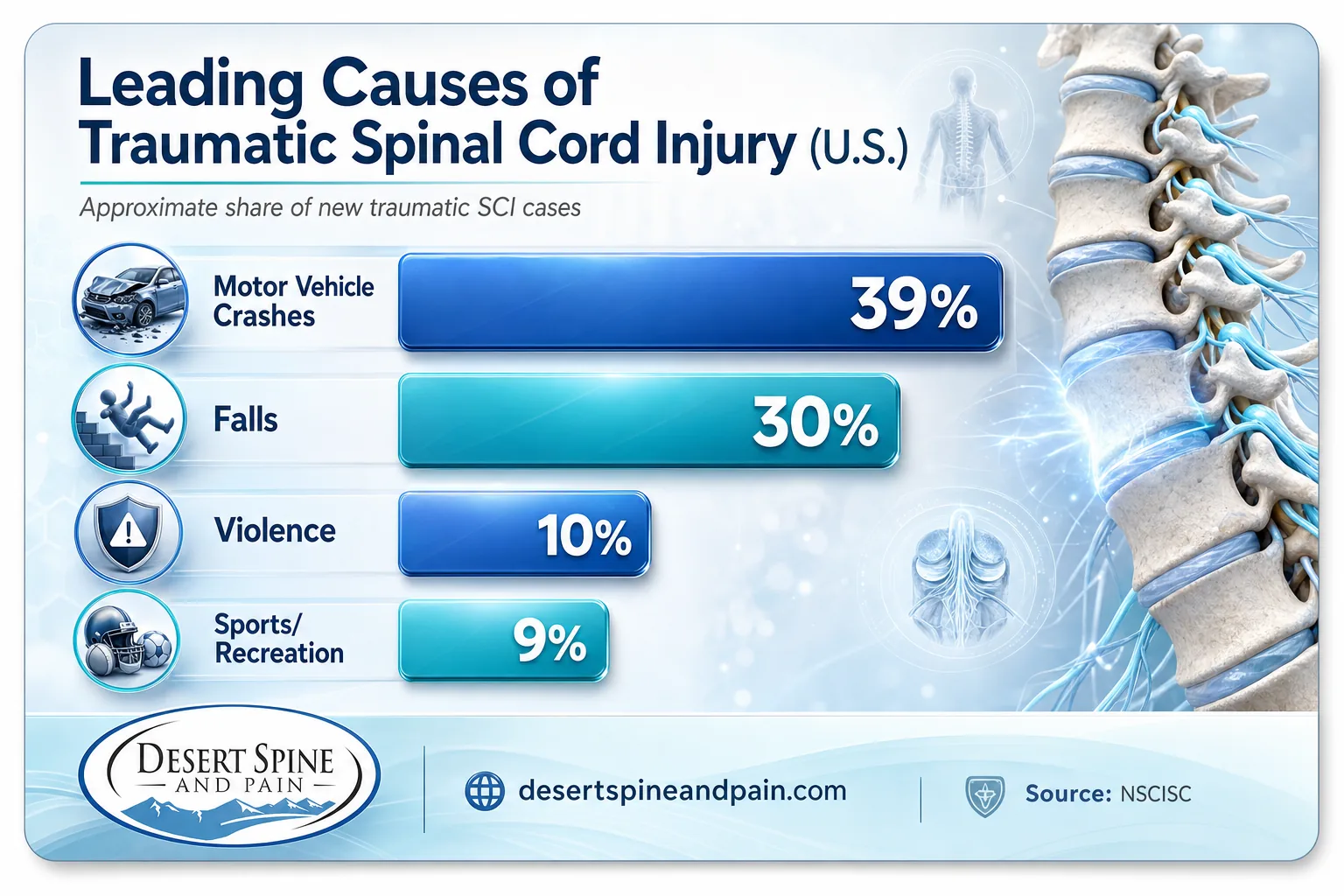
Among all the ways a person can suffer a traumatic spinal cord injury, nothing causes more than motor vehicle crashes. The National Spinal Cord Injury Statistical Center, the authoritative U.S. registry, has identified vehicle crashes as the leading cause of traumatic spinal cord injury year after year since at least 2010.
Falls are the only cause that comes close, accounting for roughly a quarter to a third of cases, and they overtake crashes as the leading cause among adults over 65. For younger adults, crashes dominate. It is worth being precise about the numbers, because they are often reported loosely.
Leading Causes of Traumatic Spinal Cord Injury (U.S.)
This figure circulates widely, but it usually comes from combining automobile and motorcycle crashes, or from older data. The National Spinal Cord Injury Statistical Center, the primary U.S. source, places motor vehicle crashes at roughly 38 to 40 percent of traumatic spinal cord injuries. It is the leading cause by a clear margin, but the precise share matters, especially in any setting where the data will be cited.
Source: National Spinal Cord Injury Statistical Center, Facts and Figures | National Institutes of Health, Causes of Spinal Cord Injury
2 The Full Spectrum of Crash Spine Injuries
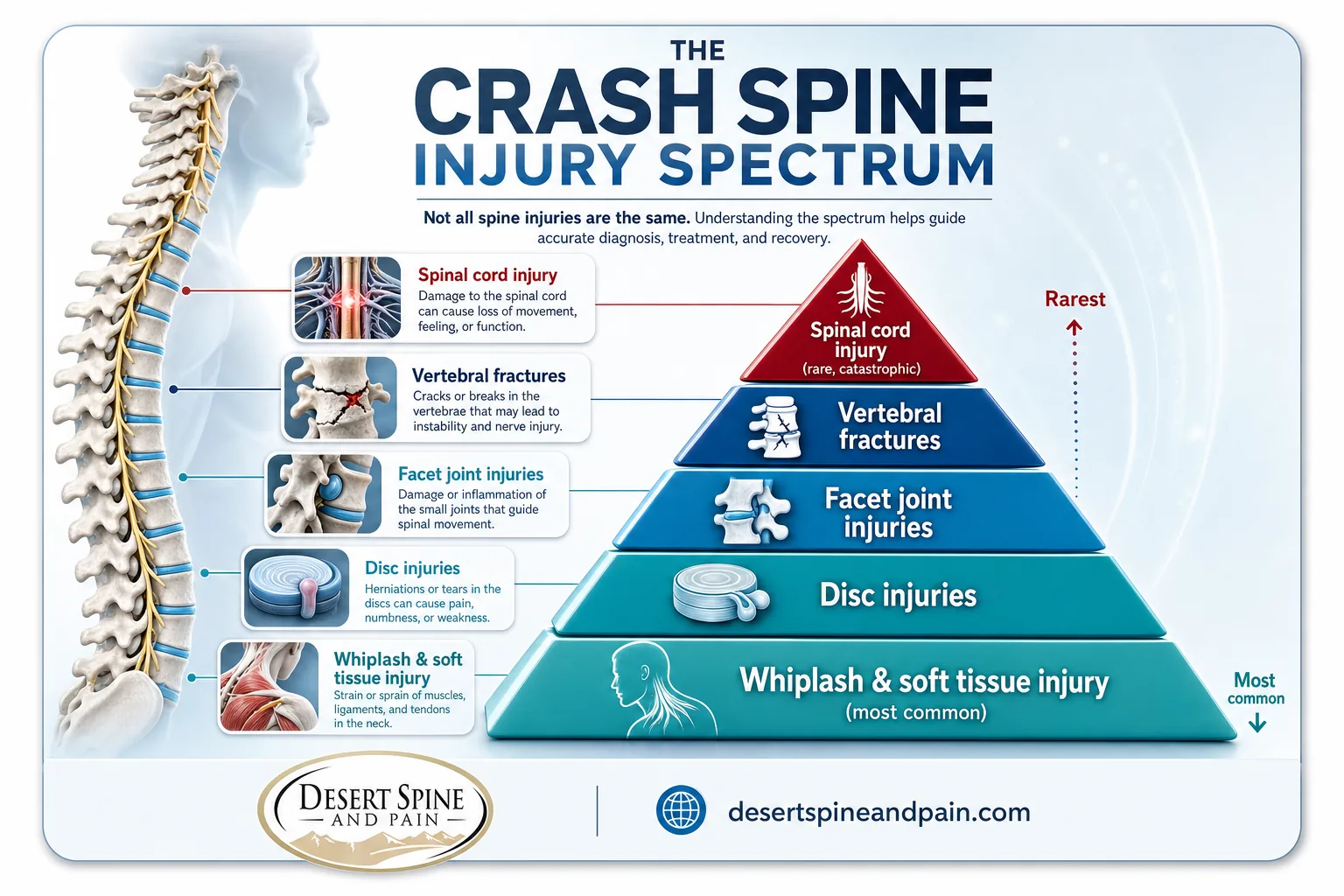
Spinal cord injury is the most catastrophic outcome, but it is also the rarest. Focusing only on cord injuries misses the much larger reality: the spine can be seriously injured without the cord ever being touched. Understanding that spectrum is essential to understanding crash injuries as a whole.
The clinical definition of spinal cord injury specifically excludes intervertebral disc disease, vertebral injuries that do not damage the cord, and injuries to nerve roots outside the spinal canal. That means the roughly 17,000 annual cord injuries sit on top of a far larger base of spine injuries, whiplash, sprains, facet injuries, herniated discs, and vertebral fractures, that crashes produce in enormous numbers every year.
- Whiplash and soft tissue injury: by far the most common, especially in rear-end collisions.
- Disc injuries: herniated and bulging discs, often with delayed symptoms.
- Facet joint injuries: a frequent source of lasting neck and back pain.
- Vertebral fractures: more common in higher-severity crashes.
- Spinal cord injury: the rare, catastrophic end of the spectrum.
NSCISC data attributes just under 7,000 spinal cord injuries a year to motor vehicle crashes. Against the millions of crash injuries recorded annually in the U.S., and the peer-reviewed finding of roughly 511 spinal injuries per 10,000 people exposed to a crash, the cord-injury cases represent only a small fraction of all crash-related spine trauma. The takeaway: for every catastrophic cord injury, a far larger number of people sustain fractures, disc injuries, and whiplash that still require specialist spine care.
Calculation and interpretation original to Desert Spine and Pain.
For the broader picture of how many crash injuries involve the spine and back, see our companion report on Arizona car accident injury stats.
Source: National Center for Biotechnology Information, StatPearls: Motor Vehicle Collisions
Learn how we evaluate whiplash and crash-related neck injuries
3 Which Spinal Levels Are Injured
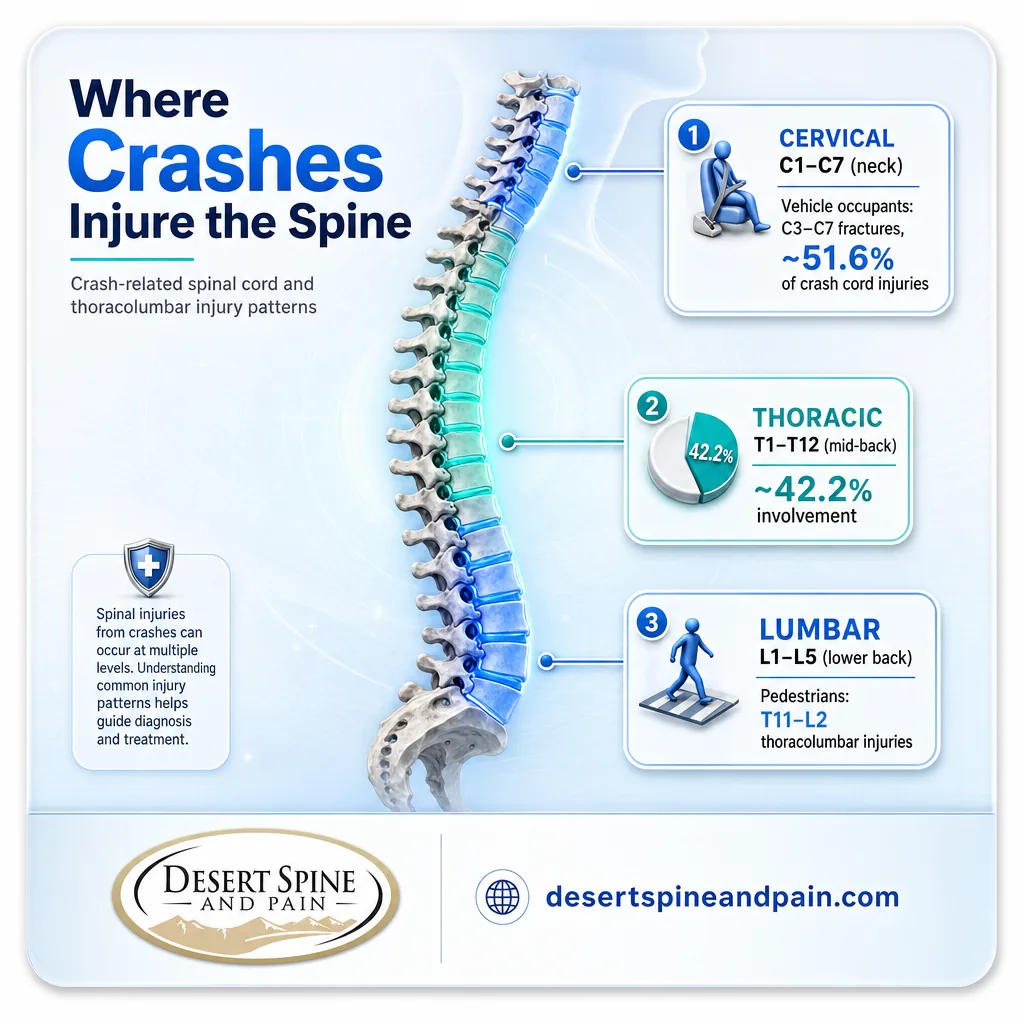
Where the spine is injured depends heavily on how the person was positioned during the crash, and the pattern is remarkably consistent in the clinical literature. The spine divides into three regions: the cervical spine (neck, C1 to C7), the thoracic spine (mid-back, T1 to T12), and the lumbar spine (lower back, L1 to L5).
For vehicle occupants, the neck bears the brunt. Clinical studies of crash-related spinal cord injury find cervical involvement in just over half of cases, with fractures concentrated at the C3 to C7 levels. This reflects the whipping motion of the head during impact. Pedestrians struck by vehicles show a different pattern, with injuries concentrated at the thoracolumbar junction around T11 to L2, where the more rigid thoracic spine meets the more mobile lumbar spine.
Spinal Cord Injury Level in Crash Patients (clinical data)
The distinction between complete and incomplete injuries matters enormously for outcomes. In crash-related cord injuries, incomplete injuries, where some function remains below the injury level, are common, and clinical series have found incomplete tetraplegia to be among the most frequent presentations. Incomplete injuries generally carry a better prognosis for some recovery than complete ones.
Source: National Institutes of Health, Traumatic Spinal Cord Injury from Traffic Accidents
4 How a Crash Injures the Spine
The spine is engineered to bear load along its vertical axis. A crash subjects it to something very different: sudden, multi-directional force applied faster than the muscles can brace against. That mismatch is the root of nearly every crash spine injury.
When a collision occurs, several things can happen to the spine in a fraction of a second. Ligaments stretch and tear, the discs between vertebrae can herniate and press on adjacent nerves, and the vertebrae themselves can fracture. In the most severe cases, this damages the spinal cord directly. A sobering clinical finding is that roughly 85 percent of spinal cord injuries occur at the moment of impact rather than developing afterward, which underscores why the forces involved are so consequential and why immobilization after a serious crash is a standard precaution.
Importantly, the force does not have to be dramatic to cause harm. Head position at the moment of impact, seat position, and pre-existing conditions such as degenerative disc disease all influence whether and how the spine is injured. Someone with an already-vulnerable disc can sustain a significant injury in a crash that leaves the vehicle barely dented.
Source: NSCISC data via published injury analysis | NIH StatPearls, Motor Vehicle Collisions
5 Who Is Most at Risk
Spinal cord injury from crashes is not evenly distributed across the population. The clearest risk factors are age and sex. More than half of all spinal cord injuries occur in people between 16 and 30, an age band that also drives more of the crashes. Males account for the clear majority of cases, with a male-to-female ratio well above two to one in clinical series.
Behavioral factors compound the picture. Alcohol is a factor in roughly a quarter of spinal cord injury cases, and risky driving behaviors such as speeding and failure to wear a seatbelt raise the odds substantially. For older adults, the pattern shifts: while falls become the leading cause of spinal cord injury after 65, crashes remain a major contributor, and age-related changes in the spine can make injuries more severe when they do occur.
Spinal Cord Injury Risk Factors in Crashes
Source: National Spinal Cord Injury Statistical Center | NIH, TSCI from Traffic Accidents
Explore the spine conditions we treat after a crash
6 Warning Signs and What to Do
Because some spine injuries declare themselves immediately while others build over days, knowing the warning signs is genuinely important. Certain symptoms after a crash call for urgent evaluation.
- Intense or worsening back or neck pain in any region of the spine.
- Numbness or tingling in the arms, legs, hands, or feet.
- Weakness or difficulty moving a limb.
- Loss of bladder or bowel control, which is a medical emergency.
Even in the absence of these red flags, delayed-onset neck and back pain is common after a crash, and early evaluation serves two purposes: it catches injuries before they worsen, and it creates an accurate medical record from the outset. For the personal injury attorneys whose clients make up much of any spine practice's crash caseload, that early, well-documented diagnosis is often decisive.
How Desert Spine and Pain fits in
Desert Spine and Pain is led by Dr. David L. Greenwald, a board-certified surgeon who is both a spine surgeon and a neurosurgeon. That dual training is directly relevant to crash spine injuries, which can involve the vertebral column, the discs, and the neural structures all at once. The practice pursues the least invasive effective treatment first, escalating to surgery only when the injury requires it. For attorneys in the Phoenix area, the practice offers 24/7 concierge coordination, fast response, and the clear documentation that spine cases depend on.
Book a consultation or connect our team with your attorney
Source: American Association of Neurological Surgeons
7 Summary Data Table
| Statistic | Figure | Source | Year |
|---|---|---|---|
| MVC share of traumatic spinal cord injuries | ~38-40% | NSCISC | 2024 data sheet |
| New traumatic SCIs per year (U.S.) | ~17,000-18,000 | NSCISC | 2024 |
| SCIs per year from motor vehicle crashes | ~6,950 | NSCISC | 2024 |
| Falls as share of SCI (second cause) | ~25-32% | NSCISC / NIH | 2024 |
| Auto crashes in NIH SCI database | 31.5% | NIH (NSCID) | 2005-2011 |
| Motorcycle crashes in NIH SCI database | 6.8% | NIH (NSCID) | 2005-2011 |
| Cervical injury share in crash SCI | ~51.6% | NIH clinical series | 2022 |
| Thoracic injury share in crash SCI | ~42.2% | NIH clinical series | 2022 |
| Occupant fracture levels | C3-C7 | NIH clinical series | 2022 |
| Pedestrian fracture levels | T11-L2 | NIH clinical series | 2022 |
| Tetraplegia vs paraplegia | 51.6% / 48.4% | NIH clinical series | 2022 |
| SCIs occurring at moment of impact | ~85% | Clinical literature | Cited |
| Share of SCI in ages 16-30 | >50% | NSCISC | 2024 |
| Male share of crash SCI (clinical) | ~73% | NIH clinical series | 2022 |
| Alcohol involvement in SCI cases | ~25% | Published SCI data | Cited |
| Spinal injuries per 10,000 MVC-exposed | ~511 | Peer-reviewed (ScienceDirect) | 2023 |
Frequently Asked Questions
What percentage of spinal cord injuries are caused by car accidents?
How many spinal cord injuries happen each year from car accidents?
Which part of the spine is most often injured in a car crash?
Can a minor car accident cause a spinal injury?
What are the warning signs of a spinal injury after a crash?
All figures trace to primary sources. Spinal cord injury causation, annual incidence, and demographic data are drawn from the National Spinal Cord Injury Statistical Center's Facts and Figures data sheets, the authoritative U.S. registry. Cause-breakdown percentages are also referenced from peer-reviewed analysis of the National SCI Database published through the National Institutes of Health. Injury-level distribution, occupant versus pedestrian fracture patterns, and complete-versus-incomplete data come from peer-reviewed clinical studies of traffic-related traumatic spinal cord injury. Where sources differ, this report favors the NSCISC primary figures and notes the range. Reported percentages near 50 percent typically combine automobile and motorcycle crashes; this report keeps them separate where the source allows.
This is a sensitive topic. Spinal cord injury can be life-altering, and anyone affected by one should be under the care of qualified medical professionals.