

Average Whiplash Settlement Statistics (2026): Payouts by Grade and Value Drivers
The average whiplash settlement sits just under $20,000, but that number hides more than it reveals. The median is closer to $10,000, the range runs from a few thousand dollars to over $1 million, and the single biggest predictor is the injury's grade on the CAD/WAD scale, where each step up roughly doubles or triples the value. Whiplash is also the most-litigated auto injury in the country, and one of the most aggressively disputed by insurers.
- The national average whiplash settlement is just under $20,000 ($15,000 to $25,000 for grade 1 to 2 per NAIC data); the median is closer to $10,000.
- Whiplash value is graded on the Quebec Task Force CAD/WAD scale (Grade 0 to 4), and each step up tends to double or triple the range.
- Grade 4 cases (fracture or dislocation) commonly reach $100,000 to $1,000,000 or more.
- Attorney-represented whiplash claims settle for roughly 3x more on average (IRC closed-claim data).
- Whiplash is the most-litigated auto injury, with more than 2 million U.S. cases per year.
- Rear-end collisions cause the majority of whiplash and account for over 30% of car-accident injuries.
- Roughly 95% of whiplash cases settle before trial.
What's in This Guide
- The Average, the Median, and Why They Differ
- The CAD/WAD Grading Scale and Settlement Tiers
- The Attorney-Representation Multiplier
- Why Insurers Dispute Whiplash Claims
- When Whiplash Is More Than Soft Tissue
- The Arizona and Phoenix Picture
- Every Statistic in One Table
- Frequently Asked Questions
- Methodology and Sources
1The Average, the Median, and Why They Differ
Whiplash settlement figures vary more than almost any other common injury, so the "average" needs context. The most reliable national benchmark comes from insurance claims data rather than any single firm's caseload.
The gap between the roughly $20,000 average and the roughly $10,000 median tells the story: a minority of severe cases pulls the average upward, while most claimants recover less. Uncomplicated soft-tissue whiplash that resolves within a couple of months settles at the low end, while chronic, nerve-involved, or surgical cases climb far higher.
Myth: "There's a standard whiplash payout I can count on." Whiplash settlements span from about $1,000 to over $1 million. A single "average" collapses grade, treatment, chronicity, and coverage into one misleading number. Grade and documentation predict value far better than any headline figure, and the median is a better reference point than the mean for a typical case.
Source: FairSettlement.org personal injury data | National Association of Insurance Commissioners
Accurate valuation starts with an accurate diagnosis of the neck injury. Our practice evaluates the cervical spine in the detail these contested claims require.
Explore Spine Conditions We Treat2The CAD/WAD Grading Scale and Settlement Tiers
The most useful framework for understanding whiplash value is the medical-legal grading scale developed by the Quebec Task Force, known as CAD/WAD (Cervical Acceleration-Deceleration / Whiplash-Associated Disorder). Settlement value tracks the grade closely.
Whiplash Settlement by CAD/WAD Grade (Typical 2026 Ranges)
Grades per the Quebec Task Force CAD/WAD scale; ranges reflect national settlement-data compilations for 2026.
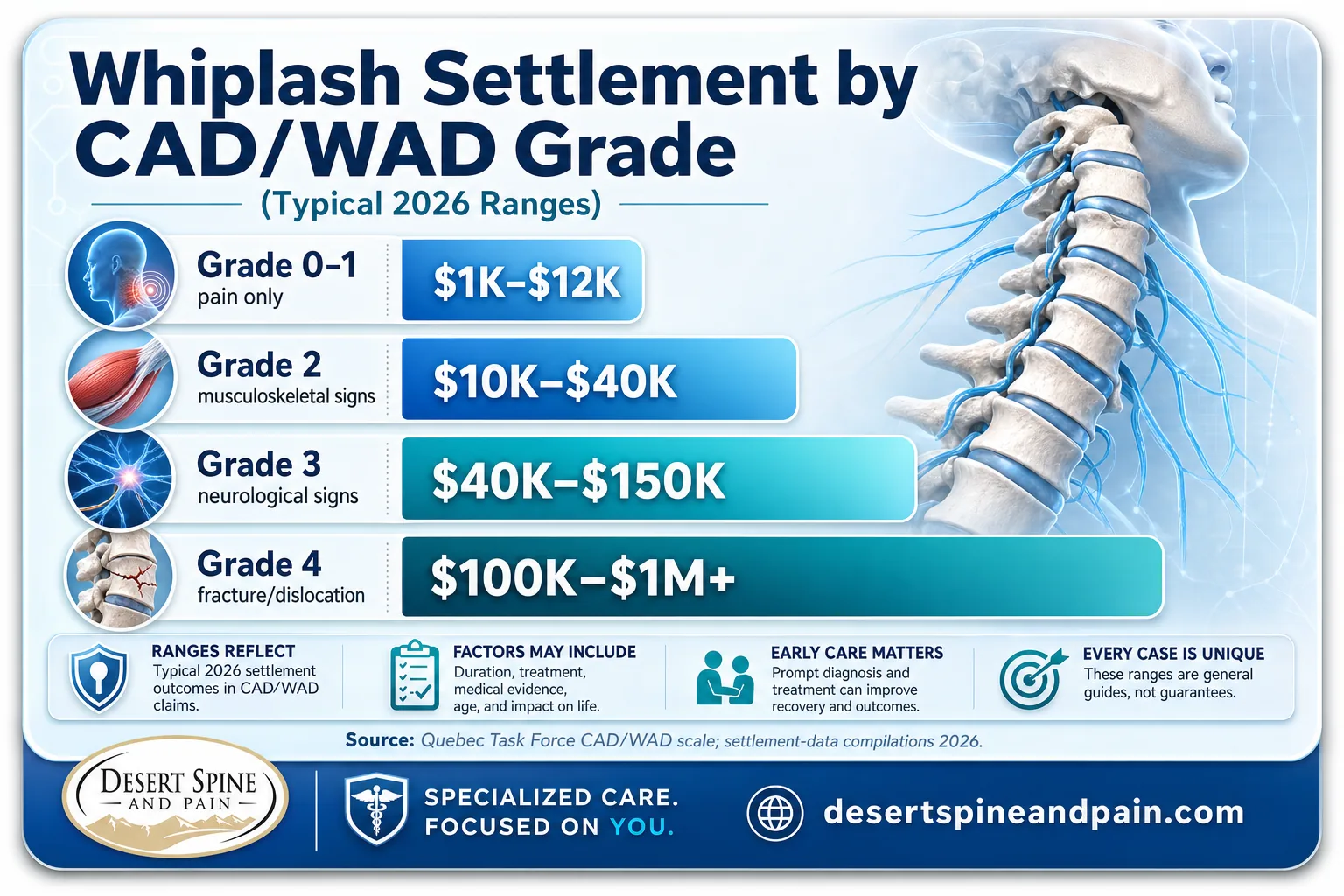
The clinical grade drives value because it maps directly onto severity, treatment intensity, and permanence. A Grade 1 case that resolves in ten to twelve weeks with conservative care sits near the bottom. A Grade 3 case with documented neurological signs, or a Grade 4 with a fracture, carries the long-term treatment and permanent-impairment components that produce large settlements.
Desert Spine and Pain Analysis: the grade multiplier effect. Reported data shows each CAD/WAD step tends to double or triple the settlement range. Modeling that from a Grade 1 baseline near $8,000: a rough doubling at each step produces roughly $16,000 at Grade 2, $40,000 to $50,000 at Grade 3, and six figures at Grade 4, closely matching observed ranges. The lesson is that accurate clinical grading, not louder pain complaints, is what moves a whiplash claim between tiers. Calculation and interpretation original to Desert Spine and Pain, based on published CAD/WAD settlement data.
Source: Settlement Insight CAD/WAD analysis | FairSettlement.org
Establishing the grade, especially distinguishing neurological Grade 3 from musculoskeletal Grade 2, is core diagnostic work for a spine and neurosurgery practice.
Learn About Diagnostic Nerve Testing3The Attorney-Representation Multiplier
Few injury types show a representation effect as clearly as whiplash, precisely because insurers discount these claims so aggressively when no attorney is involved.
The representation gap is largely an information gap. Adjusters use valuation software that scores medical bills, treatment gaps, and documentation, and unrepresented claimants rarely know how those inputs work or how far first offers sit below fair value. Objective medical evidence, prompt treatment, and a complete record are what move a whiplash claim up the software's own scale.
Source: Insurance Research Council closed-claim studies | FairSettlement.org representation data
For personal injury attorneys, our practice provides fast, thorough cervical spine evaluations and a surgeon who is both a spine surgeon and a neurosurgeon, strengthening the objective record whiplash claims live and die on.
Meet Dr. Greenwald4Why Insurers Dispute Whiplash Claims
Whiplash is uniquely contested because its central injury is often invisible on standard imaging and its symptoms can lag the crash by a day or more.
The three recurring insurer arguments are that the injury is minor, that it was pre-existing, or that a low-damage crash could not have caused it. All three are answered the same way: with prompt medical documentation, objective findings where they exist, and a clear before-and-after picture when a pre-existing condition is aggravated. The "no damage, no injury" argument is not medically accurate, but it is easier to rebut with a strong record.
Caution: treatment gaps and delayed care. Because whiplash symptoms can emerge 24 to 72 hours after a crash, delayed treatment and gaps in care are the two most common ways claimants unintentionally weaken their own cases. Prompt evaluation and consistent, physician-directed care protect both health and claim value. This article is general information, not legal or medical advice for a specific case.
Source: Settlement Insight whiplash data
Prompt, documented cervical evaluation is exactly what our least-invasive-first pathway provides, from conservative care through interventional options.
Explore Interventional Pain Treatments5When Whiplash Is More Than Soft Tissue
Whiplash is often labeled a simple soft-tissue injury, but the same mechanism can damage discs, facet joints, and nerves, and can accompany a concussion. These cases settle well above the standalone whiplash range.
This is where accurate diagnosis matters most. A cervical disc herniation from a crash is valued very differently from a neck strain, and distinguishing the two, then correlating findings to symptoms, is precisely what separates a discounted claim from a defensible one. When whiplash overlaps with disc injury, the herniated-disc value framework applies on top of the whiplash grade.
Related reading in this series: When a neck injury involves a herniation, see our herniated disc settlement data. For the broader category and crash-specific breakdowns, see our personal injury settlement statistics and car accident settlement data by injury type. For the most severe neck and spine cases, see our spinal cord injury settlement statistics.
Source: Settlement Insight severity-tier data
Because Dr. Greenwald is both a spine surgeon and a neurosurgeon, our practice can evaluate the full range of what a whiplash mechanism may cause, from soft-tissue strain to disc, nerve, and neurological involvement.
See Our Spine Surgery Options6The Arizona and Phoenix Picture
Rear-end collisions are common across the Greater Phoenix metro, making whiplash one of the most frequent crash injuries local attorneys handle. As a comparative-fault state, Arizona reduces recoverable amounts by a claimant's share of fault, so clear liability and clean documentation carry extra weight.
For patients and attorneys across the Valley, the takeaway from the data is consistent: the whiplash settlement follows the grade and the documentation. A practice that grades the injury accurately, distinguishes soft tissue from disc and nerve involvement, and documents thoroughly gives a contested whiplash claim its evidentiary foundation.
Source: FairSettlement.org
Book a Consultation7Every Statistic in One Table
| Statistic | Figure | Source | Year |
|---|---|---|---|
| National average whiplash settlement | Just under $20,000 | NAIC-based analyses | 2026 |
| Grade 1-2 average range | $15,000-$25,000 | NAIC claims data | 2026 |
| Median whiplash settlement | ~$10,000 | NAIC-based analyses | 2026 |
| Overall common range | $2,500-$50,000+ | Settlement-data compilations | 2026 |
| Grade 0-1 tier | $1,000-$12,000 | CAD/WAD settlement data | 2026 |
| Grade 2 tier | $10,000-$40,000 | CAD/WAD settlement data | 2026 |
| Grade 3 tier | $40,000-$150,000 | CAD/WAD settlement data | 2026 |
| Grade 4 tier | $100,000-$1M+ | CAD/WAD settlement data | 2026 |
| Attorney-representation multiplier | ~3x | IRC Closed Claim Study | 2026 |
| Net advantage after fees | ~2x | IRC-based analyses | 2026 |
| Insurer first-offer level | 30-50% of fair value | Settlement-data compilations | 2026 |
| Symptom onset delay | 24-72 hours | Settlement-data compilations | 2026 |
| U.S. whiplash cases per year | 2M+ | Settlement Insight | 2026 |
| Rear-end share of crash injuries | 30%+ | Compiled crash-injury data | 2026 |
| Cases settling before trial | ~95% | Settlement-data compilations | 2026 |
| Special-damages multiplier | 1.5x-4x | Compiled adjuster data | 2026 |
8Frequently Asked Questions
What is the average whiplash settlement in 2026?
How are whiplash settlements graded?
Does having an attorney increase a whiplash settlement?
Why do insurers dispute whiplash claims so often?
Can whiplash involve more than a soft-tissue injury?
9Methodology and Sources
How we compiled this data
Average and median settlement figures are drawn from insurance claims data (NAIC) as reported in settlement analyses, and from FairSettlement.org, which cites the Insurance Research Council, the Bureau of Justice Statistics, and Jury Verdict Research. The CAD/WAD grading framework is the Quebec Task Force classification for Whiplash-Associated Disorder, widely used in medical-legal valuation. Grade-tier settlement ranges are drawn from published settlement-data compilations for 2026.
Settlement ranges are descriptive summaries of reported national outcomes and are not predictions of any individual result. Whiplash settlements vary widely by grade, treatment, chronicity, jurisdiction, liability, and available insurance coverage. Figures reflect the source years indicated.
Primary and compiled sources:
- National Association of Insurance Commissioners (NAIC) claims data.
- Insurance Research Council (IRC), Closed Claim Studies.
- Quebec Task Force on Whiplash-Associated Disorders, CAD/WAD classification.
- FairSettlement.org statistics resource (compiling IRC, BJS, and Jury Verdict Research).
- Published whiplash settlement-data compilations and claim-valuation analyses, 2025-2026.
This content is provided for general educational purposes and does not constitute legal advice or individualized medical advice. Settlement outcomes depend on the specific facts of each case. Consult a qualified attorney and physician regarding any specific situation.
For journalists and researchers: The statistics in this article may be cited with attribution to Desert Spine and Pain and the underlying primary sources named above. The Desert Spine and Pain Analysis box reflects an original interpretation of published CAD/WAD settlement data and may be cited with attribution to Desert Spine and Pain.
Dealing with neck pain after a crash in Phoenix? Dr. David L. Greenwald, MD, FACS is both a board-certified spine surgeon and a neurosurgeon, offering least-invasive-first care from conservative treatment through complex surgery. Call (602) 566-9500 or book a consultation online.